Showing posts with label relatively recent comics. Show all posts

Sunday, April 27, 2014

Citizen Kent

It was three years ago this very week in  a soon to be controversial short story appearing within the pages of the milestone 900th issues of Action Comics, that Superman announced his intention to formally renounce his United States citizenship.  Why, you may be asking yourself, am I only just writing about this instead of venting my spleen on the subject back when people actually cared?  Simply put, the truth is that I had not read the story in question and I really didn't give half a crap about the latest manufactured controversy that was getting the panties of all the Fox News commentators and others of their ilk in such a twist.  The even more shocking truth, though I feel that I must reveal it in the interests of full disclosure and integrity and other such quaintly last century concepts, is that I still haven't read the story and, quite frankly, I still don't care about the whole controversy that much.  I have, however, recently been reading some of the reactions and  commentaries, including those emanating from Fox News, that popped up on-line at the time. 
Everything that I read brought one question to the forefront of what's left of my mind these days.  What does it mean?  What, to be perhaps redundantly specific, does it really mean for Superman to give up his citizenship?
Upon thinking about it further, this invariably led to other questions.  Is Superman really an American citizen at all? Is Superman even real?
Now before you accuse me of being delusional and unable to distinguish between fact and fantasy, let me assure that I am not about to tie a beach towel around my neck and leap off the roof of my apartment building shouting "Up, up and away!"  For one thing, I have neither a beach towel nor access to the roof.  More to the point, I am fully aware that Superman is a fictional character created by a couple of teenagers from Cleveland back in the 1930s and not in any sense "real" in our world.  When I ask if Superman is "real" I am speaking solely within the context of the fictional reality in which his never ending story is set.
When you get right down to it, Superman is, as John Byrne took great pains to emphasize when he revamped the character back in 1986, merely a leotard, a pair of boots, a cape and a spit curl.  He is a disguise, an assumed identity that allows Clark Kent to carry out his morally dubious, extra-legal super-powered vigilantism under a cloak of anonymity. 
It is Clark Kent who is the U.S. citizen, and presumably remained so even after having his public hissy fit in front of the entire world as Superman.  Hiding within the persona of Superman allowed Kent to be able to stand up in front of the cameras and tell America what it could go do with itself while escaping the consequences.   I assume that there would be some consequences in our reality if a high profile celebrity without a secret identity that he could retreat into publicly renounced his status as a U.S. citizen.  At the very least, I suppose that the now former citizen would be asked to exit himself from our shores immediately.  Kent, on the other hand, can slap on a pair of hipster glasses and a blue suit and go back to apartment at 344 Clinton Street in Metropolis and his job as a mild-mannered reporter for a great metropolitan newspaper as if nothing ever happened.
That lack of repercussions makes Superman renouncing his non-existent American citizenship a meaningless, empty gesture.  Therefore, the entire story itself, no matter how well written or beautifully drawn it may have been (and the pages I've seen on-line have been quite lovely, as a matter of fact), is totally pointless and a waste of paper.   Thus, pointless, as well, is all the right wing bluster that accompanied the story's publication.  But then, right wing bluster is usually pointless, no matter what the blowhards are blustering about, isn't it?

Wednesday, February 13, 2013

Unfinished Business: Justice League--Generation Lost

If you've been reading this blog for some while, you may remember that a couple of years ago I was buying the bi-weekly limited series Justice League: Generation Lost and, for awhile, reading and reviewing each issue as it came out.  Eventually, I decided to set the issues aside until the series was completed, then read it all at once and review it for you at that time.  While I did read the whole series upon publication of the final issue, I failed to get around to reviewing it here.  Until now.  While I make no promises that it was in any way worth the wait, here is my long delayed review/overview of Justice League: Generation Lost.
In retrospect, the point at which I decided to put off reading the series is really the point at which I just should have stopped buying it.  Ultimately, Gen Lost turned out to be a year long waste of time and money.  Some of the individual issues were enjoyable on their own, but taken as a whole the story was a massive disappointment.
I feel like I've been the victim of a bait-and-switch scam.  I began buying  the comic because Keith Giffen was co-writing it, returning once again to the characters he'd done such great work with back in 1980's.  However, by the eighth issue, Giffen was gone, leaving co-author Judd Winick to alone to write the bulk of the series. 
I do not hate Judd Winick's writing, at least not all of it.  I really like The Adventures of Barry Ween Ween, Boy Genius, which established Winick as one of the best humor writers of the 90's.  However, when he turned his attention to super-heroes the results have been, at best, bland, and, at worst, stupid and offensive.  
One of the big problems with the story is the pacing.  While the early issues, which, not coincidentally perhaps, were the once Giffen was involved in, moved at a pleasing pace, once on his own Winick seemed to realize that he just didn't have enough plot to fill the allotted number of issues.  Thus, the series fell into a pattern of issue long huge fight scenes followed by an entire issue of the cast sitting around talking followed by another issue long fight scene, and so on.  Occasionally, he'd throw in an issue where Captain Atom would be thrown into the future, there to witness the dire consequences if Maxwell Lord should succeed in his evil scheme.
Speaking of said evil scheme---and here is where the consensus rules of blogging require that I insert the words "Spoiler Warning", though I feel no compunction about revealing the ending of a story I'm trying to dissuade you from reading anyway---that's where the story really fell down.   After an entire year of chasing Max Lord around the globe and building him up as the greatest evil since Lucifer fell, the former JLI organizer's big top secret evil master plan turns out to be building a giant robot to beat up on Wonder Woman.  My reaction to that revelation was something like, "Are you serious? That's IT?"  It was, as I said above, a massive disappointment.  Compounding the feeling of being let down was the fact that the evil giant robot was rather easily defeated. 
Overall, Justice League: Generation Lost was not worth the money I spent on it, or the time I spent reading it, or really even the time I've spent thinking about it while writing this review.

Monday, January 7, 2013

Full Disclosure

A couple of days ago, in my speculative post about the upcoming Before Watchmen: Dollar Bill one-shot, I issued a blanket condemnation of the previous Before Watchmen efforts as rehashes of what Alan Moore and Dave Gibbons did in the original Watchmen.  In the interest of, as I titled this post, full disclosure, and total honesty (which, as Billy Joel reminds us, is such a lonely word and hardly ever heard) I feel obligated to reveal to my readers that I based that statement on hearsay and anecdotal evidence gathered from reviews, solicitations and other on-line sources. The only one of the bunch that I've actually bothered to read was the first issue of the Minutemen series, which, while it provided new biographical details about the members of the eponymous super-team, did in fact include a fair amount of rehashing.  I liked Minutemen #1, but not really enough to commit to spending four bucks a month on it over the course of half a year.
I did briefly possess copies of the first issues of Ozymandias and Comedian, which were given to me by a friend, until I fobbed them off on some poor unsuspecting fool at a White Elephant gift exchange last month without bothering to actually read them.   When I flipped through Ozymandias, it seemed, from the art, to be simply a retelling of Adrian Veidt's life story from Chapter XI of Watchmen.  Having read that chapter, and in fact the entire graphic novel, more times than I can readily remember, I didn't feel I needed to read that issue.  As for the Comedian book, I just couldn't get past that hideous cover and thus didn't even open it.   I mean, just look at the damned thing over there.  Disgusting, ain't it?
I've got to wonder if whoever commissioned or designed that repulsive cover image actually thought it was going to help sell the comic.   Is that even the function of comic book covers anymore?  Is there such a thing these days as a casual reader who might be induced to pick up a new comic because of the cover image or copy?  Or are most new comics pretty much pre-sold to a dwindling community of fans and collectors who'll buy the damn things no matter what the publisher slaps on the outside?

Monday, July 9, 2012

GONZO: A Graphic Biography of Hunter S. Thompson Reviewed

Here, then, before we get to the meat of the review, are the basic facts of the matter before us.  Gonzo: A Graphic Biography of Hunter S. Thompson, written by Will Bingley and  illustrated by Anthony Hope-Smith with an introduction by Thompson's former editor Alan Rinzler, was originally published a couple of years ago by a British outfit called SelfMadeHero, and has just been re-released in a new edition by Abrams here in the States.  The 192 page paperback will set you back $17.95 if you still want to buy a copy after reading what I've got to say about it.
My opinion, I must say, seems to be in the minority.  I Googled the title and found several reviews written around the time of the original edition's release, and most of them are, if not glowing, at least positive.   I myself found little of value between those bright orange covers other than Rinzler's introduction, which I shall deal with in more detail presently.  First though, I must dash off my dismissal of the main body of the book.  
Bingley and Smith attempt with this book, as they state in this interview, to get beyond the public persona of "Dr. Gonzo" that Thompson built up around himself and that is perpetuated in such films as Where The Buffalo Roam and Terry Gilliam's version of Fear and Loathing in Las Vegas, to, in Bingley's words, "tell a more interesting story."  There is a more interesting story to be told, but you won't read it here.  Bingley's narrative is written in the first person as if by Thompson himself in a semi-convincing pastiche of Thompson's style at its most lucid that may fool some with only a passing familiarity with his work into thinking that they are reading some sort of lost manuscript by Thompson himself.  However, Thompson's seemingly dashed off prose style was deceptively easy to imitate on the surface, but full of depth of meaning and insight combined with an inventive use of  language that his imitators, myself at times among them, rarely even attempt to duplicate beyond repeated and inappropriate use of the word "shitrain" and references to "bad craziness".  Ultimately, Bingley barely manages to scratch the surface, failing to capture the true complexity of Thompson's life and work.
The book focuses mainly on the 1970's, which I suppose is only right as this was his most productive period.  However, the final decades of his life are also important to an understanding of the man and his ultimate fate and deserve better than to be dismissed in a couple of scratchily drawn and sparsely captioned pages.  The book ends, of  course, with Thompson's death at his own hands.  Bingley seems to be among those who want to paint Thompson's end as some sort of noble or brave and heroic act, when, in fact, suicide is neither of those things.  I will have to admit that as much as I continue to admire Thompson's literary accomplishments, I lost some small measure of respect for the man because of his final act.
Of course, Bingley's failure to capture the essence of Thompson's soul is no surprise if he can't even get straight the basic biographical facts of the man's life. On page 17, "Thompson" states, "My first job was as a sportswriter in New Jersey in   1957," which is not accurate, or even true. While it is certainly a fact that Thompson began his civilian career as a journalist in the small town of Jersey Shore, that town is, as I learned in college when I met a young woman who had grown up there (and I wish I could remember her name), neither in New Jersey nor anywhere near a shore.  Instead, it is located near the center of my home state of Pennsylvania.  Apparently, Bingley wrote his caption based on an assumption made by simply looking at the town's name rather than doing any actual tedious and time consuming research.
I came away from this book with no greater understanding of its subject than I'd had before.  The only real insight into Thompson's personality is offered in the introduction by Alan Rinzler, who was Thompson's editor on what he calls "...four of his best books": Fear and Loathing On The Campaign Trail '72, Amerika, The Great Shark Hunt, and The Curse of Lono. The intro seems a bit odd to me, as it reads as if it were not specifically written for this particular book.  At the very least, Rinzler appears not to have even read the volume he's supposed to writing an introduction to.  Not once does he make any reference to the book we are about to read or its authors, focusing instead on his personal recollections of working with Thompson.  Sadly, though, those scant eight pages of prose give us more insight into who Thompson truly was than the entire 180 page sequential narrative that follows.
The one good thing I got out of this book was a renewed desire to re-read some of the classic pieces by Thompson referenced within.  Thus, I set out to pick up a new copy of The Great Shark Hunt, which, as far as I'm concerned, is, along with Campaign Trail, Hell's Angels and Songs of the Doomed, all the biography of Thompson that anyone really needs. For in Thompson's case, more than for any of the other so-called "new journalists" with whom he is often lumped in, his life and work where truly of a piece and inseparable.
If Gonzo inspires anyone else to go out and re-read, or, better yet, discover for the first time, Thompson's literary legacy, then I suppose that its existence will have been justified.  Personally, I would advise anyone curious about Thompson to skip this book and use the eighteen bucks you save to purchase the books I make reference to above.  That would be a much wiser investment of your cash and reading time.

Saturday, March 26, 2011

The Evolving Origins of Green Arrow (Part Two)

(The second part of my series on the various versions of Green Arrow's origin story over the past seven decades of the character's existence picks up with Mike Grell and The Longbow Hunters, the 1987 mini-series that redefined the character as an urban hunter.  The first part of the series covered the Golden Age origin, Jack Kirby's Silver Age origin and Green Arrow's first mini-series from 1983.  You can read that by clicking here.)
In 1987, Mike Grell crafted a new version of Green Arrow's origin for The Longbow Hunters that suited his more realistic, less super-heroic take on the character.  He later expanded upon it in 1989's Secret Origins #38 and the four issue mini-series Green Arrow: The Wonder Year, published in 1992. Grell envisioned Oliver Queen as being in his early forties and having been active as Green Arrow for about two decades.  Thus, The Wonder Year  takes place in the turbulent presidential election year of 1972.
On a friend's yacht, enjoying what he declares to be his first vacation in six years, a drunken Oliver Queen falls overboard and finds himself the next morning on the shores of a deserted and uncharted island.  In order to survive, he teaches himself to hunt and shoot a bow and arrow.  Where Grell's version differs significantly from all past and future versions is that on the island, Ollie uses only regular pointed arrows.  The trick arrows came later, after he had returned to civilization and adopted his Green Arrow identity.
After stumbling upon a couple of stoners who are growing pot on the island, Ollie captures them and uses their boat to return home.  He turns them over to the police, but doesn't stick around because he doesn't want to get involved.
Returning to work, he finds himself increasingly bored and dissatisfied.  Later, he is attending a charity masquerade ball dressed as Robin Hood, when he foils an attempted robbery.  The next day, the local newspapers dub him "Green Arrow."  Deciding that his little adventure had been fun, he begins his career as a costumed crime fighter, despite not being too happy with the name he's found himself saddled with by, as he puts it, "...a reporter with no sense of style."
Soon, he becomes involved with a former girlfriend who is at the center of a plot to assassinate a presidential candidate.  At one point, he allows men who'd been trying to kill them to escape, despite Brianna, the ex-girlfriend, urging him to shoot them.   "I'm no killer," he protests.
"You will be...someday," she retorts.  "You keep carrying that bow around and sooner or later you're going to have to use it...for real."  Inspired by this insight, he begins to develop his array of trick arrows.
The most recent revision of Green Arrow's origin occurred in 2007's six issue mini-series Green Arrow: Year One, written by Andy Diggle, with art by Jock.  In stark contrast to Grell's somewhat more realistic and down to earth take on Ollie's beginnings, Year One is the widescreen, big budget, summer blockbuster movie version of the story.  It is loud--or would be if it were a movie--action packed and exciting.
The story begins by introducing us to shallow, self centered, thrill seeking and heavy drinking young billionaire Oliver Queen.  Soon, he is betrayed by his security chief Hackett, whom he had considered a friend but was actually working with drug queenpin Chien Na-Wei, aka "China White" in a scheme to steal billions from him. When Ollie tumbles to the scheme, Hackett knocks him out and tosses him off his own yacht into the ocean.  As in all the other versions of the origin, Ollie finds himself on an island where he fashions a crude bow and arrows and hones his natural talent for archery in order to survive.
However, this time the island is not quite as deserted as in previous tellings.  In fact, it just happens to be the headquarters of China White's whole operation.  She has enslaved the native population, forcing them to grow her  genetically modified opium poppies.
Armed with only a bow and a few improvised trick arrows, Ollie manages to pretty much singlehandedly take down an army of desperate criminals, destroy China White's entire operation and free the native population.  The grateful natives give him the name "Auu Lanu Lau'ava," which, in their language, means, as you've probably guessed, "Green Arrow."
Improbable, even preposterous, as it is, Green Arrow: Year One is, nonetheless, the currently "official" version of the origin of Green Arrow.  You can be assured, however, that in a few years, changing times or changing creative teams will dictate yet another retelling and re-imagining of Ollie's early days for yet another generation.

Friday, March 11, 2011

Green Arrow in The Brave and the Bold (Part 5): Volume 3

Back in August, when I reviewed issue #35 of the latest volume of The Brave and the Bold, I had no idea that it was the final issue.  Apparently, neither did anyone else.  There has been, as far as I know, no formal announcement of the book's cancellation from DC, but #36 is, as I write this, six months late. Therefore, this is, for the time being, the final installment of my series on Green Arrow's appearances in B&B.  
Harking back to the early days of the original B&B's team-up format, the latest volume had no fixed co-star, instead featuring different pairings of heroes in almost every issue.  Often, especially during Mark Waid's tenure as writer, there would be continued stories with different sets of heroes starring in each chapter.  Green Arrow is featured in three issues out of the extant thirty-five, with a brief appearance in one more, which about matches the ratio of his appearances in the original series. In the thirty-five issues between #100 and #134 of volume one, for example, the Emerald Archer also makes four appearances.
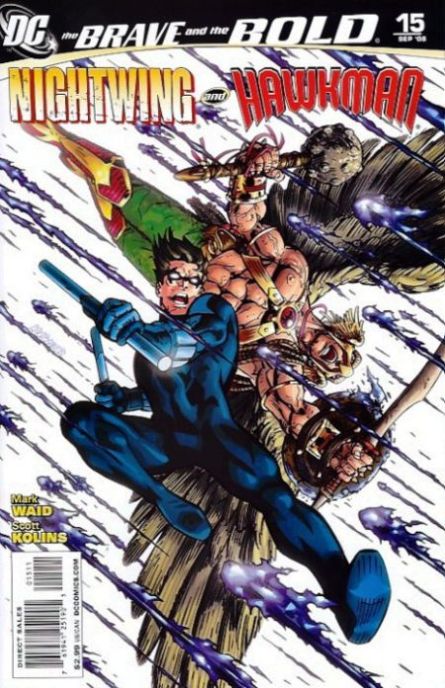
He first shows up in volume three with #14, teamed with Deadman in a story  by Mark Waid and Scott Kolins entitled "The Ghost Killers of Nanda Parbat."  The two meet when Green Arrow encounters a pair of the titular "Ghost Killers", who Deadman has pursued to Star City.  They are former residents of Nanda Parbat; the mystical Shangri-La hidden in Himalayas that is home to Rama Kushna, the god-like being who gave Deadman his powers and mission; who have been transformed by a demon priest called Siva Anuttara into entities similar to Deadman, except that they kill any living being they possess, after Anuttara imprisoned Rama Kushna in a magical amulet and took over Nanda Parbat. The Ghost Killers have been sent out into the world to spread Anuttara's evil and have set up a base in Star City.  When the Ghost Killers attack Green Arrow, Deadman hops into his body to keep them from taking it.  Still in Ollie's body, Deadman hops a plane for Nanda Parbat to confront Anuttara directly.  At the border of Nanda Parbat, Green Arrow and Deadman are able to jointly control Ollie's body and attempt to destroy Anuttara's amulet with an arrow to free Rama Kushna.  Anuttara easily swats the arrow aside, however.  Fleeing from the Ghost Killers, Ollie and Deadman enter Rama Kushna proper, where Deadman is forced to exit Ollie's body and becomes a living being.  Seemingly enraged by Deadman's delivering them right into their enemies hands, Ollie shoots Deadman, apparently killing him, and flings the body off a cliff and away from Nanda Parbat.  Thus ends The Brave and the Bold #14. Green Arrow had gambled that, once outside of the magical influence of Nanda Parbat, Deadman would simply turn into a ghost again and go off to seek help.  This is precisely what happens in the next issue in which Deadman recruits Nightwing and Hawkman to come back with him to Nanda Parbat, free Rama Kushna, defeat Anuttara and rescue Green Arrow. 
I'm not a big fan of Mark Waid, but this is one of his more enjoyable stories.  Green Arrow's a little out of his element amidst all the ghosts and demons and magical goings on, but he holds his own and his quick thinking manages to ultimately save the day. 
Green Arrow next appears in issues #21 and #22, sharing cover billing with his old pal Green Lantern.  However, despite being featured on the covers, he plays a relatively small role in the story, not even showing up until more than halfway through #21. These two issues comprise the second half of the four part story "Without Sin," written by David Hine and illustrated by Doug Braithwaite and Bill Reinhold.  The first two parts feature GL and the Phantom Stranger and the Stranger continues to play a major role in the stories conclusion, getting more on panel time than ostensible co-star Green Arrow.  My summary of these issues will focus primarily on GA's part of the story.
As "Without Sin" part three begins, GL and the Stranger are on the planet Kahlo battling an entity called the Purge who has possessed that world's Green Lantern.  Purge's schtick is to travel from world to world eliminating each planet's evil by killing the entire population, which he does by possessing the planet's most powerful being, such as, say, a Green Lantern.  After the Stranger banishes Purge from Orlan, the Kahloan GL, he and Hal remain on Kahlo to take care of a few loose ends. However, the Stranger senses that Cora, an autistic girl on Earth who appears to hold the key to defeating Purge, is in danger.  She is in a hospital for children with birth defects caused by trials of an experimental drug called Genesin. A team of killers has been sent to destroy the hospital to eliminate any evidence of the failed experiment.  The Stranger sends a psychic projection to Green Arrow, dispatching him to the hospital to try to save the children.  When he arrives, the killers are already there and manage to get off a lucky shot that grazes GA's head and leaves him lying on the floor helpless as they plant a bomb in the basement. 
In the conclusion, Green Arrow manages to recover in time to stop the bomb from exploding just as Hal and the Stranger arrive at the hospital for the final confrontation with the Purge. While that's going on, Green Arrow pursues and captures the squad of would be killers.  I like the fact that Hine keeps Green Arrow separate for the most part from the magical and science fiction elements of the story, even though that does limit his role.
I've now covered every appearance of Green Arrow in all comic book series carrying the title The Brave and the Bold.  At least those set in the mainstream DC Universe. Perhaps in the future, I'll get around to reading and reviewing the comics based on the  Cartoon Network series Batman: The Brave and the Bold. Green Arrow has been a frequent guest star on the show and I'm sure he plays a major role in the comic as well.  Furthermore, I'm fairly certain that some day, in the not too distant future, DC will revive  the title yet again and Green Arrow is sure to be a part of it.