Showing posts with label Keith Giffen. Show all posts

Sunday, May 18, 2014

Giffen's Legions Part 4: The Subs

The Subs from the cover of Superboy #243 by Mike Grell
The first, and for a long time the only, Legion comic I ever owned was Superboy and the Legion of Super-Heroes #243.  My favorite part of that issue has always been the brief appearance of the Legion of Substitute Heroes.  The issue took place right in the middle of the five part "Earthwar" saga.  Earth was under attack by the Khunds, but various other crises conspired to keep the Legion busy off planet.  So the Subs step up to the plate to fight off the invaders.  Of course, being the Subs, they were pretty quickly defeated, but by then I'd fallen in love with this plucky little band of wanna-be heroes. Well, maybe not love, exactly, but I did think that the Substitute Legion was a really cool idea.  So, years later, when I spotted a copy of the Legion of Substitute Heroes Special on the comics rack, I picked it up.  I was eager to see more of these heroes who'd so intrigued me, but wasn't quite expecting what I found inside, despite the joking cover. 
I'll talk more about that special later.  Right now, it occurs to me that it might be a good idea to go over just what the heck the Legion of Substitute Heroes actually is for the benefit of any readers out there who might not be familiar with the concept.  The Legion of Super-Heroes occasionally held open try-outs for Legion membership that worked kind of like the auditions for American Idol.  Would be Legionnaires would come to Metropolis from all across the galaxy to stand up in front of a panel of Legionnaire judges and demonstrate their powers in hopes of going on to Hollywood...excuse me, I meant being admitted into the Legion. In Adventure Comics #306, five of these rejected applicants decided to form their own group.  They acted as back-up to the real Legion, going into action when the proper super-heroes were unavailable.  The initial membership of the Legion of Substitute Heroes consisted of Polar Boy, with the power to make things cold; Night Girl, whose super-strength worked only in the absence of sunlight; Fire Lad, who could generate flames; Chlorophyll Kid, who could speed up the growth of plants; and Stone Boy, who turned to stone. 
Let's face it, the Legion of Substitute Heroes is a completely ridiculous concept.  Nowadays, of course, the trend is to take the silly ideas from comics written for kids and make them serious, adult, and dark.  I believe that Keith Giffen would take this route with the Substitute Legion late in his run on Legion of Super-Heroes Volume 4.  However, when he first got his hands on the Subs, a decade previous, he fully embraced their inherent silliness. In fact, he not only embraced it, but enhanced, making the Subs even more ridiculous than they already were. Of course, when I think about it, I suppose that could be seen as another way of making the Subs palatable to the so-called adult comics reader.
The real significance of DC Comics Presents #59 is reflected in the story's title, "Ambush Bug II."  It occured to me as I was  drafting this post in my head that perhaps someday I should write a piece on the evolution of Ambush Bug's character from his first appearance in DCCP #52 to the first issue of his first mini-series.  This post, after all, is meant to be about the Legion of Substitute Heroes.  For now, it should be sufficient to say that the Bug as seen in this story is much closer to the the character we know than he was in his initial outing.  There he was more of a run of the mill insane villain who actually murdered Metropolis' District Attorney on national television.  In his second appearance, while still technically a villain, the Bug is not so much evil but more of a trickster.  The role of the Subs in this tale is to serve as his foils.
The story is simple enough.  Ambush Bug decides to bug Superman just as the Man of Steel is beginning a journey through time and the two end up in the thirtieth century.  Superman has urgent business even farther into the future, so he decides to leave the Bug with the Legion of Super-Heroes for safekeeping until he gets back.  Unfortunately, no one's home at Legion HQ, so he drops his prisoner off with the Substitute Heroes instead, all the while hoping he won't come to regret the decision.  Needless to say he will, as the Bug quickly escapes and proceeds to raise havoc across thirtieth century Metropolis despite the efforts of the Subs and Superman to recapture him.
As with the real Legion, the membership of the Substitute Heroes underwent some changes over the years.  By the time I first encountered them, the initial five Subs had been joined by Color Kid, who had the power to change the color of any object. As of DCCP #59, Night Girl had left the team.  It seems she'd only wanted to join the Legion to meet Cosmic Boy, so once she started dating him she left those losers in the Subs behind.  New Subs included Infectious Lass, with the power to give people diseases, and Porcupine Pete, who was covered with quills and could project them but not with any accuracy.  When Ambush Bug proves a little too much for the Subs, they call in their newly created Auxillary, consisting of Heroes who weren't quite ready to be Substitute Heroes.  Those shown in this issue are Antenna Lad, who can pick up radion broadcasts, and Double Header, who has two heads. Yes, his sole "super-power" appears to be having two heads.  I suppose he must have figured that his options were limited to becoming a super-hero or joining a carnival.  He could have gone into politics, where a person with two faces can go far.
The Subs are portrayed in this story as well meaning but ineffective due to their limited powers and their inexperience.  This is consistent with the way they were used in the Earthwar, where they totally failed to make any difference against the marauding Khunds and really only succeeded in taking up two pages of story.  Being essentially an Ambush Bug story, DCCP #59 plays up the Subs' inadequacies for comic effect.  In addition to giving the Bug some more people to play off, the Subs efforts to stop him also tend to end up getting in Superman's way as he attempts to do the same.  At one point, in attempt to stop Ambush Bug, Chlorophyll Kid causes a tree to spring up out of nowhere, but its Superman who ends up colliding with it.
The Subs from their Who's Who entry by Giffen

Previously in this series, I've addressed the issue of new reader friendliness, and it occurs to me that anyone not steeped in Legion history might be at first be a bit confused by this issue, as Giffen and his co-writer Paul Levitz don't take the time to introduce the Subs either as a group or individually.  Even Legion fans might be at a bit of a loss, as the appearances of the Subs did tend to be few and far between. Still, I suppose, the fact that their function in the story is not really as full fledged guest stars but more as a plot complication makes such background superfluous in this case.
Giffen and Levitz do a little better on that score in the Legion of Substitute Heroes Special, however.  The book begins with a recap of the Subs origin in the form of a song, and throughout the issue Levitz provides background information on each of the members as they get their page in the spotlight.
"The Ballad of the Subs" Click to Enlarge and feel free to sing along

The story opens as the planet Bismoll, home of former Legionnaire Tenzil Kem, a.k.a. Matter Eater Lad, prepares to turn control of it planetary economy over to super-computers.  Kem, now a member of the Bismollian Senate, is suspicious of the computers, but not wanting to call out the Legion on a hunch he sends for the Subs instead.  We learn that Kem's fears are well founded on the title splash page when we get to see that all the giant computers resemble the Legion's old foe, the rougue computer Computo.  Of course, not being up on Legion history, I actually didn't get this reference at first, only fully appreciating it after I saw Computo's entry in Who's Who.  Nonetheless, you don't have to be a Legion scholar to realize that something's amiss when the rogue computers revive another old Legion foe, Pulsar Stargrave, giving him a new robotic body, and enlist his aid in conquering and ruling Bismoll.
Meanwhile, the Subs find themselves stuck on a satellite orbiting the planet, unable to get down to the surface.  After a couple of pages of this, there's a "memo" from scripter Levitz to plotter Giffen in which Levitz tells Giffen that he "can't dialogue a story that isn't going anywhere" and to "Get them the blazes down to the planet Bismoll already." Thus, without explanation, the Subs, with the exception of Infectious Lass, appear scattered at various locations around the planet.
In order to make the Subs capable of carrying their own Special, Giffen had two options.  He could have made them more competent and heroic, rushing into defeat Stargrave and proving themselves at last worthy of Legion membership.  Instead, he makes them even more comically inept.   Things start to go wrong even before they get to Bismoll, as Infectious Lass' uncontrollable power infects Color Kid with Grandin Gender Reversal Germs, turning him into a her, and the device they use to chose a leader for the mission instead merely knocks Porcupine Pete unconscious, while Stone Boy has turned himself to stone, in which state he is totally immobile, and forgotten to change back.
Needless to say, the Subs prove fairly useless against Stargrave, succeeding mostly in getting themselves into trouble.  Fire Lad sneezes and causes a major forest fire, and Color Kid finds herself trapped in a garbage incinerator.  Chloropyll Kid, who previously had been depicted with a traditional trim and muscular super-heroic figure but here is shown as short and pudgy, gets himself arrested because apparently it is a crime to be fat on Bismoll.
As in DCCP #59, its up to the more experienced former Legionnaire, in this case Matter Eater Lad, to stop the threat, though he does so with a little bit of help from Polar Boy and Stone Boy.
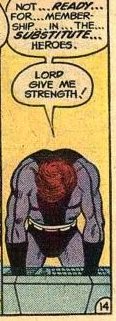
Their first starring role also turned out to be the Subs last hurrah, as the story ends with Polar Boy thinking "Maybe the Substitute Heroes wasn't such a good idea, after all..."  He subsequently went on to disband the Subs and ultimately joined the real Legion, eventually becoming the group's leader, a post he held when the Legion itself disbanded during the Five Year Gap.
I didn't read DCCP #59 until I got Showcase Presents Ambush Bug about five years ago.  Back in 1985, I was unfamiliar with Ambush Bug and knew the Subs only from their brief cameo in Superboy and the Legion #243, in which they were depicted as more or less traditional and serious super-heroes.  So, my first reaction to the Subs Special was something along the lines of "What the hell?"  Of course, over the ensuing years, especially as I've become more familiar with Giffen's body of work, I've come to appreciate this comic for what it is.  While not quite as laugh-so-hard-you'll-break-all-your-furniture hilarious as some of the early appearances of Ambush Bug, the Subs Special is a gently amusing send up of super-heroic conventions.  The story ends with a note from editor Karen Berger stating that Levitz and Giffen had gotten out of control and assuring the reader that the regular Legion title was nothing like this. The note ends "I'm sorry,everyone---really I am!"
Karen, if by some wild chance you happen to ever read this, I want to assure you that you have absolutely nothing to apologize for.   In fact, let me take this opportunity to thank you, as well as Keith and Paul, for all you've done for comics over the years. 

Monday, May 12, 2014

Giffen's Legion Part 3: Life After The Legion--Darkness, Light and Compromise

This is the post where I actually get around to discussing the story lines of Legionnaires 3 and Legion of Super-Heroes Volume 4.  Thus, spoilers lay ahead.  Tread carefully.
The greatest thematic similarity between Legionnaires 3 and the first year of Legion of Super-Heroes Volume 4 is that they both deal with life after the Legion.   The main characters of L3 are the three founding members of the Legion of Super-Heroes; Lightning Lad, Saturn Girl and Cosmic Boy. These three had recently, for different reasons, retired from the Legion and were no longer appearing regularly in the main Legion title.  Lightning Lad and Saturn Girl had recently had a child and left to devote themselves to raising him, while Cosmic Boy had simply decided it was perhaps time to do something else with his life.  LSH v4, of course, is the infamous Five Years Later version of the Legion, in which the team had been disbanded several years before the series picked up their story.  In both cases, the former Legionnaires learn that they can never truly leave their pasts, and especially the Legion, behind.
The two stories share a similarity in tone, as well.  While Giffen is best known for his humorous works, especially Ambush Bug and Justice League International, many of his comics, most famously LSH v4, can be quite dark.  Even Justice League has its serious moments, such as the Despero story line or the story in Justice League America #26, 27 and 28 where the Blue Blue Beetle, under the control of the Queen Bee, nearly kills Max Lord.
One of the criticism leveled against a lot of the so-called "grim and gritty" comics that followed the groundbreaking work of Alan Moore on Watchmen and Frank Miller on Daredevil and The Dark Knight Returns is that they copy only the surface darkness and violence of those works while missing the elements that truly made these comics great.  Giffen's LSH v4 is often lumped in with those clueless imitators.  However, I think that Giffen got it right with his Legion stories.
One thing that people often overlook about the seminal works listed above is that amidst the darkness, these stories contain an element of hope.  Miller's "Born Again" story in Daredevil is not the story of a man's life falling apart, its the story of a man fighting to get his life back.  The story ends on a hopeful note. By the the final issue of the story line, Matt Murdock has his life back.  It may not be the life he had before, but its one he has chosen for himself and one with which he is content. The Dark Knight Returns ends with Bruce Wayne embarking on a new chapter in his life with a new, more positive attitude.  Throughout the series, Batman would think in certain situations, "This would be a good death," but the story ends with him thinking, "This will be a good LIFE."
If you ask me, if anybody failed to see the hopefulness in Miller's work, especially on Daredevil, its Brian Michael Bendis.  His acclaimed run on the character is very good, I have to admit, but it is also almost unrelentingly bleak.  He just piles the crap on top of poor Matt Murdock and climaxes his run with Murdock sitting in a jail cell. 
Forgive my tangent. I was meant to be talking about Keith Giffen's Legion of Super-Heroes, wasn't I? Ok, then, let's get back on topic. 
The Legion of Super-Heroes had always been seen as presenting a utopian view of the future.  Of course, it was far from perfect.  To paraphrase Geoff Johns from Infinite Crisis, a perfect galaxy wouldn't need a Legion of Super-Heroes.  Besides, perfection makes for boring stories, especially super-hero stories.  There was always an Earthwar, a Magic War, a Great Darkness, an evil sorcerer, or a time traveling conqueror, not to mention Khunds, Dominators and other alien races of malicious intent, to keep the Legion busy.  Yet the Legion's world of the 30th century was one of hopefulness and optimism for the future of mankind.  Hell, sometimes it takes a heaping load of optimism just to imagine the human race surviving for another century, let alone a thousand years.  The Legion presented a universe where mankind had united and stood at the center of the United Planets, an alliance of civilized, space-faring worlds.  All of the threats I noted above were external, coming from outside the peaceful UP worlds.
By the first issue of LSH v4, however, the universe of the 30th century, even the once near utopian United Planets, had become a much darker place. The United Planets has all but dissolved in the wake of a galaxy wide economic disaster, the Khunds have initiated a new campaign of conquest while at the same time former UP worlds war amongst themselves, and the government of Earth (a.k.a. Earthgov) is revealed to have been infiltrated by Dominators decades earlier.  Worst of all, what had once been the light in even the UP's darkest hours, the Legion of Super-Heroes, is no more, hounded out of existence by a campaign of harassment from the Dominator controlled Earthgov.
That all does sound pretty bleak, but there is hope.  That hope lies in a reformed Legion.  Reep Daggle, the former Chameleon Boy, and Rokk Krinn, once known as Cosmic Boy, set about re-uniting their former comrades in arms becaues they are optimistic that the Legion is needed, and that they can make a difference and be the light that turns back the darkness that has spread throughout the galaxy. 
By the end of LSH v4's first year, it looks like Reep and Rokk's dream is going to come true.  The former Legionnaires have faced down two of their deadliest foes and emerged victorious.  The Legion of Super-Heroes, at last, lives again.  While it takes place against a dark backdrop, the first year of Keith Giffen's Legion of Super-Heroes Volume 4 is, in truth, a story about hope, optimism, and the belief that the right people can make a difference in even the darkest of times.
Although taking place in the near utopian environment of the pre-economic collapse United Planets, in many ways Legionnaires 3 is a much darker story than LSH v4.  It establishes the Time Trapper as a truly formidable villain and presents the three founding Legionnaires with a very personal tragedy, the kidnapping by the Trapper of Lightning Lad and Saturn Girl's son. The series does not exactly end on a hopeful note, either.  The heroes don't defeat the villain, they simply outlast him.  The conflict only ends when the self-imposed time limit that the Trapper set on what he calls his "game" runs out and the Trapper simply sends the former Legionnaires and the child home.  Furthermore, the Trapper's soliloquy on the story's final page makes it clear that even though this battle has ended, his war with the Legion is far from over.
I guess you'd call that ending an anti-climax, and its a hallmark of Keith Giffen's work, not just on Legion, but on Justice League and even as recently as Doom Patrol.  Many times the conflicts in Giffen's stories are resolved not by a knock down drag out melee between the forces of good and evil, but by negotiation and compromise, or often by the intervention of an outside force.  In LSH v4, the re-united Legionnaires free their former comrade Mysa, once known as the White Witch, from Mordru by coming to an agreement with the wizard after he and Rokk Krinn conduct negotiations over dinner.  This is quite similar to the mutual non-aggression pact reached between the Justice League and the Queen Bee at the end of the first four issue story line in Justice League Europe.  That's not to say that LSH v4 is lacking in action.  The Legion will fight when it has to, and some villains can't be reasoned with, such as the insane mass murderer Roxxas. However, Giffen recognizes that violence isn't always the answer and sometimes it takes more strength not to fight.
I'm pretty sure that this is my last post comparing and contrasting Legionnaires 3 and Legion of Super-Heroes Volume 4.  It may not, however, be my final word on Keith Giffen and the Legion of Super-Heroes.  After all, I haven't said anything about the Legion of Substitute Heroes yet. 

Sunday, May 11, 2014

Giffen's Legions Part 2: Welcome, New Readers! (...or not so much)

Before I get into today's post, I should offer a slight correction to something I wrote in part one of this series.  There are actually three full page splashes in Legion of Super-Heroes Volume 4 #12.  Yes, I have actually read the book, and do own a copy, however, I didn't look at it while I was writing the post, and the full page image of Celeste Rockfish bathed in a mysterious green light slipped my mind.  This error, though, in no way invalidates the point I was making about Giffen's use of splash pages in LHS v.4, as this "revelation" is pretty effectively telegraphed in the pages leading up to it.
To begin today's post, I invite you to join me on a journey through time, back three decades to 1985 where we will meet me as I was then.  I was quite different back then.  I hadn't yet taken up smoking, nor was I yet a coffee addict, and I was only just beginning to discover that I am not a man who can hold his liquor.  More relevant to our topic, I also was not yet the slavering obsessed comics fanboy that I would later devolve into.  I was a casual reader of super-hero comics at perhaps the last time in the history of the genre was such a thing was possible.
I knew little of the Legion of Super-Heroes.  While I was aware of the comic's existence, I didn't really know anything about the characters or the strip's then two and a half decade history.  Aside from a brief cameo in DC Comics Presents #2 and their appearance, along with every other DC hero, in Crisis On Infinite Earths, the only Legion stories I'd read were the 1977 JLA/JSA cross-over in Justice League of America #'s 147 and 148 and a 1978 issue of Superboy and the Legion of Super-Heroes that was part of the "Earthwar" saga.  As it was thirty years ago, I can't really say at this point what it was that motivated me to purchase the first issue of the Legionnaires 3 mini-series. I suppose, however, that having enjoyed the few Legion tales I had read, I was curious about the team and looking to learn more about them, and the first issue of this mini-series seemed a good place to start.
That, as it turned out, was a pretty accurate assessment.  Though I've still read relatively few Legion stories compared to the vast amount that have been published since 1958, of the ones that I have read L3 is probably the one that I'd recommend to someone as their first Legion comic, with the possible exception of the origin story in Superboy #147 or one of the retellings of that tale I mentioned in my post on that issue.
While the primary audience for this mini-series is obviously long time hardcore Legion fans, the series is carefully crafted to be welcoming to new readers as well.  The story can be read and understood by a reader unfamiliar with Legion history and I'd even venture to say that someone totally new to comics and unfamiliar with their language and storytelling conventions would have little problem following the action.    A knowledge of the history of the characters certainly provides a richer reading experience for those in possession of such facts, but it is hardly a prerequisite.  All the back story and information about the characters pertinent to the story at hand is laid out for the reading within the first issue.  Even the creative team's one questionable story telling choice, the decision to show three Legionnaires who are supposedly retired from active duty with the group lounging around at home and off duty in their super-heroing attire, was, as scripter Mindy Newell explains in answer to a reader in the third issue's letters column, made in the name of enhancing the reader's comprehension of the story by making recognition and identification of the characters easier.  Not only does this not make sense within the context of the story but is ultimately unnecessary due to penciler Ernie Colon's skill in rendering each character in the story in a unique and recognizable manner.  Even two characters who share similar characteristics, Cosmic Boy and Rond Vidar, and could, in the hands of a lesser artist, have been rendered almost interchangeably, stand out instead as distinct individuals.
To me, L3 stands out as a particularly well crafted example of what Colin Smith, writing about Stan Lee and Jack Kirby's work on the first Avengers #1 at his blog Too Busy Thinking About My Comics, terms the "paternalistic" approach to comic book story telling.  In this model, the creative team figuratively take the reader by the hand in order to, as Smith puts it, "guide them through a story in a highly controlled and specific sense."  Every story telling choice, from the dialogue and captions to the number,placement and size and shape of the panels to the composition of the images within those panels, is carefully calculated to enhance the reader's understanding and enjoyment of the story and produce in them the effect desired by the creative team.  To a greater or lesser extant, and with varying degrees of success, the paternalistic model was the dominant mode of comics story telling through most of the medium's history.
As far as I can tell, Legion of Super-Heroes Volume 4 represents one of the mainstream super-hero genres earliest moves away from the paternalistic approach, as well as an early flirtation with what has come to be known as decompressed story telling.
I think it may be time now for another disclaimer.  I may not be the most qualified person to talk about the issue of new reader friendliness. Personally, I don't mind a little initial confusion on jumping into a series, and a long and complicated back story usually doesn't deter me as long as the story I'm reading at the moment is understandable and enjoyable.  When I started getting into Doctor Who a couple of years ago, I found learning the show's fifty years of history to be as much fun as watching the current episodes.  With that qualification in mind, let me say that I don't find LSH v4 as impenetrable as it has acquired a reputation for being.
On the other hand, creators Keith Giffen and Tom and Mary Bierbaum certainly aren't holding our hands here, either.  They expect the reader to be a participant in the story telling process and do a little bit of work to make sense of what's going on.  As with any long running series, the long time reader has an advantage over the new reader, and that's especially true in LSH v4, although in the the letters columns, even some long time readers expressed a degree of confusion. Still, setting the beginning of this series five years after the end of the previous Legion book does serve to put both new and older readers on somewhat of an equal footing, as now neither knows the status quo.
In sharp contrast to L3's showing off duty heroes lounging around in their fighting uniforms, this series eschews super-hero costumes for at least the first twelve issues. Furthermore, the characters are referred to by their civilian identities rather than their super-hero code names. A few characters are referred to by abbreviated versions of their code names, but these are more like affectionate nicknames rather than noms de guerre, such as Brainy (Brainiac 5), Cham (Chameleon Boy, also referred to as Reep Daggle) and Vi (Shrinking Violet or Salu Digby). This is entirely appropriate in a story that begins with the Legion having been disbanded several years in the past, but this seems to have been one reason even long time readers, more familiar with the character's super-heroic names, experienced some confusion.
With overall lack of narrative captions, other than those tersely telling us what planet we're on, and establishing panels that just show background with no people along with several unattributed dialogue balloons, sometimes it can be difficult at first to figure out what's going on or who's speaking. Nonetheless, all the information the reader needs to fully understand each issue is contained within that issue.  Its just that it is not presented right up front and the readers has to piece it together for himself.
I'm a big fan of Keith Giffen's artwork, and the late 80'/early 90's is one of my favorite periods of his work.  He had synthesized his early Jack Kirby and Jim Starlin influenced style with the controversial influence of Jose Munoz to produce a style that blended cartooniness and realism in a way that particularly suited the super-hero genre.  His face and figure drawings are excellent, giving each character a recognizable individual look.  His background drawings, however, can at times be a little too busy and somewhat hard to interpret at first glance, especially when divided into multiple panels. 
In both its story and art, LSH v4 is most definitely a series that rewards, and in fact demands, repeated readings.  I find myself understanding and enjoying the story more each time I read it.
I also find that its best to read several issues  at one time, as the story does unfold rather slowly and developments in early issues do take some time to pay off.  The series would definitely benefit from being collected, but no such collected editions exist. 
 It seems that many people writing about LSH v4 experience a problem similar to the one I've been having in writing this post.  I really like the series, but the story telling approach taken by Giffen and the Bierbaums has it drawbacks as well as its pleasures and the series does take some time to get into.  In pointing this out, I may seem to be discouraging you from seeking this series out and reading it.  That however, is the exact opposite of my intent.  Legion of Super-Heroes Volume 4 is actually a series I would highly recommend. Anyone willing to be patient with the series and put the required effort into it will ultimately find it a rewarding reading experience.

Sunday, May 4, 2014

Giffen's Legions: Legionnaires 3 and Legion of Super-Heroes Volume 4

If, to open this post with a reference to an obscure episode of the animated Star Trek, Keith Giffen were to be kidnapped into space and place on display in an  interplanetary zoo for the amusement of giant slug-like extra-terrestrials (which could totally happen, you know), back here on Earth he would most likely be remembered by future generations of comics readers, if indeed there are to be any, for three things: Ambush Bug, Justice League International, and The Legion of Super-Heroes.  Celebrated primarily for his artistic contributions to the series in collaboration with long time writer Paul Levitz, Giffen also wrote, along with Tom and Mary Bierbaum, the controversial and divisive "Five Years Later" version of the Legion that appeared in Volume 4 of the series beginning in 1989.
However, Giffen's first crack at writing a Legion story came some four years earlier in a largely unheralded four issue mini-series entitled Legionnaires 3, with dialogue by Mindy Newell and art by Ernie Colon and Karl Kesel.  Perhaps I should qualify that statement a bit.  L3 was Giffen's first attempt at writing a serious Legion story featuring actual Legionnaires.  He had earlier written DC Comics Presents #59, co-starring the Legion of Substitute Heroes in 1983 and 1985's Legion of Substitute Heroes Special.  These efforts were more in the spirit of Giffen's work on Ambush Bug, however.  In fact, DCCP #59 featured that character's second appearance.
In contrast to the goofiness of those stories, L3 and LSH v.4, while they do contain flashes of humor, are for the most part deadly serious, even grim, affairs.  The first year of Volume 4 is concerned with the rebuilding of the Legion several years after the team's dissolution in the wake of a galaxy wide economic collapse that has left the 30th century a much darker and more dangerous place than it had been in the previous Legion series.  In L3, retired Legionnaires Lightning Lad and Saturn Girl's baby is kidnapped by one of the Legion's deadliest foes, the Time Trapper, in as part of a plot to destroy the Legion.  This post, however, is concerned not so much with the plots of the two series, but with the story telling choices Giffen makes in each and how they compare and contrast.
Giffen drew the early issues of LSH v. 4, with inks by Al Gordon, while on L3 he is credited as plotter and "designer".  I assume this means the same thing as "breakdowns", which is how his credit on the Justice League books read, thus the story telling choices are his for the most part, with Colon and Kesel following his lead.
A hallmark of both series is their dense visual story telling.  On Volume 4, Giffen famously, or infamously, stuck to a grid of nine equal sized panels for the overwhelming majority of pages.  This, combined with the text pieces at the end of most issues, even today draws comparisons between this volume of LSH and Alan Moore and Dave Gibbons Watchmen, which used similar techniques.  However, whereas Gibbons, while essentially sticking to the nine panel design, would judicially "combine" panels, eliminating the borders and gutters to create a larger uninterrupted image when it suited Moore's story, Giffen, for the most part, stuck to the grid seemingly at all costs.  Larger images, mostly establishing shots, where divided into two or three panels.  Also, ocassionally a single drawing would be reproduced across several panels.
L3 is, if anything, even more dense.  While not bound to a rigid nine panel pattern, each page is similarly packed with images.  There are very few pages with fewer than six panels, and one page in the first issue crams in a whopping thirteen panels. Unlike Volume 4, in which Giffen's nine panels were all of uniform size and shape throughout, even on pages with nine or more panels Colon gave greater emphasis to some images by varying the width of panels within the grid.  This was accomplished through the widening of certain panels to allow more to be shown while narrowing others in order to focus attention on detail.  Many pages consist of a relatively large image, running either across the top or bottom of the page or in some cases along the side, accompanied by a series of smaller panels.  While not meaning to diminish Colon's contributions to the storytelling, I'm attributing thes story telling techniques to Giffen, as perhaps communicated through his "designs."  He uses similar techniques in Legion tales of the period that he drew himself, such as the story contained in Tales of the Legion of Super-Heroes Annual #4.
The profusion of smaller panels serves to give the sporadic half and full page images, when they occur, a greater impact.  Full page splashes are not there merely to show off Colon and Kesel's beautiful art, though, make no mistake, the art in L3 is some of Colon's best super-hero work and Kesel's inks are part of the reason for that, but instead they serve to give proper emphasis to moments that are meant to shock or surprise the reader.  
While full page images are decidedly far rarer in Giffen's work on Volume 4, their impact, perhaps somewhat paradoxically, is not as great.  For the most part, the few story ending full page images serve to re-emphasize certain story points rather than to shock or reveal new information.  Most effective are the blank white pages at the end of issues #4 and 5 after the time line is shattered first by Mon-El's destruction of the Time Trapper then by Glorith's spell to restore the former time line.  The sixth issue's full page reintroduction of Jan Arrah, formerly known as Element Lad, is hardly shocking or even mildly unexpected.  After all, it is Arrah who Celeste Rockfish, Bounty and Devlin O'Ryan traveled to the dead planet Trom to find, and he is, in fact, the only living being on the planet.  Issue #12 contains two full page splashes.  The first is merely a field of stars with the words "The Legion of Super-Heroes" in the middle of the page.  This somewhat redundantly serves only to re-emphasize the point made by the previous pages nine panel exchange of dialogue between Rokk Krinn (Cosmic Boy) and Reep Daggle (Chameleon Boy) that the Legion has at long last been reborn.  The final page splash serves as a cliffhanger, emphasizing the danger that the newly introduced character Kent Shakespeare is in from the escaped villain The Persuader.  
Well, folks, it looks to me like we've got a series on our hands here.  Having said, I believe, all I have to say on the use of panel layouts in L3 and LSH v. 4, the next part will deal with the thorny issue of accessibility, or new reader friendliness.

Sunday, March 23, 2014

On The Horizon: Infinity Man and The Forever People

I have, for reasons that are primarily financial in nature, taken a break from purchasing new comics in recent months.  However, while looking over J. Caleb Mozzocco's monthly rundown of upcoming comics from DC at Everyday Is Like Wednesday, my attention was caught by one particular item that might just be enough to pull me back to the Laughing Ogre for at least one Wednesday a month.
The second week in June sees the release of Infinity Man and the Forever People #1.   This is yet another updating of one of Jack Kirby's Bronze Age concepts by Dan Didio, Keith Giffen and Scott Koblish. That's the same team responsible for the late OMAC title.  Given the success, or, rather, lack thereof, of OMAC, that might not really be something to brag about.
I enjoyed OMAC quite a bit and it was widely hailed as one of the best  books of the original New 52.  Sales, as is too often the case, did not match the critical acclaim and the series met a premature end after eight issues in the first wave of New 52 cancellations.
With just the limited information provided by the solicitation to go on, there are a couple of things about this new series that strike me as interesting or curious.  The first is the title of the book itself, which gives top billing to the Infinity Man.  In Kirby's original series, Infinity Man played a very small part, appearing in less than half, four out of eleven to be exact, of the issues.  He was, quite literally, a Deus Ex Machina, showing up at the end of an issue when the Forever People touched their living computer, Mother Box, and shouted a magic word in order to mop up the bad guys and get the Forever People out of whatever mess they'd gotten themselves into in the preceding twenty pages or so.  Infinity Man was never much of a well rounded character in his own right.  He spoke in cliched heroic platitudes and displayed little personality beyond a selfless nobility and devotion to the Foerever People.  His true nature and origins were never explored, though perhaps, if the book had continued past its eleventh issue, they might eventually have been. The series was, to be honest, much better off without him in my not so humble opinion.  Giffen and Didio have a lot of work to do with Infinity Man if they're going to develop him into a character worthy of star credit.
Secondly, as I looked over the cover, this little detail caught my eye:

It appears that in this new series, Giffen and Didio have made Serifan a woman.  While I don't really think this is such a major change to the original concept and won't make too much of a difference, I do predict howls of outrage all over the Wild, Wild Web from Kirby purists.  For me, it all comes down to how its handled, and I generally have pretty high expectations of Keith Giffen, so I'm somewhat optimistic.
That is, I'm optimistic for the creative success of Infinity Man and the Forever People.  Commercially, I honestly don't expect it to do much better than OMAC.  That series managed to match the eight issue run of Kirby's original series, so my prediction is that Infinity Man and the Forever People will do the same and last a whole eleven issues before being cancelled.
Giffen has been doing the best art of career in the past five years or so, and his stories are always entertaining, so I'm sure that Infinity Man and the Forever People will be worth reading however long it lasts.

Monday, March 17, 2014

The Greatest G'Nort Stories Ever Told

In honor of St. Patrick's Day, we turn our attention to one of the super-hero genre's proudest wearers of the green; a most distinguished member of that fabled cadre of interstellar policemen known as the Green Lantern Corps.  I speak of the greatest being ever to wear a power ring, none other than the inimitable G'Nort Esplanade Gneesmacher.  From the moment that he burst upon the scene in 1987's Justice League International #10, this furry wonder immediately captured the hearts and minds of comics fans the world over, and quickly became a beloved fan favorite.
Well, maybe not, but I like him.  Thus, I have compiled a list of what I consider to be the five best stories featuring the character. 

5. Justice League America #36 
"G'Nort by G'Nortwest"
by Keith Giffen, J.M. DeMatteis, Tom Artis and Art Nichols
For the number five spot on my list, it was a toss-up between this issue and Justice League Quarterly #2's "Designing Humans."
"G'Nort by G'Nortwest" finds G'Nort's "arch-enemy", by virtue of being the only criminal G'Nort ever actually apprehended, the Scarlet Skier, former "locater" for interplanetary designer Mr. Nebula, coming to Earth after being released from prison to seek revenge on the Green Lantern who put him behind bars.
The JLQ issue, in which Mr. Nebula comes to Earth looking for the skier and the Justice League must prevent him from redecorating the planet, is actually, in my opinion, a better story.  However, JLA #36 features G'Nort more prominently, so it makes the list.

4. Green Lantern #9-#12 
 "A Guy And His G'Nort"
by Gerard Jones, Joe Staton and Bruce Patterson

Although this was billed as the first ever Guy Gardner solo story, the JLI's brain damaged ring-bearer isn't exactly going it alone for these four issues.  He's got ol' G'Nort in tow as the two go on a quest to uncover G'Nort's true origins.  After the newly returned Guardians of the Universe reveal that they've never seen or heard of G'Nort before, Guy and G'Nort uncover a plot by the Thunderers of the Anti-Matter universe of Qward to discredit the Green Lantern Corps by distributing fake GL rings to idiots like G'Nort.  G'Nort, however, proves himself truly worthy of the ring when he sacrifices his power to save Guy.

3.  Mister Miracle #6  
"Barking Up the Wrong Tree"
by Giffen, DeMatteis, Mike McKone and Peter Gross

When some two-bit gangsters try to get a protection racket going in Bailey, New Hampshire, the small town where Scott Free (a.k.a. Mr. Miracle) and his wife Barda have settled down, Oberon contacts the Justice League for help and G'Nort answers the call.  Any story that contains the line "Help! A giant dog is trying to sell me insurance!" has got to be a classic.

2. Justice League America #51
 "My Dinner With G'Nort"
by Giffen, DeMatteis, Adam Hughes and Joe Rubinstein

I actually have two copies of this issue.  One is to read, and the other is bagged, boarded and signed by artist Adam Hughes.
When G'Nort drops by the JLI's New York embassy for a surprise visit, a bored of his skull Kilowog invites his "brother alien" out for a night on the town.  J'Onn J'Onnz, the Martian Manhunter, tags along to keep the pair out of trouble.  You can imagine how well that works out.  You've got to wonder who thought that taking G'Nort to see Cats was a good idea, and things only get worse when a super-villain attacks during dinner.
This issue was a serious candidate for the top spot on the list, but after some consideration I decided to give it to:

1. Justice League America Annual #4 
 "What's Black and White and Black and White and Bl..."
by Giffen, DeMatteis, McKone and Bob Smith

 After inadvertantly foiling a robbery, which they themselves had intended to commit, the quintet of inept second rate super-villains known as the Injustice League find themselves hailed as heroes and decide to go straight, offering their services to the Justice League International.  Together with G'Nort and the Scarlet Skier, they become Justice League Antarctica and soon find themselves facing a horde of genetically engineered, man-eating penguins.
There you have it, dear readers.  The Top 5 G'Nort stories.  Proof, if any were needed, that G'Nort Esplanade Gneesmacher is indeed the greatest canine Green Lantern of them all.

Monday, April 8, 2013

Me and Irwin

As I mentioned back in my wrap-up of my weekend at Gem City Comic Con, among the many comics fans wandering the Wright State University's E.J. Nutter Center dressed in the costumes of their favorite comic book super-hero was one who had chosen to don the guise of Irwin Schwab, a.k.a. the Ambush Bug.  At my urging, Canada Keck, with whom I was manning the Sunday Comix table, retrieved her camera from her car and I fetched Mr. Schwab to our table to pose with me for the photo which appears below.
For those of you who may not be familiar with Ambush Bug, or me, for that matter, the Bug is the green one and I'm the one wearing the scarf.
Now, if I can only get a picture of me with G'Nort, I could die happy.

Wednesday, February 13, 2013

Unfinished Business: Justice League--Generation Lost

If you've been reading this blog for some while, you may remember that a couple of years ago I was buying the bi-weekly limited series Justice League: Generation Lost and, for awhile, reading and reviewing each issue as it came out.  Eventually, I decided to set the issues aside until the series was completed, then read it all at once and review it for you at that time.  While I did read the whole series upon publication of the final issue, I failed to get around to reviewing it here.  Until now.  While I make no promises that it was in any way worth the wait, here is my long delayed review/overview of Justice League: Generation Lost.
In retrospect, the point at which I decided to put off reading the series is really the point at which I just should have stopped buying it.  Ultimately, Gen Lost turned out to be a year long waste of time and money.  Some of the individual issues were enjoyable on their own, but taken as a whole the story was a massive disappointment.
I feel like I've been the victim of a bait-and-switch scam.  I began buying  the comic because Keith Giffen was co-writing it, returning once again to the characters he'd done such great work with back in 1980's.  However, by the eighth issue, Giffen was gone, leaving co-author Judd Winick to alone to write the bulk of the series. 
I do not hate Judd Winick's writing, at least not all of it.  I really like The Adventures of Barry Ween Ween, Boy Genius, which established Winick as one of the best humor writers of the 90's.  However, when he turned his attention to super-heroes the results have been, at best, bland, and, at worst, stupid and offensive.  
One of the big problems with the story is the pacing.  While the early issues, which, not coincidentally perhaps, were the once Giffen was involved in, moved at a pleasing pace, once on his own Winick seemed to realize that he just didn't have enough plot to fill the allotted number of issues.  Thus, the series fell into a pattern of issue long huge fight scenes followed by an entire issue of the cast sitting around talking followed by another issue long fight scene, and so on.  Occasionally, he'd throw in an issue where Captain Atom would be thrown into the future, there to witness the dire consequences if Maxwell Lord should succeed in his evil scheme.
Speaking of said evil scheme---and here is where the consensus rules of blogging require that I insert the words "Spoiler Warning", though I feel no compunction about revealing the ending of a story I'm trying to dissuade you from reading anyway---that's where the story really fell down.   After an entire year of chasing Max Lord around the globe and building him up as the greatest evil since Lucifer fell, the former JLI organizer's big top secret evil master plan turns out to be building a giant robot to beat up on Wonder Woman.  My reaction to that revelation was something like, "Are you serious? That's IT?"  It was, as I said above, a massive disappointment.  Compounding the feeling of being let down was the fact that the evil giant robot was rather easily defeated. 
Overall, Justice League: Generation Lost was not worth the money I spent on it, or the time I spent reading it, or really even the time I've spent thinking about it while writing this review.

Friday, April 6, 2012

OMAC # 8: The Best for Last

You're probably familiar with the old show biz saying that you should always leave your audience wanting more.  Keith Giffen and Dan DiDio certainly are, as O.M.A.C. #8, the series' final issue, proves.  The writer/artist team go out with a bang, producing the best issue of yet of this regrettably short lived book.
In this jam-packed issue, we finally, albeit belatedly, get some real insight into the character of Kevin Kho, O.M.A.C.'s alter ego; a knock down drag out throwdown between O.M.A.C. and the forces of Checkmate; the final showdown between Brother Eye and Maxwell Lord; and a final twist that sets in motion a new direction for the character when he appears again.
Giffen's art over the course of these eight issues has been the best of his career and for the finale he outdoes himself with a kinetic, frenetic, Kirby-inspired tour de force.  I'll miss seeing Giffen's art on a regular basis and I hope it won't be too long before he picks up another pencilling assignment.
You know, sales on this title must have been really bad if even the fact that it was co-written by the company's co-publisher couldn't save it.  I really can't figure out why that is, though, because this book was everything fans say that they want in a super-hero comic.  I'm going to miss it, but at least I've still got these eight issues to read over and over again.

Thursday, September 15, 2011

OMAC #1 Reviewed

Prior to OMAC #1, the only other comic written by Dan DiDio that I'd read was the Metal Men feature in Wednesday Comics a couple of years ago.  It was alright.  The sequence of events made sense and the characters acted in character.  That may seem like damning with faint praise, but that minimal standard appears to be setting the bar too high for some writers. (Yes, I'm looking at you, Brad Meltzer and J.T. Krul.)  Of course, given the rather ambiguous, Lee/Kirby-esque credit of "Story and Art by" DiDio and Keith Giffen, I'm inclined to believe that the lion's share of the credit for OMAC being as good as it is lies with Giffen.  
Giffen's involvement in the project is what led me to pick up this issue.  I've always been a fan of his work, and I really like his current art style.  Here he manages to evoke OMAC's creator Jack Kirby while remaining unmistakably and uniquely Giffen. 
The story, "Office Management Amidst Chaos," begins with the headquarters of genetic research firm Cadmus coming under attack by a super powered intruder who identifies himself as OMAC.  As he fights his way past Cadmus security down to the top secret lower levels and his real goal, the Cadmus Mainframe computer, we get a high speed tour of the world of this new series, introducing us to the characters, concepts, settings and a few mysteries that will, we assume, be fleshed out in future issues. 
The main mysteries revolve around the orbiting satellite calling itself Brother Eye.  Who or what is he and what's his beef with Cadmus?  And why has he chosen Cadmus employee Kevin Kho to be his champion in the guise of OMAC?
As of now, I plan to be around for awhile to see  these mysteries played out.  This was a good, old fashioned solid super hero action tale with great art that left me wanting more and looking forward to next issue.
One other thing I'm wondering is if Giffen and DiDio are going to keep up the conceit of having the first letters of words in the individual issue's story title spell out OMAC.  I hope they do.  It would be one more thing to make this series stand out from the rest of the so-called New 52. 

Thursday, April 14, 2011

Bye, Bye, Booster

Yesterday, I bought my last issue of Booster Gold for the foreseeable future.  That's because, just shy of a year after coming on to the book, writers Keith Giffen and J.M. DeMatteis are leaving.  Beginning next issue, Booster's creator Dan Jurgens returns to write and draw the series. 
There are a couple of reasons why I'm dropping the series.  Dan Jurgens is one of them.  While I did enjoy the original Booster Gold series, I've not been too wild about most of what Jurgens has written since.  His Superman was ok, though not especially memorable, but I've never been able to forgive him for Zero Hour.
There's also the fact that the next few issues of Booster will be closely tied to Flashpoint, DC's latest company wide crossover event.  I'm not even remotely interested in this so-called event, and plan on avoiding it as much as I possibly can.
Sadly, Giffen and DeMatteis are being taken off of Booster just as they were beginning to hit their stride.  The latest story line, involving time displaced Nazis and Booster returning to the 25th century to stand trial for the theft of the time machine that brought him to our time and the devices that gave him his powers and then meeting and battling across the timestream with a future version of himself called the Perforated Man, has been the best of their run and one of the best Booster Gold stories I've ever read. 
It seems to me that while they may have been writing the character's eponymous title, Giffen and DeMatteis were never really in control of Booster Gold's destiny.  The first half of their run, though fun and enjoyable, reads like they're just marking time while the really important events in Booster's life were unfolding in the limited series Justice League: Generation Lost and Time Masters: Vanishing Point.  In fact, it appears  that from the begininng Giffen and DeMatteis were only meant to be filling in while Jurgens went off and did Vanishing Point.
Considering the great things they did with the Booster back when they did have total control of him during the period following the cancellation of his first series when he was in the Justice League International, it's kind of a shame the pair never really got to strut their stuff on the character's own book.

Saturday, February 12, 2011

Secret Six #30

I can say honestly and without equivocation that Secret Six #30 is, without a doubt, the best issue of that title that I have ever read.  It is also (and I'm sure you could see this "revelation" coming from five miles away on a foggy day) the only issue, so far at least, of Secret Six that I've ever read.  It won't be the last. 
The only reason I bought this issue is because it's the first part of a crossover with Doom Patrol.  I probably could have skipped this issue.  I'm sure DP writer Keith Giffen would have given me enough info that I wouldn't be totally lost if I'd opted to only buy the second part of the story.  Giffen's pretty good about that actually.  As it turns out, there are plenty of reasons to buy this issue other than just to get the bare bones of the plot.
Before I picked up this comic, I read a few of the reviews on-line.  The general consensus out there in web land is that this issue is very good, and that Secret Six writer Gail Simone does the DP as well as Giffen.  One reviewer admits to laughing out loud at several points during the issue.
So, what did I think about it?  Well, it was very good, I laughed out loud a few times, and Simone does, indeed, write the Doom Patrol as well as Giffen. She even gets Ambush Bug right, which isn't easy.  Even Giffen, the character's creator, hasn't always pulled it off.  Bumblebee is just as useless here as she's been over in the Patrol's own book.  Her big contribution to the team this issue is to get swallowed by a mutant man-fish.
Before this issue, I never would have thought Bane could be funny.  But there is a hilarious scene near the beginning involving the backbreaker on a blind date.  After meeting his date, he thrusts a bouquet of flowers in her face and flatly declares, "I wish to mate." The girl, Spencer, is a dancer at a super-hero themed gentlemen's club called "Superiors", which is where she and Bane meet. When she's harrassed by a drunken customer, Bane punches his face in, then asks, "Shall I snap his spine? I am unsure of the etiquette?"  The date ends there, as Bane is ushered out before the cops can arrive, but Spencer tells him to call her. Not only is Bane funny, but he actually comes off somewhat sweet, innocent and naive.  I certainly never would have expected that of the guy who crippled the Batman.
Then there's Deadshot.  Especially after John Ostrander and Kim Yale's excellent, but very, very grim, 1988 mini-series, I wouldn't have pegged Floyd Lawton for a barrel of laughs either.  However, he's got a couple of very funny lines here as well.
The story concerns a slacker kid named Eric who suddenly inherits his grandfather's fortune and criminal empire.  He decides to rebuild the organization as C.R.U.S.H. (Companians Recently United to Spread Hate--a great acronym, by the way) with his gamer friends and sets out to get himself a secret headquarters inside a volcano.  The volcano he has his eyes on just happens to be on Oolong Island, current home of the Doom Patrol, so he hires the Secret Six to take over the island for him. 
Given the overall irreverent tone of this issue, I'm not surprised that the Secret Six appears to consist of eight members.  However, I didn't recognize about half of them and it would have been nice if Simone had taken the time to introduce them to any Doom Patrol  readers, like me, picking this up just for the crossover, or to introduce the Patrol to Secret Six readers who for some reason aren't reading their book. 
That minor quibble aside, this was an excellent comic, and enough to make me want to read more of this series.  I've already bought the six issues mini-series that preceded the current monthy and includes the first encounter between the Doom Patrol and the Secret Six, and I plan to read that this weekend.  I might even check out next issue, which the blurb at the end of this one promises contains "...the most requested Secret Six story ever!"  Don't know what that could be, but I am a little curious.
Personally, the story I'd most like to see is Bane and Spencer actually getting to finish their date.

Saturday, November 13, 2010

Justice League: Generation Lost at the Halfway Mark

Back in my review of Justice League: Generation Lost #10, I wrote, "...as the halfway  point of the series approaches, I am going to have to decide if this book is really worth three bucks every two weeks."
With the release this past Wednesday of the thirteenth of twenty-six issues of this year long bi-weekly mini-series, we have come to that halfway marker and now seems like a good time to take stock of the series so far.  
As you might expect from a series of this length, the story has been somewhat leisurely paced.  It took a couple of months for the story to really kick into gear, and it continues to move forward somewhat slowly.  Along the way there've been a couple of issues that have seemed little more than filler, adding little to the development of the plot.  The last three issues have been little more than extended fight scenes, with only small advancement in the actual story.  Meanwhile, I'm still not sure about the exact nature of Max Lord's master plan, though we are assured that he has one.
The main appeal of the series is the characters.  Captain Atom has been one of my favorites since the first issue of his 80's series; Booster Gold has always been at his best when he's with the JLI, and I really like the new Blue Beetle and Rocket Red. Fire and Ice, especially Ice in light of the controversial retcons in #12, aren't quite the same characters they were in the classic JLI stories of the 80's, though they're still recognizable to long time fans.  The only character whose portrayal I'm not happy with is Max Lord, but the damage to him was done long before this current story began. Overall, I've noticed that Judd Winick is stronger on character than story, and he seems to have a good handle on this group of heroes. 
So, while it's been somewhat uneven in pacing and quality, for the most part, Justice League: Generation Lost has been a fairly entertaining read.  It's not a classic, but it doesn't totally suck, either. If I were one to dish out letter grades in my reviews, I'd give it a "C."
As to the question of my continuing to follow the series, to be blunt, the answer is that I've come this far with it so I might as well see it through to the finish.
What remains in question is whether I'll keep reviewing the issues here as they come out.  It seems that I just can't win with this book.  If I don't like an issue, I get comments telling me how wrong I am  and if I like an issue, I get obscenity laced comments also telling me how wrong I am.  There may be no consensus on the merits of Generation Lost, but there appears to be general agreement out there in cyber-space that I am just wrong. 
In the end, I suppose I'll do what I've always done.  If I have something that I think is interesting to say about a particular issue, I'll say it.  If you don't like it, that's why there's that white box underneath these ramblings.  Whether you agree with me or think I'm an idiot, your comments are always welcomed in these quarters.

Wednesday, October 27, 2010

A Legion of Legions: "Snapshot: Revisions!" in DCU: Legacies #6

Each issue of DC Universe: Legacies so far has featured a back up story spotlighting various nooks and crannies of the DC Universe largely untouched upon in the main feature's narrative of DC history as seen through the eyes of Metropolis policeman Paul Lincoln.  To date, these "Snapshot" stories have focused on DC's magic based heroes, the Seven Soldiers of Victory, non super powered adventurers such as the Challengers of the Unknown and the Sea Devils, and DC's war and outer space heroes.  I haven't written about them so far because, frankly, their hasn't really been anything to write about.   They've been good but unremarkable. 
The most recent issue (#6) contains "Snapshot: Revision!" (all the subtitles of these stories so far have begun with "R"), an amusing story, written by Len Wein with art by Keith Giffen and Al Milgrom, which gently pokes fun at the convoluted continuity of the Legion of Super-Heroes. Teenaged Clark Kent is working out in the fields of the Kent family farm in Smallville when a Time Bubble appears carrying Legion founders Cosmic Boy, Lightning Lad and Saturn Girl.  They've traveled back in time one thousand years to invite "Superboy", although Clark never actually called himself that in the current continuity, to come back to the 31st century with them and join their super-hero club.
So far, things have proceeded pretty much the way they did in the Legion's first appearance in Adventure Comics #247.  Soon, however, another Time Bubble appears carrying older versions of the Legionnaires warning of dire consequences for Earth if their younger selves take Clark back to the 31st century and seeking to prevent that from occurring.  They are soon joined by yet another Time Bubble carrying yet another group of Legionnaire's seeking Superboy's help.  Then comes another Time Bubble. And another. And another. And another. And another, and so on.  This goes on until the Kent cornfield is filled with Time Bubbles, all bearing representatives from all of the various revisions, revamps, reworkings and regurgitations of the Legion that have occurred over the past couple of decades.  Confusion reigns as the many Legions take to bickering amongst themselves while a confused Clark can only stand by helplessly scratching his head and wondering what the heck is going on.
It's really nice to see a lighthearted, somewhat silly story like this in a modern super-hero comic.  In the darker post-Identity Crisis Dan DiDio/Geoff Johns DC Universe it sometimes seems that there just isn't room for this type of story.  I'm glad that an exception was made in this case, and I'd like to see more stories like this.

Tuesday, October 26, 2010

They Don't Write 'Em Like This Any More: Action Comics #646

One of the rituals around which I organize my sad little life is my bi-weekly trip to the Graceland Shopping Center.  Every two weeks, as soon as my paycheck is deposited in my bank account, I head up there to buy two cartons of smokes, then go to the Half Price Books across the street to browse through their selection of old comic books.  On my most recent such excursion, I picked up a copy of Action Comics #646, published in 1989.
What's so special about this particular comic?
To be honest, absolutely nothing.
That's not to say that it's bad, because it isn't, not at all. In fact, it's really quite good.  It's just that there's really nothing especially noteworthy about it.  It's not an anniversary issue or a first or last issue, nor is it part of any major story line or company wide, universe changing crossover and no major character either debuts nor dies in it. 
For my part, I picked it up because it happened to be drawn, as well as plotted, by Keith Giffen with Roger Stern scripting. Those who've been reading this blog over the past 362 days most likely know by now of my undying and somewhat disturbing love for Giffen.
The story is called "Burial Ground," and features Superman fighting a giant slug from outer space in the Antarctic. Sure, there are a few panels recapping the last couple of issues by way of explaining just what Superman is doing down there, one page checking in on events in Metropolis which sets up the "Brainiac Trilogy" story beginning in the following issue, and an ominous hint of things to come even farther down the line in the issue's very last panel.  The bulk of the issue, however, is taken up by the Man of Steel slugging it out with a giant slug. Like I said, nothing especially special.
What it is, though, is an example of something you don't see a lot of in super-hero comics these days.  You don't need to have read the previous several decades worth of issues or have an encyclopedic of DC Universe history and continuity in order to understand what's going on in the story and enjoy it. Nor are you expected to buy thirty other comics in order to get the whole story.  While it evokes the lighter mood of the Silver Age Superman tales, it does so subtly without expecting the reader to have actually read or be familiar with those stories.  Also, unlike a lot of  super-hero comics put out recently, this is a comic I wouldn't have second thoughts about actually letting a kid read. "Burial Ground" is a completely self-contained and totally accessible single issue story that can be enjoyed by all ages.
Above all, Action Comics #646 is pure, simple, mindless fun. After all, mature, sophisticated and thought provoking comics are all well and good, and I enjoy reading them, but sometimes you just want to see Superman beating up a giant outer space slug.  Unfortunately, you just don't get enough of that in today's super-hero comics. 

Wednesday, October 20, 2010

Giffen, DeMatteis and Maguire Do Marvel--The Defenders: Indefensible

While I was reading Dr. Fate, I thought that J. M. DeMatteis could probably write a mean Dr. Strange story as well.  It turns out that he did write a short run of Strange tales back in the late 80's, but I've yet to read them.  The closest thing I have read is the five issue Defenders mini-series from 2005, collected in book form as Defenders: Indefensible.  Of course, since this mini is yet another reunion with his Justice League International cohorts Keith Giffen and Kevin Maguire, you can be pretty sure that Indefensible is not a serious meditation on love, reincarnation and human destiny as Dr. Fate is.  I wrote in my post on Dr. Fate that there seem to be two sides of DeMatteis; the serious and mystical and the silly.  It is the silly J.M. who's driving the train here.  Indefensible is a full on BWAH-HA-HA-fest in the jovial JLI tradition.
Love, in fact, is in pretty short supply here.  Most of the main characters don't even seem to like each other much at all.  The fighting between Hulk and the Sub-Mariner gets so bad that Dr. Strange transports the three of them to the realm of the dread Dormammu to put a stop to it.
Dormammu is the villain of the piece, teaming with his sister Umar to steal the power of Eternity and become a god.  He uses this power to reshape the Earth in his own warped image as part of his endless quest to destroy his old enemy Dr. Strange.  
To stop him, Strange gets the band back together, essentially guilt tripping the Hulk and Prince Namor into joining him.  The fourth Defender, the Silver Surfer, has found a group of what he believes are kindred spirits in others who "ride the board," a bunch of surfers on a California beach.  The Surfer refuses to rejoin the Defenders, preferring instead to hang with his new buddies, participating in clambakes and limbo contests.  Throughout the series, Giffen and DeMatteis cut away from the main action to check in on the Surfer and the surfers.  The funniest such bit is when the Surfer is so lost in his philosophical musings that he fails to notice that Dormammu has altered reality and his surfer buds have turned into hideous demons.
The Defenders are famous as Marvel's "non-team" and it seems from this mini-series that the reason they never became a formal team is because they can't stand each other.  Much of the humor comes from the bickering and barbs between the characters, particularly Hulk/Bruce Banner and Namor.  Immortal siblings Dormammu and Umar do their share of infighting as well. Meanwhile, just about all the characters get in a shot at Dr. Strange's somewhat pretentious speech patterns.
Maguire's mastery of facial expressions is put to good use here, wonderfully capturing all the various degrees of disdain the characters feel for each other and the situation.
The reshaped Earth that Dormammu creates includes altered versions of several familiar Marvel heroes, such as Spider-Man and Daredevil as well as the Defenders themselves. As in I Can't Believe It's Not the Justice League, a Giffen/DeMatteis/Maguire JLI sequel that came out about the same time as this, part of the fun of this story is seeing the Defenders meet and interact with their alternate universe counterparts.  The Banner of Dormammu's universe is particularly amusing.
While I can see hard-core Defenders fans objecting to some of the characterizations and the overall tone of silliness in this book, if you're a fan of Giffen, DeMatteis and Maguire's past collaborations you should definitely seek this out.  Defenders: Indefensible is definitely the best work this team has done for Marvel Comics. 
Of course, it's also the only one.

Friday, October 15, 2010

Quick Takes: Gen Lost #11 and Booster Gold #37

What follows are my first impressions and snap judgments on the latest issues of a couple of the current series I've been following:
Y'know, I never seriously thought that I would read the phrase "take a dump" in a mainstream super-hero comic.  Yet there it is in Booster Gold #37 when our hero uses it when pressed to come up with an excuse for his temporary disappearance.  This comedic gem is followed three pages later by an only mildly amusing fart joke. Geez, it almost makes me miss the Comics Code. 
Despite these moments of questionable taste, overall the issue is a fun and enjoyable continuation of Booster's romp through his own past accompanying Blue Beetle on another misadventure as super-powered repo men. 
I somewhat controversially accused Justice League: Generation Lost #10 of having nothing happen in the entire issue.  The just released #11 is a big improvement, however, as we get a big fight scene, a couple of intriguing plot twists, the addition of a new player to Max Lord's game, a couple of funny lines, and a guest appearance by the Metal Men.  Overall, this series has been pretty uneven, with the quality varying from issue to issue, but this was one of the better ones.