Showing posts with label Silver Age. Show all posts

Sunday, April 27, 2014

Superboy #147

I'd never read the lead story  in Superboy #147 before yesterday, yet I'd read the story many times.  The seeming contradiction in that previous sentence dissolves once I reveal that this is the story that finally, a dozen years on since their initial appearance, revealed the origin of the Legion of Super-Heroes.  It's a story that has been told and retold, with only slight modification, many times since.  Besides this issue, my vast accumulation of old comics includes the Legionnaires 3 mini-series, Secret Origins #25, and Legion of Super-Heroes (Vol. 4) #1, #8 and #0, all of which contain retellings or summaries of these same events.
Thus, anyone with even a mere passing knowledge of the Legion and its history, such as myself, should not need me to provide a recap of the story. However, I'm going to do so anyway.  
Three teenagers, Garth Ranzz from the planet Wynath, Rokk Krinn of Braal, and Imra Ardeen, a native of Saturn, find themselves travelling together as passengers on a spaceship bound for Earth.  Each has their own reasons for coming to our world.  Garth is searching for his missing brother, and  Rokk has come to find work, while Imra has hopes of joining the interplanetary law enforcement agency known as the Science Police.  Additionally, each of the trio of youngsters has their own super-power.  Rokk's and Imra's are innate.  Everyone on Braal has magnetic powers, and all Saturnians are telepathic.  Garth's electrical powers are the result of an attack by Lightning Monsters while out joyriding with his twin sister and brother, who gained similar powers in the incident.
Also on board is R.J. Brande, whom Rokk describes as "richest man in the universe."  When the ship lands on Earth, a pair of gunmen attempt to assassinate Brande on behalf of his shady cousin Doyle.  After Imra reads the killers' minds and warns the tycoon of the danger, Garth and Rokk use their powers to disarm and capture the criminals. The grateful Brande invites the heroic trio to meet him in his office the next morning where he offers to set them up as a team of teen super-heroes inspired by the example provided by 20th century legend Superman through his adventures as Superboy.  
The subsequent retellings of the tale to which I alluded above are all remarkably faithful to this seminal version by writer E. Nelson Bridwell and artist Pete Costanza.  The basic story survived the continuity changes of Crisis On Infinite Earths, and writer Paul Levitz even found a way to keep Superboy as a part of  Legion history after John Byrne's revamp of Superman wrote that phase of the Man of Steel's life out of existance.  The most significant alteration of the origin came with Legion #8 in 1990.  Apparently  operating under an editorial decree that all ties between the Legion and Superman be cut, writers Keith Giffen and Tom and Mary Bierbaum fashioned a new time line in which the inspiration for the Legion's founding was not Superboy, but rather Daxamite hero Lar Gand, the former Mon-El now to be known by the name of Valor.
It's interesting that, aside from a cameo on the splash page and a brief mention at the end of the story, the title character of the series does not appear in the lead story of his own book.  This foreshadows developments of just over a decade hence when Superboy would abandon the title, which had become known as Superboy and the Legion of Super-Heroes some years earlier altogether, after which it would be entitled simply Legion of Super-Heroes, and finally Tales of the Legion of Super-Heroes before ultimately being canceled in 1987. 
The remainder of this 80 Page Giant issue is filled out by a quitnet of reprints re-presenting the initial appearances of several Legion members or elements of the Legion mythos, as well as the story in which Supergirl is inducted into the group.   The Legionnaires whose debuts are shown are Ultra Boy, Triplicate Girl, Phantom Girl, Sun Boy, Bouncing Boy, Shrinking Violet and Brainiac 5.  Also included are the initial appearances of the Legions of Super-Villains and Super-Pets, the latter consisting of Krypto, Streaky the Super-Cat, Comet the Super-Horse and Beppo the Super-Monkey.
"The Legion of Super-Traitors," the tale which introduces the Super-Pets, has a couple of pieces of unintentionally hilarious dialogue.  After Superboy, under the influence of the sinister Brain Globes of Rambat, attempts to kill Krypto, meeting, understandably, with a look of disapproval from the super-dog, the Boy of Steel, still controlled by the Brain  Globes, thinks to himself, "Where does this mere mutt get off looking down his wet nose at the mightiest boy in the universe?"  Where, indeed?
Later, as Krypto attacks one of the Globes, it pleads, "Don't come near me, Accursed Mongrel!"  In reply, Krypto thinks, "Accursed mongrel, huh?--Making with the mental digs, eh?  Okay, you're asking for it, Buster!"  Yeah, baby, it is ON! Krypto don't take no shit from nobody!
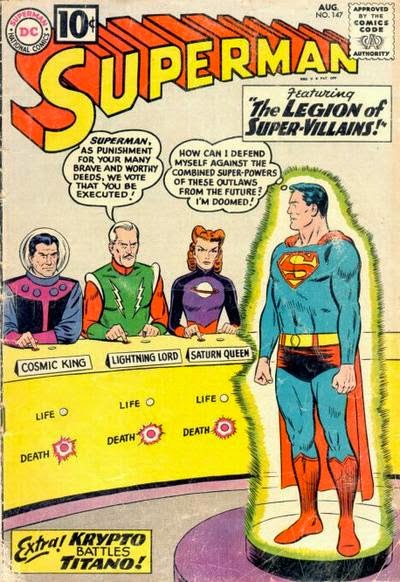
Since this post is part of my series on 147th issues, I'm going to go into a little more detail here on the final story in the book, which first appeared in Superman #147.  This is the tale which introduces the Legion of Super-Villains in a story by Superman co-creator Jerry Siegel and artists Curt Swan and Sheldon Moldoff imaginatively entitled "The Legion of Super-Villains."
The story begins with an imprisoned Lex Luthor volunteering to help out his fellow convicts by repairing their broken radios.  Clandestinely stealing parts from every unit he works on, Luthor builds a device capable of communicating with the future.  Knowing of the existence of the Legion of Super-Heroes, Luthor has reasoned that there must also be a Legion of Super-Villains to oppose them.  His attempt to contact the villainous Legion is answered by the appearance in his cell of futuristic devices which he uses to escape.  Shortly, he hooks up with the Super-Villains themselves, who proceed to introduce themselves and relate their origins.
Cosmic King is a scientist from Venus who invented a ray that could transmute matter, and who gained that power for himself after being zapped by his own ray.  Unfortunately for him, his dreams of fame and fortune are short circuited when he learns that transmutation is considered a great evil on Venus and he is subsequently banished from his homeworld, leading him to journey to Earth and take up a life of crime.
Lightning Lord is the brother of Legionnaire Lightning Man, formerly Lightning Lad.  He relates a slightly different version of the incident which gave him and his brother powers which does not include any mention of their sister, whose first appearance as Lightning Lass was still two years in the future as of this story's initial publication.  A footnote added for this reprint observes that "Lightning Lord hasn't told the full truth," and directs the reader to "See the first story in this magazine."  Well, of course he's lying. He IS a super-villain, after all, and therefore EEEE-VIL.
Saturn Queen comes from Saturn, where there is no crime.  Upon arriving on Earth, however, she suddenly felt compelled to use her powers of super-hypnotism to become a criminal.
The evil Legionnaires lure Superman to a planet in another solar system and trap him in a Kryptonite force field.  Luthor is prepared to execute his archenemy when the adult version of Superman's former teenage pals in the Legion of Super-Heroes arrive.
The two Legions battle to a stand off until Superman tricks Luthor into releasing him from the force field, after which he journeys to Saturn and uses a giant shovel gather material from Saturn's rings and encircle the planet where he had been imprisoned with it.  Apparently it is radiation in the rings of Saturn that affects the minds of its citizens and keeps the world free of crime.  Under the influence of Superman's newly created ring around this planet, Saturn Queen turns against her comrades, tipping the balance of power and winning the battle for the good guys.  The good Legion take their evil counterparts back to future and Superman returns Luthor to his cell on Earth.
While I'm reluctant to criticize the work of one of the men who invented the entire super-hero genre and without whom I would not be writing this blog, I have to say that the level of imagination reflected in the rather bland title of the story is, unfortunately, on display throughout the entire eleven pages of the story.  It is a rather pedestrian and unremarkable tale, aside from its importance in Legion history. 

Monday, January 13, 2014

Gutter Talk's 2nd Annual, Rather Quite Late, Year In Review Post

[Before we proceed any further, it is my bloggerly (like that word? I just made it up just now) duty to inform you that the sections of this post concerning Doctor Who contain spoilers pertaining to the recent fiftieth anniversary special.  If you've not yet seen it, proceed at your own peril.]
You might be wondering why my 2013 Year In Review post is so late, coming as it does nearly 1/26 of the way through the New Year.  The first and most important answer to that is quite simply that I am lazy and I tend to procrastinate.  
My lack of ambition notwithstanding, nonetheless I have always preferred, on my various blogs over the years, to put off doing my Year In Reviews until the year is actually over.  You never know when some earth shattering, game changing bit of news is going to occur on New Year's Eve, leaving all the other  bloggers who wrapped up their post mortem on the year the week before Christmas slapping their foreheads and making Homer Simpson noises.  To be sure, that didn't happen in  2013, but one of these years it will and I shall be hailed far and wide as prescient and a visionary.
Enough preamble, on, at last, to the business at hand:
On a personal note, I did somewhat better at keeping up the blog in the year past, with 88 posts compared to a mere 58 in the twelve months previous.  However, as is my typical pattern, I sort of slacked off in the latter half of the year.
Since September, my contributions to this blog have mostly been limited to my weekly reviews of Star Trek: The Animated Series.  These have turned out to be some of my most popular and well received posts, so you can rest assured that I shall, as promised, be resuming the series with the second season of six episodes come September.  Its perhaps worth noting that, other than my observance of it here, the fortieth anniversary of the debut of the animated version of Trek went largely unheralded by fandom.  On the other hand, I am fairly certain that such shall by no means be the case in two years when the original series reaches its fiftieth anniversary year.  
One anniversary that did not slip by unnoticed by fandom was the fiftieth anniversary of Doctor Who's debut on November 23, 1963.  I feel that the anniversary episode, "The Day of the Doctor," was one of the best Who episodes since Series 5, which I consider the best of Stephen Moffatt's term as show runner.  The only real flaw in the episode is that I feel that Moffatt dropped the Zygon invasion plot about five minutes too soon, just short of an actual satisfying resolution.  Of course, the Zygons were not the point of the episode.  The real point was to lay to rest once and for all the specter of the Time War and to absolve the Doctor of his guilt for the supposed destruction of Gallifrey.  Retroactively making it so that Gallifrey was never really destroyed may seem to some a bit of a cop-out, but Moffat pulled it off in an emotionally satisfying manner and without contradicting anything that the series has established in the eight years since its return to the airwaves in 2005.  
The year in Doctor Who not only saw the end of Matt Smith's reign as the Doctor, but gave not just one, but three regenerations, and all within the space of little more than a month.  The on-line short "The Night of the Doctor" brought back eighth Doctor Paul McGann to show his transformation into John Hurt's "War Doctor"; the anniversary special ended with Hurt turning into the ninth Doctor; and, of course, there was the the Christmas special, featuring Peter Capaldi's first appearance as the Doctor, or his second if count his brief cameo, in extremely extreme close up, in "The Day of the Doctor."
Turning, finally, to the ostensible niche of this blog, the world of comics, it would appear that my powers of prognostication are perhaps not as prodigioous as I pretend. That bit of somewhat strained alliteration refers to the fact that in my previous Year In Review post, I forecast that when I sat down to write the post that you are reading right now I would be reporting the demise, sometime during the previous year, of DC's creator owned, mature readers imprint Vertigo after two decades of existence.  Unheeding of how it my affect my self-esteem, it turns out that the venerable imprint is  still chugging along.  However, it was announced a few weeks ago that the line will soon be losing its latest flagship title.  Bill Willingham's popular and long running Fables is due to cease publication with its 150th issue, due to appear on comic store shelves in just over a year. 
Meanwhile, a prediction that I ventured to make back in 2012 has, indeed, proven accurate.  Dark Horse's license to produce comics based on the Star Wars franchise is set to  expire in the upcoming year, and it has recently been announced that Lucasfilm's new owners, the Walt Disney Corporation, which also, not coincidentally, happens to own its own comics publisher, will be, as I foretold at the time of Disney's aquisition of the Star Wars property,  shifting the Star Wars license back to its original home at Marvel Comics.  Of course, you don't have to be Nostrodamus to realize that it makes more sense for Disney to produce Star Wars comics in-house if they, as they, in fact, do, have the means.
The past year saw the deaths of a trio of notable artists of the Silver Age of comics.  
Carmine Infantino's passing I noted when it occurred this April past.
Veteran Superman artist Al Plastino, who expired in November, had recently been in the news due to a legal conflict over some original artwork from a 1963 Superman story that he had wished, at the time, to be donated to the John F. Kennedy Library, but which, obviously, never ended up there.
To my mind, Plastino will always be the artist who was called in to "fix" Jack Kirby's Superman and Jimmy Olson faces during the King's run on Superman's Pal: Jimmy Olsen in order to bring them more in line with the look of the other Superman titles.  I also was somewhat surprised to learn when I read Schulz and Peanuts, David Michaelis' biography of the Charlie Brown's creator, that, back in 1978, Plastino had been in line to take over Peanuts if contract renewal negotiations between Schulz and his syndicate went sour.  It is my understanding that Plastino actually worked up about six weeks worth of Peanuts strips, just in case.  I've never seen them, but I've heard that they were fairly awful.
In November, the comics world also bade farewell to Nicholas Viscardy, better known to fans of his artwork on Aquaman, Teen Titans and The Brave and the Bold, among other titles, not to mention countless DC covers during the 1970's, as Nick Cardy.
Finally, speaking, as I was earlier, of anniversaries, I cannot believe that, being the huge fan of the Doom Patrol that I am, I failed to realize, and thus to mark the occasion on this blog, that 2013 had been the fiftieth anniversary of the team's debut in My Greatest Adventure #80, cover dated June 1963--which, of course, means it may have been on newsstands as early as March. In belated recognition of this milestone, I refer you now to this post from the very earliest days of this blog detailing the publication history of the Doom Patrol series around the time of the debut of the title's most recent incarnation, as well as all of the other posts I have composed about the team over the life of this blog.

Monday, September 9, 2013

Superman #200: "Hey! Look At How Different We're Being!"

After I reviewed Superman #300 for my 300th post on this blog, I decided, since I own every centennial issue of Superman/The Adventures of Superman with the exception of #100, which I plan on buying just as soon as I win the lottery, to make that sort of thing a tradition here.  Thus, for the 400th post, I'll look at Superman #400 and so on.  As I arrived at this brainstorm too late to cover Superman #200 in my 200th post, I'll take a look at that one right now here in post #350.
The first challenge in writing about this issue is telling you that, as was the custom with Superman anniversary issues prior to the Byrne revamp, it contains what used to be called an "imaginary story" while resisting the almost overwhelming urge to quote Alan Moore. (And now I don't have to.  I'm willing to bet that most of you are now doing it for yourselves, my referring to it having called to mind the very quote I'm talking about.)  When comics fans and historians discuss the great Superman imaginary stories of the Silver Age, bandying about such titles as "The Death of Superman" and "The Amazing Story of Superman Red and Superman Blue,"  this issue's tale, "Super-Brother Against Super-Brother," written by Cary Bates and drawn by Wayne Boring, never comes up in the conversation.  As you'll see, there is a reason for that.
The story begins like the traditional origin of Superman, with Kryptonian scientist Jor-El, having determined that the planet Krypton is soon to explode, feverishly working to complete the rocket ship that will carry his young son Kal-El to safety.  His plans are interrupted by the arrival of Brainiac, who shrinks Jor-El's home city of Kryptonopolis and places inside a bottle.  The living computer has done this in order to save the city from Krypton's imminent destruction.  Before he can shrink the rest of Krypton's cities, however, the danged planet goes and blows up.
Unfortunately, Brainiac's plans to enlarge Kryptonopolis on a new planet are scuttled by the fact that the only known supply of ZN-4, the rare element needed to enable him to enlarge living beings, has been exhausted.  Thus, he wanders about the galaxy for years looking for a new supply.
Meanwhile, life goes on in Kryptonopolis, and the Els have a second son, Knor-El.  The two brothers grow up and Kal becomes a scientist, while Knor trains to go into law enforcement.
Eventually, Brainiac finds some more ZN-4 and a suitable planet to enlarge Kryptonopolis upon.  Before he can do so a stray meteor collides with his ship, forcing him to crash on Earth, but not before safely depositing the bottle city on the ground.
Surveying their new home on their viewscreens, the Kryptonians notice that, in Jor-El's words, "Earth is overrun with crime."  Soon, Jor discovers that Brainiac managed to teleport to holding tanks in Kryptonopolis just enough ZN-4 to enlarge one person.  He further realizes that the yellow sun and weaker gravity of Earth would make grant superpowers to any Kryptonian who ventured outside the bottle.  Therefore, he sponsors a competition among the city's young men to determine who will get to be Earth's Superman and aid the humans in their war on crime.
Knor-El wins, and takes a job at the Daily Planet under the name of Ken Clarkson so that he will know when Superman is needed.  Soon, aliens come to Earth with conquest on their minds and expose Knor to Kryptonite, seemingly killing him. After Jor-El loses contact with Knor on his video monitor, Kal, reasoning that his brother is danger, uses synthetic ZN-4 that he has made to enlarge himself and go outside the bottle to save Knor.  The aliens use their green Kryptonite on Kal, but instead of killing him, it turns him into a giant, because, for no good, the green K in this imaginary story has the unpredictable effects of red K in the "real" Superman stories.  So, Knor isn't dead after all, just in temporary suspended animation, and he revives in time to help Kal dispose of the aliens.
The story ends with Knor continuing his career as Superman in Metropolis, while Kal moves to Quebec, takes a job at the Montreal Star as reporter Charles LeBlanc, and protects Canada under the name of Hyperman.
Throughout the story, Bates has an annoying habit of exaggeratedly pointing out the obvious changes he has made to the traditional Superman mythos for this imaginary tale, as if we couldn't see them for ourselves.  For example: "Yes, in this story, it is Kryptonopolis, not Kandor, which is stolen by Brainiac!" or "Another surprise! In this imaginary saga, Brainiac is not a diabolical villain, but a life-saving hero!" or, most egregiously, "And so, in this tale, it not Kal-El, but his brother Knor,  who becomes Superman!"  Thanks for clearing that up, Cary, since the image in that same panel of Knor-El wearing the Superman costume kind of left things a little vague.
Aside from Bates talking down to the reader, there are more important reasons why this issue isn't on a par with the classic imaginary stories cited above.  The changes to the legend of Superman that Bates so painstakingly points out seem random and made simply for the sake of being different.  Furthermore, the story offers no fresh perspectives or insight into the character and legend of Superman.   Even worse than that, its kind of dull and predictable, despite Bates' labored efforts to surprise the reader.
Finally, the ending of the story is just plain odd.  Out of nowhere, a caption in the final panel, which shows Kal-El as Hyperman soaring over the Quebec skyline, informs us, "As we celebrate our 200th issue, Canada is celebrating its 100th anniversary as a United Federation.  This is our tribute to our neighbor to the north.---Ed."
What's odd about it is that the country the issue is supposedly paying tribute to isn't even mentioned in the story until the bottom half of the final page.  In fact, the whole issue turning out to have been a salute to Canada is the only real surprise Bates delivers in the entire story.

Wednesday, September 4, 2013

Quarter Bin Finds: The Owl #1

While pawing through the quarter boxes in the comics area of the North High Street branch of Half Price Books here in Columbus, Ohio recently, I discovered, hidden amidst cast offs from the worst excesses of the 1990s and good size runs from several excellent but criminally under appreciated series of the late 1980s (Hawkworld, Suicide Squad, William Messner-Loebs' run on Flash), a battered and aged copy of Gold Key's The Owl #1 from 1967.  Curious, and almost always willing to gamble a quarter on a totally unknown property, I tossed it onto to my buy pile, figuring that, if nothing else, it would be good for a post here on this blog.
A caption on the splash page touts this comic as the long awaited revival of a hero from what was already being referred to as the Golden Age of Comics.  At first, cynic that I am, I figured this for some sort of put on.  Having never heard of a Golden Age character called the Owl, I thought it possible that Gold Key had created a new character out of whole cloth and were attempting to pass him off as a Golden Age revival, similar to what Marvel tried to do with the Sentry a decade or so ago. 
Of course, I wasn't alive and buying comics back in the 1940s, and just because I've never heard of something doesn't mean it never existed. (Hell, I've probably never heard of most of you reading this piece, but you exist, right?)  So, I did some research and apparently the editors at Gold Key were not quite as clever, or cynical, depending on your perspective, as I would have given them credit for being. There was indeed a Golden Age Owl, one of the few non-licensed properties published by Dell Comics, who enjoyed a brief run during the early 40s.  However, I think the overwhelming demand for the character's return cited in the caption was most likely, at the very least, a bit of an exaggeration.
The creation of an artist by the name of Frank Thomas, the Owl debuted in Crackajack Funnies #25. He was secretly police detective Nick Terry, who, feeling hampered in his efforts to dispense justice to criminals by such trivialities as the law, adopted his costumed identity to allow him to deal with crime his way. As was the fashion in those days, he soon acquired a partner in crime fighting.  In this case, it was his fiancee assuming the costumed nom de guerre of Owl Girl.  When Crackajack ceased publication with #43, the Owl moved over to Popular Comics for a brief run beginning with #72 and concluding with #83, cover dated March 1943.  After that, it was nearly a quarter century before the character was heard from again.
By 1967, the popularity of the Batman TV series had made super-heroes briefly fashionable again, and every publisher of comics was looking for a way to cash in on the fad.  Thus, Gold Key, which by this time had inherited most of the Dell Comics properties, decided the time was ripe to bring back the Owl.  The series was written by none other than Superman co-creator Jerry Siegal and drawn by Tom Gill, an artist apparently best known for his Western comics, most notably The Lone Ranger.
The revived series transported the Owl into the late 1960's with no attempt made at explaining where he'd been for the last two and a half decades or why he hadn't seemed to have aged.  The only major change made to the concept seems to have been the changing of Owl Girl's secret ID from Belle Wayne to Laura Holt.  I can only guess at the reason for this, but perhaps it was because of the similarity of her original name to that of Batman's alter ego, Bruce Wayne.  It happens, by the way, that Laura Holt was also the name of the character played by Stephanie Zimbalist in the TV series Remington Steele two decades later.  This is likely just coincidence, as  there are no other similarities between the two characters.
The first issue's story, "The Attack of the Diabolical Birdmen," pits the Owl and Owl Girl against the Birds of Prey Gang, a group of criminals who wear bird mask, call themselves by the names of birds, and, of course, commit bird themed crimes.   With a solid, entertaining script by Siegel that emphasizes plot over characterization, this is a pretty typical Silver Age super-hero story.  In fact, its actually one of the better examples of the genre from that era.  Despite riding Batman's coattails, Siegel doesn't go overboard in aping that show's "camp" humor.  There is a series of weak bird related puns from the villains, but those are kept to near minimum.  Gill's art tells the story effectively and has a slight Golden Age feel, perhaps appropriate for the revival of a 1940's hero.
Despite its charms, The Owl #1 apparently failed to set the world on fire.  The second, and final, issue would not appear for another year.   After that,  with the exception of a one issue appearance in a 1976 issue of The Occult Files of Doctor Spektor, it was back to comic book limbo for the Owl and Owl Girl...
....Until a couple of months ago.  In July, Dynamite released a new The Owl #1 set in its Project: Superpowers universe.  Out of curiousity, I went and picked up a copy, despite it having been written by my least favorite comics writer ever, J.T. Krul, and a review shall be forthcoming. 

Friday, April 5, 2013

Carmine Infantino (1925-2013)

I'd been outside smoking and returned to my apartment to hear Carmine Infantino being talked about on All Things Considered.  Unfortunately, it turned out that the reason Infantino was being mentioned on the NPR news program is that he died yesterday at the age of 87.
Born in 1925, Infantino began working in the comics industry while still in high school.  His greatest impact came in the 1950s through to the 70s.  In 1956, he co-created with writer Robert Kanigher a new version of the DC's moribund super-hero The Flash.  The revamped character's debut in Showcase #4 is widely considered the event which initiated the Silver Age.  
When the Flash was given his own title soon after, Infantino continued delineating the speedster's adventures until 1967.  Late in his career, he would return to illustrate the final five years of the Flash's comic.  Overall,  between his two stints on the title, Infantino ended up drawing fully half of the character's Silver and Bronze Age adventures.
Infantino's first go-round on Flash ended when he got "kicked upstairs" in 1967,  becoming first DC's first artistic director, then editorial director and finally publisher.  He stepped down as publisher in 1976 and returned to freelancing.
It was as editorial director in 1970 that Infantino helped to bring to a close the very Silver Age he had kicked off with the first Flash story  when he lured Jack Kirby away from Marvel over to DC to create his Fourth World titles.  Many people, myself among them, consider Kirby's defection to signal the beginning of the Bronze Age.
In addition to The Flash, Infantino is best known for drawing Adam Strange and the Elongated Man, initiating the "New Look" Batman in the mid-60s, and a run on Marvel's Star Wars comic.  He also drew the very first Deadman story.
A more complete account of Infantino's career and a full list of his artistic credits can be found at the Comic Book Database.

Tuesday, January 15, 2013

Stuff I'll Probably Be Throwing My Money Away On Next Month

Last week I wrote that I'll probably be picking up Before Watchmen: Dollar Bill in February to see how Len Wein and Steve Rude flesh out the story of one of the more minor characters from Watchmen.  Well, while preparing for that post, I took a peek at what else DC was offering up for sale next month, and I thought I'd share with you some preliminary impressions of a couple of items that will most likely be finding themselves a home in my comics boxes or on my bookshelves.  
Another book that I've written about previously that I'm planning to get is Hellblazer #300, which brings to a close the Vertigo imprint's longest running title and last remaining of the six existing books that formed the original core of the line on its launch in 1993.  As I've speculated on numerous previous occasions, the loss of the adventures of John Constantine to mainstream New 52 line combined with the forthcoming resignation of founding editor Karen Berger seem to bode ill for the future of Vertigo.
Then there are the two ongoing comics that I have been purchasing regularly since their debuts eighteen and ten months ago, respectively.  The first is Action Comics, though #17 may be the last issue of that title for me, as it marks the end of the story line begun by Grant Morrison in #1 and the writers departure from the title.  I've only read one comic by incoming writer Andy Diggle, but I did like it, so maybe I'll give his run a couple of issues to see how it goes.  That's a decision I'll put off until March, however.
Next up is Earth 2.  While the book hasn't been quite as good since the plot actually kicked in as it was for the first couple issues when writer James Robinson was setting up his alternate world and introducing the major and minor characters, its still one of the best super-hero comics I've read from DC in quite some time.  This issue also promises the introduction of the New 52 version of Dr. Fate, which I'm sort of curious to see.
I have made no secret on this blog of my longstanding and slightly unnatural love for Oliver Queen, a.k.a. the Green Arrow.  Because of this, I desperately want the character's eponymous monthly comic to be good.  However, in its New 52 incarnation, the closest Green Arrow has come to anything that I might want to read on a sustained basis were the three issues written by Keith Giffen and Dan Jurgens.  DC, I'm sure, wants Green Arrow to be worth reading as well, which is the best spin I can put on the fact that in February the book is getting its fifth creative team in the year and a half since the New 52 relaunch.  
The new writer is Jeff Lemire.  I've not read anything he's written previous, but I've yet to find a reviewer who's had anything all that bad to say about any of it.  As I did with Ann Nocenti before him, I plan to give Lemire one story line to impress me.  
Another reason I'll be picking up up Green Arrow #17 is that I'm somewhat intrigued by the the actual text of the solicitation, which reads:
"As Ollie struggles to come to terms with the loss of his fortune, his company and his heritage, he discovers a shocking truth about his father that ties to his time stranded on an island before he became Green Arrow."
The second part of that sentence seems to indicate that Lemire, most likely at the direction of DC management, is planning to move the book in a direction more in line with the story of the CW's TV series Arrow.  I have mixed feelings about that, as, while the show is not really bad at all, I'm not overly fond of it, however, if DC really wants fans of the series to sample the comics, then I suppose its not such a dumb move.  
It's the first part of the description that has really piqued my interest, though.  I've always preferred poor Ollie to rich Ollie, partly because that's how I first encountered the character, but mostly because its in that era that the best Green Arrow stories were told.
Above, I mentioned having read only one comic by Andy Diggle and having liked it.  Well, that comic was Green Arrow: Year One.  Based on that mini-series, I'm thinking that once Lemire moves on, and given this books track record that will probably happen sooner than later, DC should give Diggle a shot at writing GA's exploits on a regular basis.  While I liked Year One, at the time I read it I sort of consigned it to an alternate history or something like that, despite it being the new "official" version of GA's history, because I couldn't quite see the Oliver Queen depicted therein becoming the character I'd been reading for the past few decades.  However, I can see him becoming the New 52 Green Arrow, thus making Diggle a natural to continue his adventures in the monthly book.
Lastly, there's Crisis On Multiple Earths Volume 6, the latest in the series of trade paperback collections of the meetings of Earth One's Justice League and their counterparts in Earth Two's Justice Society that were an annual tradition in the pages of Justice League of America from 1963 until 1985 and the merging of all of DC's alternate worlds in Crisis On Infinite Earths.  These have always been some of my favorite comics of the Silver and Bronze Ages and, quite naturally, I already possess the first five volumes in the series.  The latest edition covers the years 1981 to 1983 and includes the first of the JLA/JSA "crossovers" to actually crossover into another title, winding its way through three issues of Justice League and two issues of the World War II set JSA book All-Star Squadron, thus making it the longest of the JLA/JSA team-ups. 
Compared to amount of new comics that I buy most months, that's actually quite a long list I've compiled above, and I'm sure I'll be writing about at least one or two of them here in the future.

Tuesday, January 1, 2013

That Was The Blog That Was: A Gutter Talk Year In Review

To begin with, let me say that 2012 was not a good year for this blog.  I managed a mere 58 posts during the previous 52 weeks. (Compare that to October 2010, when I managed nearly that number in just one month) I shall try to do better in the new 12 month cycle, but I'm making no promises.  Still, there were some happenings in the world of comics that managed to break through my lethargy and compel me to go to the keyboard and share my special brand of ill-considered analysis with the world at large, or at least my couple of dozen regular  readers.  Below are recaps of some of the more interesting developments of the 366 days just gone by.
The big controversy of the year  was the debate over creators' rights inspired by DC's decision to publish Before Watchmen, a series of prequels to Alan Moore and Dave Gibbons' 1985 classic, despite Moore's objections, though Gibbons did give it his somewhat half-hearted blessing.  I wrote at length about this issue (here, here, here, here, here, and again here, although that last post is really more about my all-time favorite Superman story than it is about Before Watchmen) during the spring and early summer, and linked to Moore himself opining about it in a BBC radio interview, so there's really not much more to say about it now.
The major business story of the year, at least amongst the rank and file of geek culture, was, of course, the October announcement of the Walt Disney Company, also owners of industry leading comics publisher Marvel, aquiring Lucasfilm and the rights to the Star Wars franchise, accompanied by the promise of a new installment in the film series to come in 2015.  You can read my first impressions of the news here.
DC's Public Relations shop showed more creativity and energy than is on display in many of the comics themselves as they managed to drum up a fair amount of unwarranted mainstream media hype over minor developments in a couple of those comics.  First came the announcement that one of the company's "iconic" characters, eventually revealed to be original Green Lantern Alan Scott (leading to much speculation about what exactly DC thinks "iconic" actually means), was to revealed to be gay in the 2nd issue of Earth 2. Even more mystifying was how the publisher's flaks somehow got respectable news outlets to cover Clark Kent quitting his job as a reporter for the Daily Planet in a fairly undramatic scene from Superman #13.  At least in the case of Earth 2, there was a decent story behind all the hype, though not so much with the Superman tale.
Meanwhile, it appears that the writing is on the wall for DC's two decade old Vertigo imprint.  First came the announcement that the imprint's longest running title, Hellblazer, will come to an end with its 300th issue in February with the book's lead character, John Constantine, reappearing the following month in a new series set in the mainstream New 52 DC Universe.  Coming quickly of this news was word of Vertigo founding editor Karen Berger's decision to step down as head of the imprint as of March.  Furthermore, I have heard from a semi-reliable source that Vertigo is no longer entertaining proposals for new projects and has canceled some others already commissioned.  Given all these developments, it seems that one of the big stories in next year's year in review post will be the news of the demise of DC's venerable mature readers line.
While I lamented the passing of science fiction legend Ray Bradbury in June, one death that I failed to note was that of Golden Age veteran Sheldon Moldoff, who died on Superman's birthday, February 29.  This is sort of fitting, given that he was the last surviving contributor to the first Action Comics #1, the issue that introduced the Man of Steel and jumpstarted the entire comics industry.  However, he was, perhaps ironically, best known as a ghost artist, illustrating numerous Batman stories appearing under the mass-produced signature of Batman co-creator Bob Kane. Among the classic tales of the Caped Crusader which Moldoff delineated were "The First Batman" from Detective Comics #235, in which the discovery of an old Halloween costume worn by Bruce Wayne's father ultimately leads to the capture of Lew Moxon, the mobster who hired Joe Chill to kill Thomas Wayne for daring to testify against him, and Batman #156's "Robin Dies At Dawn", one of the most awesomely bizarre Batman stories ever, which has Batman deciding to hang up his cape and cowl after he is nearly killed by bank robbers wearing gorilla suits because he's hallucinating as a result of having participated in a top secret government experiment. Seriously, bank robbers dressed as gorillas would be enough to make this story a classic, but this story isn't even about them.  They're just one random element of weirdness in a stew of mind-boggling madness.  As an added bonus, there's even an appearance by Ace, the Bat-Hound.  
That's pretty much what stuck in my mind as I looked back over the comics news of the past year.  Let's now look forward to the surprises that 2013 has in store for us, shall we?

Friday, November 2, 2012

Stan Lee's TOP 5 "Amazing Spider-Man" Story Titles

(I shall be honest here and admit that this is pretty much just a quick post put up mostly just to be posting something, as I've been on a bit of a streak lately and I'd like to try and keep it up as long as possible.  I'll take some time tomorrow and provide some more of the in-depth analysis and perspicacious prose you've come to expect of me in my next post.)
Perhaps Stan Lee's most overlooked talent was his ability to come up with attention grabbing and memorable titles for his little tales of super-heroic adventure, which ranged from the terrifically tongue-in-cheek ("Never Step On A Scorpion" or "You Think It's Easy to Dream Up Titles Like This?" from Amazing Spider-Man #29) to the magnificently melodramatic ("If This Be My Destiny...!" from ASM #31 and "O, Bitter Victory!" from ASM #60).   Below is a list of my five personal favorite story names from Lee's 105 issue run on Amazing Spider-Man:

5.
"Bring Back My Goblin To Me!"
(Amazing Spider-Man #27)


4.
"The Tentacles and the Trap!"
(Amazing Spider-Man #54)


3.
"If This Be Bedlam!"
(Amazing Spider-Man #74


2.
"The Molten Man Regrets...!
(Amazing Spider-Man #35)


1.
"How Green Was My Goblin!"
(Amazing Spider-Man #39)
 

It seems that the Green Goblin really got Stan's creative juices flowing, at least when it came to campy and creative story titles. 
Someday soon, I'll have to do a similar list covering Lee's run on Fantastic Four.

Sunday, October 2, 2011

'Tec Support: "The Million Dollar Debut of Batgirl!" (Focus On Batgirl)

Created by a trio of comics legends, editor Julius Schwartz, writer Gardner Fox and artist Carmine Infantino, at the behest of Batman TV series producer William Dozier, who was looking for a female character to appeal to that segment of the TV audience, the new--and "real", as we're told in a caption--Batgirl (there had been a previous character called Bat-Girl in the late 50's and early 60's) met the comics reading public in the January 1967 issue of Detective Comics, #359, in a story entitled "The Million Dollar Debut of Batgirl!"   The introduction of Batgirl, incidentally, was not the first change made in the comics to accomodate the TV series.  One of Schwartz's first moves on assuming editorship of the Batman books was to kill off Bruce Wayne's butler, Alfred.  However, he and Fox were compelled to bring the character back to life when the producers wanted to include him in the show.
The story moves quickly, giving us just a two panel introduction to Barbara Gordon, the previously unseen and unmentioned librarian daughter of Gotham City Police Commissioner James Gordon, before she dons her Batgirl costume and is off to the Policeman's Masqerade Ball.  Setting off  for the ball, Barbara thinks that "...tonight will be the highlight of my life!"  She's right, of course, but not quite in the way she was thinking of.  A funny thing happens on the way to the party, when she sees Killer Moth's minions attempting to put the snatch on "...Daddy's millionaire friend" Bruce Wayne.  Proving that "clothes make the woman," she leaps into action to save Wayne, allowing the millionaire to slip away and change to Batman.  The Caped Crusader ends up having to rescue Batgirl while Killer Moth escapes. Her costume messed up in the fight, Batgirl tells Batman she won't be going to the masqerade after all, but holds back on telling him her name, despite thinking to herself that this might be both Batgirl's "...debut and farewell appearance..."
She soon finds, however, that after her brush with crimefighting, the fast paced life of the librarian just doesn't thrill her the way it used to.  Then one night, Barbara goes to deliver a rare book to Bruce Wayne and sees him apparently murdered by Killer Moth.  She once again goes into action as Batgirl, but soon learns that her interference has spoiled the Dynamic Duo's plans to follow Killer Moth back to his hideout.  Nonetheless, it turns out, somewhat predictably, I'll admit, that despite her initial blunder, it is Batgirl whose nick of time arrival at Killer Moth's lair serves to save Batman and Robin's bacon and capture the villain.
If, as the conventional wisdom among comics fans holds, the intentionally campy tone of the TV series had infected the comics, it is not much in evidence in this issue.  True, Killer Moth, with his themed henchmen Larva and Pupa, is a silly villain, and Robin spouts a couple of truly dreadful puns, while, at one point, daring to criticize Batgirl's "terrible puns."  For the most part, however, "The Million Dollar Debut of Batgirl!" is a fairly straightforward, serious minded adventure story, thanks to Fox's fast-paced and witty script and Infantino's suitably dark and moody artwork.
Quite a few of the "important" stories of the Silver Age--the first appearance of the Teen Titans springs to mind--are worth reading only for their significance to comics history.  Detective #359 is not one of those issues, though.  "The Million Dollar Debut of Batgirl!" stands on its own, aside from its place in history, as an entertaining and fun Batman story.
In a future post, I'll take a look at Batgirl's second first appearance, in the third season premiere of the Batman TV show.

Monday, March 28, 2011

The Uncollected: Green Arrow

I'm going to kick off this overview of Green Arrow stories that have yet to be reprinted in trade paperback with a round up of what has been collected so far.  There's actually quite a bit available in TPB or hardcover, representing a significant chunk of the character's history.  There remain, however, many glaring omissions.
Green Arrow's Silver Age adventures, beginning in 1958 with the first story drawn by Jack Kirby and continuing on  through the landmark The Brave and the Bold #85, which introduced GA's goatee and new Neal Adams designed costume, are gathered together in one hefty volume as Showcase Presents the Green Arrow.  In addition, the Kirby drawn tales are presented in full color in the slim and affordable volume The Green Arrow by Jack Kirby. 
In keeping with the current industry practice of rushing out a collected edition almost as soon as the last chapter of a story line or mini-series hits the stands, Green Arrow's most recent exploits, beginning with his resurrection by Kevin Smith in the "Quiver" story line, are all available in book form.  This includes the latest retelling of his origin by Andy Diggle and Jock in Green Arrow: Year One.  A collection of the first half dozen issues of the currently ongoing series is due out in the next couple of months. 
Most of the "important" Green Arrow stories, that is the ones that are essential reading for an understanding of the character as he exists today, have been reprinted in at least one edition over the years.  These include B&B  #85, Justice League of America #75, in which he lost his fortune, and the acclaimed Dennis O'Neil/Neal Adams run on Green Lantern.
I would guess that Green Lantern #76, the first issue of the O'Neil/ Adams series, would be near the top of any list of most reprinted comic issues ever.  I have owned at least three different editions of the story in various forms over the course of my comics reading and collecting career.  These have included a mass market paperback reprinting issues #76 and #77, the two volume Hard Traveling Heroes trade paperback series, and the hardcover edition of The Greatest Team-Up Stories Ever Told.   Other reprintings include the first issue of the 1983 deluxe format mini-series that presented the entire O'Neil/Adams run, a slipcased hardcover edition of those issues in 2000, another TPB collection in 2004, and issues of the Silver Age Classics and Millennium Edition series which re-presented landmark issues from DC Comics' history.
The story is due to be reprinted yet again next month, leading off Showcase Presents Green Lantern Volume 5.   This volume will present the entire O'Neil/Adams run, after which the title was canceled; pick up with the series' revival in 1976 which carried on the series' original numbering from #90 with Green Arrow still sharing cover billing; and continue on to #100.  When, or if, there is a sixth volume in this series, GA will be a major part of that tome as well, as Hal Jordan did not regain his status as solo star of his own book until #123.
The major exceptions to the reprinting of milestone story lines are the 1983 mini-series by Mike W. Barr and Trevor Von Eeden and the story in which Oliver Queen was killed.  The mini-series doesn't make any significant changes to the character's status quo, and is mostly notable for being the first comic book actually titled Green Arrow, appearing some forty years after the character's debut.  Still, it's a fun and entertaining superhero mystery story that certainly deserves to be represented for new readers.  The actual issue in which Ollie gets blown up by terrorists is included in Green Arrow/Black Canary: For Better or For Worse, but the story line as a whole has yet to be collected.
In fact, while The Longbow Hunters has long been available in trade paperback, the ongoing series that followed it remains out of print, except for a couple of issues included in For Better or For Worse and a team-up of Connor Hawke and Kyle Rayner included in a Green Lantern collection.  This includes not only the 80 issues written by Mike Grell, but the post Grell issues drawn by Jim Aparo as well as Connor Hawke's entire tenure as Green Arrow.  Two other Green Arrow mini-series written by Grell, The Brave and the Bold Volume 2 and Green Arrow: The Wonder Year are also MIA.
While I  believe, although I've never actually seen it, that there is an Archives edition of Golden Age Green Arrow stories, it is, if it even exists, only one volume.  The majority of pre-1958 GA stories are available only to those willing to pay the undoubtedly sky high price of the original issues.  
While the upcoming release of Showcase Presents Green Lantern Volume 5 is a good start, the bulk of Green Arrow's Bronze Age adventures remain in reprint limbo.  This includes not only the remainder of his stint as Green Lantern's co-star, but also the back up stories from Action Comics, World's Finest Comics and Detective Comics.  The major exception to this, as I noted last week, is "Night Olympics" from Detective Comics #'s 449 and 450, which, while fairly unspectacular, has merited  several reprintings mostly due to the fact that it was written by Alan Moore.
Among the Action Comics stories are Mike Grell's first work on the character, which you would think would rate reprinting on that basis alone.  I'm sure however, though I've not read them, that they're good stories in their own right, as they were written by Elliot S! Maggin.
Nonetheless, despite the significant omissions noted here, which I hope will one be rectified, there's still plenty of  stories available in collected editions for the Green Arrow fan.  

Friday, March 25, 2011

The Past Ain't What It Used T'Be: The Evolving Origin of Green Arrow (Part One)

(NOTE: This look at the changes in Green Arrow's origin stories is another of those long rambling posts covering several decades of comics history that I have a tendency to write when I've got too much time on my hands and nothing better to do.  Thus, I shall be dividing it into two parts.)
It's a bit of a cliche to speak of super  hero comics as modern mythology, but you know what they say about why cliches are cliches.  Central to  any hero's myth is his origin story.  Like the myths and legends of old, there are often many different versions of a hero's origin as is it occasionally tweaked or completely rewritten to fit the needs of the story at hand, the changing times and tastes of the readers or the approach of the current creative team to the character. 
In 1992, John Byrne, writing in his editorial column "A Flame About This High" in the letters  pages of John Byrne's Next Men #1, stated that "Origins are a fairly recent convention, as comics go."  It is certainly true that during the Golden Age of the 1940's, many super heroes leapt right into crimefighting without stopping to explain to the reader why they did so or where their powers, if they had any, came from.  Even Batman, who these days can't seem to go a single issue without flashing back to his origin, wasn't granted a backstory until several months after his initial appearance.  Many characters of this period didn't last long enough to even have an origin, disappearing after just one or two outings.   Green Arrow was one of the lucky ones.  Not only was he was popular enough with readers to stick around, but  the editors apparently considered him a sufficient drawing card to warrant his taking over the covers of More Fun Comics within months of his debut.  Still, it wasn't until 1943, nearly two years after his initial appearance, that he was finally provided with an origin.  This occurred in a story entitled "The Birth of the Battling Bowmen," the lead feature of More Fun Comics #89.
According to this version of events, Oliver Queen was a wealthy collector of Native American artifacts who, after his collection is destroyed in a museum fire, is told by a friend of a "gold mine" of such relics at a place called Lost Mesa.  Some criminals who overhear this conversation and think it is about an actual gold mine head to Lost Mesa  to get the gold before Queen can.  Living on Lost Mesa are a boy named Roy Harper and his faithful Indian companion Quoag, who had been stranded there years before after a plane crash that killed Roy's father.  After the criminal gang kills Quoag, Queen and Harper use their archery skills to defeat them.  Queen then takes Harper in as his ward and the two decide to continue fighting crime as the Green Arrow and Speedy, taking the names from remarks made by the criminals on Lost Mesa.  Prior to Crisis on Infinite Earths, this story had come to be considered the origin of the Earth-2 Green Arrow.  For all I know, it may be once again, now that the Multiverse and Earth-2 have been reinstated following Infinite Crisis and 52.
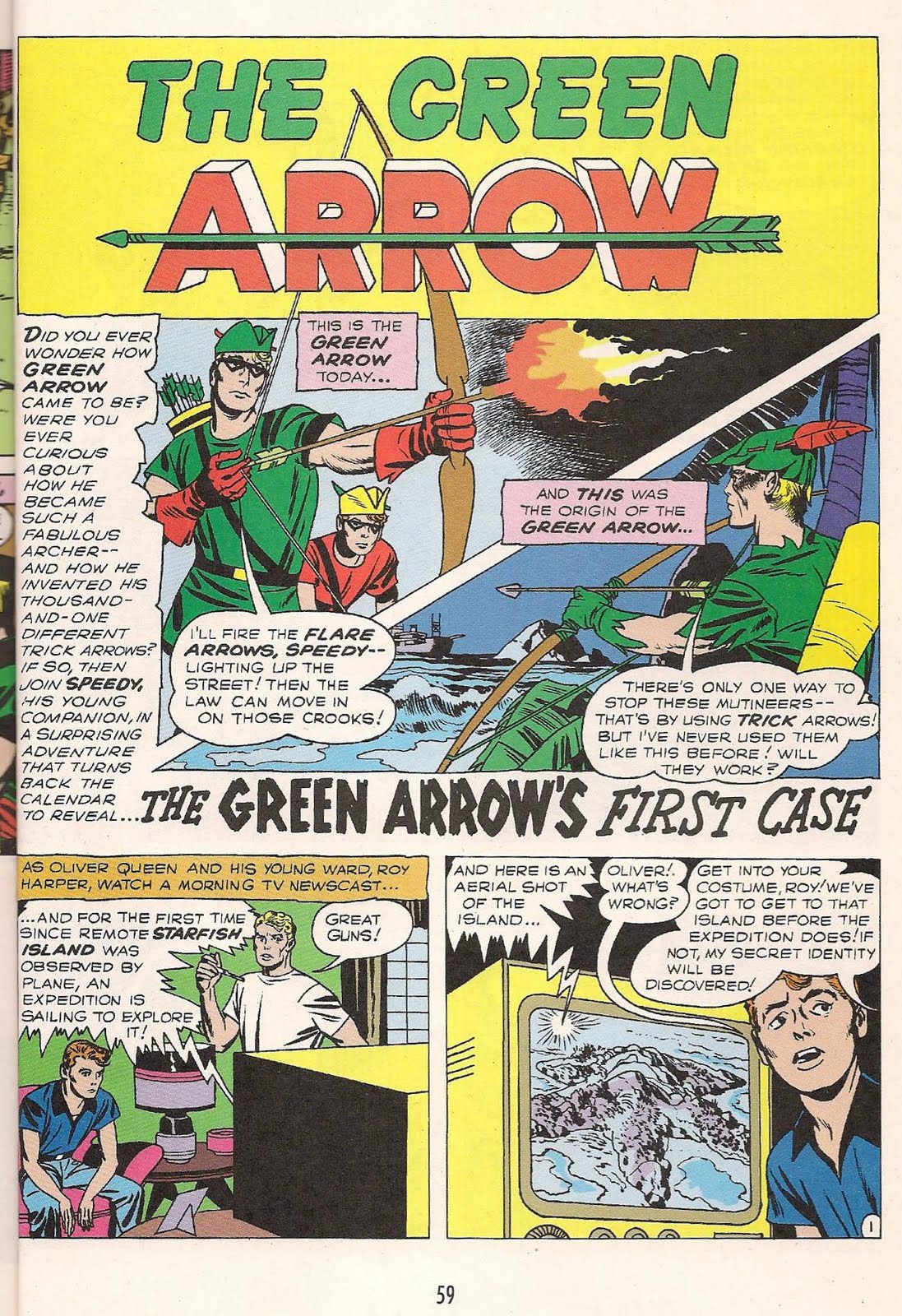
Fifteen years later, Ed Herron and Jack Kirby crafted a totally different origin story in "The Green Arrow's First Case" which appeared in Adventure Comics #256. After falling overboard during a sea voyage, millionaire Oliver Queen  washes up on Starfish Island, which, as the name implies, just happens to be shaped like a starfish for no reason that has anything to do with the story.  While stranded there, he makes a bow and teaches himself archery in order to survive, fashioning a variety of trick arrows to help him perform various tasks. Eventually,  a freighter anchors itself off shore. Swimming out to it, Oliver discovers that the crew has mutinied.  After using his archery skills and trick arrows to thwart the mutineers, Ollie hitches a ride back to civilization.  Upon his return, he continues using his new found mastery of archery to fight crime as the Green Arrow.
A revised version of this origin appeared as a part of a flashback sequence in the debut issue of Green Arrow's first ever eponymous mini-series in 1983 written by Mike W. Barr and illustrated by Trevor Von Eeden and Dick Giordano.  When his girfriend dumps him, Oliver Queen takes a cruise to help him escape the pain of his broken heart.  He gets more of an escape than he bargained for when pirates raid the ship and toss him overboard.  He eventually finds himself on a deserted island where he builds himself a bow and several trick arrows and teaches himself to shoot in order to survive.  Eventually,  the very same pirates who stranded him there come to the island to stash the loot from their latest act of piracy.  Ollie captures them using his newly developed archery skills and trick arrows.  Upon returning to civilization, Oliver decides to use these skills to fight crime in Star City as the Green Arrow.  
As you can see, Barr altered a few details from the Herron/Kirby story,  such as changing the mutineers to pirates and making them the reason for Ollie being on the island.  By the way, the  island isn't given a name in this or any of the subsequent future retellings and re-imaginings of the origin and is not depicted as having any unusual or distinctive shape.  The motivation for Ollie being on the ship in the first place is important in that the girl who broke his heart all those years ago naturally comes back into his life in the course of the mini-series. 
(That brings us to about the halfway mark of this overwrought essay, so I'm going to give my fingers a rest from typing and pick this up later.   In part two, I look at Mike Grell's take on Green Arrow's beginning and get to the current "official" version of the classic origin as related in Green Arrow: Year One.)

Saturday, March 5, 2011

Green Arrow Helps "The Cop Who Lost His Nerve"

When I posted about Showcase Presents Green Arrow, I dropped a reference to a story featuring a "stuffed cat arrow" and mentioned that it deserved a post of its own. My friend Mike Carroll, whom I encountered while I was leafing through that volume at the comic shop just prior to purchasing it, appeared to believe that this one six page story alone was reason enough to justify spending seventeen dollars on a five hundred page book.  I wouldn't go that far.  There are plenty of reasons to buy the book, many of  which I covered in my previous post.  However, it is one of the quirkiest and most original of Green Arrow's Silver Age adventures.
Originally published in World's Finest Comics #121, "The Cop Who Lost His Nerve" is the only Green Arrow story written by long time Flash and Green Lantern writer John Broome,  and is drawn, as are the bulk of the stories in the Showcase Presents volume, by Lee Elias.  Broome and Elias team to introduce us to Fred Jenkins, whom the opening caption describes as "...the top rookie on the police force--the most promising patrolman ever to walk a beat."  Later, Green Arrow recognizes him as having been "...top student at the Police Academy."  However, we are also told that Jenkins has "...a terrible secret" that threatens his future on the force.
Green Arrow and his ward Speedy first encounter Jenkins when they are summoned by the police, via the Arrow Signal, to deal with a robbery in progress.  When they arrive, they at first conclude that their super heroic services won't be needed after all, as Jenkins has apparently captured the perpetrator.  However,  Jenkins becomes paralysed with fear when a cat suddenly appears seemingly out of nowhere, allowing the thief to make a break for it. Fortunately, GA and Speedy are still on the scene to capture the crook using their boomerang arrows.  
After the Ace Archers deliver their prisoner into the hands of the authorities, Jenkins confesses his "terrible secret" to them.  As a child, Jenkins had been badly injured and almost killed in a terrible automobile accident.  Just before losing consciousness, the last sound he heard was the meowing cry of a cat.  Since that time, he has had a paralyzing fear of felines.  
Jenkins' revelation is overheard by a hood called Weasel.  Weasel takes this information to a crook named Artie who immediately begins to plan how he  can use it to his advantage.  While this is taking place, back in the Arrowcave, Green Arrow is preparing a special arrow to help Officer Jenkins.
The next night, Fred comes across some suspicious looking characters carrying a sack and loitering in front of the Sports Museum after hours.  When he questions them, they literally let the cat out of the bag.  When the rookie officer once again becomes frozen with fear, one of the thugs grabs his gun.  Just as this is occuring, GA and Speedy happen by in the Arrowcar. Suddenly, there's a loud "ME-EE-EOW" and another cat leaps out of nowhere,  knocking the gun out of the crook's hand.  Fred recovers from his paralysis, retrieves his firearm and aids Green Arrow and Speedy in capturing the gang. 
In the next to last panel, Green Arrow is shown holding what appears to be a cat with an arrow sticking out of its butt.  (...and where else but in a blog about comics would I ever get an opportunity to write a sentence like that?)  He explains that the cat which attacked the crook was actually a dummy attached to an arrrow.  The meowing was produced by a fluted arrow fired by Speedy.  GA had reasoned that the way to cure Jenkins' fear of cats was to arrange for a cat to save his life.   The logic of that sounds a little shaky to me, but it works.  The story ends with the now cured rookie petting the very cat the criminal gang had sicced on him earlier.
Now retired, former police officer Fred Jenkins lives by himself in a trailer with three dozen cats and a ferret named Speedy. 

Friday, March 4, 2011

Green Arrow Showcased

Showcase Presents Green Arrow  collects the Emerald Archer's Silver Age adventures in one five hundred thirty page black and white volume.  Beginning with the first  Green Arrow story illustrated by Jack Kirby, the book brings together stories from World's Finest and Adventure Comics with Green Arrow's early appearances in The Brave and the Bold with his initiation into the JLA in Justice League of America #4. 
We've all heard it said that prior to his revamp in B&B #85, Green Arrow was a Batman wanna-be without much of a personality.  That's true as far as it goes.  Like Bruce Wayne, Oliver Queen is a millionaire with a youthful ward who fights crime along side him.   All the faux-Bat accoutrements are on hand, as well, including the Arrow Cave, the Arrow Car, the Arrow Plane and the Arrow Signal. As far as the lack of personality goes, to be fair, most of  these stories were only eight pages long and it is hard to squeeze a complete story and characterization into that short a space.  The stories themselves tend to be formulaic and a bit repetitive.  There are two separate stories in here where GA meets a circus clown who parodies the archer in his act.  Of course, those stories were originally published several years apart and the writer probably never foresaw that they would end up collected in a book together.  
What imagination did go into these stories seems to have been mostly directed to coming with the wide array of trick arrows that Green Arrow and Speedy, and occasionally their female counterpart Miss Arrowette, use to help them catch the bad guys. There were, of course, the ubiquitous net, and handcuff arrows as well as the infamous boxing glove arrow.  Among some of the more unusual were:
  • cloud seeding arrow
  • hypnotic arrow
  • rain arrow
  • aqualung arrow
  • short circuit arrow
  • fountain pen arrow
  • two stage rocket arrow 
  • tumbleweed arrow
  • sun arrow 
  • antler arrow
  • needle arrow
  • baby rattle arrow
  • bubble gum arrow
  • chimney sweep arrow
  • salt arrow
  • inflatable Green Arrow and Speedy dummy arrows
  • combination boomerang-balloon arrow
  • cobweb arrow
  • bloodhound arrow
  • paintbrush arrow
  • anchor arrow
  • avalanche arrow
  • mummy arrow
  • 2 way radio arrow 
  • fire extinguisher arrow
  • blackout arrow
In one story, the Battlin' Bowmen take to sea equipped with an "aqua bow" and special aqua arrows that include:
  • octopus arrow
  • glowfish arrow
  • jellyfish arrow
  • electric eel arrow
Coming from Miss Arrowette's quiver are:
  • hairpin arrow
  • powder puff arrow
  • lotion arrow 
  • mirror arrow
  • hair tint arrow
  • kerchief arrow
  • hair net arrow
  • bubble bath arrow
  • nail file arrow
Then there's the stuffed cat arrow.  But that really deserves a post of its own.
In the final analysis, for what they are, which is basically short adventure stories meant to entertain kids for a few minutes, these stories really aren't bad.  They also feature some pretty good art.  After the Kirby issues, most of the stories are drawn by Lee Elias.  Elias started his cartooning career as an assistant to Milton Caniff, and the Caniff influence is clear in the characters' faces and Elias' use of shadow.  Other artists represented include original GA artist George Papp, Mike Sekowsky on the JLA issue, and Neal Adams on the groundbreaking B&B #85.
Overall, this is a volume that I would recommend to any fan of Green Arrow or Silver Age Comics in general.

Sunday, January 30, 2011

'Tec Support: Batman Meets Zatanna (Sort Of) In Detective Comics #336

I had a great idea for commemorating DC Comics' 75th anniversary.  I would spotlight selected issues of their longest running title and the comic from which the company takes its name: Detective Comics.  Unfortunately, DC's 75th anniversary was last year and I just had that idea about a week ago.  Still, that's really no reason to let a semi-decent idea go to waste, is it?  Of course not.  Thus, I'm kicking off my new feature "'Tec Support" with a look at the Batman story in Detective Comics #336, "Batman's Bewitched Nightmare",  written by Gardner Fox and drawn by Bob Kane and Joe Giella, which was reprinted back in 2004 in the trade paperback collection Zatanna's Search, re-presenting the earliest appearances of DC's premier sorceress. 
In the Batman story, the Caped Crusader and the Boy Wonder are in pursuit of a gang of bank robbers who are under the seemingly magical protection of an old woman who appears to be a witch.  She even flies around Gotham on a broom.  The witch, in turn, is an agent of Batman's mysterious foe who calls himself the Outsider.  The Outsider would later be revealed to be Bruce Wayne's butler Alfred, who had been killed off when editor Julius Schwartz took over the Bat titles and brought back to life as the Outsider with weird powers and a grudge against his former friend and employer.
A couple of years later, in Justice League of America #51, Zatanna finally locates her missing father Zatara with the help of magically created duplicates of all the super-heroes she'd encountered during the course of her quest: Hawkman, the Atom, Green Lantern, the Elongated Man and Batman.  When Zatanna gathers the real heroes together to tell them about her adventure, Batman points out that, as far as he knows, he's never met Zatanna before.  She then reveals that the witch he'd encountered earlier had been her in disguise and controlled by the Outsider.
One thing I wondered when I read Zatanna's Search is whether Gardner Fox originally intended the Detective Comics story to be part of the Zatanna story line when he wrote it, or if he retconned it in when he wrote the JLA story in order to get Batman into that story.  To me, the latter scenario seems more likely.
First of all, there's absolutely nothing in the earlier story to suggest that the witch is Zatanna.  In fact, there are quite a few things in the story that argue against it being her.  For one thing, the witch does not speak her spells backward, which is the trademark of the Zatara family.  Furthermore, the story seems to establish that the witch is not a real magical being at all, but that her seemingly magical powers come from her special broom given to her by the Outsider.
Secondly, the JLA issue was published in 1967 when ABC's Batman TV series with Adam West was the most popular show on the tube.  DC probably wanted to get as much Batman product out as possible and the idea of putting out an issue of JLA without Batman in it must have been unthinkable.  Note also the prominence of Batman on the cover and the blurb which exaggerates his role in the story.
"Batman's Bewitched Nightmare", since it includes the Outsider, also represents another compromise Fox was forced to make because of the TV show.  Since the show's producers were going to use Alfred, Fox was instructed to bring the character back.  Thus, he abandoned his original plans for the identity of the Outsider, which, as far as I know, remain unknown to this day, and used him as the vehicle for Alfred's resurrection.