Showing posts with label Superman. Show all posts

Sunday, April 27, 2014

Citizen Kent

It was three years ago this very week in  a soon to be controversial short story appearing within the pages of the milestone 900th issues of Action Comics, that Superman announced his intention to formally renounce his United States citizenship.  Why, you may be asking yourself, am I only just writing about this instead of venting my spleen on the subject back when people actually cared?  Simply put, the truth is that I had not read the story in question and I really didn't give half a crap about the latest manufactured controversy that was getting the panties of all the Fox News commentators and others of their ilk in such a twist.  The even more shocking truth, though I feel that I must reveal it in the interests of full disclosure and integrity and other such quaintly last century concepts, is that I still haven't read the story and, quite frankly, I still don't care about the whole controversy that much.  I have, however, recently been reading some of the reactions and  commentaries, including those emanating from Fox News, that popped up on-line at the time. 
Everything that I read brought one question to the forefront of what's left of my mind these days.  What does it mean?  What, to be perhaps redundantly specific, does it really mean for Superman to give up his citizenship?
Upon thinking about it further, this invariably led to other questions.  Is Superman really an American citizen at all? Is Superman even real?
Now before you accuse me of being delusional and unable to distinguish between fact and fantasy, let me assure that I am not about to tie a beach towel around my neck and leap off the roof of my apartment building shouting "Up, up and away!"  For one thing, I have neither a beach towel nor access to the roof.  More to the point, I am fully aware that Superman is a fictional character created by a couple of teenagers from Cleveland back in the 1930s and not in any sense "real" in our world.  When I ask if Superman is "real" I am speaking solely within the context of the fictional reality in which his never ending story is set.
When you get right down to it, Superman is, as John Byrne took great pains to emphasize when he revamped the character back in 1986, merely a leotard, a pair of boots, a cape and a spit curl.  He is a disguise, an assumed identity that allows Clark Kent to carry out his morally dubious, extra-legal super-powered vigilantism under a cloak of anonymity. 
It is Clark Kent who is the U.S. citizen, and presumably remained so even after having his public hissy fit in front of the entire world as Superman.  Hiding within the persona of Superman allowed Kent to be able to stand up in front of the cameras and tell America what it could go do with itself while escaping the consequences.   I assume that there would be some consequences in our reality if a high profile celebrity without a secret identity that he could retreat into publicly renounced his status as a U.S. citizen.  At the very least, I suppose that the now former citizen would be asked to exit himself from our shores immediately.  Kent, on the other hand, can slap on a pair of hipster glasses and a blue suit and go back to apartment at 344 Clinton Street in Metropolis and his job as a mild-mannered reporter for a great metropolitan newspaper as if nothing ever happened.
That lack of repercussions makes Superman renouncing his non-existent American citizenship a meaningless, empty gesture.  Therefore, the entire story itself, no matter how well written or beautifully drawn it may have been (and the pages I've seen on-line have been quite lovely, as a matter of fact), is totally pointless and a waste of paper.   Thus, pointless, as well, is all the right wing bluster that accompanied the story's publication.  But then, right wing bluster is usually pointless, no matter what the blowhards are blustering about, isn't it?

Superboy #147

I'd never read the lead story  in Superboy #147 before yesterday, yet I'd read the story many times.  The seeming contradiction in that previous sentence dissolves once I reveal that this is the story that finally, a dozen years on since their initial appearance, revealed the origin of the Legion of Super-Heroes.  It's a story that has been told and retold, with only slight modification, many times since.  Besides this issue, my vast accumulation of old comics includes the Legionnaires 3 mini-series, Secret Origins #25, and Legion of Super-Heroes (Vol. 4) #1, #8 and #0, all of which contain retellings or summaries of these same events.
Thus, anyone with even a mere passing knowledge of the Legion and its history, such as myself, should not need me to provide a recap of the story. However, I'm going to do so anyway.  
Three teenagers, Garth Ranzz from the planet Wynath, Rokk Krinn of Braal, and Imra Ardeen, a native of Saturn, find themselves travelling together as passengers on a spaceship bound for Earth.  Each has their own reasons for coming to our world.  Garth is searching for his missing brother, and  Rokk has come to find work, while Imra has hopes of joining the interplanetary law enforcement agency known as the Science Police.  Additionally, each of the trio of youngsters has their own super-power.  Rokk's and Imra's are innate.  Everyone on Braal has magnetic powers, and all Saturnians are telepathic.  Garth's electrical powers are the result of an attack by Lightning Monsters while out joyriding with his twin sister and brother, who gained similar powers in the incident.
Also on board is R.J. Brande, whom Rokk describes as "richest man in the universe."  When the ship lands on Earth, a pair of gunmen attempt to assassinate Brande on behalf of his shady cousin Doyle.  After Imra reads the killers' minds and warns the tycoon of the danger, Garth and Rokk use their powers to disarm and capture the criminals. The grateful Brande invites the heroic trio to meet him in his office the next morning where he offers to set them up as a team of teen super-heroes inspired by the example provided by 20th century legend Superman through his adventures as Superboy.  
The subsequent retellings of the tale to which I alluded above are all remarkably faithful to this seminal version by writer E. Nelson Bridwell and artist Pete Costanza.  The basic story survived the continuity changes of Crisis On Infinite Earths, and writer Paul Levitz even found a way to keep Superboy as a part of  Legion history after John Byrne's revamp of Superman wrote that phase of the Man of Steel's life out of existance.  The most significant alteration of the origin came with Legion #8 in 1990.  Apparently  operating under an editorial decree that all ties between the Legion and Superman be cut, writers Keith Giffen and Tom and Mary Bierbaum fashioned a new time line in which the inspiration for the Legion's founding was not Superboy, but rather Daxamite hero Lar Gand, the former Mon-El now to be known by the name of Valor.
It's interesting that, aside from a cameo on the splash page and a brief mention at the end of the story, the title character of the series does not appear in the lead story of his own book.  This foreshadows developments of just over a decade hence when Superboy would abandon the title, which had become known as Superboy and the Legion of Super-Heroes some years earlier altogether, after which it would be entitled simply Legion of Super-Heroes, and finally Tales of the Legion of Super-Heroes before ultimately being canceled in 1987. 
The remainder of this 80 Page Giant issue is filled out by a quitnet of reprints re-presenting the initial appearances of several Legion members or elements of the Legion mythos, as well as the story in which Supergirl is inducted into the group.   The Legionnaires whose debuts are shown are Ultra Boy, Triplicate Girl, Phantom Girl, Sun Boy, Bouncing Boy, Shrinking Violet and Brainiac 5.  Also included are the initial appearances of the Legions of Super-Villains and Super-Pets, the latter consisting of Krypto, Streaky the Super-Cat, Comet the Super-Horse and Beppo the Super-Monkey.
"The Legion of Super-Traitors," the tale which introduces the Super-Pets, has a couple of pieces of unintentionally hilarious dialogue.  After Superboy, under the influence of the sinister Brain Globes of Rambat, attempts to kill Krypto, meeting, understandably, with a look of disapproval from the super-dog, the Boy of Steel, still controlled by the Brain  Globes, thinks to himself, "Where does this mere mutt get off looking down his wet nose at the mightiest boy in the universe?"  Where, indeed?
Later, as Krypto attacks one of the Globes, it pleads, "Don't come near me, Accursed Mongrel!"  In reply, Krypto thinks, "Accursed mongrel, huh?--Making with the mental digs, eh?  Okay, you're asking for it, Buster!"  Yeah, baby, it is ON! Krypto don't take no shit from nobody!
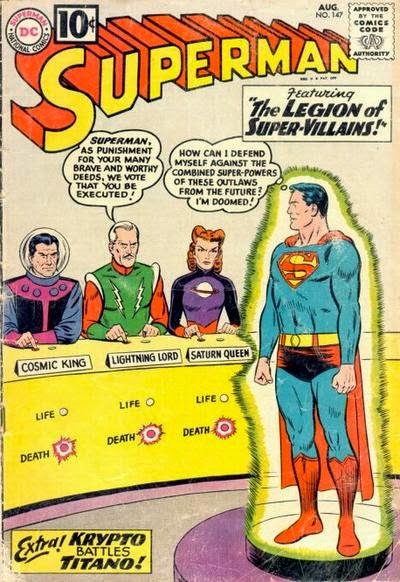
Since this post is part of my series on 147th issues, I'm going to go into a little more detail here on the final story in the book, which first appeared in Superman #147.  This is the tale which introduces the Legion of Super-Villains in a story by Superman co-creator Jerry Siegel and artists Curt Swan and Sheldon Moldoff imaginatively entitled "The Legion of Super-Villains."
The story begins with an imprisoned Lex Luthor volunteering to help out his fellow convicts by repairing their broken radios.  Clandestinely stealing parts from every unit he works on, Luthor builds a device capable of communicating with the future.  Knowing of the existence of the Legion of Super-Heroes, Luthor has reasoned that there must also be a Legion of Super-Villains to oppose them.  His attempt to contact the villainous Legion is answered by the appearance in his cell of futuristic devices which he uses to escape.  Shortly, he hooks up with the Super-Villains themselves, who proceed to introduce themselves and relate their origins.
Cosmic King is a scientist from Venus who invented a ray that could transmute matter, and who gained that power for himself after being zapped by his own ray.  Unfortunately for him, his dreams of fame and fortune are short circuited when he learns that transmutation is considered a great evil on Venus and he is subsequently banished from his homeworld, leading him to journey to Earth and take up a life of crime.
Lightning Lord is the brother of Legionnaire Lightning Man, formerly Lightning Lad.  He relates a slightly different version of the incident which gave him and his brother powers which does not include any mention of their sister, whose first appearance as Lightning Lass was still two years in the future as of this story's initial publication.  A footnote added for this reprint observes that "Lightning Lord hasn't told the full truth," and directs the reader to "See the first story in this magazine."  Well, of course he's lying. He IS a super-villain, after all, and therefore EEEE-VIL.
Saturn Queen comes from Saturn, where there is no crime.  Upon arriving on Earth, however, she suddenly felt compelled to use her powers of super-hypnotism to become a criminal.
The evil Legionnaires lure Superman to a planet in another solar system and trap him in a Kryptonite force field.  Luthor is prepared to execute his archenemy when the adult version of Superman's former teenage pals in the Legion of Super-Heroes arrive.
The two Legions battle to a stand off until Superman tricks Luthor into releasing him from the force field, after which he journeys to Saturn and uses a giant shovel gather material from Saturn's rings and encircle the planet where he had been imprisoned with it.  Apparently it is radiation in the rings of Saturn that affects the minds of its citizens and keeps the world free of crime.  Under the influence of Superman's newly created ring around this planet, Saturn Queen turns against her comrades, tipping the balance of power and winning the battle for the good guys.  The good Legion take their evil counterparts back to future and Superman returns Luthor to his cell on Earth.
While I'm reluctant to criticize the work of one of the men who invented the entire super-hero genre and without whom I would not be writing this blog, I have to say that the level of imagination reflected in the rather bland title of the story is, unfortunately, on display throughout the entire eleven pages of the story.  It is a rather pedestrian and unremarkable tale, aside from its importance in Legion history. 

Sunday, February 2, 2014

Super Sunday IV: Elliot S. Maggin's "Superman: Last Son of Krypton"

Once again, in somewhat of an annual tradition, while the vast majority of the nation focuses its attention on some sort of big sporting event or something like  that, we hear at Gutter Talk HQ turn our attention to telling readers of this blog about a classic tale of the Man of Steel.  This time out, our subject is not one of the character's comic book exploits, but one of his early ventures into the realm of prose novels. 
Regardless of outward appearances, despite the fact that it uses the  film's crystalline Superman logo, notwithstanding the picture of Christopher Reeve in his Superman costume on the cover, and setting aside the sixteen pages of black and white photos from the movie embedded in the center of the book, Elliot S. Maggin's 1978 novel Superman: Last Son of Krypton is not an adaptation of the then newly released Superman: The Movie.  Rather,  it is an original tale set in a rough approximation of DC's Bronze Age Earth-One continuity and reflects pretty accurately Superman as he was appearing in the comics of the day, many of them, not coincidentally, also written by Maggin.  As had been the case for several years in his comics titles, Superman, in his secret identity of Clark Kent, works not as a mild mannered reporter for a great metropolitan newspaper but as anchor for the WGBS six o'clock news and fairly recent additions to the supporting cast Steve Lombard and Morgan Edge figure prominently in the story alongside old standbys Lois Lane, Perry White and Jimmy Olson.
It has been said that the advantage that comics had over film, especially in the pre-CGI days when this novel was published, is that they could portray things that were beyond the scope of special effects technology.  Comics, especially in the Bronze Age, had their own limitations, however.  One was space.  A typical single issue of the day contained a mere seventeen pages of story, and, at least at DC, single issue stories, or at least stories no more than two or three issues in length, were still the norm.  Words and pictures, of course, take more room to tell the same events than words alone, thus far more story could be conveyed in a 238 page novel, allowing Maggin to tell an epic, cosmic science fiction adventure story on a scale previously unattempted in any Superman comic.
Maggin peppers the novel with many of his signature themes and tropes.  The author's admiration of Albert Einstein is well known among comics fans and the renowned physicist, though never actually identified, is a major character in the novel as well as a main motivating factor in the plot.  The Guardians of the Galaxy, from Green Lantern, make an appearance, and in a nod to the classic Dennis O'Neil/Neal Adams "Hard Traveling Heroes" era of the book, the exiled Guardian known as the "Old Timer" shows up.  Part of his purpose in the story is to give voice to another of Maggin's favorite themes as he, in  disguise as a human sociologist being  interviewed by Lois Lane for a TV talk show, warns of the possible negative effects of Superman's presence on Earth on human evolution, echoing Maggin's earlier short comics story "Must There Be A Superman?"
The novel begins begins with a retelling of Superman's origin, but with a new spin.  Prior to baby Kal-El's arrival on Earth, a probe carrying a message from Jor-El visits Einstein, who, as "the most highly developed intellect" on Earth, is entreated by the Kryptonian to take in and raise his son.  Instead, the aged scientist travels to Smallville, Kansas, near where Kal-El's rocket is to land, and chooses a local couple, Jonathan and Martha Kent, whom he deems suitable to give the Kryptonian child a good upbringing.  Through the ruse of selling the Kents a new tractor, he maneuvers the couple into position to discover the child from the stars upon his arrival. 
The novel then moves to the present day, as Superman's arch-enemy Lex Luthor makes plans to steal a document left behind by the now late Professor Einstein and sealed in a vault for the last quarter century.  Einstein, it turns out, is a personal hero of the criminal scientist, and it is speculated that the document may contain one last scientific breakthrough.  
Lex makes off with the document, but it is, in turn, stolen from him by an alien named Towbee on behalf of the Master, not the Doctor Who villain but the ruler of the planet Oric in the Vega system.  After meeting with the Old Timer, Superman recruits Luthor to journey with him to Oric and aid him in retrieving the Einstein papers.  Once on Oric, the unlikely allies discover a plan by the Master to make himself ruler of his section of the galaxy, after he has, by manipulating black holes, physically separated that arm of the galaxy from the rest of the rest of the Milky Way, thus putting him out of the Guardians' jurisdiction and beyond the reach of the Green Lantern Corps.
One of the best things about the book is Maggin's exploration of the character of Lex Luthor, who emerges as much more than simply a two dimensional mad scientist.  Throughout the early chapters of the novel, Maggin introduces flashbacks to Clark Kent and Lex Luthor's childhood days in Smallville.  He expands the story of how Luthor came to hate Superboy, giving the future villain a more emotionally resonant and realistic reason for his emnity toward the hero than simple vanity over the loss of his hair.  Superboy, in his attempt to save Luthor's life, in Maggin's account not only causes the permanent loss of Luthor's hair, but destroys his greatest experiment as well. 
I've wondered recently how come someone supposedly as smart as Luthor never figured out that Clark Kent and Superman were the same person, especially since he knew both of them back in Smallville.  After all, both Clark and Superman are about the same age, each left Smallvile at the same time, and then showed up in Metropolis at pretty much exactly the same time.  It really doesn't take a scientific genius, as Luthor purports to be, to put two and two together and come up with something other than mere coincidence. 
Okay, digression over, let's wrap up this post.
While Superman: Last Son of Krypton is dressed up as a novelization of the first Superman movie, it is, in my opinion at least, something even better; the ultimate Superman epic from one of the character's premier writers. 
Here are some links to sites where you can get other opinions and perspectives on today's topic (and maybe even buy a copy):


Monday, January 13, 2014

Gutter Talk's 2nd Annual, Rather Quite Late, Year In Review Post

[Before we proceed any further, it is my bloggerly (like that word? I just made it up just now) duty to inform you that the sections of this post concerning Doctor Who contain spoilers pertaining to the recent fiftieth anniversary special.  If you've not yet seen it, proceed at your own peril.]
You might be wondering why my 2013 Year In Review post is so late, coming as it does nearly 1/26 of the way through the New Year.  The first and most important answer to that is quite simply that I am lazy and I tend to procrastinate.  
My lack of ambition notwithstanding, nonetheless I have always preferred, on my various blogs over the years, to put off doing my Year In Reviews until the year is actually over.  You never know when some earth shattering, game changing bit of news is going to occur on New Year's Eve, leaving all the other  bloggers who wrapped up their post mortem on the year the week before Christmas slapping their foreheads and making Homer Simpson noises.  To be sure, that didn't happen in  2013, but one of these years it will and I shall be hailed far and wide as prescient and a visionary.
Enough preamble, on, at last, to the business at hand:
On a personal note, I did somewhat better at keeping up the blog in the year past, with 88 posts compared to a mere 58 in the twelve months previous.  However, as is my typical pattern, I sort of slacked off in the latter half of the year.
Since September, my contributions to this blog have mostly been limited to my weekly reviews of Star Trek: The Animated Series.  These have turned out to be some of my most popular and well received posts, so you can rest assured that I shall, as promised, be resuming the series with the second season of six episodes come September.  Its perhaps worth noting that, other than my observance of it here, the fortieth anniversary of the debut of the animated version of Trek went largely unheralded by fandom.  On the other hand, I am fairly certain that such shall by no means be the case in two years when the original series reaches its fiftieth anniversary year.  
One anniversary that did not slip by unnoticed by fandom was the fiftieth anniversary of Doctor Who's debut on November 23, 1963.  I feel that the anniversary episode, "The Day of the Doctor," was one of the best Who episodes since Series 5, which I consider the best of Stephen Moffatt's term as show runner.  The only real flaw in the episode is that I feel that Moffatt dropped the Zygon invasion plot about five minutes too soon, just short of an actual satisfying resolution.  Of course, the Zygons were not the point of the episode.  The real point was to lay to rest once and for all the specter of the Time War and to absolve the Doctor of his guilt for the supposed destruction of Gallifrey.  Retroactively making it so that Gallifrey was never really destroyed may seem to some a bit of a cop-out, but Moffat pulled it off in an emotionally satisfying manner and without contradicting anything that the series has established in the eight years since its return to the airwaves in 2005.  
The year in Doctor Who not only saw the end of Matt Smith's reign as the Doctor, but gave not just one, but three regenerations, and all within the space of little more than a month.  The on-line short "The Night of the Doctor" brought back eighth Doctor Paul McGann to show his transformation into John Hurt's "War Doctor"; the anniversary special ended with Hurt turning into the ninth Doctor; and, of course, there was the the Christmas special, featuring Peter Capaldi's first appearance as the Doctor, or his second if count his brief cameo, in extremely extreme close up, in "The Day of the Doctor."
Turning, finally, to the ostensible niche of this blog, the world of comics, it would appear that my powers of prognostication are perhaps not as prodigioous as I pretend. That bit of somewhat strained alliteration refers to the fact that in my previous Year In Review post, I forecast that when I sat down to write the post that you are reading right now I would be reporting the demise, sometime during the previous year, of DC's creator owned, mature readers imprint Vertigo after two decades of existence.  Unheeding of how it my affect my self-esteem, it turns out that the venerable imprint is  still chugging along.  However, it was announced a few weeks ago that the line will soon be losing its latest flagship title.  Bill Willingham's popular and long running Fables is due to cease publication with its 150th issue, due to appear on comic store shelves in just over a year. 
Meanwhile, a prediction that I ventured to make back in 2012 has, indeed, proven accurate.  Dark Horse's license to produce comics based on the Star Wars franchise is set to  expire in the upcoming year, and it has recently been announced that Lucasfilm's new owners, the Walt Disney Corporation, which also, not coincidentally, happens to own its own comics publisher, will be, as I foretold at the time of Disney's aquisition of the Star Wars property,  shifting the Star Wars license back to its original home at Marvel Comics.  Of course, you don't have to be Nostrodamus to realize that it makes more sense for Disney to produce Star Wars comics in-house if they, as they, in fact, do, have the means.
The past year saw the deaths of a trio of notable artists of the Silver Age of comics.  
Carmine Infantino's passing I noted when it occurred this April past.
Veteran Superman artist Al Plastino, who expired in November, had recently been in the news due to a legal conflict over some original artwork from a 1963 Superman story that he had wished, at the time, to be donated to the John F. Kennedy Library, but which, obviously, never ended up there.
To my mind, Plastino will always be the artist who was called in to "fix" Jack Kirby's Superman and Jimmy Olson faces during the King's run on Superman's Pal: Jimmy Olsen in order to bring them more in line with the look of the other Superman titles.  I also was somewhat surprised to learn when I read Schulz and Peanuts, David Michaelis' biography of the Charlie Brown's creator, that, back in 1978, Plastino had been in line to take over Peanuts if contract renewal negotiations between Schulz and his syndicate went sour.  It is my understanding that Plastino actually worked up about six weeks worth of Peanuts strips, just in case.  I've never seen them, but I've heard that they were fairly awful.
In November, the comics world also bade farewell to Nicholas Viscardy, better known to fans of his artwork on Aquaman, Teen Titans and The Brave and the Bold, among other titles, not to mention countless DC covers during the 1970's, as Nick Cardy.
Finally, speaking, as I was earlier, of anniversaries, I cannot believe that, being the huge fan of the Doom Patrol that I am, I failed to realize, and thus to mark the occasion on this blog, that 2013 had been the fiftieth anniversary of the team's debut in My Greatest Adventure #80, cover dated June 1963--which, of course, means it may have been on newsstands as early as March. In belated recognition of this milestone, I refer you now to this post from the very earliest days of this blog detailing the publication history of the Doom Patrol series around the time of the debut of the title's most recent incarnation, as well as all of the other posts I have composed about the team over the life of this blog.

Monday, September 9, 2013

Superman #200: "Hey! Look At How Different We're Being!"

After I reviewed Superman #300 for my 300th post on this blog, I decided, since I own every centennial issue of Superman/The Adventures of Superman with the exception of #100, which I plan on buying just as soon as I win the lottery, to make that sort of thing a tradition here.  Thus, for the 400th post, I'll look at Superman #400 and so on.  As I arrived at this brainstorm too late to cover Superman #200 in my 200th post, I'll take a look at that one right now here in post #350.
The first challenge in writing about this issue is telling you that, as was the custom with Superman anniversary issues prior to the Byrne revamp, it contains what used to be called an "imaginary story" while resisting the almost overwhelming urge to quote Alan Moore. (And now I don't have to.  I'm willing to bet that most of you are now doing it for yourselves, my referring to it having called to mind the very quote I'm talking about.)  When comics fans and historians discuss the great Superman imaginary stories of the Silver Age, bandying about such titles as "The Death of Superman" and "The Amazing Story of Superman Red and Superman Blue,"  this issue's tale, "Super-Brother Against Super-Brother," written by Cary Bates and drawn by Wayne Boring, never comes up in the conversation.  As you'll see, there is a reason for that.
The story begins like the traditional origin of Superman, with Kryptonian scientist Jor-El, having determined that the planet Krypton is soon to explode, feverishly working to complete the rocket ship that will carry his young son Kal-El to safety.  His plans are interrupted by the arrival of Brainiac, who shrinks Jor-El's home city of Kryptonopolis and places inside a bottle.  The living computer has done this in order to save the city from Krypton's imminent destruction.  Before he can shrink the rest of Krypton's cities, however, the danged planet goes and blows up.
Unfortunately, Brainiac's plans to enlarge Kryptonopolis on a new planet are scuttled by the fact that the only known supply of ZN-4, the rare element needed to enable him to enlarge living beings, has been exhausted.  Thus, he wanders about the galaxy for years looking for a new supply.
Meanwhile, life goes on in Kryptonopolis, and the Els have a second son, Knor-El.  The two brothers grow up and Kal becomes a scientist, while Knor trains to go into law enforcement.
Eventually, Brainiac finds some more ZN-4 and a suitable planet to enlarge Kryptonopolis upon.  Before he can do so a stray meteor collides with his ship, forcing him to crash on Earth, but not before safely depositing the bottle city on the ground.
Surveying their new home on their viewscreens, the Kryptonians notice that, in Jor-El's words, "Earth is overrun with crime."  Soon, Jor discovers that Brainiac managed to teleport to holding tanks in Kryptonopolis just enough ZN-4 to enlarge one person.  He further realizes that the yellow sun and weaker gravity of Earth would make grant superpowers to any Kryptonian who ventured outside the bottle.  Therefore, he sponsors a competition among the city's young men to determine who will get to be Earth's Superman and aid the humans in their war on crime.
Knor-El wins, and takes a job at the Daily Planet under the name of Ken Clarkson so that he will know when Superman is needed.  Soon, aliens come to Earth with conquest on their minds and expose Knor to Kryptonite, seemingly killing him. After Jor-El loses contact with Knor on his video monitor, Kal, reasoning that his brother is danger, uses synthetic ZN-4 that he has made to enlarge himself and go outside the bottle to save Knor.  The aliens use their green Kryptonite on Kal, but instead of killing him, it turns him into a giant, because, for no good, the green K in this imaginary story has the unpredictable effects of red K in the "real" Superman stories.  So, Knor isn't dead after all, just in temporary suspended animation, and he revives in time to help Kal dispose of the aliens.
The story ends with Knor continuing his career as Superman in Metropolis, while Kal moves to Quebec, takes a job at the Montreal Star as reporter Charles LeBlanc, and protects Canada under the name of Hyperman.
Throughout the story, Bates has an annoying habit of exaggeratedly pointing out the obvious changes he has made to the traditional Superman mythos for this imaginary tale, as if we couldn't see them for ourselves.  For example: "Yes, in this story, it is Kryptonopolis, not Kandor, which is stolen by Brainiac!" or "Another surprise! In this imaginary saga, Brainiac is not a diabolical villain, but a life-saving hero!" or, most egregiously, "And so, in this tale, it not Kal-El, but his brother Knor,  who becomes Superman!"  Thanks for clearing that up, Cary, since the image in that same panel of Knor-El wearing the Superman costume kind of left things a little vague.
Aside from Bates talking down to the reader, there are more important reasons why this issue isn't on a par with the classic imaginary stories cited above.  The changes to the legend of Superman that Bates so painstakingly points out seem random and made simply for the sake of being different.  Furthermore, the story offers no fresh perspectives or insight into the character and legend of Superman.   Even worse than that, its kind of dull and predictable, despite Bates' labored efforts to surprise the reader.
Finally, the ending of the story is just plain odd.  Out of nowhere, a caption in the final panel, which shows Kal-El as Hyperman soaring over the Quebec skyline, informs us, "As we celebrate our 200th issue, Canada is celebrating its 100th anniversary as a United Federation.  This is our tribute to our neighbor to the north.---Ed."
What's odd about it is that the country the issue is supposedly paying tribute to isn't even mentioned in the story until the bottom half of the final page.  In fact, the whole issue turning out to have been a salute to Canada is the only real surprise Bates delivers in the entire story.

Sunday, September 1, 2013

Superman: Dark Knight Over Metropolis

For most of the company's history, DC Comics' two top heroes, Superman and Batman, have teamed up on a regular basis in a shared title.  However, there was a relatively brief period in the wake of the post-Crisis on Infinite Earths revamp of Superman in John Byrne's The Man of Steel mini-series, when DC's official editorial stance was that the Man of Tomorrow and the Dark Knight should, by virtue of their differing personalities and methods of operation, have a more adversarial relationship.  Man of Steel #3 depicted the "first" meeting of the two in the new continuity and served to solidify the new status quo in the Superman/Batman relationship.  However, blame for the dissolution of that long running friendship and partnership cannot be laid solely at the feet of Byrne.  Hints of the new direction could be seen as early as the final issue of World's Finest Comics (#323 cover dated January 1986), which ended with the former "World's Finest Duo" parting on somewhat less than congenial terms.
Due for release later this month, the trade paperback collection Dark Knight Over Metropolis collects two meetings of the erstwhile "World's Finest Duo" from this period.  The earliest of these, and the one from which this volume's Art Adams drawn cover is taken, is "Skeeter", written by Byrne with pencils by Adams inked by Dick Giordano, from Action Comics Annual #1, which came out during Action's brief stint as a Superman team-up book.  The story has Batman reluctantly calling on Superman for help when he confronts a situation he is forced to concede that he cannot handle by himself; vampires overrunning a small Louisiana town.
The core of the book is "Dark Knight Over Metropolis", three part story that ran through the trio of Superman titles cover dated June 1990.  The first installment in Superman #44 is written and penciled by Jerry Ordway with inks by Dennis Janke. Part two from The Adventures of Superman #467 is written and penciled by Dan Jurgens and inked by Art Thibert.  Roger Stern wrote Action Comics #654's conclusion with art by Bob McLeod and Brett Breeding.  Investigating a mysterious death in his hometown of Gotham lands the Dark Knight in Superman's territory and smack dab in the middle of the Man of Steel's ongoing plotlines.  In between following up leads to the case that brought him to Metropolis, Batman aids Superman in protecting Clark Kent's Daily Planet colleague Cat Grant from attacks by such second rate villains as Chiller and Shockwave (Where, you almost have to wonder, was Bolt?) when Grant is targeted for death by the organized crime outfit Intergang after daring to agree to testify against former Galaxy Communications chief and Intergang operative Morgan Edge.
Also stated to included in the collection are the issues of Action and Adventures that immediately precede the "Dark Knight Over Metropolis" story.  While the events of Action  #653 are a direct prelude to those issues, Adventures of Superman #466 contains only a few panels directly pertaining to the Intergang sub-plot.  The issue's main story is most notable for being the debut of Hank Henshaw, who would go on to infamy as the Cyborg Superman in the post Doomsday "Reign of the Superman" epic.
The ending of "Dark Knight Over Metropolis", does contain, as the Collected Editions blog states, "...an important event in post-Crisis continuity."  It also serves to wrap up a dangling plot thread dating all the way back to Superman #2.  Furthermore, that aforementioned "important event" signaled the beginning of the softening of relations between DC's two top crime fighters.  Eventually, the two would again become good friends and even come to have shared adventures in a communal title.  However, in the post Man of Steel continuity, instead of being presented with that friendship as a predetermined fact, readers got to see it grow and evolve over time.  "Dark Knight Over Metropolis" signalled the true beginning of that evolution.
I  would definitely recommend that you read these  stories. However, I suspect that if you're willing to do a little digging through back issue boxes you might be able to pick up the individual issues for  somewhat less than the cost of the upcoming trade paperback.


Saturday, July 13, 2013

What DC Expects People To Pay Good Money For In October

Following in the well worn footsteps of  fellow comics bloggers J. Caleb Mozzocco and Tom Bondurant, I now present my take on some of the items that DC Comics will be shipping out to your friendly neighborhood comics shop in October that look even halfway interesting or worth checking out.
The list of things that could possibly entice me to buy an Aquaman comic is very, very short.  The credit line "written by John Ostrander," however, would most definitely be up near the top.  One of comics' finest writers returns, if only briefly, to the company where he did most of his best work with October's Aquaman Annual #1.  According to Bondurant, if sales of this issue warrant, it could lead to an ongoing series featuring Aquaman's former teammates The Others.  If so, DC could do a lot worse than let Ostrander stick around to write it.
Earth 2 #16 may be the last issue of the series I buy.  Its writer James Robinson's swan song, and my decision to continue with the book will rest entirely on whose name replaces his in the credit box.
Justice League 3000 #1 offers up yet another reunion of the classic Justice League International creative team of Giffen, DeMatteis and Maguire (Attorneys at Law--sorry couldn't resist.)  However, I'm not expecting a JLI style BWAH-HA-HA fest, as there seems precious little room for that brand of irreverent humor in the New 52.  This title replaces Legion of Super-Heroes and involves the members of the Justice League seemingly thrown into the far future.
I thought Damian Wayne was dead.  Apparently, he gets better by October when the first issue of the six part mini-series Damian: Son of Batman ships.
Adventures of Superman #6 is a decided "NO!", at least in these parts.  The issue is written by J.T. Krul, and regular readers of this blog will be familiar with my longstanding and passionate contempt for everything the man has ever written.
Green Arrow Volume I: Hunter's Moon collects at long last the first six issues, comprising three two part story lines, of Oliver Queen's first ongoing series written by Mike Grell, with art by Ed Hannigan, Dick Giordano and Frank McLaughlin.  Even though I am one of the world's biggest GA fans, I won't be buying this.  You see, sometime during the two and a half decades that it took DC to deem these stories suitable for reprinting, I went ahead and aquired the contents of this book in individual issue form.  (And I picked them up Packrat Comics for a buck apiece, thus paying less than half what DC is asking for the collection.) Still, the fact that this book exists after all this time makes me happy.  I certainly hope future volumes are in the offing. 
Meanwhile, in issue #24 of the ongoing Green Arrow series, writer Jeff Lemire introduces the New 52 incarnation of Grell creation Shado.
Speaking of Green Arrow, he and ladylove Black Canary also show up this month as guest stars in the trade paperback The Joker: Clown Prince of Crime, reprinting for the first time the entire nine issues of Joker's eponymous series from 1975.  This is another one I'll be leaving on the shelf.  I've read about half of the issues to be reprinted here, and despite a laundry list of top talents of the day that includes Dennis O'Neil, Martin Pasko and Elliot S! Maggin on the writing side, and Ernie Chan, Irv Novick, Dick Giordano and Jose Luis Garcia-Lopez at the drawing board, those stories just weren't very good at all.
 Ever since the publication of Sandman #1 a quarter century ago, series writer Neil Gaiman has assured us that there's more to the story of Morpheus' capture by Roderick Burgess than we were shown in that issue.  In years' since Sandman #75 rolled off the presses, he has repeatedly assured us that someday he would share that tale with us.  Someday has come, just in time for the Silver anniversary of Sandman #1's publication, as the first issue of The Sandman: Overture, a six issue mini-series that finally lifts the veil of secrecy that has long shrouded the events that weakened the Dream King sufficiently to allow Burgess' spell to entrap him, comes to comic shops in October.  The only question in my mind is whether I wait for the collection or buy it in installments.  I guess that really depends on just how excited I am about new Sandman material after all this time.   My gut reaction is to wait for the trade.  We'll see how I feel, and how much disposable income I have, in October.
As I said above, whether or not I actually purchase any of the above comics depends on a combination of my mood and my financial well-being.  However, I'm highly likely to tell you all about whatever I do purchase on this blog when the time comes.

The "Forgotten" Superman Movie: Superman and the Mole Men

With the debut of a new ongoing comic and, of course, the release of a new movie, there's been a lot of buzz about a certain Man of Steel recently.  I haven't yet seen the new film, and based on the evidence of  the reviews I've read and the reactions of my friends who've seen it, I'll probably be defering that singular pleasure for some time yet.  No, I'm here today to discuss an earlier Superman movie, though not the one that probably leapt to your mind when you read that last clause.  The film under consideration in this post is one you probably didn't even know existed, even though its likely that you may have seen it.  If so, it probably wasn't in its original form as a movie, but re-edited into the two part episode of The Adventures of Superman that closed out that series' inaugural season.
Superman and the Mole Men (or "The Unknown People" as it was retitled for its television debut), released to theaters in November of 1951, effectively served as the pilot for that long running show, introducing the world to George Reeves, the man who be intrextricably identified in the eyes of the world with the character of Superman for the rest of his life and for another two decades thereafter until Christopher Reeve donned the cape and tights in the late 1970s.  Reeves, an amateur boxer in his youth, had, by the time Superman and the Mole Men began filming in the summer of 1951, been a working actor for a decade and change, even landing, as his film debut, a blink and you'll miss it role in an obscure, low budget B-movie called Gone With The Wind in 1939.   Among his other film credits, and I single this one out only because it happens to be one I've actually seen, is the Charlie Chan mystery Dead Men Tell.  However, it was, of course, The Adventures of Superman that would make him a household name.
Mole Men also introduced moviegoers to the new Lois Lane, Phyllis Coates.  Coates never became associated in the public consciousness with Lois in the way that Reeves did with Superman, as she played the part for only the first of Adventures' six seasons.  There was a two year delay between the filming of the first and second seasons, and when time came for the cameras to roll on the second set of twenty-six episodes, Coates had already committed to another project and was thus unavailable.  She was replaced by Noel Neill, who had played the part opposite Kirk Alyn in the serials Superman and  Atom Man vs.Superman.
Billed on its promotional poster as Superman's "FIRST Full-Length Adventure," "full length" obviously not meaning the same thing in 1951 as it does in today's era of three hour epics, Superman and the Mole Men clocks in at a mere fifty-eight minutes. The film was written by co-producer Robert Maxwell, under the nom de plume of Richard Fielding.  The director was Lee Sholem.  Sholem would go on to split the directing duties on the remaining twenty-four episodes of The Adventures of Superman's first season with Tommy Carr, who had done similar duty on the Kirk Alyn serials. 
Perhaps because it had been told a mere three years earlier in the first serial and thus was fresh in viewers' minds, Fielding/Maxwell's script glosses over Superman's origin in a short opening narration and gets straight to the story.  That's not to say that The Adventures of Superman didn't produce its own version of the origin, but it would be early 1953 before "Superman On Earth" aired, kicking off the series' run.
Curiously, aside from Lois Lane, most of the familiar trappings of the Superman mythos, from the majority of his supporting cast, to his Achilles heel, Kryptonite, to the city of Metropolis itself, are noticeably absent from Superman and the Mole Men. The story is set in the small Texas oil town of Silsby, which, as a sign that is the first image we see following the introductory narration informs us, is the home of the world's deepest oil well.  Big city reporters Kent and Lane have travelled all the way from Metropolis to do a story on the well, only to find upon their arrival that the well is being shut down for reasons that foreman Bill Corrigan tersely refuses to elaborate on.
The mystery deepens when "Pop" Shannon, the aged night watchman at the well site, is found dead of a heart attack later that evening.  The tragedy is enough to loosen Corrigan's tongue, and he tells Kent the story behind the well's closing.
As the drill bored deeper, soil samples began coming back with a strange, possibly radioactive glow.  At approximately six miles deep, the drill bit seemed to be hanging in mid-air, as if it had broken through to the center of the earth.  Strange microbes were found on the drill bit, leading Corrigan to speculate that more complex life forms may be living down there.
He's right, of  course, and now a pair of diminutive, hairy creatures with big bald heads and exhibiting the same mysterious glow found in the soil samples have come up to explore this strange new world that has invaded there own.  Unfortunately, the first person they encounter is poor old "Pop", who is so frightened by their appearance that his ticker gives out.
The death of "Pop" and other sightings of the creatures get the townsfolk of Silsby worked into a lather.  Kent tries to calm the populace, but his entreaties of understanding fall on deaf ears.  Worked into a murderous frenzy by a nasty character by the name of Luke Benson, the frightened citizens form a mob to hunt down the invaders. 
It is only then, twenty-eight minutes into this less than hour long film, that Kent ducks into an alley and changes to his super-heroic alter-ego in order to protect the aliens from the lynch mob, as well as protect the people of Silsby from the creature's possibly radioactive glow.  This is fairly typical of the pattern that The Adventures of Superman would fall into.  Like the later TV adaptation of The Incredible Hulk, due mostly to the limitations of a TV special effects budget, Superman usually only showed up near the end of each episode as a sort of deus ex machina to clean up whatever mess Lois and Jimmy Olsen had gotten themselves into that week.
Benson and his mob succeed in critically wounding one of the aliens with a shotgun and trapping the other in a burning shack.  Superman rescues the alien who gets shot and takes him to the local hospital.  His compatriot escapes from the fire and heads back down the well, re-emerging with reinforcements and a big sci-fi ray gun in order to rescue his wounded friend.
Superman and the Mole Men has more in common with The Day the Earth Stood Still than with your typical Superman tale.  Even moreso than in that Robert Wise genre classic, the aliens here are presented as peaceful and sympathetic.  They are shown as innocent and childlike.  In fact, the only person in Silsby who befriends them is a little girl.  She is frightened not by the creatures, but by her mother's hysterical reaction to them.  The real monsters in Mole Men are Luke Benson and his cronies.  Though their fear of the unknown is understandable, they let it get the best of them, blinding them to reason.
The comparison to The Day the Earth Stood Still is apt, as Superman and the Mole Men is truly representative of the best of 1950s science fiction films.  It also represents the best The Adventures of Superman. Based on the color episodes, after producer Whitney Ellsworth, who replaced Bob Maxwell in the second season, decreed that the show should be essentially dumbed down to make it more "kid-friendly", its easy to dismiss the entire series as insipid pablum.  However, the black and white episodes, especially Maxwell's first season, are among the finest examples of 50s TV.

Tuesday, March 26, 2013

Grant Morrison's Action Comics Overview

What had been perhaps the most anticipated run of the New 52 prior to the launch of the rebooted DCU a year and a half ago, Grant Morrison's take on Superman's early years in Action Comics, has come to a slightly delayed end with the release last week of Action #18 featuring the Man of Steel's climactic showdown with 5th Dimensional menace Lord Vyndktvx and his Anti-Superman Army.
In the beginning, Morrison's story line was being promoted as a return to Superman's roots, telling tales of a Kal-El far less powerful than he would eventually become acting as a defender of the common man.  The first issue started out that way, but that direction didn't last long.  The seeds of what was to come were planted in the very first panel with the appearance of "the little man," who would eventually be revealed as Vyndktvx.  Then things got cosmic pretty quickly as Brainiac showed up at the end of the second issue. Following the defeat of Brainiac and Superman's discovery of his Kryptonian heritage, things start to get truly weird and Morrisonian, as the story of Lord Vyndktvx's revenge moved to the fore.  At first, the villain only made cameo appearances in what appeared at first to be a series of stand alone one or two issue stories.  With #14, though, his plot against the Last Son of Krypton swung into full force. 
This is definitely a story that reads better when taken in all at once rather than in monthly installments.  Reading the last few months worth of issues as they came out, I really couldn't make heads or tails of them.  However, when read straight through, the pieces of the puzzle fit together neatly to form a surprisingly straightforward tale of vengeance, albeit one played out across all of time and space and through various alternate dimensions and planes of existence.  Despite taking an extra issue to wrap things up, the ending still in spots comes off a little rushed and disjointed, but that's actually pretty typical of Morrison's epic super-hero sagas.  Despite its flaws, the final chapter was a fittingly grand conclusion to Grant's run.
It does seem to a certain extant that Grant is having his cake and eating it too with this story.  While it reintroduces a new Superman for the New 52 continuity, it simultaneously draws on the past history of the character.  Certainly a working knowledge of Superman's past encounters with Mr. Mxyzptlk helps in order to get the full impact of the tale.
On the whole, Grant Morrison has crafted in these nineteen issues a Superman story in the classic mode, pitting the Man of Steel against a foe truly worthy of his might and once again reinforcing his stature as the world's greatest hero.  If the run failed to live up to some people's expectations, I would say that is likely due more to the fact that,  spurred on by Morrison's earlier All-Star Superman, those expectations were almost impossibly high, rather than any deficiencies of Morrison's story itself.

Monday, February 25, 2013

Superman 2001

For this, my 300th post on this blog, I thought it would be appropriate to review Hellblazer #300.  Unfortunately, I have yet to acquire a copy.  I fell quite ill around the middle of last week and by the time I was able to rouse myself from my sickbed each of the two comics shops I visited was sold out.  Apparently I'm not the only lapsed reader who came back for the final storyline. Perhaps all those copies were snapped up by fools who are still under the delusion that comics are sure-fire investments that will put their grandchildren through college.   The Laughing Ogre assures me they'll have more copies soon, so there will be a review forthcoming.  For now, however, I am forced to turn to another 300th issue, one already in my possession, for today's post. 
Superman #300 presents "Superman 2001", an "imaginary story" positing what would happen if young Kal-El, last survivor of the doomed planet Krypton, landed on Earth in the then present day of 1976 to emerge as Superman in the futuristic society of the year 2001.
Rather than crash-landing in the American Midwest, the rocket from the stars splashes down in the middle of the Pacific Ocean, leading to a race between the U.S. and the Soviet Union to claim the alien artifact from which the Americans ultimately emerge victorious.  The rocket's youthful passenger is dubbed Skyboy and raised in secrecy at a top secret U.S. military installation.  
As of 1990, an unnamed "third world power" has emerged with dreams of world conquest and a plan to start a devastating nuclear war between America and the U.S.S.R.  that will leave them as rulers of the world in its wake.   Skyboy goes into action to prevent the conflagration and, following the close call, America and the Soviets begin peace talks.  Thus, peace reigns for the next eleven years.  Following the averted war, Skyboy disappears.  He leaves the military base, adopts the name Clark Kent and vows never to use his powers again.  
On January 1st, 2001, the world celebrates the dawning of a new century and milennium--unlike the real world, where we marked those events a year early.  Clark Kent has become an anchorman for the Planet-Wide News where he recieves a report of a strange, four-armed creature suddenly appearing in Times Square.  Calling itself Moka, the beast claims to be the saviour who saved the world from nuclear destruction over a decade earlier and demands the world give him its allegiance and make him their ruler.  Surprisingly, the crowd in Times Square, at least, seems ready to go along with him.  Moka, it turns out, is a robot controlled by agents of that same "third world power" that almost caused the aforementioned nuclear destruction. 
Knowing that Moka ain't what he says he is, Clark dons his Skyboy costume for the first time in years and, now calling himself Superman, flies off to do battle with the would-be usurper.
It's amusing to read speculative stories like this one from a vantage point several years beyond the "futuristic" setting of the tale.  As futurists, writers Cary Bates and Elliot S! Maggin make fine comic book writers.  There's little that is original in their vision of the future, which seems mostly derived from The Jetsons and other pop culture projections of the world to come.
By 1990, the United States has a female president who lives in a White House entombed within a giant transparent dome for her protection.  While women seem to have made great strides in this world, African Americans seem to have all but disappeared.  The only black faces in the entire issue show up in a crowd scene toward the end of the story.  Even the leaders of the mysterious "third world power" are shown as old white guys.  In our world, a third power has risen, but its run not by old white guys, but old Chinese guys--since its China to which I refer. Of course, the whitewashing of reality was pretty typical for comics, and most entertainment, of the day and remains so to a large extent today.
As the new milennium dawns, Americans relax in their homes in floating chairs while they watch something called "Tri-Vision".    I assume that's meant to be some sort of 3-D holographic future version of television.  Meanwhile, as Clark Kent reports, the large cities of America's West Coast from Boston down to Washington, D.C., have merged into giant urban area dubbed "Metropolis." Which, this being a Superman comic and the city of Metropolis being an integral part of the charatcter's legend, makes sense, at least for the story.  Although most of the other seemingly integral parts of the character's legend, such as Lois Lane, the Kents, the Daily Planet and Lex Luthor, have been abandoned.
In contrast to its futuristic setting, Superman #300 seems to me like something out of an earlier time.  The era of Superman comics under editor Julius Schwartz was concerned with humanizing and modernizing the character, most notably by having Clark Kent move into broadcast journalism, and "imaginary stories" were one of the remnants of the reign of former editor Mort Weisinger that had been cast into the dustbin of history.  Thus, "Superman 2001" feels more like the belated last hurrah of the Weisinger era than a celebration of the Man of Steel as he existed in 1976.

Saturday, February 16, 2013

Card Game


Once again, DC Comics seems to be living by the old cliche that there is no such thing as bad publicity.  The latest flap involves the authorship of a segment of the company's digital Adventures of Superman anthology.
It seems to me that Orson Scott Card; of whom, until this week, I knew nothing other than his name and the titles of some of his books that I'd never read and now likely never will; has joined the club of creative individuals, which includes Steve Ditko and Dave Sim, whose extreme and unpopular political views have overshadowed, and at times overtaken, their creative output.  In Cards case, it is his outspoken stand against gay marriage rights that has lowered him into pariahship. Thus, DC's engaging of this controversial author to script a tale of its flagship character has been met with much outrage in the world of Internet opinionating.  There is an on-line petition, although likely too late to do any other than symbolic good (yet I've signed it nonetheless), urging DC to reconsider its decision to hire Card, and a few retailers have announced their intent not to carry the print edition of the comic when it ships in May
When contacted by The Advocate, a spokesman for DC spewed out the following half-assed, have-your-cake-and-eat-it-too, corporate double speak statement that seems to be trying to split the difference between defending the decision to hire Card while simultaneously distancing the company from his more controversial views:
 “As content creators we steadfastly support freedom of expression, however the personal views of individuals associated with DC Comics are just that — personal views — and not those of the company itself.”
Now, I figure that someone at DC must have realized that this controversy would occur.  Thus, it seems highly likely to me that, following the above stated dictum that there is no such thing as bad publicity, the prospect of the expected outrage drawing media attention to DC and this particular comic, which is exactly what has happened, may have played some part in the decision by the company to hire Card.
As I probably was not going to anyway, this controversy and my discovery of Card's true colors hasn't influenced my decision about whether or not to purchase or read Adventures of Superman.  It has, however, pretty much wiped out whatever vestigial desire I may have harbored to read anything else the man has written.

Monday, October 29, 2012

Superman #13 Reviewed (With Accompanying Rant)

DC's PR department certainly earned its pay last week, as they managed to generate a fair amount of unwarranted hype over Clark Kent's leaving the employ of the Daily Planet in Superman #13.
Tuesday must have been what we in the journalism biz call a "slow news day".  (Not to be confused with Andi Watson's charming graphic novel Slow News Day, which I highly recommend, by the way.)  How else would you explain ostensibly serious news outlets such as NPR and the BBC devoting any airtime at all to a relatively minor plot point in a comic book?
It's hardly that big a deal, after all.  This isn't the first time Clark's left the Planet.  He spent most of the 70's and the first half of the 80's working in TV as the anchor of the WGBS Evening News, and in the mid-90's he briefly left his newspaper job to become an editor at newsmagazine Newstime.  Besides, this dramatic  development will probably be undone by the next writer anyway, and, judging from the turnover on this book so far in its New 52 incarnation, that next writer will be along in about three or four months. 
However, all cynicism aside, the publicity was sufficient to induce me to purchase a copy of the issue just to see if the actual story, if there was one, was actually worth reading.  
Truthfully, there really isn't much of a story here.  The meat of the issue is your basic Superman versus giant alien monster story.  I've never been a huge fan of Scott Lobdell, the Superman writer of the moment.  His stories aren't bad, but neither are they all that especially good, either.  This issue is squarely in that area.  It's an entertaining, but not that impressive or especially memorable, few minutes read.  That's  pretty much what I've come to expect from Superman stories, and this issue delivers.
To me, the most interesting aspect of this issue is the confirmation that the  ridiculously powerful Superman of the late Silver and Bronze Ages who could push planets around with his pinky is officially back.  The issue opens with the Man of Steel in some sort of secret underground research facility attempting to discover the upper limit of his super-strength and being told, essentially, that there isn't one.  Further, Lobdell goes so far in this issue as to introduce a new super-power, or rather, perhaps more accurately, a heretofore unseen application of one his long time powers.  Apparently, his super-hearing is able to act like sonar to form an image in his head of distant objects.  
Also back in the New 52 is the proliferation of survivors of Krypton.  This issue features a guest appearance by Supergirl and (obligatory but half-hearted SPOILER WARNING) the aforementioned giant alien monster turns out to be of Kryptonian origin.  This issue also serves as a prelude to an upcoming crossover in all the Superman related titles, except for Action Comics, which takes place five years in the past, called "H'El on Earth," which seems like it will introduce yet another Kryptonian refugee who, from all indications I've seen, looks like he'll turn out to be related to Kal-El in some way.   I'm not sufficiently impressed with this issue, however, to follow the story any further to get the full details.  
Meanwhile, over in Action, Grant Morrison reintroduced the Bottle City of Kandor some months ago and in the latest issue he brings back both the Phantom Zone and Krypto.   Honestly, as my all time favorite Superman stories are from the Bronze Age, especially, as I've stated one or two times  before, Martin Pasko's run on Superman in the mid-70's, these are not, to me, totally unwelcome developments.
Going back to Clark's decision to quit his day job, it seems to me that Kent's actually got a valid point in his condemnation of the state of modern mainstream news coverage in which he laments that news has been totally supplanted by entertainment.   The last time I watched one of the three original broadcast network's evening newscast, I found it as devoid of anything resembling actual news as Monty Python's cheese shop was uncontaminated by cheese.  I tuned into the NBC Nightly News the night before the Olympics began to find that the broadcast was less a newscast than an extended promo for the network's upcoming coverage of the Games.   Later that evening, starved for some real information, I checked out BBC World News America on one of the digital sub-channels of the local PBS station.  There was, as you might expect since the Olympics were held in London this year and the first B in BBC does stand for "British", a fair amount of Olympic boosterism, but it didn't dominate the half hour.  They actually found some time to report on events of actual significance.  
Thankfully, there are still a few outlets, such as the BBC, NPR and PBS, that still believe in actually delivering real news, even if they do ocassionally give into the impulse to report on a fictional character leaving his fictional job at a fictional newspaper as if it actually mattered to anyone besides me and my fellow middle-aged fanboys.

Wednesday, July 11, 2012

THIS Is The Best You Got? Seriously?!?

It has often been observed that prior to John Byrne's 1986 revamp of the character, Superman had become so ridiculously powerful that it was difficult for the writers to come up with credible challenges for him.  To me, that sounds like a lame excuse for churning out mediocre stories.  Still, I suppose there is some truth to it. If Superman #299 is any indication, it certainly seems to have been nigh impossible for Silver and Bronze Age writers to come up with decent villains for him to fight.
"The Double-Or-Nothing Life of Superman" was written by Cary Bates and Elliot S! Maggin and drawn, it pretty much goes without saying as we are talking about 1970's Superman here, by Curt Swan with inks by Bob Oksner. It is the concluding chapter of a four part epic (that should probably be in quotes) centered around the machinations of Clark Kent's mysterious neighbor, Mr. Xavier.  It turns out that Mr. Xavier is really Xviar, an agent of an unnamed alien planet referred to only as "Homeworld" which plans to destroy the Earth in order to make way for a hyperspace by-pass, because, of course, "by-passes have to be built."  
That is not just a random Hitchhiker's Guide to the Galaxy allusion that I threw in just for the heck of it.  It's the actual plot of the story.  Ok, so Bates and Maggin don't call it a "hyperspace by-pass".  Instead, its a "teleportation route", but the basic effect is the same. 
Anyway, as part of his plan to use Superman's powers to destroy the planet, Xviar rounds up Superman's "9 Deadliest Foes".  There's a panel early in the issue where the villains are all convened in Clark Kent's apartment before being dispersed to the far corners of the globe by Xviar. (Funny that none of them questioned why they were summoned to that particular apartment and put two and two together to deduce that Clark Kent just might be Superman.)
Those gathered include:
  1. Lex Luthor
  2. Brainiac
  3. The Parasite
  4. Terra-Man
  5. The Toyman
  6. The Prankster
  7. Mr. Mxyzptlk
  8. The Kryptonite Man
  9. Amalak
This bunch of clowns are Superman's deadliest foes?
Seriously?  
Ok, Luthor, the Parasite and Brainiac I can buy. They are legitimate bad asses. The rest, however, are kind of lame.  Who's even heard of Amalak?  If he was really one of the Man of Steel's "deadliest foes," how come he didn't rate even half a page in Who's Who?  Furthermore, I've never really thought of Mxyzptlk as a "fearsome super-villain" but as more of a pain in the tuchus.
And why only nine? Was Superman's Rogue's Gallery really so weak that Bates and Maggin couldn't even muster a top ten?  
If they were having a lame villain convention, maybe they should have invited Whirlicane, so named because he is "dual master of whirlwind and hurricane!" as he tells us in #303.  I don't think Blackrock had been created yet, but he would have fit right in with this pack of losers.  The same goes for the Purple Pile-Driver. (No. I did not just make him up.)
You might be wondering why Bizarro and Metallo didn't make the scene.  Without asking Bates or Maggin, I cannot account for Bizarro's absence.  Metallo, on the other hand, was at the time spending a few years dead for tax purposes.  (That, by the way, IS a Hitchhiker's reference.  More specifically, The Restaurant at the End of the Universe.)
Actually, the original Metallo would remain dead. About a year later, Martin Pasko would create a new Metallo, the brother of the first one.  He also brought back from comics limbo Titano the Super-Ape, who would have fit right in with crowd listed above, though he might not have fit into Clark's apartment.  

Saturday, July 7, 2012

It Ain't Necessarily So

Just because I feel like playing Devil's Advocate this afternoon, I want to address one other aspect of the advanced criticism of "Before Watchmen" that showed up again and again across the Wild, Wild Web.  That is the notion that prequels to Watchmen were going to automatically suck because Alan Moore wasn't writing them, which seems to carry with it the assumption that any follow-up to Watchmen that was done by Moore would have been brilliant.
That  ain't necessarily so.
It is entirely possible that a Watchmen sequel by Moore and Dave Gibbons could have been awful, and a bad sequel by the original creators would have done more to damage the reputation of the original than anything done by a bunch of hired guns.
I can, just off the top of my head, come up with a long list of sequels  to classic works by the original creators that didn't even come close to matching the brilliance of the originals.
Need I mention the Star Wars prequels?  I'm sure that even a lot of hardcore Star Wars fans would prefer that I didn't.
Then there's The Dark Knight Strikes Again, which, while it may have charms of its own for certain readers, comes nowhere near matching the sheer visceral gut-level impact of The Dark Knight Returns.
While I've never read them, I've heard that the sequels to the novel MASH, and there are quite a few, are fairly awful, and all of them are written by Richard Hooker, the author of the original.
One of my favorite Superman stories is "The Super-Cigars of Perry White" from Action Comics #436.  The story was written by Elliot S! Maggin and drawn by Curt Swan.  A couple of issues earlier, in a story I've never read, Daily Planet editor Perry White had apparently aided Superman in overthrowing a dictator on an alien world.   In gratitude, a pair of teenagers from that planet are dispatched to Earth to bring a gift to Perry.  Without telling White, they substitute his normal cigars for stogies that will give him any super-power that he can think of while he is smoking them.  On a trip to New York City, accompanied by Clark Kent, to accept his latest Pulitzer Prize, awarded, I believe, for reporting on that same extraterrestrial civil war that he and Superman had intervened in, Perry uses his newfound powers to aid the Man of Steel in rescuing the very plane he and Clark are traveling on and defeating a nameless criminal driving a nuclear powered super-tank.  Only after deducing that he was gaining any super-power that he asked for and asking for the power to know where his powers come from does Perry learn the source of his mysterious new abilities. Realizing that he has only one super-cigar remaining, Perry locks it a wall safe concealed behind his framed Pulitzer Prize certificate in case of a later emergency.
One thing that I love about this story, aside from its sheer brilliant silliness, is how absolutely politically incorrect the very concept is.  You just know that "The Super-Cigars of Perry White" would never get printed today.  Given the political and social climate of the last couple of decades, no comics publisher would dare to present a story that even hinted at any positive effects of smoking.  Hell, I'm a little surprised that it got past editor Julius Schwartz's desk even back in 1974.
Anyway, to get back to my point in even mentioning this story, in 1982, after a few years away from the Superman titles, Maggin returned as of Superman #376 with a story entitled " The Ozone-Master Comes Calling!" which was a direct sequel to "The Super-Cigars of Perry White."  Perry White is attacked in his home by the eponymous Ozone-Master in order to prevent Perry from publishing incriminating photos in the Planet.  From his hospital bed, he directs Superman to bring him his last super-cigar from the wall safe in his office.  Perry uses the powers granted by the alien stogie to temporarily restore himself to full health and aid Superman in bringing the Ozone-Master to justice.  
While just as politically incorrect as its predecessor, Superman #376 possesses none of the original's goofy charms.  Instead, it is a fairly bland Superman tale, pretty typical of the stuff that DC was cranking out in the half decade prior to John Byrne's 1986 revamp of the character in The Man of Steel.
Well, I think I've managed to make my point and I got to talk about one of my favorite comic book stories.  All in all, a good day at the keyboard.

Wednesday, July 4, 2012

Living In The Past (Action Comics #463)

Perhaps, as has been theorized, a nation still reeling from the upheavals of the 1960's and the trauma of Watergate was desperately seeking a reason to feel good about itself.  Perhaps it was a natural and predictable expression of some inborn American tendency toward hype, excess and spectacle.  Perhaps the occasion actually warranted all the hooplah.  
Whatever the deeper reasons, in the summer of 1976, as the 200th anniversary of the signing of the Declaration of Independence neared, the United States of America was a country in the full grip of "Bicentennial Fever."
Everyone wanted in on the gig, including the nation's oldest publisher of comic books.  That's only fitting, of course.  By the mid-70's, DC Comic's flagship character, Superman, had become as widely recognized a symbol of "truth, justice and the American Way," as the intro to his 1950's TV series put it, as Old Glory and Apple Pie. Somehow seeing a drawing of the Man of Steel standing alongside the Founding Fathers at the signing of the Declaration didn't seem all that odd.
That is the image that graces the splash page of Action Comics #463, DC's contribution to the celebration of America's 200th birthday.  "Die Now, Live Later," written by Cary Bates and drawn by Curt Swan and Tex Blaisdell, is actually the concluding chapter of a four part story.  However, you don't need to have read the previous three installments to get a clear picture of what's going on in this issue.  I never have and I really don't feel the need to.  Bates does such a good job of laying out the story so far that reading the previous issues seems kind of redundant.  
Of course, before he does that, Bates lets us wonder just what the heck is going on for a page or five.   After that splash page I mentioned before, which depicts a scene that doesn't actually occur in the story, we see Clark reporting for work.  However, he's reporting to Ben Franklin at the Pennsylvania Gazette, and the assignment he receives is to cover the signing of Declaration of Independence later that day, July 4, 1776.
As is often the case with super-heroes trapped several centuries in the past, Clark has no memory of his life as Superman in the 20th century or of his extraordinary powers.   Gradually, however, his powers begin to manifest themselves, such as when he instinctively acts to subdue a ruanaway horse, and every time he looks in a mirror he sees not the colonial garb that everyone else sees, but his Superman costume.
This is where Bates breaks in to tell us what's really up.  You see, it turns out that Superman's "deadliest foe," a weird looking, white skinned, red haired alien named Karb-Brak, the amazing palindromic man, has exiled Superman in the far reaches of history so that he can survive.  Karb-Brak ended up on Earth after being forced to leave his home planet, a place where everyone has super-powers, because he happens to be fatally allergic to people with super-powers.  He thought he could live out his life in peace here, but he seems to have been about the only person in the whole Milky Way galaxy who'd never heard of Superman.  Desperate to survive, Karb-Brak uses his multi-purpose Psi-Machine to erase Superman's memory, send him back to the past, and cause everyone there to see not his super-suit but typical attire of the period, unless they happen to be looking in a mirror.  The amazing Psi-Machine also allows Karb-Brak to see into the past and check up on how Superman is doing.
It's too bad that with all the other things it was capable of, the Psi-Machine wasn't able to remove Superman's powers, especially his power to travel through time.  After Clark suddenly finds himself seeing through the walls of Independence Hall, he regains his memory just in time to foil a plot by British spies to steal the Declaration of Independence before it can be signed.
With America's future thus secured, Superman returns to 1976 Metropolis to do battle with Karb-Brak, who "dies" as a result of his contact with the Man of Steel.   Superman takes the clinically dead alien to his Fortress of Solitude where he cures Karb-Brak's fatal allergy, then revives him.  ( Thus the story's title "Die Now, Live Later.")  Then Superman uses Karb-Brak's own Psi-Machine to force him to use his shape changing powers to assume human form and forget that he's an alien.  The story ends with Clark Kent sitting on a city bus next to construction worker Andrew Meda.  (Oh, I forgot to mention that Karb-Brak was from the Andromeda galaxy.  Get it?)
While the story is certainly fun and enjoyable, with great art by Swan (especially his crazy design for Karb-Brak),  when you stop and think about it plot holes that you could fly the Death Star through become glaringly apparent.  If Karb-Brak is allergic to super-powers, yet possesses super-powers himself, how come he isn't allergic to himself?  Why does sending Superman to the past seem to alleviate his fatal allergy?  What about Supergirl and the dozens of other super-powered beings running around the DC Universe by 1976?  And why, once he's cured Karb-Brak, doesn't Superman send him to his own planet rather than force him to stay on Earth disguised as a human?  After all, as Bates tells us in a caption during his recap, Karb-Brak isn't actually evil.  It was only his will to survive that brought him into conflict with Superman in the first place.
This, of course, simply proves what I've said many times.  With super-hero stories, especially a lot of Bronze Age DC comics, its best not to think about them too much and just enjoy for them for what they are.  What Action Comics #463 is happens to be a pretty good Superman story and a fun salute to America's Bicentennial.