Showing posts with label Green Arrow. Show all posts

Tuesday, September 10, 2013

Green Arrow Volume I: Hunter's Moon Preview

As I noted earlier, next month sees the release of Green Arrow Volume I: Hunter's Moon, the far too long overdue collection of the first six issues of the Mike Grell's Green Arrow series. Since I happen to own the issues that comprise this forthcoming trade paperback, I don't have to wait until next month to review it for you.
With the advent of Green Arrow's first ongoing series, Grell continued in the new direction that he had established for the character in the Prestige Format mini-series The Longbow Hunters.  Grell's Oliver Queen was, as editor Mike Gold termed it, an "urban hunter," who had left behind the fictional Star City for Seattle, Washington, eschewing the boxing glove arrow and other such gimmicks in favor of plain old pointy tipped shafts. Furthermore, Grell banished many traditional elements of the super-hero genre, including colorful costumed super-villains, from the book's pages.  Actually, this last wasn't all that much of a departure from tradition in Green Arrow's case.  If you look at the Silver Age adventures collected in the character's Showcase Presents volume, you'll see that his opponents were more often common street thugs, bank robbers and mobsters rather than maniacal super-villains.  Another indicator of the less, shall we say, "comic booky", for lack of a better term, direction of the book, and one that's so subtle that I didn't actually notice it until it was pointed out to me, is that nowhere in these stories is Oliver Queen actually referred to as Green Arrow.
While Grell's new approach was, for the most part, popular with readers, at  least the majority of those who took the time and trouble to write in to the letters column, there was some scattered opposition to the supposed changes that Grell had made in Ollie's character.   For my part, I consider what Grell did with Ollie not so much change as evolution.  I can plainly see how the character Grell is writing is, in fact, the same anti-establishment defender of the common man defined by Denny O'Neil over a decade and a half earlier.  Grell's version is older and more world weary, if not wiser, and with an outlook on life somewhat hardened by time and experience.
Grell structured the Green Arrow series, for the most part, as a series of two-part stories with the ocassional four parter about once every year.  Thus, Hunter's Moon, reprinting as it does six issues of the series, contains three separate stories.  It is the first of these, "Hunter's Moon," from which the volume's title is taken.
In this inauguaral two parter, a notorious child murderer is released from prison after eighteen years pending a new trial.  Somehow, despite his house arrest and constant police surveillance, he manages to get out to terrorize his sole surviving victim and the only eyewitness against him.  Ollie becomes involved when that survivor, Dr. Annie Green, turns out to be the therapist that he and Dinah Lance, a.k.a. the Black Canary, go to in order to help her deal with the trauma she experienced in The Longbow Hunters.
This story gets the new series off to a strong start, picking up on plot threads from The Longbow Hunters and cementing the new direction for Oliver Queen's adventures Grell established in that mini-series, including, most controversially, the character's newfound willingness to kill when he deemed it necessary.
The second two parter, "The Champion," begins with a top secret space shuttle exploding, causing an experimental biological weapon to fall to Earth somewhere in the vicinity of Washington state.  Oliver is recruited by agents of the Soviet Union (you remember them, right?) to find the vial containing the biological agent before the Chinese, their partners in the secret experiment, can get to it.  The Chinese have recruited to work for them the nerdy looking but nonethess deadly killer for hire introduced in The Longbow Hunters, Eddie Fyers. (Although for some reason, Grell spelled it Fyres in that series.)  While this is a good and exciting story, the premise seems more suited to Jon Sable, Freelance than to this version of Green Arrow.
The final two parter that comprises Hunter's Moon is "Gauntlet," which returns Oliver to the urban jungle to investigate a series of gay bashings that turn out to be related to a gang called the Warhogs which is attempting to expand its terrotory into Seattle.  This is a solid story that is squarely in the Denny O'Neil Green Lantern/Green Arrow tradition of putting Ollie in situations taken from the news of the day.
"Are you still?  A good guy?" Annie Green asks Oliver in the first issue.  The answer is an unqualified yes, and in Hunter's Moon, Grell has put him in three very good stories.  I definitely recommend this forthcoming volume, and hope that it sells well enough to convince DC to reprint the remainder of Grell's eighty issue run on Green Arrow. 

Saturday, July 13, 2013

What DC Expects People To Pay Good Money For In October

Following in the well worn footsteps of  fellow comics bloggers J. Caleb Mozzocco and Tom Bondurant, I now present my take on some of the items that DC Comics will be shipping out to your friendly neighborhood comics shop in October that look even halfway interesting or worth checking out.
The list of things that could possibly entice me to buy an Aquaman comic is very, very short.  The credit line "written by John Ostrander," however, would most definitely be up near the top.  One of comics' finest writers returns, if only briefly, to the company where he did most of his best work with October's Aquaman Annual #1.  According to Bondurant, if sales of this issue warrant, it could lead to an ongoing series featuring Aquaman's former teammates The Others.  If so, DC could do a lot worse than let Ostrander stick around to write it.
Earth 2 #16 may be the last issue of the series I buy.  Its writer James Robinson's swan song, and my decision to continue with the book will rest entirely on whose name replaces his in the credit box.
Justice League 3000 #1 offers up yet another reunion of the classic Justice League International creative team of Giffen, DeMatteis and Maguire (Attorneys at Law--sorry couldn't resist.)  However, I'm not expecting a JLI style BWAH-HA-HA fest, as there seems precious little room for that brand of irreverent humor in the New 52.  This title replaces Legion of Super-Heroes and involves the members of the Justice League seemingly thrown into the far future.
I thought Damian Wayne was dead.  Apparently, he gets better by October when the first issue of the six part mini-series Damian: Son of Batman ships.
Adventures of Superman #6 is a decided "NO!", at least in these parts.  The issue is written by J.T. Krul, and regular readers of this blog will be familiar with my longstanding and passionate contempt for everything the man has ever written.
Green Arrow Volume I: Hunter's Moon collects at long last the first six issues, comprising three two part story lines, of Oliver Queen's first ongoing series written by Mike Grell, with art by Ed Hannigan, Dick Giordano and Frank McLaughlin.  Even though I am one of the world's biggest GA fans, I won't be buying this.  You see, sometime during the two and a half decades that it took DC to deem these stories suitable for reprinting, I went ahead and aquired the contents of this book in individual issue form.  (And I picked them up Packrat Comics for a buck apiece, thus paying less than half what DC is asking for the collection.) Still, the fact that this book exists after all this time makes me happy.  I certainly hope future volumes are in the offing. 
Meanwhile, in issue #24 of the ongoing Green Arrow series, writer Jeff Lemire introduces the New 52 incarnation of Grell creation Shado.
Speaking of Green Arrow, he and ladylove Black Canary also show up this month as guest stars in the trade paperback The Joker: Clown Prince of Crime, reprinting for the first time the entire nine issues of Joker's eponymous series from 1975.  This is another one I'll be leaving on the shelf.  I've read about half of the issues to be reprinted here, and despite a laundry list of top talents of the day that includes Dennis O'Neil, Martin Pasko and Elliot S! Maggin on the writing side, and Ernie Chan, Irv Novick, Dick Giordano and Jose Luis Garcia-Lopez at the drawing board, those stories just weren't very good at all.
 Ever since the publication of Sandman #1 a quarter century ago, series writer Neil Gaiman has assured us that there's more to the story of Morpheus' capture by Roderick Burgess than we were shown in that issue.  In years' since Sandman #75 rolled off the presses, he has repeatedly assured us that someday he would share that tale with us.  Someday has come, just in time for the Silver anniversary of Sandman #1's publication, as the first issue of The Sandman: Overture, a six issue mini-series that finally lifts the veil of secrecy that has long shrouded the events that weakened the Dream King sufficiently to allow Burgess' spell to entrap him, comes to comic shops in October.  The only question in my mind is whether I wait for the collection or buy it in installments.  I guess that really depends on just how excited I am about new Sandman material after all this time.   My gut reaction is to wait for the trade.  We'll see how I feel, and how much disposable income I have, in October.
As I said above, whether or not I actually purchase any of the above comics depends on a combination of my mood and my financial well-being.  However, I'm highly likely to tell you all about whatever I do purchase on this blog when the time comes.

Wednesday, March 13, 2013

"A Debt Repaid..." in Marvel Team-Up #147

Analogy Time:  The Human Torch was to Marvel Team-Up what Green Arrow was to The Brave and the Bold, only more so.
You could say, as I once did about Green Arrow and The Brave and the Bold, that Marvel Team-Up was almost as much the Human Torch's book as it was Spider-Man's.  Like GA in B&B, Johnny Storm appeared in MTU more times than any other hero, save for Spider-Man, of course.  In fact, the Torch showed up in MTU more frequently than GA in B&B.  Whereas GA appears in 11 of the 151 issues between the initiation of the team-up format in B&B #50 and  the series' end with #200, MTU was graced with the Human Torch's presence 16 times in its 150 issues run.  Two of those appearances were as a member of  the Fantastic Four, while six of them were as the star of the book, teaming up with other heroes while Spidey took an issue off.  The tradition of teaming Spider-Man and the Torch predates MTU, of course, going back to their friendly rivalry in the early days of The Amazing Spider-Man.
So when I tracked down  Marvel Team-Up #147 for my ongoing series of reviews of 147th issues, I was not at all surprised to find that the web-slingers co-star for the issue was none other than the Human Torch.
"A Debt Repaid..." is written by Cary Burkett, with art by Greg LaRocque and Mike Esposito.  This is one of only a handful of stories Burkett wrote for Marvel, primarily in MTU.  He spent the bulk of his career at DC, where he wrote a few issues of The Brave and the Bold, including, not surprisingly, a Batman/Green Arrow team-up.  
This issue is the middle part of a trilogy of sorts, teaming Spidey with Nomad (in #146), the Torch, and Thor (in #148) against a new villain called the Black Abbott.  The Abbott has set himself up in a base located off the shore of New Jersey where he is using his hypnotic powers to recruit scientific wunderkind to help him build a device to amplify his psychic powers enough to allow him to control an entire city.  He is also planning an assault on the prison at Ryker's Island to free the prisoners there to act as an army to carry out his dreams of conquest.
One of the science prodigies the Abbott, wearing the psychic disquise of a seemingly harmless old coot calling himself Mr. Abbott, recruits is none other than Peter Parker.  Thanks to his Spider-Sense, Peter is able to resist the Abbott's mental control, but he goes along with him to find out what his scheme is and to perhaps a rescue an old friend of his whom the Abbott also claims to have recruited.
Earlier, the Torch and Spidey had rescued a defector from Abbott's organization from other agents of the Abbott seeking to kill him for his betrayal.  However, the man's injuries were too severe to allow him to survive for long, but before he died, he spilled the beans about the Abbott's plans to the Torch.  Thus, shortly after Peter arrives at the Abbott's base, the Torch shows up as well.  However, Torchy gets himself captured pretty quickly and ends up under the hypnotic control of the Abbott, unable to flame on or fight the villain in any way. 
Switching to Spider-Man, Peter finds the mesmerized Torch and attempts to snap him out of the Abbott's spell by hurling insults at him in an effort to make him angry.  One particularly cruel and totally inappropriate remark finally manages to piss Johnny off enough to snap him back to reality.  Infuriated with Spidey, he and the wall crawler have a brief fight---because this is a Marvel comic, after all, and such is expected--before teaming up to take down the Black Abbott.  Even though his current plans are thwarted and his offshore base abandoned, the Abbott himself escapes to regroup and face off against Spidey and Thor in the issue following.
The title of the story, by the way, comes from Spidey feeling that his motivating the Torch to fight back against the Abbott's mental control is repayment for the Torch unknowingly inspiring him to get back in the game and defeat Doctor Octopus way back in Amazing Spider-Man #3.
All in all, this is a pretty typical meeting of two Marvel heroes, playing out as so many others did during the Silver and Bronze Ages.  Nonetheless, its an enjoyable little story, and I'll be keeping an eye out for a reasonably priced copy of #148 so I can find out how the saga of the Black Abbott plays out.

Friday, March 8, 2013

GREEN ARROW #18 Reviewed

Have you ever enjoyed an issue of a comic so much that you couldn't wait to read the next issue, but because you liked the comic so much your expectations for the next issue were so impossibly high that nothing could possibly meet them, so the next issue, no matter how good it turns out to be, turns out to be something of a disappointment?
That was my initial response to the second half of  Alan Moore's farewell to the pre-Crisis On Infinite Earths Superman,"Whatever Happened to the Man of Tomorrow?", in Action Comics #583.  That, however, is quite possibly a subject for an entirely different post. 
We are hear today to talk about Green Arrow.
While the above outlined scenario could still occur next month, as of #18, "The Kill Machine", new writer Jeff Lemire's debut storyline, has only gotten better.  In my review of the previous issue I was already ready to place this story on a pedestal alongside "The Longbow Hunters" in the pantheon of great Green Arrow stories, and second installment only serves to confirm that opinion.
After losing his company, his fortune and most of his trick arrows and other equipment, our hero is wanted for murder and on the run from the law in both his Oliver Queen and Green Arrow identities.  New characters are introduced, older characters are violently dispatched, and the mysteries surrounding the secrets of Ollie's father and the time Ollie spent stranded on an island learning to use a bow and arrow and their connection to his current woes continue to deepen.  The action and intrigue move forward at a brisk pace and the issue ends with a mid-air cliffhanger.  We know  Ollie is going to survive, but I can't wait to see how. 
Furthermore, Lemire takes further steps toward making Oliver Queen a mature, interesting and likable character again.
I haven't mentioned the art yet, either here or in my last review, and that is a grievous over site. Andrea Sorrentino's dark, moody drawings wonderfully capture the tone of Lemire's script.
The first two chapters of "The Kill Machine" are a great start to Lemire's re-revamping of Green Arrow, and I'm definitely looking forward to reading more. 

Saturday, February 9, 2013

Earth 2 and Green Arrow Reviews

As promised in an earlier post, on my trip to the comic shop this past Wednesday, I picked up copies of Green Arrow #17 and Earth 2 #9 and now sit before my keyboard in order to share with you my thoughts upon them.
One thing that you get from reading monthly comics that you don't get from waiting for the inevitable trade paperback collection is the thrill of anticipation that you get when you come to the last page of a really good issue and can't wait to know what happens next.  Earth 2 has, more often than not, been providing that sensation throughout its run.  The pleasant surprise for me this week was to find myself looking forward to a new Green Arrow comic for the first time in about a decade.
As advertised, the latest issue of Earth 2 introduces the new Dr. Fate, although he apparently has not yet adopted that name.  He is not, as I sort of expected, Kent Nelson, the alter ego of the Golden Age (and pre-Crisis on Infinite Earths Earth-Two) Fate, but a young man named Khalid Ben-Hassin.  Since the story of Dr. Fate has always been rooted in a sort of pseudo-Egyptian mythology, it certainly makes sense to have the new Fate be, I presume, Egyptian.  Although I assume that the name Kent Nelson, either as a separate character or perhaps as a pseudonym for Khalid, will pop up eventually.
Anyway, we first meet him at his home when Hawkgirl pops in for a visit and it is revealed that they both received their powers at the same time.  Again, not all that surprising, as the Golden Age Hawkman was a reincarnated Egyptian prince, thus linking the  two origins now makes perfect sense.  Hawkgirl persuades Khalid to teleport over to Michigan and keep an eye on Jay Garrick, the Flash, as he goes home to visit his mother.  Needless to say, chaos ensues as Atom Smasher and Wesley Dodds and his Sandmen show up to apprehend Jay.   With Khalid's help, Jay and his mom escape, but they're really jumping out of the frying pan and into the fire as they find themselves confronted by an even greater menace.  
As I said, I am definitely looking forward to seeing how this story plays out over the coming months.
As for Green Arrow #17, I can boil down my review to just one sentence:  This is the best issue of any Green Arrow series that I've read since Mike Grell left the character's first ongoing series.  
Yes, I enjoyed the Kevin Smith written issues, but I think that your enjoyment of those really depends on how much you like Kevin Smith.   Jeff Lemire has crafted a story that can be enjoyed by any fan of the character, weaving together echoes of the character's pre-Flashpoint continuity with plot points from the Arrow TV series while taking the story in an exciting new direction.  
I picked up this issue with expectations so low as to be nonexistent, but found myself really liking it. If Lemire can sustain the level of quality storytelling on display in this issue, I won't be surprised in the future to see "The Kill Machine" ranked alongside The Longbow Hunters as one of the great Green Arrow stories.

Saturday, April 7, 2012

Green Arrow #'s 7 & 8

Overall, the last couple of issues of the relaunched yet again Green Arrow weren't as bad as I thought they'd be.  That's not to say that they were good, you understand.  It's just that I expected them to be a lot worse. 
Previous to her taking over as writer of Green Arrow, I'd read only one other story by Ann Nocenti, where she introduced the character of Typhoid Mary in Daredevil, and I was, to say the least, less than enthralled by her writing.  In fact, it was pretty awful.  The big problem with that arc was the dialogue, which was all written in the same voice.  I could read you a random passage from the story and you would be unable to tell whether it came from Daredevil, Karen Page, the Kingpin or a caption.  The whole thing read more like an essay than a story.  Her run on that book is generally well spoken of these days, but based on what I've read, I can't see why.
But this isn't a review of a thirty year old Daredevil story, but of the current Green Arrow arc.  Nocenti  hasn't quite developed an ear for naturalistic dialogue in the intervening years.  It comes across as slightly less "written" than in Daredevil, but still not anything you could imagine real people saying.  
The plot involves Green Arrow being seduced and kidnapped by genetically engineered triplets who finish each other's sentences and go by the collective name of Skylark.  He is taken to an Arctic retreat where he meets the Skylarks' father, an albino man-beast named Leer who performs experiments on the local wildlife in order to prepare them to survive some sort of coming disaster.  It comes off as kind of a weird cross between King Lear and The Island of Dr. Moreau that has yet, two issues into a three issue arc, to coalesce into a coherent story. 
Slightly more interesting is the subplot involving the struggle for control of Queen Enterprises after Oliver Queen is presumed dead when the Skylarks crash his jet.  This plotline, at least, makes sense.
Perhaps my biggest problem with the new series as a whole is the title character.  I'm not really all that crazy about this new guy calling himself Green Arrow.  This is definitely not the same Ollie Queen who was re-invented by Denny O'Neil in the 70's.  He's shallower, more reckless and impulsive, and, frankly, not as smart.  
Part of it may be the way Nocenti writes him, which really emphasizes the character's many bad points.  He was slightly more tolerable in the preceding arc by Keith Giffen and Dan Jurgens.  Still, even then, he wasn't the sort of hero whose adventures I'd really want to follow over the long term.
I was planning on waiting 'til next month, when Nocenti's initial arc was finished, to write this review.  Issue #7 was intriquing enough to get me to come back for the next one, but after reading the mess that is #8 I think I'll spend my three bucks on something else the first week in May.  The same goes for every subsequent month, at least until a new writer decides to have Ollie grow up a little.

Sunday, October 9, 2011

Potpourri for 1000, Alex (A Hodge-Podge of Seemingly Unconnected Random Thoughts)

Here are a few things that have been on my mind over the past few days.
A couple of weeks ago, I asked the rhetorical question, "What does Sheldon Cooper (of The Big Bang Theory) think of DC's New 52?"  That was meant as a joke, but, having a fairly mindless job that allows me to ponder such things as I perform my menial tasks, I found myself thinking more about the question and coming up with  a partial answer.  Sheldon strikes me as someone who doesn't deal well with any sort of change, so I assume that he was quite distressed by the initial announcement.  However, as Green Lantern seems to be his favorite character, he was most likely at least partially reassured by the fact that that character's continuity has escaped the reboot essentially unaltered.
Speaking of Big Bang Theory, I was watching an older episode in which Leonard states that he has 2600 comic books in his apartment.  For a serious geek of Leonard's age, that number actually seems kind of small to me.  Perhaps he was referring to the comics that he actually keeps at home, with the bulk of his collection stored elsewhere.
Moving on, then, based on what I've read so far, it seems to me that DC's relaunch isn't so much a bold step forward into a new future for comics as a giant leap backwards to about the early 80's.  Co-publisher Dan DiDio has apparently recently announced that Crisis On Infinite Earths and all subsequent "Crisis-level" events never occurred. The upcoming Justice Society series will be set on Earth-2.  The Huntress may once again be the daughter of that parallel world's Batman.  On Earth-1, if that's what they're calling it, Barbara Gordon is Batgirl again and Supergirl is once again Superman's Kryptonian cousin (although that retro move actually occurred a few years ago). Over in Superman, Morgan Edge looks like he will once again be a major supporting player and there are hints that Clark Kent may once again be taking a job as a TV news anchor sometime in the near future.  Edge is now a bald, goateed African-American man, but other than that minor cosmetic change, he  appears to be the same character who was a thorn in Kent's side throughout the Bronze Age.  Now, if Clark were dating his childhood friend Lana Lang, who was also his co-anchor on the nightly newscast, then it would be 1983 in Metropolis all over again.
I can only fervently hope that DiDio's revelation that all stories with the word "Crisis" in the title never happened includes Identity Crisis.  If any story ever needed to be negated by editorial fiat, it's that one.  I would love to see Ralph Dibny show up alive somewhere with his girlfriend Sue Dearborn. With the apparent exception of Buddy Baker, it seems that super-heroes aren't allowed to be married in the new DCU.  Most famously, the marriage of Clark and Lois Kent has been retconned into oblivion, while in Flash, Barry Allen isn't even dating Iris West anymore.  But, as far as I'm concerned, they don't need to be married as long as they're alive.  
By the way, it sort of reveals what a huge geek I am that I actually know Sue Dibny's maiden name, doesn't it?
I've found myself wondering if, in this new continuity, Batman has yet caught up with the killer of Thomas and Martha Wayne.  In the pre-COIE continuity, Batman found Joe Chill fairly early in his career, and, though  the details changed, in the post-Crisis DCU he also encountered Chill fairly early.  However, after the DC Universe was destroyed and restructured for the second time in Zero Hour, it was decided that not only had Batman never found his parents' killer, but it wasn't even Joe Chill.  I was unaware of the change, though, until I read "Public Enemies," Jeph Loeb's first storyline in Superman/Batman.  The change was undone soon after "Public Enemies" in what was basically a throwaway line of dialogue toward the end of Infinite Crisis.  Now, with the latest restructuring of the DC Universe in the wake of Flashpoint, the issue may once again be up  in the air. 
I recently ran across this old interview on-line in which Denny O'Neil, editor of the Bat books at the time, defends the initial continuity change thusly: "It was done because we thought that Batman's motivations--and therefore his saga--are stronger if he never learns who killed his parents."
I have to disagree with Mr. O'Neil here.  To me, it makes Batman a stronger, and saner, character if he discovered and caught the Waynes' killer and still continued being Batman.  He becomes less of a revenge driven psycho and more the public spirited crimefighter that I feel he was meant to be.  Bruce Wayne's being Batman, after all, isn't really about finding his parents' killer, or revenge, but about making sure that no one else ever has to go through the ordeal that he did.  It's about helping other people, not making Bruce Wayne feel better.
Finally, it appears that DC may not hate me as much as I'd initially thought.  They are sort of giving me a Christmas present.  As of December's issue #4, J.T. Krul will no longer be writing Green Arrow.  He cites some mysterious new project as the reason for his leaving, but I honestly don't care as long as he's gone. The new writers will be Keith Giffen and Dan Jurgens, who will continue as penciller with George Perez inking.  
I still have a few reservations.  I'm assuming that Giffen and Jurgens' working relationship will be similar to that of Giffen and other collaborators, with Keith plotting and Dan writing the dialogue.  Unfortunately, dialogue is, to me, the weakest of Jurgens many weak points as a writer.  Also, from what I've read, it seems that the Green Arrow of this new series isn't quite the same character I fell in love with back in the 70's.  Apparently, he's closer to the character as portrayed on TV in Smallville than the O'Neil/Adams version. I only saw a couple of episodes  with Green Arrow in them, but I wasn't exactly thrilled with their depiction of one of my favorite characters.  Still, I do plan on picking up Green Arrow #4 the first week in December (provided that it stays on schedule) and I will, of course, report my impressions to you here on this blog.
Well, it certainly feels good to get all that off my chest.  Now, I've got some old Firestorm comics to re-read so that I can tell you all about them. 
Talk to you later.

Monday, June 27, 2011

Why, DC. WHY?

The biggest question raised in my mind by DC's upcoming line-wide relaunch is: 
WHY DOES DC HATE ME?
Okay, you're probably thinking to yourself about now that I'm taking this too personally being frickin' paranoid.  To that I counter that if DC doesn't hate me, why, then, do they not want me to read their comics?  The entire relaunch, and the list of titles that will be part of  it, seems calculated to keep me away from the comics shop.  
Consider that among the titles not returning in September are the only two comics that I'm currently buying on a monthly basis, Xombi and Secret Six.  The latter I discovered only a couple of months ago, with the Doom Patrol crossover, but it became one of my favorite comics almost from the first page I read and I will miss it.  Still, I did only start reading it with #30, so I've got the first two and a half years of the series to catch up on either through back issues or trade paperback collections.
The end of Xombi after only six issues serves to give credence to J. Caleb Mozzocco's speculation over at his blog Every Day Is Like Wednesday that the whole relaunch idea couldn't have been in the works for all that long despite the claims of DC's Unholy Trinity (Didio, Lee and Johns) that they've been planning this for a couple of years now.  "After all," Caleb asks, referring to the recently concluded retelling of the history of the DCU in DC Universe: Legacies, "why bother making and publishing this comic if you knew you were going to change the history it covered anyway in about a year?"  Similarly, why would they launch any new title in the spring of this year knowing that no matter well it sold or what the critical reception was that they were going to cancel it a mere six months later?  Neither move seems to make much sense unless Dan Didio just woke up one day last month and said, "Hey, this brilliant idea just came to me in a dream. I gotta tell Jim and Geoff.  They'll love it." (Actually, now that I think about it a little, it's far more likely that the whole fiasco was the idea of Fanboy-In-Chief Johns.)
I think this is meant to be Captain Atom
With one exception, which I'll get to later, the list of 52 titles that DC will be publishing doesn't really hold any attraction for me.  True, there will be titles featuring my two favorite super-hero characters, Green Arrow and Captain Atom.  Regular, or even casual, for that matter, readers of this blog are no doubt aware of my love of the Emerald Archer, to whom I have devoted two whole months worth of posts over the life of the site.  I became a fan of Captain Atom back in the 80's due to his eponymous series by Cary Bates and Pat Broderick and his leading role in Justice League Europe.  Unfortunately, and further proof, to my mind, at least, that the company hates me, DC has handed these characters to perhaps the worst writer they have ever employed, J.T. Krul.  Krul's already been making a mess of Green Arrow's legacy for over a year now, and I can't even begin to imagine the horrible train wreck that his Captain Atom series will no doubt turn out to be.  I'd venture to guess that Captain Atom's book will be among the first of the new 52 titles to go on the chopping block.
The one title that I just might consider picking up is Action Comics, which will be written by Grant Morrison.  Morrison is my favorite writer in comics, and anyone who's checked out All-Star Superman knows that he can tell a hell of  a story about the Man of Tomorrow.  On the negative side of the equation is the announcement that Action will be one of only four of the 52 relaunched titles that will be priced at $3.99 rather than $2.99.  Whatever happened to "holding the line," guys?  Still, this probably means that it will have a few more pages than the other books, and it's not like I'm going to buying anything else, after all, unless its more comics from smaller publishers.  

Thursday, March 31, 2011

Green Arrow Poll Results: Everybody Loves Denny!

I'm going to close the latest edition of Gutter Talk's "Green Arrow Month" with a quick review of the results of our latest poll.  This time I asked you to vote for your favorite chronicler of Green Arrow's adventures.  Unlike previous polls, you were allowed--nay, encouraged, even--to vote for multiple candidates.  
For the most part, the results were no surprise.  Due to the nature of the question this time, I expected fewer responses, as Green Arrow fans are a small subset of comics readers, and Green Arrow fans who read this blog an even smaller clique.  Thus, I wasn't too disappointed to get only about a third of the number of participants this time out as I did in my last poll about movie Supermen.  
I also expected Dennis O'Neil to be at or near the top of the results when all the votes were in.  What did surprise me, however, is the decisiveness of his victory.   O'Neil ended up with 100% of the vote.  Due to the fact that multiple votes were allowed, a few other candidates, including Bob Haney, Mike W. Barr, Mike Grell and Kevin Smith, got a smattering of votes, but everyone, no matter if they voted for several candidates or just one, registered their affection for O'Neil's version of the Emerald Archer.
I guess this isn't much of a surprise after all.  O'Neil did write the fondly remembered Green Lantern/Green Arrow series of the early 70's.
To some today, those stories seem dated and I've even read comments by some people saying that the only reason to read those stories anymore is for Neal Adams art.  Adams art is stunning, and it is true that those stories, like any work of art, are very much of their time, and they are not without flaws.  They tend to be somewhat heavy handed and often preachy, and Green Lantern often comes off seeming not just hopelessly naive, but just plain stupid.  It seems as if O'Neil didn't really like Hal Jordan and he appears uncomfortable with the space opera aspect of the character, which he plays down, keeping the stories, for the most part, literally down to Earth.  
It's clear, to me at least, that O'Neil was much more interested in writing Green Arrow.  Oliver is the real star of the series during O'Neil's tenure, no matter what the indicia may have stated, and the real reason, in my mind, that these stories continue to be worth reading.  Yet, O'Neil didn't make Ollie perfect.  Witness his reaction to his ward's drug use.  First, he slaps Roy around a little, then throws the kid out on the street, and convinces himself that he, as the boy's parent, was in no way responsible for his adopted child's problems, despite having pretty much abandoned him to travel around the country "looking for America."  Still, Ollie somehow manages to retain our sympathy in that story.   What emerges in O'Neil's stories is a flawed, but still heroic and likable character.  
For my part, while I may have first seen Green Arrow on SuperFriends, it was O'Neil's GL/GA stories that began my life long love for the character.

To put it simply, O'Neil defined the modern version of Green Arrow.  All who've followed him, from Elliot S! Maggin to Mike Grell to Kevin Smith, and even J.T. Krul, have merely been building on the foundation that Dennis O'Neil established. 
That's it for the 2011 version of  "Green Arrow Month."  There was, by the way, one more Green Arrow post I was planning, comparing GA to Daredevil, but it never quite gelled when I sat down to write it.  Perhaps if I can make it work, I'll present it at a later date.  If I have enough ideas for more posts on GA, I might just do yet another "Green Arrow Month."

Tuesday, March 29, 2011

Beards and Blurbs

This cover, drawn by Mike Grell for Green Lantern #94, is notable, to me, at least, for the question mark shaped cover blurb floating in the air by Green Arrow's right elbow.  It reads:
"GREEN ARROW WITHOUT A BEARD? WHY?"
When I first bought this issue, as a ten year old in 1977, the blurb attracted my attention, yet while, even then, I did think it kind of an odd thing to emphasize, I didn't find anything else especially noteworthy about it at that time.  Back then, I had only read a few Green Arrow stories and was unaware of the character's history, either within the fictional DC Universe or as a fictional character in the real world.
In 1977, Green Arrow had been around for 36 years.  For most of that time, up until Brave and the Bold #85 in 1969, he had been clean shaven.  When I look at that cover today, I'm struck by how, in such a relatively short time, the beard had become such an integral part of the character's iconography that the editors of Green Lantern thought that its absence was sufficient hook to get someone to pick up the issue.  You must also take into account that back then, the comics industry was still working under the assumption that most of their readers were young children and that the readership turned over about every five years.  Thus, the blurb appears to be aimed at readers such as I was at the time, that is, kids who'd recently discovered comics  in general, and Green Arrow in particular, and didn't know that Oliver Queen hadn't always had that beard.
The industry, and the audience, has changed a lot in the thirty four years since this issue hit the stands.  Such a blurb might not be as effective today with an older audience more aware of the histories of these characters and the fictional universes they inhabit.   On the other hand, by this point in time, Ollie has had the beard for over forty years, far longer than he went without it, so its absence today would be even more noteworthy than it was in 1977, especially to long time GA fans.

Monday, March 28, 2011

The Uncollected: Green Arrow

I'm going to kick off this overview of Green Arrow stories that have yet to be reprinted in trade paperback with a round up of what has been collected so far.  There's actually quite a bit available in TPB or hardcover, representing a significant chunk of the character's history.  There remain, however, many glaring omissions.
Green Arrow's Silver Age adventures, beginning in 1958 with the first story drawn by Jack Kirby and continuing on  through the landmark The Brave and the Bold #85, which introduced GA's goatee and new Neal Adams designed costume, are gathered together in one hefty volume as Showcase Presents the Green Arrow.  In addition, the Kirby drawn tales are presented in full color in the slim and affordable volume The Green Arrow by Jack Kirby. 
In keeping with the current industry practice of rushing out a collected edition almost as soon as the last chapter of a story line or mini-series hits the stands, Green Arrow's most recent exploits, beginning with his resurrection by Kevin Smith in the "Quiver" story line, are all available in book form.  This includes the latest retelling of his origin by Andy Diggle and Jock in Green Arrow: Year One.  A collection of the first half dozen issues of the currently ongoing series is due out in the next couple of months. 
Most of the "important" Green Arrow stories, that is the ones that are essential reading for an understanding of the character as he exists today, have been reprinted in at least one edition over the years.  These include B&B  #85, Justice League of America #75, in which he lost his fortune, and the acclaimed Dennis O'Neil/Neal Adams run on Green Lantern.
I would guess that Green Lantern #76, the first issue of the O'Neil/ Adams series, would be near the top of any list of most reprinted comic issues ever.  I have owned at least three different editions of the story in various forms over the course of my comics reading and collecting career.  These have included a mass market paperback reprinting issues #76 and #77, the two volume Hard Traveling Heroes trade paperback series, and the hardcover edition of The Greatest Team-Up Stories Ever Told.   Other reprintings include the first issue of the 1983 deluxe format mini-series that presented the entire O'Neil/Adams run, a slipcased hardcover edition of those issues in 2000, another TPB collection in 2004, and issues of the Silver Age Classics and Millennium Edition series which re-presented landmark issues from DC Comics' history.
The story is due to be reprinted yet again next month, leading off Showcase Presents Green Lantern Volume 5.   This volume will present the entire O'Neil/Adams run, after which the title was canceled; pick up with the series' revival in 1976 which carried on the series' original numbering from #90 with Green Arrow still sharing cover billing; and continue on to #100.  When, or if, there is a sixth volume in this series, GA will be a major part of that tome as well, as Hal Jordan did not regain his status as solo star of his own book until #123.
The major exceptions to the reprinting of milestone story lines are the 1983 mini-series by Mike W. Barr and Trevor Von Eeden and the story in which Oliver Queen was killed.  The mini-series doesn't make any significant changes to the character's status quo, and is mostly notable for being the first comic book actually titled Green Arrow, appearing some forty years after the character's debut.  Still, it's a fun and entertaining superhero mystery story that certainly deserves to be represented for new readers.  The actual issue in which Ollie gets blown up by terrorists is included in Green Arrow/Black Canary: For Better or For Worse, but the story line as a whole has yet to be collected.
In fact, while The Longbow Hunters has long been available in trade paperback, the ongoing series that followed it remains out of print, except for a couple of issues included in For Better or For Worse and a team-up of Connor Hawke and Kyle Rayner included in a Green Lantern collection.  This includes not only the 80 issues written by Mike Grell, but the post Grell issues drawn by Jim Aparo as well as Connor Hawke's entire tenure as Green Arrow.  Two other Green Arrow mini-series written by Grell, The Brave and the Bold Volume 2 and Green Arrow: The Wonder Year are also MIA.
While I  believe, although I've never actually seen it, that there is an Archives edition of Golden Age Green Arrow stories, it is, if it even exists, only one volume.  The majority of pre-1958 GA stories are available only to those willing to pay the undoubtedly sky high price of the original issues.  
While the upcoming release of Showcase Presents Green Lantern Volume 5 is a good start, the bulk of Green Arrow's Bronze Age adventures remain in reprint limbo.  This includes not only the remainder of his stint as Green Lantern's co-star, but also the back up stories from Action Comics, World's Finest Comics and Detective Comics.  The major exception to this, as I noted last week, is "Night Olympics" from Detective Comics #'s 449 and 450, which, while fairly unspectacular, has merited  several reprintings mostly due to the fact that it was written by Alan Moore.
Among the Action Comics stories are Mike Grell's first work on the character, which you would think would rate reprinting on that basis alone.  I'm sure however, though I've not read them, that they're good stories in their own right, as they were written by Elliot S! Maggin.
Nonetheless, despite the significant omissions noted here, which I hope will one be rectified, there's still plenty of  stories available in collected editions for the Green Arrow fan.  

Sunday, March 27, 2011

Green Arrow In Cyberspace

It appears that I am not the only blogger out here in the wilds of cyber-webland with the Emerald Archer on his mind recently.  
Even more obsessive than devoting two entire months to posts about a single character is dedicating an entire blog to that character.  That is exactly what the blogger who signs his posts "Mac" has been doing for over three years now with The Green Arrow Guide to Revolutionary Heroism. Recent posts have reviewed the first couple of issues of the new Green Arrow monthly series and a new Green Arrow action figure based on that series.
J. Caleb Mozzocco, on his blog Every Day Is Like Wednesday, has an entire category labeled "Green Arrow Is A Dick", though it's clear from reading those posts that he harbors a certain affection for the character.  The latest entry in that category was uploaded on Friday.  Entitled "Green Arrow, possessive a-hole," it spotlights GA's role in Justice League of America #88, and is illustrated with scans of some nice black and white artwork, taken from the latest volume of Showcase Presents Justice League of America, by long time JLA artist Dick Dillin.
Just this morning, the blogger identifying himself only as "Earth-Two" , author of the blog DC Multiverse, offers up a brief intro to two vintage "Kings of Crime", the Clock King and the Storm King, who fought Green Arrow back in the days before he stopped shaving.
As for this blog, I've still got a couple of Green Arrow related essay to unleash on you before April Fool's Day.  Tomorrow, my series "The Uncollected," which looks at comics as yet unavailable in trade paperback or hardcover reprints,  continues with a look at the collections starring GA that are available and those that have yet to see the light of day.

Saturday, March 26, 2011

The Evolving Origins of Green Arrow (Part Two)

(The second part of my series on the various versions of Green Arrow's origin story over the past seven decades of the character's existence picks up with Mike Grell and The Longbow Hunters, the 1987 mini-series that redefined the character as an urban hunter.  The first part of the series covered the Golden Age origin, Jack Kirby's Silver Age origin and Green Arrow's first mini-series from 1983.  You can read that by clicking here.)
In 1987, Mike Grell crafted a new version of Green Arrow's origin for The Longbow Hunters that suited his more realistic, less super-heroic take on the character.  He later expanded upon it in 1989's Secret Origins #38 and the four issue mini-series Green Arrow: The Wonder Year, published in 1992. Grell envisioned Oliver Queen as being in his early forties and having been active as Green Arrow for about two decades.  Thus, The Wonder Year  takes place in the turbulent presidential election year of 1972.
On a friend's yacht, enjoying what he declares to be his first vacation in six years, a drunken Oliver Queen falls overboard and finds himself the next morning on the shores of a deserted and uncharted island.  In order to survive, he teaches himself to hunt and shoot a bow and arrow.  Where Grell's version differs significantly from all past and future versions is that on the island, Ollie uses only regular pointed arrows.  The trick arrows came later, after he had returned to civilization and adopted his Green Arrow identity.
After stumbling upon a couple of stoners who are growing pot on the island, Ollie captures them and uses their boat to return home.  He turns them over to the police, but doesn't stick around because he doesn't want to get involved.
Returning to work, he finds himself increasingly bored and dissatisfied.  Later, he is attending a charity masquerade ball dressed as Robin Hood, when he foils an attempted robbery.  The next day, the local newspapers dub him "Green Arrow."  Deciding that his little adventure had been fun, he begins his career as a costumed crime fighter, despite not being too happy with the name he's found himself saddled with by, as he puts it, "...a reporter with no sense of style."
Soon, he becomes involved with a former girlfriend who is at the center of a plot to assassinate a presidential candidate.  At one point, he allows men who'd been trying to kill them to escape, despite Brianna, the ex-girlfriend, urging him to shoot them.   "I'm no killer," he protests.
"You will be...someday," she retorts.  "You keep carrying that bow around and sooner or later you're going to have to use it...for real."  Inspired by this insight, he begins to develop his array of trick arrows.
The most recent revision of Green Arrow's origin occurred in 2007's six issue mini-series Green Arrow: Year One, written by Andy Diggle, with art by Jock.  In stark contrast to Grell's somewhat more realistic and down to earth take on Ollie's beginnings, Year One is the widescreen, big budget, summer blockbuster movie version of the story.  It is loud--or would be if it were a movie--action packed and exciting.
The story begins by introducing us to shallow, self centered, thrill seeking and heavy drinking young billionaire Oliver Queen.  Soon, he is betrayed by his security chief Hackett, whom he had considered a friend but was actually working with drug queenpin Chien Na-Wei, aka "China White" in a scheme to steal billions from him. When Ollie tumbles to the scheme, Hackett knocks him out and tosses him off his own yacht into the ocean.  As in all the other versions of the origin, Ollie finds himself on an island where he fashions a crude bow and arrows and hones his natural talent for archery in order to survive.
However, this time the island is not quite as deserted as in previous tellings.  In fact, it just happens to be the headquarters of China White's whole operation.  She has enslaved the native population, forcing them to grow her  genetically modified opium poppies.
Armed with only a bow and a few improvised trick arrows, Ollie manages to pretty much singlehandedly take down an army of desperate criminals, destroy China White's entire operation and free the native population.  The grateful natives give him the name "Auu Lanu Lau'ava," which, in their language, means, as you've probably guessed, "Green Arrow."
Improbable, even preposterous, as it is, Green Arrow: Year One is, nonetheless, the currently "official" version of the origin of Green Arrow.  You can be assured, however, that in a few years, changing times or changing creative teams will dictate yet another retelling and re-imagining of Ollie's early days for yet another generation.

Friday, March 25, 2011

The Past Ain't What It Used T'Be: The Evolving Origin of Green Arrow (Part One)

(NOTE: This look at the changes in Green Arrow's origin stories is another of those long rambling posts covering several decades of comics history that I have a tendency to write when I've got too much time on my hands and nothing better to do.  Thus, I shall be dividing it into two parts.)
It's a bit of a cliche to speak of super  hero comics as modern mythology, but you know what they say about why cliches are cliches.  Central to  any hero's myth is his origin story.  Like the myths and legends of old, there are often many different versions of a hero's origin as is it occasionally tweaked or completely rewritten to fit the needs of the story at hand, the changing times and tastes of the readers or the approach of the current creative team to the character. 
In 1992, John Byrne, writing in his editorial column "A Flame About This High" in the letters  pages of John Byrne's Next Men #1, stated that "Origins are a fairly recent convention, as comics go."  It is certainly true that during the Golden Age of the 1940's, many super heroes leapt right into crimefighting without stopping to explain to the reader why they did so or where their powers, if they had any, came from.  Even Batman, who these days can't seem to go a single issue without flashing back to his origin, wasn't granted a backstory until several months after his initial appearance.  Many characters of this period didn't last long enough to even have an origin, disappearing after just one or two outings.   Green Arrow was one of the lucky ones.  Not only was he was popular enough with readers to stick around, but  the editors apparently considered him a sufficient drawing card to warrant his taking over the covers of More Fun Comics within months of his debut.  Still, it wasn't until 1943, nearly two years after his initial appearance, that he was finally provided with an origin.  This occurred in a story entitled "The Birth of the Battling Bowmen," the lead feature of More Fun Comics #89.
According to this version of events, Oliver Queen was a wealthy collector of Native American artifacts who, after his collection is destroyed in a museum fire, is told by a friend of a "gold mine" of such relics at a place called Lost Mesa.  Some criminals who overhear this conversation and think it is about an actual gold mine head to Lost Mesa  to get the gold before Queen can.  Living on Lost Mesa are a boy named Roy Harper and his faithful Indian companion Quoag, who had been stranded there years before after a plane crash that killed Roy's father.  After the criminal gang kills Quoag, Queen and Harper use their archery skills to defeat them.  Queen then takes Harper in as his ward and the two decide to continue fighting crime as the Green Arrow and Speedy, taking the names from remarks made by the criminals on Lost Mesa.  Prior to Crisis on Infinite Earths, this story had come to be considered the origin of the Earth-2 Green Arrow.  For all I know, it may be once again, now that the Multiverse and Earth-2 have been reinstated following Infinite Crisis and 52.
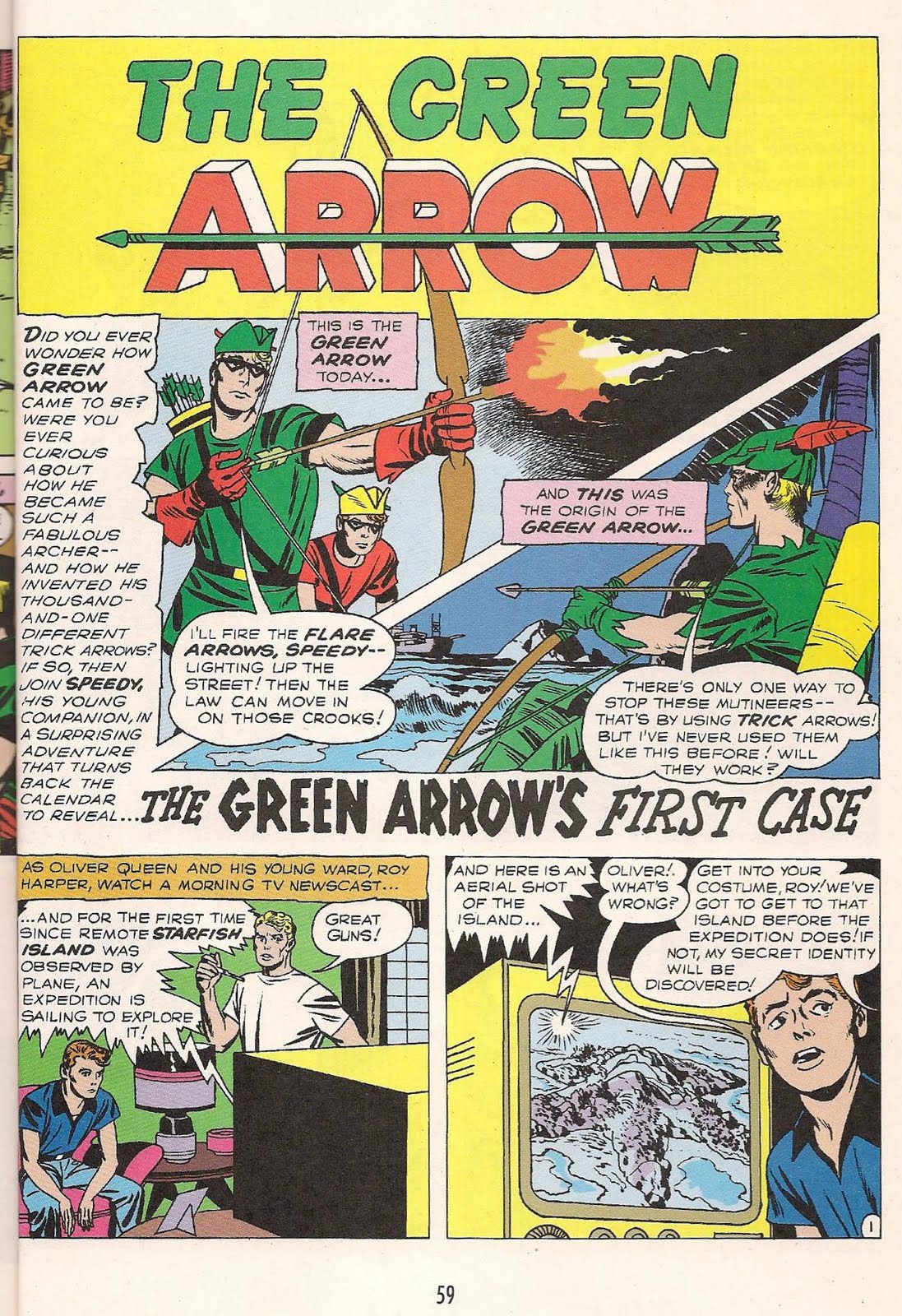
Fifteen years later, Ed Herron and Jack Kirby crafted a totally different origin story in "The Green Arrow's First Case" which appeared in Adventure Comics #256. After falling overboard during a sea voyage, millionaire Oliver Queen  washes up on Starfish Island, which, as the name implies, just happens to be shaped like a starfish for no reason that has anything to do with the story.  While stranded there, he makes a bow and teaches himself archery in order to survive, fashioning a variety of trick arrows to help him perform various tasks. Eventually,  a freighter anchors itself off shore. Swimming out to it, Oliver discovers that the crew has mutinied.  After using his archery skills and trick arrows to thwart the mutineers, Ollie hitches a ride back to civilization.  Upon his return, he continues using his new found mastery of archery to fight crime as the Green Arrow.
A revised version of this origin appeared as a part of a flashback sequence in the debut issue of Green Arrow's first ever eponymous mini-series in 1983 written by Mike W. Barr and illustrated by Trevor Von Eeden and Dick Giordano.  When his girfriend dumps him, Oliver Queen takes a cruise to help him escape the pain of his broken heart.  He gets more of an escape than he bargained for when pirates raid the ship and toss him overboard.  He eventually finds himself on a deserted island where he builds himself a bow and several trick arrows and teaches himself to shoot in order to survive.  Eventually,  the very same pirates who stranded him there come to the island to stash the loot from their latest act of piracy.  Ollie captures them using his newly developed archery skills and trick arrows.  Upon returning to civilization, Oliver decides to use these skills to fight crime in Star City as the Green Arrow.  
As you can see, Barr altered a few details from the Herron/Kirby story,  such as changing the mutineers to pirates and making them the reason for Ollie being on the island.  By the way, the  island isn't given a name in this or any of the subsequent future retellings and re-imaginings of the origin and is not depicted as having any unusual or distinctive shape.  The motivation for Ollie being on the ship in the first place is important in that the girl who broke his heart all those years ago naturally comes back into his life in the course of the mini-series. 
(That brings us to about the halfway mark of this overwrought essay, so I'm going to give my fingers a rest from typing and pick this up later.   In part two, I look at Mike Grell's take on Green Arrow's beginning and get to the current "official" version of the classic origin as related in Green Arrow: Year One.)

Monday, March 21, 2011

Sunday Comix Raffle to Benefit AFSP at S.P.A.C.E.

"Every 15 minutes someone dies by suicide."
That sad statistic comes from the web-site of The American Foundation for Suicide Prevention.  As far as I'm concerned, once every twenty years is more than enough.  In my life, I have lost two people that I have cared about to suicide.  First, my childhood best friend Eric "Igor" Brown in 1991, and most recently my nephew Steve Pisarchick in 2008.  
Thus, this past weekend at the 12th Annual Small Press and Alternative Comics Expo (S.P.A.C.E.), I organized a raffle at the Sunday Comix table, the proceeds of which went to the AFSP. 
Before the show, I took a basket, donated by fellow Sunday Comix member Canada Keck, around the room, filling it with comics generously donated  by many of the exhibitors to be the prize.  Throughout the day, as well, several other artists came up to the table and added to the prize pool.  By the time we finally held the drawing, the basket could no longer hold all the comics that had been donated. 
Selling tickets for $2, or 12 for $10, we managed to raise $168.  To that I added $32 from my own pocket to make a $200 donation to AFSP in Steve's memory. 
I would like to thank everyone at the show who donated comics, all those who bought tickets, and, most of all, my fellow members of Sunday Comix, especially Canada and Max Ink, for all their help and support.  I could not have pulled this off without it.
You can find more information about the American Foundation for Suicide Prevention, and make a donation on-line, at afsp.org.

Friday, March 18, 2011

Green Arrow Meets....Jon Sable?

Well, not really.  But in the story "Seattle & Die" from Green Arrow (Vol. 2) #'s 15 and 16 Ollie does encounter a character who bears many striking similarities to Mr. Sable.  The story was, of course, written by Mike Grell and drawn by Ed Hannigan, Dick Giordano and Frank McLaughlin.
It seems that Oliver Queen and Dinah Lance, a.k.a. the Black Canary, just can't enjoy a nice quiet night on the town without without finding themselves smack dab in the middle of an attempted robbery.  Whether its costumed crazies like the Riddler in Kevin Smith's Green Arrow (Vol. 3) #12, or a trio of garden variety street crooks as in this story, trouble just seems to find the pair wherever they go.  Ollie and Dinah are attempting to enjoy the music at a Seattle blues club when said crooks appear and demand that the patrons turn over their valuables.  Being who they are, our heroes leap into action to thwart the robbers.  When one of them has his shotgun pointed at Oliver, a man who had been quietly drinking at the bar all night pulls his own gun and kills him and the other would be robbers.  Naturally, he splits the scene before the cops arrive.
Our heroes aren't so fortunate, however, though Ollie is less than co-operative with the police.  Ollie's decided to find the mysterious shooter himself and get his side of the story.  Green Arrow tracks the guy to a fleabag hotel and the two share a drink and talk.  However, the mystery man choses to remain an enigma and Ollie leaves without having really learned anything.  As Ollie drives away, he sees an explosion coming from the mystery shooter's hotel room.
Rushing back to the room, Green Arrow encounters two men who identify themselves as Gavin and Daryl, agents of ASIO, the Australian Secret Intelligence Organization.   After their quarry, aided by Ollie, escapes, the pair of agents accompany Ollie back to his place.  There they tell Oliver and Dinah a story that should give anyone who's read the origin story in Jon Sable, Freelance #'s 3-6 a strong sense of deja vu.
The mystery man's name is Jake Moses.  In a former life, Moses was a long jumper who had once represented the United States in the Pan American Games.  In 1978, he and his new bride, fashion model Alison Gardner, travel to Africa on their honeymoon.  On a photo safari, they encounter a group of rhino poachers who open fire on the safari group.  Gardner along with their guide and tracker are killed and Moses is badly injured.  Upon regaining consciousness, he stumbles upon the poachers and kills them.  As one of the ASIO agents says,"The killin' got in 'im, and he got good at it," He becomes a mercenary who would work for anyone who could pay his price.
The story told by the ASIO agents is more or less a Reader's Digest version of Sable's origin.  Moses himself is essentially a dark reflection of Jon Sable, lacking Sable's moral center or talent for writing children's literature.  Also unlike Sable, Moses is driven by guilt, blaming himself for his wife's death, and increasingly turns to alcohol in an attempt to deal with it. Similar to Deadshot as written by John Ostrander in Suicide Squad, Moses appears to have a death wish, and in the story's climax makes a suicidal leap off the roof of the latest sleazy hotel that Green Arrow and the Australians had tracked him to. His fate is left ambiguous as the story ends with an image of Moses in mid-leap silhoutted by a flash of lightning.
This story leaves me wondering two things.  The first is, of course, what ever did become of Jake Moses.  The second is what a meeting between Green Arrow and the real Jon Sable might be like.  We'll probably never get a definitive answer to either question, though it's always fun to speculate. 

Wednesday, March 16, 2011

"Great Flaming Arrows!" Green Arrow Saves the World on Super Friends

I'm not really sure when and where I first encountered Green Arrow.  It may have been a battered copy of a mass market paperback reprinting of Green Lantern #76 and 77 that I bought for a dime at a flea market.  However, the more I think about it, the more I think that it was probably his lone appearance, alongside Wendy, Marvin and Wonderdog, on the original SuperFriends in 1973.
Not only was the episode entitled "Gulliver's Gigantic Goof" Green Arrow's only appearance on any of the various versions of SuperFriends, but it was his only appearance on television, period, until the debut of Justice League Unlimited over three decades later in 2004. Since then, he has made numerous television appearances, both animated in JLU, The Batman and Batman: The Brave and the Bold and live action in Smallville.
Many of the so-called villains on the first incarnation of  SuperFriends were not truly evil, but simply misguided.  Their intentions were always noble, but their efforts to improve the human condition inevitably backfired, endangering the entire planet and requiring the intervention of the Justice League.  After our heroes saved humanity they would then impart a valuable moral lesson to the impressionable youth of America.
One such well meaning scientist was Dr. Hiram Gulliver.  It was his intent to alleviate world hunger and over population by shrinking everyone in the world down to  a height of about two inches.  Rather than proposing his plan to the governments of the world or the United Nations, he just goes ahead and starts shrinking people.  In the course of attempting to stop Gulliver, the core group of SuperFriends, Superman, Wonder Woman, Aquaman, Batman and Robin, manage to get themselves shrunken and captured.  It's then up to none other than Green Arrow, despite ending up shrunken himself, to save the SuperFriends and put a stop to Gulliver's scheme.  First, though, he finds time to take a side trip to "Bornego," which appears to be somewhere in Africa, to rescue a pair of animal photographers from "giant" ants with the aid of his trusty trick arrows, as seen in this clip.
The voice of Green Arrow was provided by regular SuperFriends cast member Norman Alden, who also voiced Aquaman.
This one appearance doesn't really show much of the Green Arrow that I've come to know and love over the years, but obviously my eight year old self must have seen something there that appealed to me and would lead me to seek out Green Arrow's adventures in the comics.  Say what you will about SuperFriends, and, truth be told, it really wasn't very good, but I apparently do owe them that.

Monday, March 14, 2011

'Tec Support: "Night Olympics" by Alan Moore and Klaus Jansen

For the most part, my series of posts on Detective Comics will deal with the Batman stories, but in this special Green Arrow Month edition of 'Tec Support, I'll be taking a look at one of the back up stories starring the Emerald Archer. 
Green Arrow ended his days as a third string back up feature in the pages of Detective Comics in the mid-1980's before finally graduating to his own monthly series following The Longbow Hunters.  For the most part, the series was written by Joey Cavalieri, but in #'s 549 and 550, Alan Moore stepped in to contribute the two-part "Night Olympics," illustrated by Klaus Jansen. The title derives from Moore's comparison of night life in Star City to a sporting event.  

The plot of the story is fairly straightforward, you might even say simple.  It  involves a mohawked, bow wielding punk named Pete Lomax who's decided to make a name for himself by taking out a super-hero.  Thus, the first part of the story ends as gets Black Canary in his sights and fires.  In part two, an enraged Green Arrow pursues and captures Lomax.  
The only really interesting part of the story is the dialogue between Green Arrow and Black Canary toward the end of the part one. They are discussing the impact that the presence of super-heroes and costumed vigilantes like themselves has had on the criminal class.  "We're gradually weeding out all the just-plain-average goons, gradually improving the strain..." Ollie says, "...until only the flat-out-dangerous psychos are left running around."  This was a fairly new idea for 1985.  Such analysis of super-hero conventions was pretty much unknown in the Bronze Age and foreshadows the full blown deconstruction of the genre that Moore would undertake in Watchmen.
Even so, "Night Olympics" is not one of Moore's better works.  The prose in the captions is a particularly dark shade of purple and the sports metaphor becomes strained almost to the breaking point pretty quickly.   Still, Moore's name alone is enough to make this one of the few Bronze Age Green Arrow stories to be reprinted.  It appears in Across the Universe: The DC Universe Stories of Alan Moore, DC Universe: The Stories of Alan Moore (basically the same book, except it includes "Whatever Happened to the Man of Tomorrow?" and The Killing Joke) and Green Arrow/Black Canary: For Better or For Worse.