Showing posts with label super-hero. Show all posts

Sunday, May 18, 2014

Giffen's Legions Part 4: The Subs

The Subs from the cover of Superboy #243 by Mike Grell
The first, and for a long time the only, Legion comic I ever owned was Superboy and the Legion of Super-Heroes #243.  My favorite part of that issue has always been the brief appearance of the Legion of Substitute Heroes.  The issue took place right in the middle of the five part "Earthwar" saga.  Earth was under attack by the Khunds, but various other crises conspired to keep the Legion busy off planet.  So the Subs step up to the plate to fight off the invaders.  Of course, being the Subs, they were pretty quickly defeated, but by then I'd fallen in love with this plucky little band of wanna-be heroes. Well, maybe not love, exactly, but I did think that the Substitute Legion was a really cool idea.  So, years later, when I spotted a copy of the Legion of Substitute Heroes Special on the comics rack, I picked it up.  I was eager to see more of these heroes who'd so intrigued me, but wasn't quite expecting what I found inside, despite the joking cover. 
I'll talk more about that special later.  Right now, it occurs to me that it might be a good idea to go over just what the heck the Legion of Substitute Heroes actually is for the benefit of any readers out there who might not be familiar with the concept.  The Legion of Super-Heroes occasionally held open try-outs for Legion membership that worked kind of like the auditions for American Idol.  Would be Legionnaires would come to Metropolis from all across the galaxy to stand up in front of a panel of Legionnaire judges and demonstrate their powers in hopes of going on to Hollywood...excuse me, I meant being admitted into the Legion. In Adventure Comics #306, five of these rejected applicants decided to form their own group.  They acted as back-up to the real Legion, going into action when the proper super-heroes were unavailable.  The initial membership of the Legion of Substitute Heroes consisted of Polar Boy, with the power to make things cold; Night Girl, whose super-strength worked only in the absence of sunlight; Fire Lad, who could generate flames; Chlorophyll Kid, who could speed up the growth of plants; and Stone Boy, who turned to stone. 
Let's face it, the Legion of Substitute Heroes is a completely ridiculous concept.  Nowadays, of course, the trend is to take the silly ideas from comics written for kids and make them serious, adult, and dark.  I believe that Keith Giffen would take this route with the Substitute Legion late in his run on Legion of Super-Heroes Volume 4.  However, when he first got his hands on the Subs, a decade previous, he fully embraced their inherent silliness. In fact, he not only embraced it, but enhanced, making the Subs even more ridiculous than they already were. Of course, when I think about it, I suppose that could be seen as another way of making the Subs palatable to the so-called adult comics reader.
The real significance of DC Comics Presents #59 is reflected in the story's title, "Ambush Bug II."  It occured to me as I was  drafting this post in my head that perhaps someday I should write a piece on the evolution of Ambush Bug's character from his first appearance in DCCP #52 to the first issue of his first mini-series.  This post, after all, is meant to be about the Legion of Substitute Heroes.  For now, it should be sufficient to say that the Bug as seen in this story is much closer to the the character we know than he was in his initial outing.  There he was more of a run of the mill insane villain who actually murdered Metropolis' District Attorney on national television.  In his second appearance, while still technically a villain, the Bug is not so much evil but more of a trickster.  The role of the Subs in this tale is to serve as his foils.
The story is simple enough.  Ambush Bug decides to bug Superman just as the Man of Steel is beginning a journey through time and the two end up in the thirtieth century.  Superman has urgent business even farther into the future, so he decides to leave the Bug with the Legion of Super-Heroes for safekeeping until he gets back.  Unfortunately, no one's home at Legion HQ, so he drops his prisoner off with the Substitute Heroes instead, all the while hoping he won't come to regret the decision.  Needless to say he will, as the Bug quickly escapes and proceeds to raise havoc across thirtieth century Metropolis despite the efforts of the Subs and Superman to recapture him.
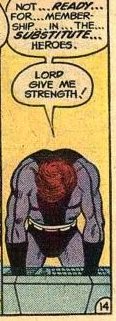
As with the real Legion, the membership of the Substitute Heroes underwent some changes over the years.  By the time I first encountered them, the initial five Subs had been joined by Color Kid, who had the power to change the color of any object. As of DCCP #59, Night Girl had left the team.  It seems she'd only wanted to join the Legion to meet Cosmic Boy, so once she started dating him she left those losers in the Subs behind.  New Subs included Infectious Lass, with the power to give people diseases, and Porcupine Pete, who was covered with quills and could project them but not with any accuracy.  When Ambush Bug proves a little too much for the Subs, they call in their newly created Auxillary, consisting of Heroes who weren't quite ready to be Substitute Heroes.  Those shown in this issue are Antenna Lad, who can pick up radion broadcasts, and Double Header, who has two heads. Yes, his sole "super-power" appears to be having two heads.  I suppose he must have figured that his options were limited to becoming a super-hero or joining a carnival.  He could have gone into politics, where a person with two faces can go far.
The Subs are portrayed in this story as well meaning but ineffective due to their limited powers and their inexperience.  This is consistent with the way they were used in the Earthwar, where they totally failed to make any difference against the marauding Khunds and really only succeeded in taking up two pages of story.  Being essentially an Ambush Bug story, DCCP #59 plays up the Subs' inadequacies for comic effect.  In addition to giving the Bug some more people to play off, the Subs efforts to stop him also tend to end up getting in Superman's way as he attempts to do the same.  At one point, in attempt to stop Ambush Bug, Chlorophyll Kid causes a tree to spring up out of nowhere, but its Superman who ends up colliding with it.
The Subs from their Who's Who entry by Giffen

Previously in this series, I've addressed the issue of new reader friendliness, and it occurs to me that anyone not steeped in Legion history might be at first be a bit confused by this issue, as Giffen and his co-writer Paul Levitz don't take the time to introduce the Subs either as a group or individually.  Even Legion fans might be at a bit of a loss, as the appearances of the Subs did tend to be few and far between. Still, I suppose, the fact that their function in the story is not really as full fledged guest stars but more as a plot complication makes such background superfluous in this case.
Giffen and Levitz do a little better on that score in the Legion of Substitute Heroes Special, however.  The book begins with a recap of the Subs origin in the form of a song, and throughout the issue Levitz provides background information on each of the members as they get their page in the spotlight.
"The Ballad of the Subs" Click to Enlarge and feel free to sing along

The story opens as the planet Bismoll, home of former Legionnaire Tenzil Kem, a.k.a. Matter Eater Lad, prepares to turn control of it planetary economy over to super-computers.  Kem, now a member of the Bismollian Senate, is suspicious of the computers, but not wanting to call out the Legion on a hunch he sends for the Subs instead.  We learn that Kem's fears are well founded on the title splash page when we get to see that all the giant computers resemble the Legion's old foe, the rougue computer Computo.  Of course, not being up on Legion history, I actually didn't get this reference at first, only fully appreciating it after I saw Computo's entry in Who's Who.  Nonetheless, you don't have to be a Legion scholar to realize that something's amiss when the rogue computers revive another old Legion foe, Pulsar Stargrave, giving him a new robotic body, and enlist his aid in conquering and ruling Bismoll.
Meanwhile, the Subs find themselves stuck on a satellite orbiting the planet, unable to get down to the surface.  After a couple of pages of this, there's a "memo" from scripter Levitz to plotter Giffen in which Levitz tells Giffen that he "can't dialogue a story that isn't going anywhere" and to "Get them the blazes down to the planet Bismoll already." Thus, without explanation, the Subs, with the exception of Infectious Lass, appear scattered at various locations around the planet.
In order to make the Subs capable of carrying their own Special, Giffen had two options.  He could have made them more competent and heroic, rushing into defeat Stargrave and proving themselves at last worthy of Legion membership.  Instead, he makes them even more comically inept.   Things start to go wrong even before they get to Bismoll, as Infectious Lass' uncontrollable power infects Color Kid with Grandin Gender Reversal Germs, turning him into a her, and the device they use to chose a leader for the mission instead merely knocks Porcupine Pete unconscious, while Stone Boy has turned himself to stone, in which state he is totally immobile, and forgotten to change back.
Needless to say, the Subs prove fairly useless against Stargrave, succeeding mostly in getting themselves into trouble.  Fire Lad sneezes and causes a major forest fire, and Color Kid finds herself trapped in a garbage incinerator.  Chloropyll Kid, who previously had been depicted with a traditional trim and muscular super-heroic figure but here is shown as short and pudgy, gets himself arrested because apparently it is a crime to be fat on Bismoll.
As in DCCP #59, its up to the more experienced former Legionnaire, in this case Matter Eater Lad, to stop the threat, though he does so with a little bit of help from Polar Boy and Stone Boy.
Their first starring role also turned out to be the Subs last hurrah, as the story ends with Polar Boy thinking "Maybe the Substitute Heroes wasn't such a good idea, after all..."  He subsequently went on to disband the Subs and ultimately joined the real Legion, eventually becoming the group's leader, a post he held when the Legion itself disbanded during the Five Year Gap.
I didn't read DCCP #59 until I got Showcase Presents Ambush Bug about five years ago.  Back in 1985, I was unfamiliar with Ambush Bug and knew the Subs only from their brief cameo in Superboy and the Legion #243, in which they were depicted as more or less traditional and serious super-heroes.  So, my first reaction to the Subs Special was something along the lines of "What the hell?"  Of course, over the ensuing years, especially as I've become more familiar with Giffen's body of work, I've come to appreciate this comic for what it is.  While not quite as laugh-so-hard-you'll-break-all-your-furniture hilarious as some of the early appearances of Ambush Bug, the Subs Special is a gently amusing send up of super-heroic conventions.  The story ends with a note from editor Karen Berger stating that Levitz and Giffen had gotten out of control and assuring the reader that the regular Legion title was nothing like this. The note ends "I'm sorry,everyone---really I am!"
Karen, if by some wild chance you happen to ever read this, I want to assure you that you have absolutely nothing to apologize for.   In fact, let me take this opportunity to thank you, as well as Keith and Paul, for all you've done for comics over the years. 

Monday, May 12, 2014

Giffen's Legion Part 3: Life After The Legion--Darkness, Light and Compromise

This is the post where I actually get around to discussing the story lines of Legionnaires 3 and Legion of Super-Heroes Volume 4.  Thus, spoilers lay ahead.  Tread carefully.
The greatest thematic similarity between Legionnaires 3 and the first year of Legion of Super-Heroes Volume 4 is that they both deal with life after the Legion.   The main characters of L3 are the three founding members of the Legion of Super-Heroes; Lightning Lad, Saturn Girl and Cosmic Boy. These three had recently, for different reasons, retired from the Legion and were no longer appearing regularly in the main Legion title.  Lightning Lad and Saturn Girl had recently had a child and left to devote themselves to raising him, while Cosmic Boy had simply decided it was perhaps time to do something else with his life.  LSH v4, of course, is the infamous Five Years Later version of the Legion, in which the team had been disbanded several years before the series picked up their story.  In both cases, the former Legionnaires learn that they can never truly leave their pasts, and especially the Legion, behind.
The two stories share a similarity in tone, as well.  While Giffen is best known for his humorous works, especially Ambush Bug and Justice League International, many of his comics, most famously LSH v4, can be quite dark.  Even Justice League has its serious moments, such as the Despero story line or the story in Justice League America #26, 27 and 28 where the Blue Blue Beetle, under the control of the Queen Bee, nearly kills Max Lord.
One of the criticism leveled against a lot of the so-called "grim and gritty" comics that followed the groundbreaking work of Alan Moore on Watchmen and Frank Miller on Daredevil and The Dark Knight Returns is that they copy only the surface darkness and violence of those works while missing the elements that truly made these comics great.  Giffen's LSH v4 is often lumped in with those clueless imitators.  However, I think that Giffen got it right with his Legion stories.
One thing that people often overlook about the seminal works listed above is that amidst the darkness, these stories contain an element of hope.  Miller's "Born Again" story in Daredevil is not the story of a man's life falling apart, its the story of a man fighting to get his life back.  The story ends on a hopeful note. By the the final issue of the story line, Matt Murdock has his life back.  It may not be the life he had before, but its one he has chosen for himself and one with which he is content. The Dark Knight Returns ends with Bruce Wayne embarking on a new chapter in his life with a new, more positive attitude.  Throughout the series, Batman would think in certain situations, "This would be a good death," but the story ends with him thinking, "This will be a good LIFE."
If you ask me, if anybody failed to see the hopefulness in Miller's work, especially on Daredevil, its Brian Michael Bendis.  His acclaimed run on the character is very good, I have to admit, but it is also almost unrelentingly bleak.  He just piles the crap on top of poor Matt Murdock and climaxes his run with Murdock sitting in a jail cell. 
Forgive my tangent. I was meant to be talking about Keith Giffen's Legion of Super-Heroes, wasn't I? Ok, then, let's get back on topic. 
The Legion of Super-Heroes had always been seen as presenting a utopian view of the future.  Of course, it was far from perfect.  To paraphrase Geoff Johns from Infinite Crisis, a perfect galaxy wouldn't need a Legion of Super-Heroes.  Besides, perfection makes for boring stories, especially super-hero stories.  There was always an Earthwar, a Magic War, a Great Darkness, an evil sorcerer, or a time traveling conqueror, not to mention Khunds, Dominators and other alien races of malicious intent, to keep the Legion busy.  Yet the Legion's world of the 30th century was one of hopefulness and optimism for the future of mankind.  Hell, sometimes it takes a heaping load of optimism just to imagine the human race surviving for another century, let alone a thousand years.  The Legion presented a universe where mankind had united and stood at the center of the United Planets, an alliance of civilized, space-faring worlds.  All of the threats I noted above were external, coming from outside the peaceful UP worlds.
By the first issue of LSH v4, however, the universe of the 30th century, even the once near utopian United Planets, had become a much darker place. The United Planets has all but dissolved in the wake of a galaxy wide economic disaster, the Khunds have initiated a new campaign of conquest while at the same time former UP worlds war amongst themselves, and the government of Earth (a.k.a. Earthgov) is revealed to have been infiltrated by Dominators decades earlier.  Worst of all, what had once been the light in even the UP's darkest hours, the Legion of Super-Heroes, is no more, hounded out of existence by a campaign of harassment from the Dominator controlled Earthgov.
That all does sound pretty bleak, but there is hope.  That hope lies in a reformed Legion.  Reep Daggle, the former Chameleon Boy, and Rokk Krinn, once known as Cosmic Boy, set about re-uniting their former comrades in arms becaues they are optimistic that the Legion is needed, and that they can make a difference and be the light that turns back the darkness that has spread throughout the galaxy. 
By the end of LSH v4's first year, it looks like Reep and Rokk's dream is going to come true.  The former Legionnaires have faced down two of their deadliest foes and emerged victorious.  The Legion of Super-Heroes, at last, lives again.  While it takes place against a dark backdrop, the first year of Keith Giffen's Legion of Super-Heroes Volume 4 is, in truth, a story about hope, optimism, and the belief that the right people can make a difference in even the darkest of times.
Although taking place in the near utopian environment of the pre-economic collapse United Planets, in many ways Legionnaires 3 is a much darker story than LSH v4.  It establishes the Time Trapper as a truly formidable villain and presents the three founding Legionnaires with a very personal tragedy, the kidnapping by the Trapper of Lightning Lad and Saturn Girl's son. The series does not exactly end on a hopeful note, either.  The heroes don't defeat the villain, they simply outlast him.  The conflict only ends when the self-imposed time limit that the Trapper set on what he calls his "game" runs out and the Trapper simply sends the former Legionnaires and the child home.  Furthermore, the Trapper's soliloquy on the story's final page makes it clear that even though this battle has ended, his war with the Legion is far from over.
I guess you'd call that ending an anti-climax, and its a hallmark of Keith Giffen's work, not just on Legion, but on Justice League and even as recently as Doom Patrol.  Many times the conflicts in Giffen's stories are resolved not by a knock down drag out melee between the forces of good and evil, but by negotiation and compromise, or often by the intervention of an outside force.  In LSH v4, the re-united Legionnaires free their former comrade Mysa, once known as the White Witch, from Mordru by coming to an agreement with the wizard after he and Rokk Krinn conduct negotiations over dinner.  This is quite similar to the mutual non-aggression pact reached between the Justice League and the Queen Bee at the end of the first four issue story line in Justice League Europe.  That's not to say that LSH v4 is lacking in action.  The Legion will fight when it has to, and some villains can't be reasoned with, such as the insane mass murderer Roxxas. However, Giffen recognizes that violence isn't always the answer and sometimes it takes more strength not to fight.
I'm pretty sure that this is my last post comparing and contrasting Legionnaires 3 and Legion of Super-Heroes Volume 4.  It may not, however, be my final word on Keith Giffen and the Legion of Super-Heroes.  After all, I haven't said anything about the Legion of Substitute Heroes yet. 

Sunday, May 11, 2014

Giffen's Legions Part 2: Welcome, New Readers! (...or not so much)

Before I get into today's post, I should offer a slight correction to something I wrote in part one of this series.  There are actually three full page splashes in Legion of Super-Heroes Volume 4 #12.  Yes, I have actually read the book, and do own a copy, however, I didn't look at it while I was writing the post, and the full page image of Celeste Rockfish bathed in a mysterious green light slipped my mind.  This error, though, in no way invalidates the point I was making about Giffen's use of splash pages in LHS v.4, as this "revelation" is pretty effectively telegraphed in the pages leading up to it.
To begin today's post, I invite you to join me on a journey through time, back three decades to 1985 where we will meet me as I was then.  I was quite different back then.  I hadn't yet taken up smoking, nor was I yet a coffee addict, and I was only just beginning to discover that I am not a man who can hold his liquor.  More relevant to our topic, I also was not yet the slavering obsessed comics fanboy that I would later devolve into.  I was a casual reader of super-hero comics at perhaps the last time in the history of the genre was such a thing was possible.
I knew little of the Legion of Super-Heroes.  While I was aware of the comic's existence, I didn't really know anything about the characters or the strip's then two and a half decade history.  Aside from a brief cameo in DC Comics Presents #2 and their appearance, along with every other DC hero, in Crisis On Infinite Earths, the only Legion stories I'd read were the 1977 JLA/JSA cross-over in Justice League of America #'s 147 and 148 and a 1978 issue of Superboy and the Legion of Super-Heroes that was part of the "Earthwar" saga.  As it was thirty years ago, I can't really say at this point what it was that motivated me to purchase the first issue of the Legionnaires 3 mini-series. I suppose, however, that having enjoyed the few Legion tales I had read, I was curious about the team and looking to learn more about them, and the first issue of this mini-series seemed a good place to start.
That, as it turned out, was a pretty accurate assessment.  Though I've still read relatively few Legion stories compared to the vast amount that have been published since 1958, of the ones that I have read L3 is probably the one that I'd recommend to someone as their first Legion comic, with the possible exception of the origin story in Superboy #147 or one of the retellings of that tale I mentioned in my post on that issue.
While the primary audience for this mini-series is obviously long time hardcore Legion fans, the series is carefully crafted to be welcoming to new readers as well.  The story can be read and understood by a reader unfamiliar with Legion history and I'd even venture to say that someone totally new to comics and unfamiliar with their language and storytelling conventions would have little problem following the action.    A knowledge of the history of the characters certainly provides a richer reading experience for those in possession of such facts, but it is hardly a prerequisite.  All the back story and information about the characters pertinent to the story at hand is laid out for the reading within the first issue.  Even the creative team's one questionable story telling choice, the decision to show three Legionnaires who are supposedly retired from active duty with the group lounging around at home and off duty in their super-heroing attire, was, as scripter Mindy Newell explains in answer to a reader in the third issue's letters column, made in the name of enhancing the reader's comprehension of the story by making recognition and identification of the characters easier.  Not only does this not make sense within the context of the story but is ultimately unnecessary due to penciler Ernie Colon's skill in rendering each character in the story in a unique and recognizable manner.  Even two characters who share similar characteristics, Cosmic Boy and Rond Vidar, and could, in the hands of a lesser artist, have been rendered almost interchangeably, stand out instead as distinct individuals.
To me, L3 stands out as a particularly well crafted example of what Colin Smith, writing about Stan Lee and Jack Kirby's work on the first Avengers #1 at his blog Too Busy Thinking About My Comics, terms the "paternalistic" approach to comic book story telling.  In this model, the creative team figuratively take the reader by the hand in order to, as Smith puts it, "guide them through a story in a highly controlled and specific sense."  Every story telling choice, from the dialogue and captions to the number,placement and size and shape of the panels to the composition of the images within those panels, is carefully calculated to enhance the reader's understanding and enjoyment of the story and produce in them the effect desired by the creative team.  To a greater or lesser extant, and with varying degrees of success, the paternalistic model was the dominant mode of comics story telling through most of the medium's history.
As far as I can tell, Legion of Super-Heroes Volume 4 represents one of the mainstream super-hero genres earliest moves away from the paternalistic approach, as well as an early flirtation with what has come to be known as decompressed story telling.
I think it may be time now for another disclaimer.  I may not be the most qualified person to talk about the issue of new reader friendliness. Personally, I don't mind a little initial confusion on jumping into a series, and a long and complicated back story usually doesn't deter me as long as the story I'm reading at the moment is understandable and enjoyable.  When I started getting into Doctor Who a couple of years ago, I found learning the show's fifty years of history to be as much fun as watching the current episodes.  With that qualification in mind, let me say that I don't find LSH v4 as impenetrable as it has acquired a reputation for being.
On the other hand, creators Keith Giffen and Tom and Mary Bierbaum certainly aren't holding our hands here, either.  They expect the reader to be a participant in the story telling process and do a little bit of work to make sense of what's going on.  As with any long running series, the long time reader has an advantage over the new reader, and that's especially true in LSH v4, although in the the letters columns, even some long time readers expressed a degree of confusion. Still, setting the beginning of this series five years after the end of the previous Legion book does serve to put both new and older readers on somewhat of an equal footing, as now neither knows the status quo.
In sharp contrast to L3's showing off duty heroes lounging around in their fighting uniforms, this series eschews super-hero costumes for at least the first twelve issues. Furthermore, the characters are referred to by their civilian identities rather than their super-hero code names. A few characters are referred to by abbreviated versions of their code names, but these are more like affectionate nicknames rather than noms de guerre, such as Brainy (Brainiac 5), Cham (Chameleon Boy, also referred to as Reep Daggle) and Vi (Shrinking Violet or Salu Digby). This is entirely appropriate in a story that begins with the Legion having been disbanded several years in the past, but this seems to have been one reason even long time readers, more familiar with the character's super-heroic names, experienced some confusion.
With overall lack of narrative captions, other than those tersely telling us what planet we're on, and establishing panels that just show background with no people along with several unattributed dialogue balloons, sometimes it can be difficult at first to figure out what's going on or who's speaking. Nonetheless, all the information the reader needs to fully understand each issue is contained within that issue.  Its just that it is not presented right up front and the readers has to piece it together for himself.
I'm a big fan of Keith Giffen's artwork, and the late 80'/early 90's is one of my favorite periods of his work.  He had synthesized his early Jack Kirby and Jim Starlin influenced style with the controversial influence of Jose Munoz to produce a style that blended cartooniness and realism in a way that particularly suited the super-hero genre.  His face and figure drawings are excellent, giving each character a recognizable individual look.  His background drawings, however, can at times be a little too busy and somewhat hard to interpret at first glance, especially when divided into multiple panels. 
In both its story and art, LSH v4 is most definitely a series that rewards, and in fact demands, repeated readings.  I find myself understanding and enjoying the story more each time I read it.
I also find that its best to read several issues  at one time, as the story does unfold rather slowly and developments in early issues do take some time to pay off.  The series would definitely benefit from being collected, but no such collected editions exist. 
 It seems that many people writing about LSH v4 experience a problem similar to the one I've been having in writing this post.  I really like the series, but the story telling approach taken by Giffen and the Bierbaums has it drawbacks as well as its pleasures and the series does take some time to get into.  In pointing this out, I may seem to be discouraging you from seeking this series out and reading it.  That however, is the exact opposite of my intent.  Legion of Super-Heroes Volume 4 is actually a series I would highly recommend. Anyone willing to be patient with the series and put the required effort into it will ultimately find it a rewarding reading experience.

Sunday, May 4, 2014

Giffen's Legions: Legionnaires 3 and Legion of Super-Heroes Volume 4

If, to open this post with a reference to an obscure episode of the animated Star Trek, Keith Giffen were to be kidnapped into space and place on display in an  interplanetary zoo for the amusement of giant slug-like extra-terrestrials (which could totally happen, you know), back here on Earth he would most likely be remembered by future generations of comics readers, if indeed there are to be any, for three things: Ambush Bug, Justice League International, and The Legion of Super-Heroes.  Celebrated primarily for his artistic contributions to the series in collaboration with long time writer Paul Levitz, Giffen also wrote, along with Tom and Mary Bierbaum, the controversial and divisive "Five Years Later" version of the Legion that appeared in Volume 4 of the series beginning in 1989.
However, Giffen's first crack at writing a Legion story came some four years earlier in a largely unheralded four issue mini-series entitled Legionnaires 3, with dialogue by Mindy Newell and art by Ernie Colon and Karl Kesel.  Perhaps I should qualify that statement a bit.  L3 was Giffen's first attempt at writing a serious Legion story featuring actual Legionnaires.  He had earlier written DC Comics Presents #59, co-starring the Legion of Substitute Heroes in 1983 and 1985's Legion of Substitute Heroes Special.  These efforts were more in the spirit of Giffen's work on Ambush Bug, however.  In fact, DCCP #59 featured that character's second appearance.
In contrast to the goofiness of those stories, L3 and LSH v.4, while they do contain flashes of humor, are for the most part deadly serious, even grim, affairs.  The first year of Volume 4 is concerned with the rebuilding of the Legion several years after the team's dissolution in the wake of a galaxy wide economic collapse that has left the 30th century a much darker and more dangerous place than it had been in the previous Legion series.  In L3, retired Legionnaires Lightning Lad and Saturn Girl's baby is kidnapped by one of the Legion's deadliest foes, the Time Trapper, in as part of a plot to destroy the Legion.  This post, however, is concerned not so much with the plots of the two series, but with the story telling choices Giffen makes in each and how they compare and contrast.
Giffen drew the early issues of LSH v. 4, with inks by Al Gordon, while on L3 he is credited as plotter and "designer".  I assume this means the same thing as "breakdowns", which is how his credit on the Justice League books read, thus the story telling choices are his for the most part, with Colon and Kesel following his lead.
A hallmark of both series is their dense visual story telling.  On Volume 4, Giffen famously, or infamously, stuck to a grid of nine equal sized panels for the overwhelming majority of pages.  This, combined with the text pieces at the end of most issues, even today draws comparisons between this volume of LSH and Alan Moore and Dave Gibbons Watchmen, which used similar techniques.  However, whereas Gibbons, while essentially sticking to the nine panel design, would judicially "combine" panels, eliminating the borders and gutters to create a larger uninterrupted image when it suited Moore's story, Giffen, for the most part, stuck to the grid seemingly at all costs.  Larger images, mostly establishing shots, where divided into two or three panels.  Also, ocassionally a single drawing would be reproduced across several panels.
L3 is, if anything, even more dense.  While not bound to a rigid nine panel pattern, each page is similarly packed with images.  There are very few pages with fewer than six panels, and one page in the first issue crams in a whopping thirteen panels. Unlike Volume 4, in which Giffen's nine panels were all of uniform size and shape throughout, even on pages with nine or more panels Colon gave greater emphasis to some images by varying the width of panels within the grid.  This was accomplished through the widening of certain panels to allow more to be shown while narrowing others in order to focus attention on detail.  Many pages consist of a relatively large image, running either across the top or bottom of the page or in some cases along the side, accompanied by a series of smaller panels.  While not meaning to diminish Colon's contributions to the storytelling, I'm attributing thes story telling techniques to Giffen, as perhaps communicated through his "designs."  He uses similar techniques in Legion tales of the period that he drew himself, such as the story contained in Tales of the Legion of Super-Heroes Annual #4.
The profusion of smaller panels serves to give the sporadic half and full page images, when they occur, a greater impact.  Full page splashes are not there merely to show off Colon and Kesel's beautiful art, though, make no mistake, the art in L3 is some of Colon's best super-hero work and Kesel's inks are part of the reason for that, but instead they serve to give proper emphasis to moments that are meant to shock or surprise the reader.  
While full page images are decidedly far rarer in Giffen's work on Volume 4, their impact, perhaps somewhat paradoxically, is not as great.  For the most part, the few story ending full page images serve to re-emphasize certain story points rather than to shock or reveal new information.  Most effective are the blank white pages at the end of issues #4 and 5 after the time line is shattered first by Mon-El's destruction of the Time Trapper then by Glorith's spell to restore the former time line.  The sixth issue's full page reintroduction of Jan Arrah, formerly known as Element Lad, is hardly shocking or even mildly unexpected.  After all, it is Arrah who Celeste Rockfish, Bounty and Devlin O'Ryan traveled to the dead planet Trom to find, and he is, in fact, the only living being on the planet.  Issue #12 contains two full page splashes.  The first is merely a field of stars with the words "The Legion of Super-Heroes" in the middle of the page.  This somewhat redundantly serves only to re-emphasize the point made by the previous pages nine panel exchange of dialogue between Rokk Krinn (Cosmic Boy) and Reep Daggle (Chameleon Boy) that the Legion has at long last been reborn.  The final page splash serves as a cliffhanger, emphasizing the danger that the newly introduced character Kent Shakespeare is in from the escaped villain The Persuader.  
Well, folks, it looks to me like we've got a series on our hands here.  Having said, I believe, all I have to say on the use of panel layouts in L3 and LSH v. 4, the next part will deal with the thorny issue of accessibility, or new reader friendliness.

Sunday, April 27, 2014

Citizen Kent

It was three years ago this very week in  a soon to be controversial short story appearing within the pages of the milestone 900th issues of Action Comics, that Superman announced his intention to formally renounce his United States citizenship.  Why, you may be asking yourself, am I only just writing about this instead of venting my spleen on the subject back when people actually cared?  Simply put, the truth is that I had not read the story in question and I really didn't give half a crap about the latest manufactured controversy that was getting the panties of all the Fox News commentators and others of their ilk in such a twist.  The even more shocking truth, though I feel that I must reveal it in the interests of full disclosure and integrity and other such quaintly last century concepts, is that I still haven't read the story and, quite frankly, I still don't care about the whole controversy that much.  I have, however, recently been reading some of the reactions and  commentaries, including those emanating from Fox News, that popped up on-line at the time. 
Everything that I read brought one question to the forefront of what's left of my mind these days.  What does it mean?  What, to be perhaps redundantly specific, does it really mean for Superman to give up his citizenship?
Upon thinking about it further, this invariably led to other questions.  Is Superman really an American citizen at all? Is Superman even real?
Now before you accuse me of being delusional and unable to distinguish between fact and fantasy, let me assure that I am not about to tie a beach towel around my neck and leap off the roof of my apartment building shouting "Up, up and away!"  For one thing, I have neither a beach towel nor access to the roof.  More to the point, I am fully aware that Superman is a fictional character created by a couple of teenagers from Cleveland back in the 1930s and not in any sense "real" in our world.  When I ask if Superman is "real" I am speaking solely within the context of the fictional reality in which his never ending story is set.
When you get right down to it, Superman is, as John Byrne took great pains to emphasize when he revamped the character back in 1986, merely a leotard, a pair of boots, a cape and a spit curl.  He is a disguise, an assumed identity that allows Clark Kent to carry out his morally dubious, extra-legal super-powered vigilantism under a cloak of anonymity. 
It is Clark Kent who is the U.S. citizen, and presumably remained so even after having his public hissy fit in front of the entire world as Superman.  Hiding within the persona of Superman allowed Kent to be able to stand up in front of the cameras and tell America what it could go do with itself while escaping the consequences.   I assume that there would be some consequences in our reality if a high profile celebrity without a secret identity that he could retreat into publicly renounced his status as a U.S. citizen.  At the very least, I suppose that the now former citizen would be asked to exit himself from our shores immediately.  Kent, on the other hand, can slap on a pair of hipster glasses and a blue suit and go back to apartment at 344 Clinton Street in Metropolis and his job as a mild-mannered reporter for a great metropolitan newspaper as if nothing ever happened.
That lack of repercussions makes Superman renouncing his non-existent American citizenship a meaningless, empty gesture.  Therefore, the entire story itself, no matter how well written or beautifully drawn it may have been (and the pages I've seen on-line have been quite lovely, as a matter of fact), is totally pointless and a waste of paper.   Thus, pointless, as well, is all the right wing bluster that accompanied the story's publication.  But then, right wing bluster is usually pointless, no matter what the blowhards are blustering about, isn't it?

Superboy #147

I'd never read the lead story  in Superboy #147 before yesterday, yet I'd read the story many times.  The seeming contradiction in that previous sentence dissolves once I reveal that this is the story that finally, a dozen years on since their initial appearance, revealed the origin of the Legion of Super-Heroes.  It's a story that has been told and retold, with only slight modification, many times since.  Besides this issue, my vast accumulation of old comics includes the Legionnaires 3 mini-series, Secret Origins #25, and Legion of Super-Heroes (Vol. 4) #1, #8 and #0, all of which contain retellings or summaries of these same events.
Thus, anyone with even a mere passing knowledge of the Legion and its history, such as myself, should not need me to provide a recap of the story. However, I'm going to do so anyway.  
Three teenagers, Garth Ranzz from the planet Wynath, Rokk Krinn of Braal, and Imra Ardeen, a native of Saturn, find themselves travelling together as passengers on a spaceship bound for Earth.  Each has their own reasons for coming to our world.  Garth is searching for his missing brother, and  Rokk has come to find work, while Imra has hopes of joining the interplanetary law enforcement agency known as the Science Police.  Additionally, each of the trio of youngsters has their own super-power.  Rokk's and Imra's are innate.  Everyone on Braal has magnetic powers, and all Saturnians are telepathic.  Garth's electrical powers are the result of an attack by Lightning Monsters while out joyriding with his twin sister and brother, who gained similar powers in the incident.
Also on board is R.J. Brande, whom Rokk describes as "richest man in the universe."  When the ship lands on Earth, a pair of gunmen attempt to assassinate Brande on behalf of his shady cousin Doyle.  After Imra reads the killers' minds and warns the tycoon of the danger, Garth and Rokk use their powers to disarm and capture the criminals. The grateful Brande invites the heroic trio to meet him in his office the next morning where he offers to set them up as a team of teen super-heroes inspired by the example provided by 20th century legend Superman through his adventures as Superboy.  
The subsequent retellings of the tale to which I alluded above are all remarkably faithful to this seminal version by writer E. Nelson Bridwell and artist Pete Costanza.  The basic story survived the continuity changes of Crisis On Infinite Earths, and writer Paul Levitz even found a way to keep Superboy as a part of  Legion history after John Byrne's revamp of Superman wrote that phase of the Man of Steel's life out of existance.  The most significant alteration of the origin came with Legion #8 in 1990.  Apparently  operating under an editorial decree that all ties between the Legion and Superman be cut, writers Keith Giffen and Tom and Mary Bierbaum fashioned a new time line in which the inspiration for the Legion's founding was not Superboy, but rather Daxamite hero Lar Gand, the former Mon-El now to be known by the name of Valor.
It's interesting that, aside from a cameo on the splash page and a brief mention at the end of the story, the title character of the series does not appear in the lead story of his own book.  This foreshadows developments of just over a decade hence when Superboy would abandon the title, which had become known as Superboy and the Legion of Super-Heroes some years earlier altogether, after which it would be entitled simply Legion of Super-Heroes, and finally Tales of the Legion of Super-Heroes before ultimately being canceled in 1987. 
The remainder of this 80 Page Giant issue is filled out by a quitnet of reprints re-presenting the initial appearances of several Legion members or elements of the Legion mythos, as well as the story in which Supergirl is inducted into the group.   The Legionnaires whose debuts are shown are Ultra Boy, Triplicate Girl, Phantom Girl, Sun Boy, Bouncing Boy, Shrinking Violet and Brainiac 5.  Also included are the initial appearances of the Legions of Super-Villains and Super-Pets, the latter consisting of Krypto, Streaky the Super-Cat, Comet the Super-Horse and Beppo the Super-Monkey.
"The Legion of Super-Traitors," the tale which introduces the Super-Pets, has a couple of pieces of unintentionally hilarious dialogue.  After Superboy, under the influence of the sinister Brain Globes of Rambat, attempts to kill Krypto, meeting, understandably, with a look of disapproval from the super-dog, the Boy of Steel, still controlled by the Brain  Globes, thinks to himself, "Where does this mere mutt get off looking down his wet nose at the mightiest boy in the universe?"  Where, indeed?
Later, as Krypto attacks one of the Globes, it pleads, "Don't come near me, Accursed Mongrel!"  In reply, Krypto thinks, "Accursed mongrel, huh?--Making with the mental digs, eh?  Okay, you're asking for it, Buster!"  Yeah, baby, it is ON! Krypto don't take no shit from nobody!
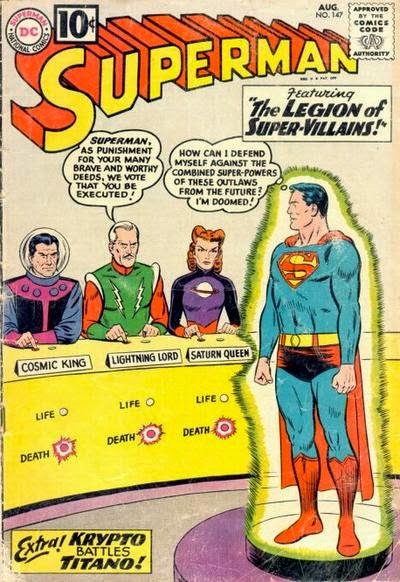
Since this post is part of my series on 147th issues, I'm going to go into a little more detail here on the final story in the book, which first appeared in Superman #147.  This is the tale which introduces the Legion of Super-Villains in a story by Superman co-creator Jerry Siegel and artists Curt Swan and Sheldon Moldoff imaginatively entitled "The Legion of Super-Villains."
The story begins with an imprisoned Lex Luthor volunteering to help out his fellow convicts by repairing their broken radios.  Clandestinely stealing parts from every unit he works on, Luthor builds a device capable of communicating with the future.  Knowing of the existence of the Legion of Super-Heroes, Luthor has reasoned that there must also be a Legion of Super-Villains to oppose them.  His attempt to contact the villainous Legion is answered by the appearance in his cell of futuristic devices which he uses to escape.  Shortly, he hooks up with the Super-Villains themselves, who proceed to introduce themselves and relate their origins.
Cosmic King is a scientist from Venus who invented a ray that could transmute matter, and who gained that power for himself after being zapped by his own ray.  Unfortunately for him, his dreams of fame and fortune are short circuited when he learns that transmutation is considered a great evil on Venus and he is subsequently banished from his homeworld, leading him to journey to Earth and take up a life of crime.
Lightning Lord is the brother of Legionnaire Lightning Man, formerly Lightning Lad.  He relates a slightly different version of the incident which gave him and his brother powers which does not include any mention of their sister, whose first appearance as Lightning Lass was still two years in the future as of this story's initial publication.  A footnote added for this reprint observes that "Lightning Lord hasn't told the full truth," and directs the reader to "See the first story in this magazine."  Well, of course he's lying. He IS a super-villain, after all, and therefore EEEE-VIL.
Saturn Queen comes from Saturn, where there is no crime.  Upon arriving on Earth, however, she suddenly felt compelled to use her powers of super-hypnotism to become a criminal.
The evil Legionnaires lure Superman to a planet in another solar system and trap him in a Kryptonite force field.  Luthor is prepared to execute his archenemy when the adult version of Superman's former teenage pals in the Legion of Super-Heroes arrive.
The two Legions battle to a stand off until Superman tricks Luthor into releasing him from the force field, after which he journeys to Saturn and uses a giant shovel gather material from Saturn's rings and encircle the planet where he had been imprisoned with it.  Apparently it is radiation in the rings of Saturn that affects the minds of its citizens and keeps the world free of crime.  Under the influence of Superman's newly created ring around this planet, Saturn Queen turns against her comrades, tipping the balance of power and winning the battle for the good guys.  The good Legion take their evil counterparts back to future and Superman returns Luthor to his cell on Earth.
While I'm reluctant to criticize the work of one of the men who invented the entire super-hero genre and without whom I would not be writing this blog, I have to say that the level of imagination reflected in the rather bland title of the story is, unfortunately, on display throughout the entire eleven pages of the story.  It is a rather pedestrian and unremarkable tale, aside from its importance in Legion history. 

Sunday, March 23, 2014

On The Horizon: Infinity Man and The Forever People

I have, for reasons that are primarily financial in nature, taken a break from purchasing new comics in recent months.  However, while looking over J. Caleb Mozzocco's monthly rundown of upcoming comics from DC at Everyday Is Like Wednesday, my attention was caught by one particular item that might just be enough to pull me back to the Laughing Ogre for at least one Wednesday a month.
The second week in June sees the release of Infinity Man and the Forever People #1.   This is yet another updating of one of Jack Kirby's Bronze Age concepts by Dan Didio, Keith Giffen and Scott Koblish. That's the same team responsible for the late OMAC title.  Given the success, or, rather, lack thereof, of OMAC, that might not really be something to brag about.
I enjoyed OMAC quite a bit and it was widely hailed as one of the best  books of the original New 52.  Sales, as is too often the case, did not match the critical acclaim and the series met a premature end after eight issues in the first wave of New 52 cancellations.
With just the limited information provided by the solicitation to go on, there are a couple of things about this new series that strike me as interesting or curious.  The first is the title of the book itself, which gives top billing to the Infinity Man.  In Kirby's original series, Infinity Man played a very small part, appearing in less than half, four out of eleven to be exact, of the issues.  He was, quite literally, a Deus Ex Machina, showing up at the end of an issue when the Forever People touched their living computer, Mother Box, and shouted a magic word in order to mop up the bad guys and get the Forever People out of whatever mess they'd gotten themselves into in the preceding twenty pages or so.  Infinity Man was never much of a well rounded character in his own right.  He spoke in cliched heroic platitudes and displayed little personality beyond a selfless nobility and devotion to the Foerever People.  His true nature and origins were never explored, though perhaps, if the book had continued past its eleventh issue, they might eventually have been. The series was, to be honest, much better off without him in my not so humble opinion.  Giffen and Didio have a lot of work to do with Infinity Man if they're going to develop him into a character worthy of star credit.
Secondly, as I looked over the cover, this little detail caught my eye:

It appears that in this new series, Giffen and Didio have made Serifan a woman.  While I don't really think this is such a major change to the original concept and won't make too much of a difference, I do predict howls of outrage all over the Wild, Wild Web from Kirby purists.  For me, it all comes down to how its handled, and I generally have pretty high expectations of Keith Giffen, so I'm somewhat optimistic.
That is, I'm optimistic for the creative success of Infinity Man and the Forever People.  Commercially, I honestly don't expect it to do much better than OMAC.  That series managed to match the eight issue run of Kirby's original series, so my prediction is that Infinity Man and the Forever People will do the same and last a whole eleven issues before being cancelled.
Giffen has been doing the best art of career in the past five years or so, and his stories are always entertaining, so I'm sure that Infinity Man and the Forever People will be worth reading however long it lasts.

Monday, March 17, 2014

The Greatest G'Nort Stories Ever Told

In honor of St. Patrick's Day, we turn our attention to one of the super-hero genre's proudest wearers of the green; a most distinguished member of that fabled cadre of interstellar policemen known as the Green Lantern Corps.  I speak of the greatest being ever to wear a power ring, none other than the inimitable G'Nort Esplanade Gneesmacher.  From the moment that he burst upon the scene in 1987's Justice League International #10, this furry wonder immediately captured the hearts and minds of comics fans the world over, and quickly became a beloved fan favorite.
Well, maybe not, but I like him.  Thus, I have compiled a list of what I consider to be the five best stories featuring the character. 

5. Justice League America #36 
"G'Nort by G'Nortwest"
by Keith Giffen, J.M. DeMatteis, Tom Artis and Art Nichols
For the number five spot on my list, it was a toss-up between this issue and Justice League Quarterly #2's "Designing Humans."
"G'Nort by G'Nortwest" finds G'Nort's "arch-enemy", by virtue of being the only criminal G'Nort ever actually apprehended, the Scarlet Skier, former "locater" for interplanetary designer Mr. Nebula, coming to Earth after being released from prison to seek revenge on the Green Lantern who put him behind bars.
The JLQ issue, in which Mr. Nebula comes to Earth looking for the skier and the Justice League must prevent him from redecorating the planet, is actually, in my opinion, a better story.  However, JLA #36 features G'Nort more prominently, so it makes the list.

4. Green Lantern #9-#12 
 "A Guy And His G'Nort"
by Gerard Jones, Joe Staton and Bruce Patterson

Although this was billed as the first ever Guy Gardner solo story, the JLI's brain damaged ring-bearer isn't exactly going it alone for these four issues.  He's got ol' G'Nort in tow as the two go on a quest to uncover G'Nort's true origins.  After the newly returned Guardians of the Universe reveal that they've never seen or heard of G'Nort before, Guy and G'Nort uncover a plot by the Thunderers of the Anti-Matter universe of Qward to discredit the Green Lantern Corps by distributing fake GL rings to idiots like G'Nort.  G'Nort, however, proves himself truly worthy of the ring when he sacrifices his power to save Guy.

3.  Mister Miracle #6  
"Barking Up the Wrong Tree"
by Giffen, DeMatteis, Mike McKone and Peter Gross

When some two-bit gangsters try to get a protection racket going in Bailey, New Hampshire, the small town where Scott Free (a.k.a. Mr. Miracle) and his wife Barda have settled down, Oberon contacts the Justice League for help and G'Nort answers the call.  Any story that contains the line "Help! A giant dog is trying to sell me insurance!" has got to be a classic.

2. Justice League America #51
 "My Dinner With G'Nort"
by Giffen, DeMatteis, Adam Hughes and Joe Rubinstein

I actually have two copies of this issue.  One is to read, and the other is bagged, boarded and signed by artist Adam Hughes.
When G'Nort drops by the JLI's New York embassy for a surprise visit, a bored of his skull Kilowog invites his "brother alien" out for a night on the town.  J'Onn J'Onnz, the Martian Manhunter, tags along to keep the pair out of trouble.  You can imagine how well that works out.  You've got to wonder who thought that taking G'Nort to see Cats was a good idea, and things only get worse when a super-villain attacks during dinner.
This issue was a serious candidate for the top spot on the list, but after some consideration I decided to give it to:

1. Justice League America Annual #4 
 "What's Black and White and Black and White and Bl..."
by Giffen, DeMatteis, McKone and Bob Smith

 After inadvertantly foiling a robbery, which they themselves had intended to commit, the quintet of inept second rate super-villains known as the Injustice League find themselves hailed as heroes and decide to go straight, offering their services to the Justice League International.  Together with G'Nort and the Scarlet Skier, they become Justice League Antarctica and soon find themselves facing a horde of genetically engineered, man-eating penguins.
There you have it, dear readers.  The Top 5 G'Nort stories.  Proof, if any were needed, that G'Nort Esplanade Gneesmacher is indeed the greatest canine Green Lantern of them all.

Sunday, February 2, 2014

Super Sunday IV: Elliot S. Maggin's "Superman: Last Son of Krypton"

Once again, in somewhat of an annual tradition, while the vast majority of the nation focuses its attention on some sort of big sporting event or something like  that, we hear at Gutter Talk HQ turn our attention to telling readers of this blog about a classic tale of the Man of Steel.  This time out, our subject is not one of the character's comic book exploits, but one of his early ventures into the realm of prose novels. 
Regardless of outward appearances, despite the fact that it uses the  film's crystalline Superman logo, notwithstanding the picture of Christopher Reeve in his Superman costume on the cover, and setting aside the sixteen pages of black and white photos from the movie embedded in the center of the book, Elliot S. Maggin's 1978 novel Superman: Last Son of Krypton is not an adaptation of the then newly released Superman: The Movie.  Rather,  it is an original tale set in a rough approximation of DC's Bronze Age Earth-One continuity and reflects pretty accurately Superman as he was appearing in the comics of the day, many of them, not coincidentally, also written by Maggin.  As had been the case for several years in his comics titles, Superman, in his secret identity of Clark Kent, works not as a mild mannered reporter for a great metropolitan newspaper but as anchor for the WGBS six o'clock news and fairly recent additions to the supporting cast Steve Lombard and Morgan Edge figure prominently in the story alongside old standbys Lois Lane, Perry White and Jimmy Olson.
It has been said that the advantage that comics had over film, especially in the pre-CGI days when this novel was published, is that they could portray things that were beyond the scope of special effects technology.  Comics, especially in the Bronze Age, had their own limitations, however.  One was space.  A typical single issue of the day contained a mere seventeen pages of story, and, at least at DC, single issue stories, or at least stories no more than two or three issues in length, were still the norm.  Words and pictures, of course, take more room to tell the same events than words alone, thus far more story could be conveyed in a 238 page novel, allowing Maggin to tell an epic, cosmic science fiction adventure story on a scale previously unattempted in any Superman comic.
Maggin peppers the novel with many of his signature themes and tropes.  The author's admiration of Albert Einstein is well known among comics fans and the renowned physicist, though never actually identified, is a major character in the novel as well as a main motivating factor in the plot.  The Guardians of the Galaxy, from Green Lantern, make an appearance, and in a nod to the classic Dennis O'Neil/Neal Adams "Hard Traveling Heroes" era of the book, the exiled Guardian known as the "Old Timer" shows up.  Part of his purpose in the story is to give voice to another of Maggin's favorite themes as he, in  disguise as a human sociologist being  interviewed by Lois Lane for a TV talk show, warns of the possible negative effects of Superman's presence on Earth on human evolution, echoing Maggin's earlier short comics story "Must There Be A Superman?"
The novel begins begins with a retelling of Superman's origin, but with a new spin.  Prior to baby Kal-El's arrival on Earth, a probe carrying a message from Jor-El visits Einstein, who, as "the most highly developed intellect" on Earth, is entreated by the Kryptonian to take in and raise his son.  Instead, the aged scientist travels to Smallville, Kansas, near where Kal-El's rocket is to land, and chooses a local couple, Jonathan and Martha Kent, whom he deems suitable to give the Kryptonian child a good upbringing.  Through the ruse of selling the Kents a new tractor, he maneuvers the couple into position to discover the child from the stars upon his arrival. 
The novel then moves to the present day, as Superman's arch-enemy Lex Luthor makes plans to steal a document left behind by the now late Professor Einstein and sealed in a vault for the last quarter century.  Einstein, it turns out, is a personal hero of the criminal scientist, and it is speculated that the document may contain one last scientific breakthrough.  
Lex makes off with the document, but it is, in turn, stolen from him by an alien named Towbee on behalf of the Master, not the Doctor Who villain but the ruler of the planet Oric in the Vega system.  After meeting with the Old Timer, Superman recruits Luthor to journey with him to Oric and aid him in retrieving the Einstein papers.  Once on Oric, the unlikely allies discover a plan by the Master to make himself ruler of his section of the galaxy, after he has, by manipulating black holes, physically separated that arm of the galaxy from the rest of the rest of the Milky Way, thus putting him out of the Guardians' jurisdiction and beyond the reach of the Green Lantern Corps.
One of the best things about the book is Maggin's exploration of the character of Lex Luthor, who emerges as much more than simply a two dimensional mad scientist.  Throughout the early chapters of the novel, Maggin introduces flashbacks to Clark Kent and Lex Luthor's childhood days in Smallville.  He expands the story of how Luthor came to hate Superboy, giving the future villain a more emotionally resonant and realistic reason for his emnity toward the hero than simple vanity over the loss of his hair.  Superboy, in his attempt to save Luthor's life, in Maggin's account not only causes the permanent loss of Luthor's hair, but destroys his greatest experiment as well. 
I've wondered recently how come someone supposedly as smart as Luthor never figured out that Clark Kent and Superman were the same person, especially since he knew both of them back in Smallville.  After all, both Clark and Superman are about the same age, each left Smallvile at the same time, and then showed up in Metropolis at pretty much exactly the same time.  It really doesn't take a scientific genius, as Luthor purports to be, to put two and two together and come up with something other than mere coincidence. 
Okay, digression over, let's wrap up this post.
While Superman: Last Son of Krypton is dressed up as a novelization of the first Superman movie, it is, in my opinion at least, something even better; the ultimate Superman epic from one of the character's premier writers. 
Here are some links to sites where you can get other opinions and perspectives on today's topic (and maybe even buy a copy):


Wednesday, January 22, 2014

DC Solicitations Confirm April Release of New Volume of "Secret Origins""

From the "Great Minds Think Alike" Department:
"What this DCU needs more than a Secret Origins title is a "Lost Years" one, filling in the blanks of what happened between the origins and the stories of September 2011.--J. Caleb Mozzocco on Everyday Is Like Wednesday on Tuesday, echoing a point I made on Saturday.
Anyway, as I reported, or, perhaps more accurately, repeated (from an item on Bleeding Cool) on Saturday, DC will indeed be releasing the first issue of a new volume of its venerable Secret Origins title in April.  Confirmation of this came Tuesday with the on-line release of the publisher's solicitations for the month.  As I predicted in my previous post, the new series will follow in the tradition of its two past incarnations and commence with an account of Superman's beginnings.  Also included in the debut issue will be the post Flashpoint origins of Supergirl and original Robin Dick Grayson.

Sunday, January 19, 2014

Also In April--"Amazing Spider-Man" Returns

It has been some time since I purchased or read a new Spider-Man comic.  However, I am tuned in enough to the zeitgeist that I am aware of the whole "Superior Spider-Man"/Doc Ock in Peter Parker's body story line that has been the character's status quo for the past year or so.  Nobody, I'm sure, was naive enough to think that this state of affairs would last forever.  Thus, in a development that will shock absolutely no one, I read recently on the Hero Complex blog that Peter Parker returns to life and his super-heroic career in April and does so in a brand new Amazing Spider-Man #1.
This will be the third ASM #1 that Marvel has published in the character's fifty two year history.  The first was, of course, the Stan Lee/Steve Ditko original from 1962.  The next one came in 1998 when Marvel tried to revive the ailing Spider-Man franchise in the wake of the almost universally poorly received Clone Saga.  The second volume of Amazing Spider-Man lasted for 58 issues until the series was returned to its original numbering with #500. From that point, the series continued until last year's 700th issue, although #'s  700.1 through 700.5 have popped up in the interim between then and now.
Considering Marvel's tendency to screw around with the numbering of its series in order to try and produce at least a temporary bump in sales, I predict that this latest volume of Amazing Spider-Man will last exactly 49 issues.  By then, it will be time for another trumped up anniversary issue and the series original numbering will re-emerge yet again with #750.
Check back here in two to four years, depending on what kind of games Marvel plays with the scheduling, to see if I'm right about this one.

Thursday, October 24, 2013

What's In A Name?

In January, Marvel Comics will release Miracleman #'s 1 and 2, beginning a semi-monthly series reprinting the seminal early 80's stories by Alan Moore that are credited by many comics historians with giving birth to the so-called Modern Age of super-hero comics. At least I think these are the Alan Moore stories.  The solicitation credits "The Original Writer" and Mick Anglo, the man who created the character as a substitute for the original Captain Marvel back in the late 50's.  Apparently the plan is that once the reprints of the stories by TOW and his successor Neil Gaiman ("The Un-Original Writer"?) are exhausted, Gaiman will at last be given the chance to continue and conclude the story begun over two decades ago and interrupted by the demise of publisher Eclipse Comics and the long legal battle over the rights to the character.
There are a couple of interesting things about the solicitation for these books.  The first is that, as noted above, the name of Alan Moore, who is well known to have written these stories despite the solicit's coyness, does not appear in it.  By the way,  I am unable, nor do I actually feel the need, to  restrain myself from observing at this juncture that I find the reference to Alan Moore as "The Original Writer" somewhat ironic in light of the longstanding  suspicions/allegations/rumors concerning the actual originality, or lack thereof, of these comics and a couple of other of Moore's best known and well regarded works from the mid-1980's.
The omission of Moore's name in the solicitation is apparently in accordance with Moore's request that Marvel and DC no longer use his name in publicizing reprints of work he did for them back when he didn't think they were the source of all evil in the universe. Marvel, I would assume, was only to happy too comply with Mr. Moore's wishes if only to avoid the backlash of negative publicity that greeted DC's flagrant flaunting of the writer's preferences in publishing its series of prequels to Watchmen.  
This development is, as I said, interesting, although, given Moore's highly publicized contempt for the mainstream of the American comics industry and the reverence with which his every mood swing is regarded by comics fans, hardly surprising.
What I find somewhat more interesting, and slightly curious, is that Marvel Comics has chosen to re-present these stories under the title Miracleman.   That was, you may remember, the name under which the comic, originally presented in Britain as "Marvelman", appeared upon its first publication within the United States in order to head off any threat of legal action by the very same Marvel Comics in whose hands the rights to the character now reside.  One of the supposed advantages of Marvel's aquisition of those rights posited at the time of said aquisition was that the deal would at last allow the early stories to be presented in America under their original title.  I can, and shall proceed to, only speculate as to Marvel's reason for this decision.
It might be that since the comics were  originally published here under the Miracleman title Marvel may believe that most people know them by that name and might not recognize them if they were presented as Marvelman.  However, I find that unlikely, as the real world story behind these comics, including the name change and the years of litigation over the rights, are today perhaps more well known than the comics themselves, which have been out of print for over two decades.  This is certainly true in my case.  All I know about these stories comes from what I've read about them, not from reading the actual comics.
More likely to me is that Marvel chose to keep the Miracleman designation in order to avoid confusion with other similarly named characters appearing in the mainstream Marvel Universe, namely Captain Marvel and, in particular, Marvel Boy.
On the other hand, I find the most likely reason to be that, as Timothy Callahan observed in the third and final installment of his 2009 series of "When Words Collide" columns at Comic Book Resources tracing the origins and history of the Marvelman/Miracleman comics, by the time that Neil Gaiman took over as writer from Alan Moore, the series had been known as Miracleman for some time and Gaiman was very clearly writing about a character named Miracleman.  Callahan wonders whether "...the name "Marvelman" would even make sense for the character Gaiman writes..." and notes that "The word 'miracle' appears repeatedly, and the god-like status of the character makes him more than just a marvel." It is very likely then, that Gaiman will continue in this vein when the narrative resumes.
Regardless of what they are called or why they are called that, the return of Miracleman/Marvelman to print after so long a hiatus is to be celebrated.  As I said before, I have never read these comics, although I just might now, I recognize that, both for their value as stories and for their importance to the development and maturation of the comics art form, in particular the super-hero genre, these comics most definitely deserve to be in print and available to all.

Monday, October 14, 2013

TV News

First off, I'd like to thank Bronze Age Babies for posting about this.  If they hadn't, I'd have never known about it, at least not in time to write about it in advance. 
Tomorrow night at 8 p.m., the three part documentary Superheroes: A Never-Ending Battle airs, as they say, on most PBS stations.   The film traces the history of the superhero genre from 1938 until the present.
You know, being a cynical sort, when I first learned of this show, my first thought was, "Oh, is it pledge drive time again?"  NPR just wrapped up their fall membership drive, and its obviously PBS' turn.   Superheroes seems like the kind of show you only see during pledge drives, and one obviously aimed at attracting new viewers, and thus new members.  All cynicism aside, let's hope the effort is a success, as I just couldn't live without Washington Week.
Actually, the subject matter of Superheroes: A Never-Ending Battle isn't all that far afield for PBS.  Public broadcasting has always been geek friendly.  It was, after all, local public television stations who first aired Doctor Who and Monty Python's Flying Circus here in the States back in the 1970's.
Speaking of Dr. Who, I suppose you've heard by now about the nine missing episodes recently discovered at a TV relay station in Nigeria.   All are from the reign of Patrick Troughton as the Second Doctor, which makes sense as that's where most of the missing episodes occur.  I've just recently discovered Doctor Who, but Troughton has quickly become one of my favorite Doctors (I think I'd rank him third, behind David Tennant and Christopher Eccleston, with Jon Pertwee and Peter Davison rounding out a top five list) and its a pity that only seven (six, until this discovery) of his twenty-one serials exist complete with no missing episodes, and many are missing in their entirety.
Of the two serials recovered or partially recovered ("The Enemy of the World" is now complete, while "The Web of Fear" is missing but one episode) the one that I most want to see is "The Enemy of the World."  This one sounds utterly awesome!  It features Patrick Troughton in a dual role, portraying not only, obviously, the Doctor, but the villain, Salamander (and isn't that a great name for a villain?) as well.
Check out this trailer to see for yourself what I'm talking about: