Showing posts with label artists. Show all posts

Sunday, May 18, 2014

Giffen's Legions Part 4: The Subs

The Subs from the cover of Superboy #243 by Mike Grell
The first, and for a long time the only, Legion comic I ever owned was Superboy and the Legion of Super-Heroes #243.  My favorite part of that issue has always been the brief appearance of the Legion of Substitute Heroes.  The issue took place right in the middle of the five part "Earthwar" saga.  Earth was under attack by the Khunds, but various other crises conspired to keep the Legion busy off planet.  So the Subs step up to the plate to fight off the invaders.  Of course, being the Subs, they were pretty quickly defeated, but by then I'd fallen in love with this plucky little band of wanna-be heroes. Well, maybe not love, exactly, but I did think that the Substitute Legion was a really cool idea.  So, years later, when I spotted a copy of the Legion of Substitute Heroes Special on the comics rack, I picked it up.  I was eager to see more of these heroes who'd so intrigued me, but wasn't quite expecting what I found inside, despite the joking cover. 
I'll talk more about that special later.  Right now, it occurs to me that it might be a good idea to go over just what the heck the Legion of Substitute Heroes actually is for the benefit of any readers out there who might not be familiar with the concept.  The Legion of Super-Heroes occasionally held open try-outs for Legion membership that worked kind of like the auditions for American Idol.  Would be Legionnaires would come to Metropolis from all across the galaxy to stand up in front of a panel of Legionnaire judges and demonstrate their powers in hopes of going on to Hollywood...excuse me, I meant being admitted into the Legion. In Adventure Comics #306, five of these rejected applicants decided to form their own group.  They acted as back-up to the real Legion, going into action when the proper super-heroes were unavailable.  The initial membership of the Legion of Substitute Heroes consisted of Polar Boy, with the power to make things cold; Night Girl, whose super-strength worked only in the absence of sunlight; Fire Lad, who could generate flames; Chlorophyll Kid, who could speed up the growth of plants; and Stone Boy, who turned to stone. 
Let's face it, the Legion of Substitute Heroes is a completely ridiculous concept.  Nowadays, of course, the trend is to take the silly ideas from comics written for kids and make them serious, adult, and dark.  I believe that Keith Giffen would take this route with the Substitute Legion late in his run on Legion of Super-Heroes Volume 4.  However, when he first got his hands on the Subs, a decade previous, he fully embraced their inherent silliness. In fact, he not only embraced it, but enhanced, making the Subs even more ridiculous than they already were. Of course, when I think about it, I suppose that could be seen as another way of making the Subs palatable to the so-called adult comics reader.
The real significance of DC Comics Presents #59 is reflected in the story's title, "Ambush Bug II."  It occured to me as I was  drafting this post in my head that perhaps someday I should write a piece on the evolution of Ambush Bug's character from his first appearance in DCCP #52 to the first issue of his first mini-series.  This post, after all, is meant to be about the Legion of Substitute Heroes.  For now, it should be sufficient to say that the Bug as seen in this story is much closer to the the character we know than he was in his initial outing.  There he was more of a run of the mill insane villain who actually murdered Metropolis' District Attorney on national television.  In his second appearance, while still technically a villain, the Bug is not so much evil but more of a trickster.  The role of the Subs in this tale is to serve as his foils.
The story is simple enough.  Ambush Bug decides to bug Superman just as the Man of Steel is beginning a journey through time and the two end up in the thirtieth century.  Superman has urgent business even farther into the future, so he decides to leave the Bug with the Legion of Super-Heroes for safekeeping until he gets back.  Unfortunately, no one's home at Legion HQ, so he drops his prisoner off with the Substitute Heroes instead, all the while hoping he won't come to regret the decision.  Needless to say he will, as the Bug quickly escapes and proceeds to raise havoc across thirtieth century Metropolis despite the efforts of the Subs and Superman to recapture him.
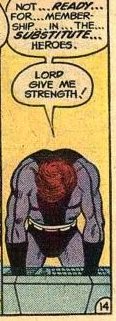
As with the real Legion, the membership of the Substitute Heroes underwent some changes over the years.  By the time I first encountered them, the initial five Subs had been joined by Color Kid, who had the power to change the color of any object. As of DCCP #59, Night Girl had left the team.  It seems she'd only wanted to join the Legion to meet Cosmic Boy, so once she started dating him she left those losers in the Subs behind.  New Subs included Infectious Lass, with the power to give people diseases, and Porcupine Pete, who was covered with quills and could project them but not with any accuracy.  When Ambush Bug proves a little too much for the Subs, they call in their newly created Auxillary, consisting of Heroes who weren't quite ready to be Substitute Heroes.  Those shown in this issue are Antenna Lad, who can pick up radion broadcasts, and Double Header, who has two heads. Yes, his sole "super-power" appears to be having two heads.  I suppose he must have figured that his options were limited to becoming a super-hero or joining a carnival.  He could have gone into politics, where a person with two faces can go far.
The Subs are portrayed in this story as well meaning but ineffective due to their limited powers and their inexperience.  This is consistent with the way they were used in the Earthwar, where they totally failed to make any difference against the marauding Khunds and really only succeeded in taking up two pages of story.  Being essentially an Ambush Bug story, DCCP #59 plays up the Subs' inadequacies for comic effect.  In addition to giving the Bug some more people to play off, the Subs efforts to stop him also tend to end up getting in Superman's way as he attempts to do the same.  At one point, in attempt to stop Ambush Bug, Chlorophyll Kid causes a tree to spring up out of nowhere, but its Superman who ends up colliding with it.
The Subs from their Who's Who entry by Giffen

Previously in this series, I've addressed the issue of new reader friendliness, and it occurs to me that anyone not steeped in Legion history might be at first be a bit confused by this issue, as Giffen and his co-writer Paul Levitz don't take the time to introduce the Subs either as a group or individually.  Even Legion fans might be at a bit of a loss, as the appearances of the Subs did tend to be few and far between. Still, I suppose, the fact that their function in the story is not really as full fledged guest stars but more as a plot complication makes such background superfluous in this case.
Giffen and Levitz do a little better on that score in the Legion of Substitute Heroes Special, however.  The book begins with a recap of the Subs origin in the form of a song, and throughout the issue Levitz provides background information on each of the members as they get their page in the spotlight.
"The Ballad of the Subs" Click to Enlarge and feel free to sing along

The story opens as the planet Bismoll, home of former Legionnaire Tenzil Kem, a.k.a. Matter Eater Lad, prepares to turn control of it planetary economy over to super-computers.  Kem, now a member of the Bismollian Senate, is suspicious of the computers, but not wanting to call out the Legion on a hunch he sends for the Subs instead.  We learn that Kem's fears are well founded on the title splash page when we get to see that all the giant computers resemble the Legion's old foe, the rougue computer Computo.  Of course, not being up on Legion history, I actually didn't get this reference at first, only fully appreciating it after I saw Computo's entry in Who's Who.  Nonetheless, you don't have to be a Legion scholar to realize that something's amiss when the rogue computers revive another old Legion foe, Pulsar Stargrave, giving him a new robotic body, and enlist his aid in conquering and ruling Bismoll.
Meanwhile, the Subs find themselves stuck on a satellite orbiting the planet, unable to get down to the surface.  After a couple of pages of this, there's a "memo" from scripter Levitz to plotter Giffen in which Levitz tells Giffen that he "can't dialogue a story that isn't going anywhere" and to "Get them the blazes down to the planet Bismoll already." Thus, without explanation, the Subs, with the exception of Infectious Lass, appear scattered at various locations around the planet.
In order to make the Subs capable of carrying their own Special, Giffen had two options.  He could have made them more competent and heroic, rushing into defeat Stargrave and proving themselves at last worthy of Legion membership.  Instead, he makes them even more comically inept.   Things start to go wrong even before they get to Bismoll, as Infectious Lass' uncontrollable power infects Color Kid with Grandin Gender Reversal Germs, turning him into a her, and the device they use to chose a leader for the mission instead merely knocks Porcupine Pete unconscious, while Stone Boy has turned himself to stone, in which state he is totally immobile, and forgotten to change back.
Needless to say, the Subs prove fairly useless against Stargrave, succeeding mostly in getting themselves into trouble.  Fire Lad sneezes and causes a major forest fire, and Color Kid finds herself trapped in a garbage incinerator.  Chloropyll Kid, who previously had been depicted with a traditional trim and muscular super-heroic figure but here is shown as short and pudgy, gets himself arrested because apparently it is a crime to be fat on Bismoll.
As in DCCP #59, its up to the more experienced former Legionnaire, in this case Matter Eater Lad, to stop the threat, though he does so with a little bit of help from Polar Boy and Stone Boy.
Their first starring role also turned out to be the Subs last hurrah, as the story ends with Polar Boy thinking "Maybe the Substitute Heroes wasn't such a good idea, after all..."  He subsequently went on to disband the Subs and ultimately joined the real Legion, eventually becoming the group's leader, a post he held when the Legion itself disbanded during the Five Year Gap.
I didn't read DCCP #59 until I got Showcase Presents Ambush Bug about five years ago.  Back in 1985, I was unfamiliar with Ambush Bug and knew the Subs only from their brief cameo in Superboy and the Legion #243, in which they were depicted as more or less traditional and serious super-heroes.  So, my first reaction to the Subs Special was something along the lines of "What the hell?"  Of course, over the ensuing years, especially as I've become more familiar with Giffen's body of work, I've come to appreciate this comic for what it is.  While not quite as laugh-so-hard-you'll-break-all-your-furniture hilarious as some of the early appearances of Ambush Bug, the Subs Special is a gently amusing send up of super-heroic conventions.  The story ends with a note from editor Karen Berger stating that Levitz and Giffen had gotten out of control and assuring the reader that the regular Legion title was nothing like this. The note ends "I'm sorry,everyone---really I am!"
Karen, if by some wild chance you happen to ever read this, I want to assure you that you have absolutely nothing to apologize for.   In fact, let me take this opportunity to thank you, as well as Keith and Paul, for all you've done for comics over the years. 

Thursday, March 20, 2014

Swamp Thing Artist Stephen Bissette to Appear at the Wexner Center in April

Stephen R. Bissette
The Comics Code is widely regarded by comics historians and fans alike as the most repressive set of content restrictions ever imposed upon any entertainment medium.  From its adoption in 1954 following the public shaming of the comics industry during Senate hearings on the causes of juvenile delinquency through the height of its power and influence during the 1960s and its long, slow slide into irrelevancy in the 1970s, 80s and into the 90s until its final dissolution in early 2011 the Code and its ubiquitous Seal of Approval stood as symbol and reminder of a dark chapter in the history of not only comic books but America itself. 
The Ohio State University's Wexner Center for the Arts, in co-operation with the Billy Ireland Cartoon Library & Museum, has invited Stephen R. Bissette, renowned artist for much of Alan Moore's historic run on Swamp Thing and creator of the short-lived independent comic Tyrant in the mid-90s, to give a presentation entitled Swamp Thing and the Birth, Life and Death of the Comics Code Authority in the Wex's Film/Video theater on Tuesday, April 29 at 7 p.m.  The event is free and open to the public, and there's a Facebook event page where you can RSVP if you're planning to attend.
It is quite probably safe to say that Bissette's talk will deliver, as the saying goes, exactly what it says on the tin, covering the origins and  six decade history of the Code from the Senate hearings until its ultimate demise just three short years ago with emphasis on the role that Bissette's own work with Alan Moore on Swamp Thing played in that history.
Swamp Thing began life as a standard format Code approved newsstand comic, but shed the Seal of Approval shortly after Moore came aboard as writer.  The story, at least as I've heard it told, is that after months of just automatically rubber stamping the book with the Seal, someone at the Code Authority actually bothered to read it and wasn't happy with what they saw.  DC, rather than ask Moore to tone down his stories in order to comply with the Code, decided to continue publishing the series without the Seal.  The creative and commercial success of Swamp Thing inspired DC to publish other non-Code approved mature readers titles, including the Swamp Thing spin-off Hellblazer and Neil Gaiman's almost universally beloved Sandman, and led eventually to the 1993 formation of the mature readers imprint Vertigo.
Other factors, of course, contributed to the weakening and eventual demise of the Code.  Chief among these, by my reckoning, was the rise of the direct market and with it the plethora of independent comics publishers who bypassed the traditional system of newsstand distribution and offered their product exclusively through comics shops without the benefit of Code sanction. This development roughly coincides with the arrival of Moore on Swamp Thing and the genesis of DC's mature readers line.  Both of these developments were contributing factors to the final revision of the Comics Code in 1989.
The history of the Comics Code has long been a subject of special interest to me.  I've read several books about, including David Hadju's excellent The Ten Cent Plague: The Great Comic Book Scare and How It Changed America and Seal of Approval: The History of the Comics Code, Amy Kiste Nyberg's more academic and analytical approach to the subject.  Thus I will be particularly interested to hear Bissette's take on the topic.  While I don't know if he'll be able to tell me any facts that I really don't already know, it will be interesting to get his unique perspective on those facts as someone who battled the Code's restrictions on the front lines.

Wednesday, March 19, 2014

Two New Exhibits Opening at Billy Ireland Cartoon Museum This Weekend

The Billy Ireland Cartoon Library & Museum
Columbus' newest and, if you ask me, coolest museum, The Billy Ireland Cartoon Library and Museum, launches two major exhibits this weekend that will run throughout the summer.  The one that everyone's talking about, of course, is Exploring Calvin & Hobbes, a retrospective of the work of beloved cartoonist Bill Watterson.  In addition to original strips and other artwork by Watterson, the exhibit also includes examples of  work by cartoonists who influenced Watterson.  Among these are Charles Schulz, Gary Trudeau, Berkeley Breathed and Ralph Steadman.
The other exhibition is The Irresistible Force Meets the Immovable Object: A Richard Thompson Retrospective spotlighting the work of the Reuben Award winning cartoonist whose comic strip Cul De Sac ran in national syndication from 2007 to 2012.  
Both shows kick off with a free, public reception on Friday night from 6 until 8 p.m. (I'll be there and I hope you can make it) and continue on until August 3.
The Billy Ireland Cartoon Library and Museum is located at 1813 North High Street on the campus of THE Ohio State University in Columbus, Ohio and is open to the public from 1-5 p.m.  every Tuesday through Sunday.

Saturday, January 18, 2014

"Talented Newcomers"

Something struck me as rather odd while I was reading the Bullpen Bulletins page in an old issue of The Incredible Hulk, and it wasn't the fact that  for some reason I was taking a break from re-reading one of my favorite comics to read a page of self-serving hyperbole, especially from a period when Marvel didn't really have a whole lot to blow its own horn about.  It was actually a somewhat peculiar turn of phrase I encountered in one of the items on the page.  I forget exactly what issue it was, but it was from 1994 during the period when the Hulk was leading the Pantheon and the book was being drawn by Gary Frank.  Anyway, the item in question was a promotional blurb touting an upcoming series called Conan The Adventurer which was to written by Roy Thomas and drawn by "talented newcomer" Rafael Kayanan.
"Talented newcomer."  Those are the exact words used.  I have a slight issue with that wording.  It isn't the word "talented."  I suppose that's a matter of personal opinion, although I've never been much of a fan of Kayanan's work.  It's calling Kayanan a "newcomer" that seems to me somewhat strange.  
By 1994, Rafael Kayanan had been working in comics for over a decade, including relatively lengthy runs on The Fury of Firestorm (beginning in 1984) and Captain Atom, taking over both of those books from Pat Broderick.
Upon thinking about this for probably longer than I really should have, I've concluded that this is a case of Marvel attempting to pretend that other comics publishers didn't exist.  Most of Kayanan's work up to that point had been, as I noted above, for DC.  He'd also done some work for independent publishers First and Eclipse as well as an outfit called Tiger Comics.  His first work for Marvel had come only about a year earlier.  So, as far as Marvel was concerned, I suppose that at that point in time it was technically accurate to refer to a ten year veteran of the comics industry as a "newcomer."
I'm still not convinced about the "talented" part, but that's just me.  Actually, though, that cover from the first issue of Conan the Adventurer isn't half bad.  In fact, its one of the better pieces of art I've seen by Kayanan.  Maybe he just preferred the sword and sorcery stuff to super-heroes, so he put more into those comics.  Perhaps I'll check out an issue or two his Conan work if I happen to come across it in a quarter bin at some point in the future.

Monday, January 13, 2014

Gutter Talk's 2nd Annual, Rather Quite Late, Year In Review Post

[Before we proceed any further, it is my bloggerly (like that word? I just made it up just now) duty to inform you that the sections of this post concerning Doctor Who contain spoilers pertaining to the recent fiftieth anniversary special.  If you've not yet seen it, proceed at your own peril.]
You might be wondering why my 2013 Year In Review post is so late, coming as it does nearly 1/26 of the way through the New Year.  The first and most important answer to that is quite simply that I am lazy and I tend to procrastinate.  
My lack of ambition notwithstanding, nonetheless I have always preferred, on my various blogs over the years, to put off doing my Year In Reviews until the year is actually over.  You never know when some earth shattering, game changing bit of news is going to occur on New Year's Eve, leaving all the other  bloggers who wrapped up their post mortem on the year the week before Christmas slapping their foreheads and making Homer Simpson noises.  To be sure, that didn't happen in  2013, but one of these years it will and I shall be hailed far and wide as prescient and a visionary.
Enough preamble, on, at last, to the business at hand:
On a personal note, I did somewhat better at keeping up the blog in the year past, with 88 posts compared to a mere 58 in the twelve months previous.  However, as is my typical pattern, I sort of slacked off in the latter half of the year.
Since September, my contributions to this blog have mostly been limited to my weekly reviews of Star Trek: The Animated Series.  These have turned out to be some of my most popular and well received posts, so you can rest assured that I shall, as promised, be resuming the series with the second season of six episodes come September.  Its perhaps worth noting that, other than my observance of it here, the fortieth anniversary of the debut of the animated version of Trek went largely unheralded by fandom.  On the other hand, I am fairly certain that such shall by no means be the case in two years when the original series reaches its fiftieth anniversary year.  
One anniversary that did not slip by unnoticed by fandom was the fiftieth anniversary of Doctor Who's debut on November 23, 1963.  I feel that the anniversary episode, "The Day of the Doctor," was one of the best Who episodes since Series 5, which I consider the best of Stephen Moffatt's term as show runner.  The only real flaw in the episode is that I feel that Moffatt dropped the Zygon invasion plot about five minutes too soon, just short of an actual satisfying resolution.  Of course, the Zygons were not the point of the episode.  The real point was to lay to rest once and for all the specter of the Time War and to absolve the Doctor of his guilt for the supposed destruction of Gallifrey.  Retroactively making it so that Gallifrey was never really destroyed may seem to some a bit of a cop-out, but Moffat pulled it off in an emotionally satisfying manner and without contradicting anything that the series has established in the eight years since its return to the airwaves in 2005.  
The year in Doctor Who not only saw the end of Matt Smith's reign as the Doctor, but gave not just one, but three regenerations, and all within the space of little more than a month.  The on-line short "The Night of the Doctor" brought back eighth Doctor Paul McGann to show his transformation into John Hurt's "War Doctor"; the anniversary special ended with Hurt turning into the ninth Doctor; and, of course, there was the the Christmas special, featuring Peter Capaldi's first appearance as the Doctor, or his second if count his brief cameo, in extremely extreme close up, in "The Day of the Doctor."
Turning, finally, to the ostensible niche of this blog, the world of comics, it would appear that my powers of prognostication are perhaps not as prodigioous as I pretend. That bit of somewhat strained alliteration refers to the fact that in my previous Year In Review post, I forecast that when I sat down to write the post that you are reading right now I would be reporting the demise, sometime during the previous year, of DC's creator owned, mature readers imprint Vertigo after two decades of existence.  Unheeding of how it my affect my self-esteem, it turns out that the venerable imprint is  still chugging along.  However, it was announced a few weeks ago that the line will soon be losing its latest flagship title.  Bill Willingham's popular and long running Fables is due to cease publication with its 150th issue, due to appear on comic store shelves in just over a year. 
Meanwhile, a prediction that I ventured to make back in 2012 has, indeed, proven accurate.  Dark Horse's license to produce comics based on the Star Wars franchise is set to  expire in the upcoming year, and it has recently been announced that Lucasfilm's new owners, the Walt Disney Corporation, which also, not coincidentally, happens to own its own comics publisher, will be, as I foretold at the time of Disney's aquisition of the Star Wars property,  shifting the Star Wars license back to its original home at Marvel Comics.  Of course, you don't have to be Nostrodamus to realize that it makes more sense for Disney to produce Star Wars comics in-house if they, as they, in fact, do, have the means.
The past year saw the deaths of a trio of notable artists of the Silver Age of comics.  
Carmine Infantino's passing I noted when it occurred this April past.
Veteran Superman artist Al Plastino, who expired in November, had recently been in the news due to a legal conflict over some original artwork from a 1963 Superman story that he had wished, at the time, to be donated to the John F. Kennedy Library, but which, obviously, never ended up there.
To my mind, Plastino will always be the artist who was called in to "fix" Jack Kirby's Superman and Jimmy Olson faces during the King's run on Superman's Pal: Jimmy Olsen in order to bring them more in line with the look of the other Superman titles.  I also was somewhat surprised to learn when I read Schulz and Peanuts, David Michaelis' biography of the Charlie Brown's creator, that, back in 1978, Plastino had been in line to take over Peanuts if contract renewal negotiations between Schulz and his syndicate went sour.  It is my understanding that Plastino actually worked up about six weeks worth of Peanuts strips, just in case.  I've never seen them, but I've heard that they were fairly awful.
In November, the comics world also bade farewell to Nicholas Viscardy, better known to fans of his artwork on Aquaman, Teen Titans and The Brave and the Bold, among other titles, not to mention countless DC covers during the 1970's, as Nick Cardy.
Finally, speaking, as I was earlier, of anniversaries, I cannot believe that, being the huge fan of the Doom Patrol that I am, I failed to realize, and thus to mark the occasion on this blog, that 2013 had been the fiftieth anniversary of the team's debut in My Greatest Adventure #80, cover dated June 1963--which, of course, means it may have been on newsstands as early as March. In belated recognition of this milestone, I refer you now to this post from the very earliest days of this blog detailing the publication history of the Doom Patrol series around the time of the debut of the title's most recent incarnation, as well as all of the other posts I have composed about the team over the life of this blog.

Tuesday, September 10, 2013

Green Arrow Volume I: Hunter's Moon Preview

As I noted earlier, next month sees the release of Green Arrow Volume I: Hunter's Moon, the far too long overdue collection of the first six issues of the Mike Grell's Green Arrow series. Since I happen to own the issues that comprise this forthcoming trade paperback, I don't have to wait until next month to review it for you.
With the advent of Green Arrow's first ongoing series, Grell continued in the new direction that he had established for the character in the Prestige Format mini-series The Longbow Hunters.  Grell's Oliver Queen was, as editor Mike Gold termed it, an "urban hunter," who had left behind the fictional Star City for Seattle, Washington, eschewing the boxing glove arrow and other such gimmicks in favor of plain old pointy tipped shafts. Furthermore, Grell banished many traditional elements of the super-hero genre, including colorful costumed super-villains, from the book's pages.  Actually, this last wasn't all that much of a departure from tradition in Green Arrow's case.  If you look at the Silver Age adventures collected in the character's Showcase Presents volume, you'll see that his opponents were more often common street thugs, bank robbers and mobsters rather than maniacal super-villains.  Another indicator of the less, shall we say, "comic booky", for lack of a better term, direction of the book, and one that's so subtle that I didn't actually notice it until it was pointed out to me, is that nowhere in these stories is Oliver Queen actually referred to as Green Arrow.
While Grell's new approach was, for the most part, popular with readers, at  least the majority of those who took the time and trouble to write in to the letters column, there was some scattered opposition to the supposed changes that Grell had made in Ollie's character.   For my part, I consider what Grell did with Ollie not so much change as evolution.  I can plainly see how the character Grell is writing is, in fact, the same anti-establishment defender of the common man defined by Denny O'Neil over a decade and a half earlier.  Grell's version is older and more world weary, if not wiser, and with an outlook on life somewhat hardened by time and experience.
Grell structured the Green Arrow series, for the most part, as a series of two-part stories with the ocassional four parter about once every year.  Thus, Hunter's Moon, reprinting as it does six issues of the series, contains three separate stories.  It is the first of these, "Hunter's Moon," from which the volume's title is taken.
In this inauguaral two parter, a notorious child murderer is released from prison after eighteen years pending a new trial.  Somehow, despite his house arrest and constant police surveillance, he manages to get out to terrorize his sole surviving victim and the only eyewitness against him.  Ollie becomes involved when that survivor, Dr. Annie Green, turns out to be the therapist that he and Dinah Lance, a.k.a. the Black Canary, go to in order to help her deal with the trauma she experienced in The Longbow Hunters.
This story gets the new series off to a strong start, picking up on plot threads from The Longbow Hunters and cementing the new direction for Oliver Queen's adventures Grell established in that mini-series, including, most controversially, the character's newfound willingness to kill when he deemed it necessary.
The second two parter, "The Champion," begins with a top secret space shuttle exploding, causing an experimental biological weapon to fall to Earth somewhere in the vicinity of Washington state.  Oliver is recruited by agents of the Soviet Union (you remember them, right?) to find the vial containing the biological agent before the Chinese, their partners in the secret experiment, can get to it.  The Chinese have recruited to work for them the nerdy looking but nonethess deadly killer for hire introduced in The Longbow Hunters, Eddie Fyers. (Although for some reason, Grell spelled it Fyres in that series.)  While this is a good and exciting story, the premise seems more suited to Jon Sable, Freelance than to this version of Green Arrow.
The final two parter that comprises Hunter's Moon is "Gauntlet," which returns Oliver to the urban jungle to investigate a series of gay bashings that turn out to be related to a gang called the Warhogs which is attempting to expand its terrotory into Seattle.  This is a solid story that is squarely in the Denny O'Neil Green Lantern/Green Arrow tradition of putting Ollie in situations taken from the news of the day.
"Are you still?  A good guy?" Annie Green asks Oliver in the first issue.  The answer is an unqualified yes, and in Hunter's Moon, Grell has put him in three very good stories.  I definitely recommend this forthcoming volume, and hope that it sells well enough to convince DC to reprint the remainder of Grell's eighty issue run on Green Arrow

Saturday, August 31, 2013

Welcome To The 21st Century--X-Men: Days of Future Past

In my post a couple of months ago on Superman #300, I wrote:
"It's amusing to read speculative stories like this one from a vantage point several years beyond the 'futuristic' setting of the tale."
For this post, I'm going to examine one possible future posited in a very famous comics story line from the vantage point of the very year that said future is meant to be taking place.
Now, as I look around and compare my real world surroundings to the world shown in this story, I can't help but think, "Where are the mutant death camps?  By God, we were promised mutant death camps by now! And what about the giant killer robots who are supposed to have the whole world on the brink of nuclear armageddon?  Where are they?"
As you may have surmised, the vision of the future of which I speak is the post apocalyptic horror posited by Chris Claremont and John Byrne as the future of the Marvel Universe in the classic tale "Days of Future, Past" from Uncanny X-Men #'s 141 and 142.  As I realized when I was re-reading my Essential  X-Men collections earlier this year, the futuristic portions of this story take place in 2013, the very year that we find ourselves in the midst of at this very moment. The fact that the next X-Men movie is apparently based on this storyline provides yet another reason to give these two issues another look.
Of course, "Days" was in no way ever meant to be a vision of our future here in what is somewhat cynically, at times, referred to as "the real world", unlike other works of futuristic speculation such as, for example, 2001: A Space Odyssey.  It has long been my contention that, at the time that film was made, the not too distant future posited in the movie was well within our grasp.  If the American space program had continued at the pace that put men on the moon less than a decade from the time that President John F. Kennedy made such a feat a priority, we no doubt could have had commercial space flight and a lunar colony by 1999, as seen in the film, and a manned vessel approaching the outskirts of the Jovian system just two short years later.  "Days of Future Past", on the other hand, is Claremont and Byrne's vision of the fantasy world known as the Marvel Universe, based not on "real world" trends, but on the stories they themselves had been telling in Uncanny for the previous three years.
Its a good bet that even if you've not read Uncanny X-Men #'s 141 and 142, or any of the many reprintings thereof, you nonetheless know at least the bare bones outline of the story.  This is, after all, one of the most well known, well regarded and influential tales ever published in the super-hero genre.  Still, I'll pause here for a brief recap for the benefit of those suffering the early stages of Alzheimer's or experiencing a momentary brain fart, or maybe even an actual non-comics reader who stumbled upon this post while searching for something else that they were actually interested in.
Uncanny #141begins by thrusting the reader without explanation at first into the world of 2013 and the ruins of New York City where we meet older versions of several of the X-Men plotting what is obviously a desperate and last ditch effort to avert a threatened nuclear war. We eventually learn that in 1980, the "present" as of the time of this story's initial publication, the Brotherhood of Evil Mutants had assassinated anti-mutant presidential candidate Senator Robert Kelly, leading to a backlash against mutants that gave rise to anti-mutant legislation and  the creation by the U.S. government of an army of Sentinels charged with the elimination of the "mutant menace."
Eventually the Sentinels took over the country, wiping out mutants and non-mutant super-powered humans alike, and confining the few survivors to detention camps.  By the time we join this scenario, the Sentinels are ready to spread their anti-mutant reign of terror beyond the borders of the United States and the other nations of the world are likewise prepared to prevent this by any means necessary, including the use of nuclear weapons.   In order to prevent Armageddon, the remaining X-Men; Kate (a.k.a. Kitty) Pryde, Colossus, Storm and Wolverine, joined by Johnny Storm Franklin Richards and a young mutant telepath named Rachel; come up with one of those plans that only make sense to comic book characters and readers.  With Rachel's help, they send the mind of the adult Kate Pryde into the body of her teenaged self, Kitty Pride, a.k.a. Sprite, in order to stop the Brotherhood from killing Kelly and starting the whole mess in the first place.
Besides providing the launching point for many future X-Men plotlines, "Days of Future Past" introduced, in a cameo, Rachel Summers, and laid the groundwork for Claremont's future attempts to rehabiliate Magneto, as he joins the surviving X-Men in hatching their ridiculous scheme.
Essentially, "Days of Future Past" is the swan song of the Claremont-Byrne collaboration on Uncanny X-Men.  The issue after "Days" conclusion, #143, a Christmas story further spotlighting Kitty Pryde, was Byrne's last.  Unlike other creative teams that I'm sure we could all think of, Claremont-Byrne went out on a high note.  The whole of 1980 was a banner year for them.  That 12 month period saw the publication of not just "Days of Future Past", but another of the most famous, best loved and most influential super-hero epics ever, "The Dark Phoenix Saga." 
Of the two, Byrne faired better following the dissolution of his partnership with Claremont.  He would go on to an acclaimed run on Fantastic Four, a brief but influential run on The Incredible Hulk, and a move to DC to revamp the Superman line of comics before the decade was over.  Claremont would continue to write Uncanny X-Men for another decade, and while those stories were good, the book's glory days were behind it.

Sunday, August 25, 2013

The Uncollected (For Now): Ostrander and Mandrake's The Spectre #'s 1-12

As reported Friday on the Collected Editions blog, next year will see the release of another trade paperback collection, The Spectre Vol. 1: Crimes and Judgments, collecting the first twelve issue story line from writer John Ostrander and artist Tom Mandrake's phenomenal 64 issue (counting #0 and an Annual) run on The Spectre, that I'm very glad is going to exist even though I don't actually need to buy it.  You see, I was one of those lucky readers who snapped up each and every issue as soon as they hit the shelves twenty years ago.  Still, I highly and enthusiastically recommend that those of you who missed out on this series the first time around and haven't yet sought out the series in back issues latch on to this collection as soon as copies become available. I only hope that the release of this volume signals that DC has finally come to their senses and plans to publish further volumes collecting the rest of the series. 
It has, after all, been, as I just stated above, more than twenty years since I picked up The Spectre #1 in October of 1992.  I kind of have a hard time grasping the concept that it has taken DC two entire decades to decide to put back in print one of the finest tales it, or any other comics publisher for that matter, has ever published.  This is especially egregious in light of the company's latter day practice of releasing instant trade or hardcover collections of the latest mediocre story lines from even the weakest of their New 52 line before the ink is even dry on the concluding chapter. True, DC did put out a similarly titled TPB, Crimes and Punishments,  in 1993, but that volume contained only the first four issues and was never followed up with further collections until now.
I will try, in the next few paragraphs, to convey just what it is about this series, and this initial story in particular, that has me gushing about it like a little girl.  I will likely fail, but don't let that deter you from checking the comic out.
The story in issues #1-12 reintroduces the Spectre in a way that is accessible to readers who, like me, were not all that terribly familiar with the character's previous adventures, wraps up a few loose ends from the previous Spectre series written by Doug Moench which had ended just over a year earlier, and weaves various elements from even further back in the Spectre's five decade history into a moving and exciting tale of vengeance and horror.  The plot involves the Spectre becoming involved in the life of Amy Beiterman, a social worker infected with the HIV virus who has become the target of the Reaver, a serial killer targeting women with AIDS.  His efforts to protect Amy are hindered by the appearance of a threat of a more cosmic nature.  Spectre's old enemy Azmodus, who first appeared in a series of Spectre issues of Showcase back in the mid-60's, appears on Earth seeking revenge on behalf of his master, the demon Shaithan.  Further complicating matters are the efforts of Spectre's erstwhile ally Madame Xanadu to usurp his power. 
The inclusion of Azmodus and Xanadu in the story is an example of something that Ostrander would continue to do throughout the series.   He seamlessly incorporated such elements from past stories, blending them with his own inventions to give the tales a sense of history that almost made it feel as if all the previous Spectre stories over the years were part of one grand narrative to which Ostrander was providing merely the latest chapter.  A  wonderful example of this is issue #24's tale, "A Small Boldness."  Here Ostrander tells the story of the Spectre's indescribably silly 1940's sidekick, known as Percival Popp the Super-Cop.  Ostrander makes the character "realistic", not by making him a "grim and gritty" overly violent stereotype, but by treating him with respect, transforming him from a cartoon into a fully rounded and sympathetic character. 
Anyway, to get back to the initial storyline, I won't give any spoilers here (well, maybe one very minor one), but I want to say that the ending of #12 affected me in a way that no other comic book story ever had up to that point in time.  Having read comics for a couple of decades up to that point, I'd seen many characters die.  But The Spectre #12 was the first time a comic book character's death had ever moved me to tears.  That, by the way, is the minor spoiler. I'm not saying who dies, although its probably obvious from my description of the plot who it is, so maybe its not such a minor spoiler.  Actually, however, this character's death is telegraphed pretty early on in the story.  It is a testament to the power of Ostrander's writing on this series  that despite knowing it was coming, I was still shocked and saddened and, as I said, moved to tears when the death actually occurred in the story.  Even more of a testimony to that power is the fact that despite the untold times that I have reread this story over the past two decades, up to and including my latest reread of #12 just a couple of days ago, those final pages never fail to have the same effect on me.
Tears may seem a pretty incongruos reaction to what could be classified as a "horror" comic.  Certainly, supernatural and horrific elements are a big part of this series and a huge factor in its appeal to some readers.  Unfettered by the approval of the Comics Code, although shunning the "For Mature Readers" label, the book certainly had its share of blood and gore.  If you're a fan of that type of thing, you will absolutely love the "Desecration" story line that commenced in #27.  For me, though, what made The Spectre so compelling was not the blood and guts, but the souls of the characters and the emotional journeys that Ostrander took every member of the book's core cast on.
That cast included not only the Spectre and Amy Beiterman, but Amy's friend police detective Nate Kane.  Nate starts out hostile to the Spectre, but that attitude thawed as the series progressed, especially after Spectre, in his human guise of Jim Corrigan, becomes Nate's partner.  In #13, Ostrander introduced into this book a character who is in my opinion the finest he has ever created, Father Richard Craemer.  Craemer was created by Ostrander for Suicide Squad, but its only once that book had been cancelled and the good Father transferred over to The Spectre that he was really given a chance to shine.
While I applaud DC for its decision to finally collect this excellent series and I think that every serious comics fan should read it, there is a reason that I'm glad that I have those original monthly issues.  The Spectre had one of the greatest letters columns ever.  Ostrander dealt with several serious and weighty topics in his stories, from relatationships to religion to politics to race, and his intelligent and thoughtful scripts inspired equally intelligent and thoughtful responses from many of his readers.  Rather than fanboy gushing about how great it was to see Azmodus appear again after nearly three decades, the letters were more likely to be about the moral and theological implications of the conflict between the Spectre and Azmodus.  Reading the letters was almost always as entertaining as reading the story that preceded them.  The excellence of The Spectre's letters column was one of the reason I missed letters columns after DC banished them in the early 2000's, although by that time The Spectre had long since finished its run.
Of course, the letters did contain a certain amount of what I termed above "fanboy gushing."  A lot of that was in praise of the art of Tom Mandrake, which I cannot conclude this post without mentioning.  Quite a few of the correspondants remarked that Mandrake seemed born to draw this series, and I have to agree.  His style was perfectly suited to the character and to Ostrander's stories, and he turned in his best art to that point throughout the run of the book. 
To be honest, when I first saw Mandrake's art on Batman back in the 80's, I didn't really like it.  I admitted as much to writer Dan Mishkin, who was at the time collaborating with Mandrake on a book called Creeps, at Mid-Ohio Con a few years ago.  He said that Mandrake really wasn't happy working on that title for a number of reasons and really wasn't putting his heart into it.  It's obvious, however, that he really enjoyed drawing  The Spectre.  
Mandrake drew nearly every issue of the series, but when there were guest artists, they were uniformly excellent.  To me, the standout was Jim Aparo's return to the character in issue #16, after illustrating the Spectre stories by Michael Fleischer in Adventure Comics in the 70's.  That issue also featured an appearance by the Phantom Stranger, another character Aparo had drawn during his early days at DC.  Its almost too bad that Ostrander couldn't have figured out a way to squeeze Batman into the story.  Aparo's pencils in that issue were inked by Kelly Jones, which at first seems an odd pairing but which, in practice, struck just the right tone for this incarnation of the Spectre.
I hope that the trade paperback collection, or, if all goes well, collections, include a gallery of the original series covers, as they were some of the best on the racks at the time, not to mention before or since.  Most every issue featured on its cover a fully painted image by one of the best artists in comics.  
I'm almost ashamed to admit that I nearly didn't collect this series.  While I enjoyed the story in issue #1, I didn't feel afterwards especially compelled to pick up the next one.  However, it was the cover of #2 that made me buy it.  It didn't glow in the dark like the first issue's cover did, nor was it chromium or 3-D or any of the other so-called "enhancements" that were all the rage at the time.  It was simply an arresting and hauntingly beautiful painting by Glenn Fabry, who was also providing cover art for Hellblazer at the time, that I simply could not walk away from after I saw it on the rack of new comics. By the time I got to the end of that issue, which concluded with police pulling the Reaver's latest victim out of a river where they also discovered the barrel in which police detective Jim Corrigan had been sealed in cement by mobsters five decades earlier, which led to his death and rebirth as the Spectre, I was hooked.  I came back for the next issue and the next sixty. The editors of The Spectre knew what many editors today have yet to discover, that the best cover enhancement was simply great art. Of course, having a great story behind that cover doesn't hurt.
I hope that, in the preceding paragraphs, I have managed to convey some sense of what made The Spectre one of the best series DC has ever published and one of my all time favorites.  If so, I hope you'll do yourself a big favor and check it out, either in trade paperback or by seeking out the back issues.

Saturday, July 13, 2013

What DC Expects People To Pay Good Money For In October

Following in the well worn footsteps of  fellow comics bloggers J. Caleb Mozzocco and Tom Bondurant, I now present my take on some of the items that DC Comics will be shipping out to your friendly neighborhood comics shop in October that look even halfway interesting or worth checking out.
The list of things that could possibly entice me to buy an Aquaman comic is very, very short.  The credit line "written by John Ostrander," however, would most definitely be up near the top.  One of comics' finest writers returns, if only briefly, to the company where he did most of his best work with October's Aquaman Annual #1.  According to Bondurant, if sales of this issue warrant, it could lead to an ongoing series featuring Aquaman's former teammates The Others.  If so, DC could do a lot worse than let Ostrander stick around to write it.
Earth 2 #16 may be the last issue of the series I buy.  Its writer James Robinson's swan song, and my decision to continue with the book will rest entirely on whose name replaces his in the credit box.
Justice League 3000 #1 offers up yet another reunion of the classic Justice League International creative team of Giffen, DeMatteis and Maguire (Attorneys at Law--sorry couldn't resist.)  However, I'm not expecting a JLI style BWAH-HA-HA fest, as there seems precious little room for that brand of irreverent humor in the New 52.  This title replaces Legion of Super-Heroes and involves the members of the Justice League seemingly thrown into the far future.
I thought Damian Wayne was dead.  Apparently, he gets better by October when the first issue of the six part mini-series Damian: Son of Batman ships.
Adventures of Superman #6 is a decided "NO!", at least in these parts.  The issue is written by J.T. Krul, and regular readers of this blog will be familiar with my longstanding and passionate contempt for everything the man has ever written.
Green Arrow Volume I: Hunter's Moon collects at long last the first six issues, comprising three two part story lines, of Oliver Queen's first ongoing series written by Mike Grell, with art by Ed Hannigan, Dick Giordano and Frank McLaughlin.  Even though I am one of the world's biggest GA fans, I won't be buying this.  You see, sometime during the two and a half decades that it took DC to deem these stories suitable for reprinting, I went ahead and aquired the contents of this book in individual issue form.  (And I picked them up Packrat Comics for a buck apiece, thus paying less than half what DC is asking for the collection.) Still, the fact that this book exists after all this time makes me happy.  I certainly hope future volumes are in the offing. 
Meanwhile, in issue #24 of the ongoing Green Arrow series, writer Jeff Lemire introduces the New 52 incarnation of Grell creation Shado.
Speaking of Green Arrow, he and ladylove Black Canary also show up this month as guest stars in the trade paperback The Joker: Clown Prince of Crime, reprinting for the first time the entire nine issues of Joker's eponymous series from 1975.  This is another one I'll be leaving on the shelf.  I've read about half of the issues to be reprinted here, and despite a laundry list of top talents of the day that includes Dennis O'Neil, Martin Pasko and Elliot S! Maggin on the writing side, and Ernie Chan, Irv Novick, Dick Giordano and Jose Luis Garcia-Lopez at the drawing board, those stories just weren't very good at all.
 Ever since the publication of Sandman #1 a quarter century ago, series writer Neil Gaiman has assured us that there's more to the story of Morpheus' capture by Roderick Burgess than we were shown in that issue.  In years' since Sandman #75 rolled off the presses, he has repeatedly assured us that someday he would share that tale with us.  Someday has come, just in time for the Silver anniversary of Sandman #1's publication, as the first issue of The Sandman: Overture, a six issue mini-series that finally lifts the veil of secrecy that has long shrouded the events that weakened the Dream King sufficiently to allow Burgess' spell to entrap him, comes to comic shops in October.  The only question in my mind is whether I wait for the collection or buy it in installments.  I guess that really depends on just how excited I am about new Sandman material after all this time.   My gut reaction is to wait for the trade.  We'll see how I feel, and how much disposable income I have, in October.
As I said above, whether or not I actually purchase any of the above comics depends on a combination of my mood and my financial well-being.  However, I'm highly likely to tell you all about whatever I do purchase on this blog when the time comes.

Wednesday, July 10, 2013

All Their Ducks In A Row: Finger Awards Honor Steve Gerber and Don Rosa

Never before in their nine year history have the Bill Finger Awards for Excellence In Comic Book Writing had anything approaching what you could reasonably call a "theme."  There is little, for instance, beyond the long decades they each spent toiling in the unforgiving vineyards of corporate comics, to link the work of last year's recipients.  Frank Doyle spent the bulk of his career relating the misadventures of amiable every-teen Archie Andrews for the company that bears that character's name, while the majority of Steve Skeates' professional output consists of super-hero comics produced for the likes of Charlton and DC.  
This year however, the two recipients of the 2013 Finger Awards, who will honored in a ceremony at next weekends Comic-Con International in San Diego, are linked by a common thread.  Each is primarily known for their work with talking ducks. 
An aside, before we go any further, for those of you reading this who may not be familiar with the concept and history of the Finger Awards.  I wrote a somewhat serviceable synopsis of the concept in my post about last years' awards, and, as I thus see no need to wrack my brain trying to reword it, I shall employ my computers copy and paste function to re-present it below:
Begun in 2005, the Bill Finger Award is the idea of veteran Batman illustrator and political cartoonist Jerry Robinson.  Its sort of a lifetime achievement award for the comics industry's journeyman creators. The recipients are writers who have built up a respectable body of work over a long career but never quite achieved super-stardom or racked up a bunch of flashy awards.  Each year two comics writers, one living and one dead, are chosen to be honored.
The selection is made by a committee of five comics professionals chaired by Mark Evanier...
 Now, where was I?
Oh--right...Ducks.  Talking ducks, at that.
In another first for the finger Awards, Don Rosa is first recipients to have also drawn the stories he wrote.  (Although, as I mentioned last year, Steve Skeates is quite an adept cartoonist, it really wasn't his early 1990s mini-comics that earned him the Finger.)  From the late 1980s until his 2008 retirement, Rosa followed in footsteps of the legendary Carl Barks as the historian of Duckburg, chronicling the new adventures of Donald Duck, his nephews Huey, Louie and Dewey, and cantankerous billionaire waterfowl Scrooge McDuck.  His signature work--some might even say, if they wanted to be so grandiose and somewhat slightly pretentious, his masterpiece--remains the graphic novel The Life and Times of Scrooge McDuck, in which Rosa wove together the fleeting and ocassionally contradictory hints to Scrooge's past that Barks seeded throughout his many stories over the years into a coherent and compelling epic tale.
This year's posthumous honoree, Steve Gerber, enjoyed a four decade career in the comics industry spanning from the early 1970s until shortly before his death in 2008.  During that time he lent his unique voice and worldview to such titles as The Defenders, Omega the Unknown, Man-Thing, Stewart the Rat, Nevada  and Hard Time.  Gerber's most enduring, and endearing, contribution to American pop culture lies in his creation of a certain cynical, cigar smoking duck from Cleveland who goes by the name of Howard.
Both of these prolific and talented creators are richly deserving of this recognition. It's somewhat of a shame, though, that the Finger Awards didn't get around to honoring Gerber during their first three years, when he was still alive to enjoy it.

Monday, July 8, 2013

Matt Wyatt's "How I Spent My Summer Vacation" at Ohio Art League

Saturday night I took a short break from listening to the commentaries on my DVD set of Series Four of Doctor Who (more on that in a later post) while consuming copious quantities of ramen noodles and occasionally dozing off to attend the gala opening reception for Matt Wyatt's exhibit of artwork from his book How I Spent My Summer Vacation, which you can purchase at the  gallery, on display through July 26 at the Ohio Art League gallery in the South Campus Gateway.  The book and exhibit consists of drawings taken from the sketchbooks that Matt brings along on his vacation travels throughout the USA and to the islands of the Caribean to record his experiences enlarged and colored with markers (except for one piece done in watercolor pencil).  
Apparently, according to Matt, I partly inspired this exhibit.  As willing as I usually am to take credit for other people's accomplishments, in this case I have no memory of saying to Matt that he should collect his vacation sketches into a book, though I've no doubt that I most likely did.  The idea to accompany the release of the book with a gallery show, however, came from Nix Comics entrepreneur Ken Eppstein, who is credited as "creator" of the exhibit, thus making his absence at Saturday's event somewhat puzzling.  (It's unlikely that I missed him, as I arrived fairly early and was there until the end.)
Though Matt has participated in several group shows, including a couple that I've had pieces in as well, "How I Spent My Summer Vacation" is his first solo show, and, as Matt told me Saturday night, it nearly didn't happen.  Ken and Matt's original application was turned down by the OAL membership.  However, in late May, he received word that there'd been a cancellation, leaving him scrambling to get the exhibit ready for its Friday, July 5th debut.
In the end, everything came together, and although you missed the opportunity to meet and hang out with Matt Wyatt himself, you can still see his artwork and purchase his book at the Ohio Art League Gallery through July 26.  

Thursday, April 11, 2013

Hey, Guys! Can I Play, Too! (X-Men #117)

In the past couple of weeks, two blogs that I follow on a regular basis, Bronze Age Babies and Comics Bronze Age, have run reviews of X-Men #117, so I'd thought I'd join in the fun and take a crack at it myself. I've got two copies of this story on my bookshelves.  One is in the first volume of Essential X-Men and the other is in a pocket sized mass market paperback in the "Marvel Illustrated Books" line that reprints this issue and Giant Size X-Men #1.  For this review, I chose to read the story from the Essential volume, as that was closest to the experience of reading the original comic.
I love those old mass market paperback reprint comics, and have a small but growing collection of them.  My one regret from my excursion to Gem City Comic Con is that I had to leave a few of these that I needed for my collection lying on the dealer's table because it was late on Sunday afternoon and I only had so much money left and I wanted to pick up those Bloom County collections that  were on sale for half price at another dealer's  table.  Still, as much as I love the mass market paperback comics, they really aren't the ideal way to read a comic.  Due to the smaller page size, and to keep the panels readable, one page of a comic is spread out over two or three pages of the book.  Panels are rearranged, shrunk, sometimes cut in half, and often omitted altogether to make the story fit.  I originally read Fantastic Four #31 in this format and, until I reread in Essential Fantastic Four Volume 2, I had no idea the Avengers appeared in the story because their cameo was omitted completely.  I have seen some that just shrink the whole page down and run it otherwise unaltered, but that makes those comics much harder to  read, especially for my aging eyeballs.
So, I was meant to be talking about X-Men #117, wasn't I?
Since I had the Essential reprint, I decided to start reading with #111 in order to place #117 in context.  The story is, after all, more or less an epilogue to the series of stories that began with #111.  It begins with Hank McCoy, a.k.a. the Beast of the original X-Men, on leave from the Avengers and searching for the missing new X-Men.  He finds them working in a circus, having been hypnotized by their old foe Mesmero into forgetting who they are.  No sooner do they escape from Mesmero's influence than they are captured by none other  than Magneto who has defeated Mesmero.  Magneto holds the team prisoner in his base beneath a volcano in Antarctica.  Yes, some villains have hide outs in the Antarctic, and some have secret lairs in volcanoes, but Magneto is so bad-ass that he had both at once.
Our heroes escape from Magneto, but during the climactic battle Magneto's Antarctic volcano HQ is destroyed.  Hank and Jean Grey are separated from the rest of the team.  Hank and Jean make their way back to the Xavier  Institute, while Cyclops, Nightcrawler, Wolverine, Storm, Colossus and Banshee end up in the Savage Land.  Each group assumes that the other died in the explosion of Magneto's lair.  
In the Savage Land, the X-Men battle their old foe Sauron, then team with Sauron's human self, Karl Lykos, and Ka-Zar to battle Garokk the Petrified Man and his high priestess Zaladane.  
Leaving the Savage Land by boat, the X-Men encounter a storm, and that's where "Psi War" in #117 picks up.
Believe it or not, all that took place in only six issues.  (Of course, Bob Haney could have squeezed all that into just one issue.)
As "Psi War" begins, the tempest tossed mutants are rescued by the crew of a Japanese ship.  The ship's on a secret mission, so the X-Men are forbidden from attempting to contact Professor X.  Thus, back in the states, the Professor, Jean, and the Shi'ar majestrix Lilandra still believe the team to be dead.  Jean decides to leave the school and get on her life, and Lilandra is trying to convince Charles to fly off to deep space with her.  Charles, meanwhile, is quite understandably feeling a bit melancholy as he reflects back on events in his past that eventually led him to form the X-Men.  
After getting out of the Army and being dumped by Moira MacTaggart, Charles had found himself wandering around Europe and eventually ending up in Cairo.  Its there, after having his pocket picked by the young Ororo, a.k.a. Storm, that he encounters his very first honest to goodness evil mutant. Amahl Farouk hits Xavier with a brain blast to get his attention, leading Charles to a seedy saloon where the two meet face to face.
After rejecting Farouk's offer to join him, Charles battles the evil telepath on the psychic plane.  Things look bad for Charles for awhile, but eventually he reaches a new mastery of his own psychic powers that allows him to defeat Farouk.
Back in the present, after telling his tale to Lilandra, Charles decides to take her up on her offer and accompany her back to the Shi'ar homeworld.
After the breakneck pace of the previous six issues, this flashback tale provides a bit of a breather before things get hectic again when the X-Men arrive in Japan next issue and face off against Moses Magnum.  "Psi War" is an excellent single issue tale that really marks the beginning, in a way, of Chris Claremont's decade and a half of fleshing out the characters of the X-Men and  turning them into believable, real seeming people.  One way he did that throughout his tenure on the title was, as with this issue, by fleshing their pasts.  He shows the characteristic Marvel respect for Continuity (that capital "C" was originally a typo, but I realized that its kind of appropriate for the Marvel Universe's approach to the subject) by acknowleding an earlier tale of Professor X's past from X-Men #20, Roy Thomas' first issue as writer, and building on that without in any way contradicting it.
The entire run of issues I mentioned above, from #111 onward, are the work of two creators, Claremont and penciler and co-plotter John Byrne, at the height of their talents working together to produce some of the finest comics of the Bronze Age.  Byrne had begun drawing the book with #108 and #111 was the first where he is credited as co-plotter.  However, I'm guessing he was perhaps co-plotting from the get-go, as #109 features the first appearance of Byrne created character James Hudson, called Weapon Alpha in that issue, though he would later be known as Vindicator and eventually Guardian.  Byrne certainly hit the ground running on X-Men, and the quality of the stories improves one hundred percent as soon as he's on the book.  In fact, when I pick up Essential X-Men Volume I, I usually skip right to #108, despite the fact that its the conclusion of a two-parter.  
The late Dave Cockrum gets my respect for reviving X-Men from five years of reprint limbo (despite what is generally reported, the title was never actually "cancelled",until just last year that is.  Marvel just stopped producing new material for it for half a decade yet continued to publish it  containing reprints of the older stories.)  with writers Len Wein and Claremont, and co-creating and designing the new characters introduced in Giant Size X-Men #1.  However, to be frank, I've never been a really big fan of his work.  There's nothing really wrong with it.  He's a competent and professional artist.  It's merely a matter of personal preference.  His art just doesn't appeal to me for some reason. 
Claremont, meanwhile,  spurred on to new heights by his collaboration with Byrne, really hit his stride as a writer with this story arc.  The conventional wisdom is that X-Men has never been as good as during the Claremont/Byrne era, and I tend to agree with the CW in this case.
So, now that I've done my take on X-Men #117, I'm throwing down the gauntlet to any other comics blogger who wants to take up the challenge.  Who's going to be next?

Sunday, April 7, 2013

2012 SPACE Prize Winners

As of today, we are six days out from the fourteenth annual Small Press and Alternative Comics Expo, a.k.a.  SPACE.  For those who don't know, SPACE is annual gathering of small press and alternative comics writers, artists and publishers held every spring here in Columbus, Ohio.  This year's show will be held this coming weekend at the Ramada Plaza Hotel and Conference Center located at 4900 Sinclair Road from 10 a.m. to 6 p.m. on Saturday and 10 to 5 p.m. on Sunday.
One of the highlights of any SPACE show is the presentation of the SPACE Prizes. From a pool of books submitted by the exhibitors at the previous year's show, SPACE organizer Bob Corby narrows the field down to ten finalists in three categories. 
The Web-Comic category honors comics published on the web in the twelve month period preceding the show at which they are submitted for consideration.
The Mini-Comics and Short Story category covers comics up to five and a half by eight and a half inches and no more than twenty-eight pages in length, as well as short stories from anthology comics that are no more than sixteen pages long.
The General category is for full size and larger and longer comics.
The finalists are submitted to a vote by a panel of two judges in each category and the SPACE exhibitors, whose decision is counted as one vote.  Once again this year, I was one of the judges, this time in the Mini-comics/Short Story category.
The winners of the 2012 SPACE Prizes, to be presented at an awards ceremony at one o'clock Saturday afternoon are:

GENERAL:
1st Place:
A tie between:


MariNaomi 
for
Kiss & Tell A Romantic Resume Ages 0 to 22
and


Katherine Wirick
for
No One is Safe

3rd Place:
for
Wild Child #1 Fight or Flight

MINI-COMIC/SHORT STORY

1st Place:

for
And Then One Day #9

2nd Place:
Tony Goins and  Andy Bennett
for
“The Only Two” from Panel #18

3rd Place:
for 
As Eavesdropped #3
WEBCOMIC:
1st Place:

Katie Valeska
for
2nd Place:
MariNaomi
for
3rd Place:
Bianca Alu-Marr and Steve Peters
for