Showing posts with label villains. Show all posts

Sunday, April 27, 2014

Superboy #147

I'd never read the lead story  in Superboy #147 before yesterday, yet I'd read the story many times.  The seeming contradiction in that previous sentence dissolves once I reveal that this is the story that finally, a dozen years on since their initial appearance, revealed the origin of the Legion of Super-Heroes.  It's a story that has been told and retold, with only slight modification, many times since.  Besides this issue, my vast accumulation of old comics includes the Legionnaires 3 mini-series, Secret Origins #25, and Legion of Super-Heroes (Vol. 4) #1, #8 and #0, all of which contain retellings or summaries of these same events.
Thus, anyone with even a mere passing knowledge of the Legion and its history, such as myself, should not need me to provide a recap of the story. However, I'm going to do so anyway.  
Three teenagers, Garth Ranzz from the planet Wynath, Rokk Krinn of Braal, and Imra Ardeen, a native of Saturn, find themselves travelling together as passengers on a spaceship bound for Earth.  Each has their own reasons for coming to our world.  Garth is searching for his missing brother, and  Rokk has come to find work, while Imra has hopes of joining the interplanetary law enforcement agency known as the Science Police.  Additionally, each of the trio of youngsters has their own super-power.  Rokk's and Imra's are innate.  Everyone on Braal has magnetic powers, and all Saturnians are telepathic.  Garth's electrical powers are the result of an attack by Lightning Monsters while out joyriding with his twin sister and brother, who gained similar powers in the incident.
Also on board is R.J. Brande, whom Rokk describes as "richest man in the universe."  When the ship lands on Earth, a pair of gunmen attempt to assassinate Brande on behalf of his shady cousin Doyle.  After Imra reads the killers' minds and warns the tycoon of the danger, Garth and Rokk use their powers to disarm and capture the criminals. The grateful Brande invites the heroic trio to meet him in his office the next morning where he offers to set them up as a team of teen super-heroes inspired by the example provided by 20th century legend Superman through his adventures as Superboy.  
The subsequent retellings of the tale to which I alluded above are all remarkably faithful to this seminal version by writer E. Nelson Bridwell and artist Pete Costanza.  The basic story survived the continuity changes of Crisis On Infinite Earths, and writer Paul Levitz even found a way to keep Superboy as a part of  Legion history after John Byrne's revamp of Superman wrote that phase of the Man of Steel's life out of existance.  The most significant alteration of the origin came with Legion #8 in 1990.  Apparently  operating under an editorial decree that all ties between the Legion and Superman be cut, writers Keith Giffen and Tom and Mary Bierbaum fashioned a new time line in which the inspiration for the Legion's founding was not Superboy, but rather Daxamite hero Lar Gand, the former Mon-El now to be known by the name of Valor.
It's interesting that, aside from a cameo on the splash page and a brief mention at the end of the story, the title character of the series does not appear in the lead story of his own book.  This foreshadows developments of just over a decade hence when Superboy would abandon the title, which had become known as Superboy and the Legion of Super-Heroes some years earlier altogether, after which it would be entitled simply Legion of Super-Heroes, and finally Tales of the Legion of Super-Heroes before ultimately being canceled in 1987. 
The remainder of this 80 Page Giant issue is filled out by a quitnet of reprints re-presenting the initial appearances of several Legion members or elements of the Legion mythos, as well as the story in which Supergirl is inducted into the group.   The Legionnaires whose debuts are shown are Ultra Boy, Triplicate Girl, Phantom Girl, Sun Boy, Bouncing Boy, Shrinking Violet and Brainiac 5.  Also included are the initial appearances of the Legions of Super-Villains and Super-Pets, the latter consisting of Krypto, Streaky the Super-Cat, Comet the Super-Horse and Beppo the Super-Monkey.
"The Legion of Super-Traitors," the tale which introduces the Super-Pets, has a couple of pieces of unintentionally hilarious dialogue.  After Superboy, under the influence of the sinister Brain Globes of Rambat, attempts to kill Krypto, meeting, understandably, with a look of disapproval from the super-dog, the Boy of Steel, still controlled by the Brain  Globes, thinks to himself, "Where does this mere mutt get off looking down his wet nose at the mightiest boy in the universe?"  Where, indeed?
Later, as Krypto attacks one of the Globes, it pleads, "Don't come near me, Accursed Mongrel!"  In reply, Krypto thinks, "Accursed mongrel, huh?--Making with the mental digs, eh?  Okay, you're asking for it, Buster!"  Yeah, baby, it is ON! Krypto don't take no shit from nobody!
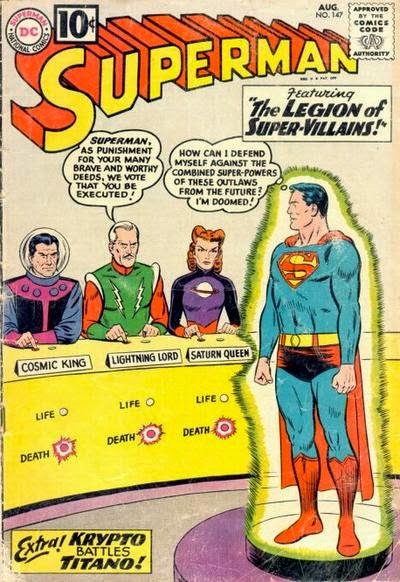
Since this post is part of my series on 147th issues, I'm going to go into a little more detail here on the final story in the book, which first appeared in Superman #147.  This is the tale which introduces the Legion of Super-Villains in a story by Superman co-creator Jerry Siegel and artists Curt Swan and Sheldon Moldoff imaginatively entitled "The Legion of Super-Villains."
The story begins with an imprisoned Lex Luthor volunteering to help out his fellow convicts by repairing their broken radios.  Clandestinely stealing parts from every unit he works on, Luthor builds a device capable of communicating with the future.  Knowing of the existence of the Legion of Super-Heroes, Luthor has reasoned that there must also be a Legion of Super-Villains to oppose them.  His attempt to contact the villainous Legion is answered by the appearance in his cell of futuristic devices which he uses to escape.  Shortly, he hooks up with the Super-Villains themselves, who proceed to introduce themselves and relate their origins.
Cosmic King is a scientist from Venus who invented a ray that could transmute matter, and who gained that power for himself after being zapped by his own ray.  Unfortunately for him, his dreams of fame and fortune are short circuited when he learns that transmutation is considered a great evil on Venus and he is subsequently banished from his homeworld, leading him to journey to Earth and take up a life of crime.
Lightning Lord is the brother of Legionnaire Lightning Man, formerly Lightning Lad.  He relates a slightly different version of the incident which gave him and his brother powers which does not include any mention of their sister, whose first appearance as Lightning Lass was still two years in the future as of this story's initial publication.  A footnote added for this reprint observes that "Lightning Lord hasn't told the full truth," and directs the reader to "See the first story in this magazine."  Well, of course he's lying. He IS a super-villain, after all, and therefore EEEE-VIL.
Saturn Queen comes from Saturn, where there is no crime.  Upon arriving on Earth, however, she suddenly felt compelled to use her powers of super-hypnotism to become a criminal.
The evil Legionnaires lure Superman to a planet in another solar system and trap him in a Kryptonite force field.  Luthor is prepared to execute his archenemy when the adult version of Superman's former teenage pals in the Legion of Super-Heroes arrive.
The two Legions battle to a stand off until Superman tricks Luthor into releasing him from the force field, after which he journeys to Saturn and uses a giant shovel gather material from Saturn's rings and encircle the planet where he had been imprisoned with it.  Apparently it is radiation in the rings of Saturn that affects the minds of its citizens and keeps the world free of crime.  Under the influence of Superman's newly created ring around this planet, Saturn Queen turns against her comrades, tipping the balance of power and winning the battle for the good guys.  The good Legion take their evil counterparts back to future and Superman returns Luthor to his cell on Earth.
While I'm reluctant to criticize the work of one of the men who invented the entire super-hero genre and without whom I would not be writing this blog, I have to say that the level of imagination reflected in the rather bland title of the story is, unfortunately, on display throughout the entire eleven pages of the story.  It is a rather pedestrian and unremarkable tale, aside from its importance in Legion history. 

Sunday, February 2, 2014

Super Sunday IV: Elliot S. Maggin's "Superman: Last Son of Krypton"

Once again, in somewhat of an annual tradition, while the vast majority of the nation focuses its attention on some sort of big sporting event or something like  that, we hear at Gutter Talk HQ turn our attention to telling readers of this blog about a classic tale of the Man of Steel.  This time out, our subject is not one of the character's comic book exploits, but one of his early ventures into the realm of prose novels. 
Regardless of outward appearances, despite the fact that it uses the  film's crystalline Superman logo, notwithstanding the picture of Christopher Reeve in his Superman costume on the cover, and setting aside the sixteen pages of black and white photos from the movie embedded in the center of the book, Elliot S. Maggin's 1978 novel Superman: Last Son of Krypton is not an adaptation of the then newly released Superman: The Movie.  Rather,  it is an original tale set in a rough approximation of DC's Bronze Age Earth-One continuity and reflects pretty accurately Superman as he was appearing in the comics of the day, many of them, not coincidentally, also written by Maggin.  As had been the case for several years in his comics titles, Superman, in his secret identity of Clark Kent, works not as a mild mannered reporter for a great metropolitan newspaper but as anchor for the WGBS six o'clock news and fairly recent additions to the supporting cast Steve Lombard and Morgan Edge figure prominently in the story alongside old standbys Lois Lane, Perry White and Jimmy Olson.
It has been said that the advantage that comics had over film, especially in the pre-CGI days when this novel was published, is that they could portray things that were beyond the scope of special effects technology.  Comics, especially in the Bronze Age, had their own limitations, however.  One was space.  A typical single issue of the day contained a mere seventeen pages of story, and, at least at DC, single issue stories, or at least stories no more than two or three issues in length, were still the norm.  Words and pictures, of course, take more room to tell the same events than words alone, thus far more story could be conveyed in a 238 page novel, allowing Maggin to tell an epic, cosmic science fiction adventure story on a scale previously unattempted in any Superman comic.
Maggin peppers the novel with many of his signature themes and tropes.  The author's admiration of Albert Einstein is well known among comics fans and the renowned physicist, though never actually identified, is a major character in the novel as well as a main motivating factor in the plot.  The Guardians of the Galaxy, from Green Lantern, make an appearance, and in a nod to the classic Dennis O'Neil/Neal Adams "Hard Traveling Heroes" era of the book, the exiled Guardian known as the "Old Timer" shows up.  Part of his purpose in the story is to give voice to another of Maggin's favorite themes as he, in  disguise as a human sociologist being  interviewed by Lois Lane for a TV talk show, warns of the possible negative effects of Superman's presence on Earth on human evolution, echoing Maggin's earlier short comics story "Must There Be A Superman?"
The novel begins begins with a retelling of Superman's origin, but with a new spin.  Prior to baby Kal-El's arrival on Earth, a probe carrying a message from Jor-El visits Einstein, who, as "the most highly developed intellect" on Earth, is entreated by the Kryptonian to take in and raise his son.  Instead, the aged scientist travels to Smallville, Kansas, near where Kal-El's rocket is to land, and chooses a local couple, Jonathan and Martha Kent, whom he deems suitable to give the Kryptonian child a good upbringing.  Through the ruse of selling the Kents a new tractor, he maneuvers the couple into position to discover the child from the stars upon his arrival. 
The novel then moves to the present day, as Superman's arch-enemy Lex Luthor makes plans to steal a document left behind by the now late Professor Einstein and sealed in a vault for the last quarter century.  Einstein, it turns out, is a personal hero of the criminal scientist, and it is speculated that the document may contain one last scientific breakthrough.  
Lex makes off with the document, but it is, in turn, stolen from him by an alien named Towbee on behalf of the Master, not the Doctor Who villain but the ruler of the planet Oric in the Vega system.  After meeting with the Old Timer, Superman recruits Luthor to journey with him to Oric and aid him in retrieving the Einstein papers.  Once on Oric, the unlikely allies discover a plan by the Master to make himself ruler of his section of the galaxy, after he has, by manipulating black holes, physically separated that arm of the galaxy from the rest of the rest of the Milky Way, thus putting him out of the Guardians' jurisdiction and beyond the reach of the Green Lantern Corps.
One of the best things about the book is Maggin's exploration of the character of Lex Luthor, who emerges as much more than simply a two dimensional mad scientist.  Throughout the early chapters of the novel, Maggin introduces flashbacks to Clark Kent and Lex Luthor's childhood days in Smallville.  He expands the story of how Luthor came to hate Superboy, giving the future villain a more emotionally resonant and realistic reason for his emnity toward the hero than simple vanity over the loss of his hair.  Superboy, in his attempt to save Luthor's life, in Maggin's account not only causes the permanent loss of Luthor's hair, but destroys his greatest experiment as well. 
I've wondered recently how come someone supposedly as smart as Luthor never figured out that Clark Kent and Superman were the same person, especially since he knew both of them back in Smallville.  After all, both Clark and Superman are about the same age, each left Smallvile at the same time, and then showed up in Metropolis at pretty much exactly the same time.  It really doesn't take a scientific genius, as Luthor purports to be, to put two and two together and come up with something other than mere coincidence. 
Okay, digression over, let's wrap up this post.
While Superman: Last Son of Krypton is dressed up as a novelization of the first Superman movie, it is, in my opinion at least, something even better; the ultimate Superman epic from one of the character's premier writers. 
Here are some links to sites where you can get other opinions and perspectives on today's topic (and maybe even buy a copy):


Saturday, February 16, 2013

Card Game


Once again, DC Comics seems to be living by the old cliche that there is no such thing as bad publicity.  The latest flap involves the authorship of a segment of the company's digital Adventures of Superman anthology.
It seems to me that Orson Scott Card; of whom, until this week, I knew nothing other than his name and the titles of some of his books that I'd never read and now likely never will; has joined the club of creative individuals, which includes Steve Ditko and Dave Sim, whose extreme and unpopular political views have overshadowed, and at times overtaken, their creative output.  In Cards case, it is his outspoken stand against gay marriage rights that has lowered him into pariahship. Thus, DC's engaging of this controversial author to script a tale of its flagship character has been met with much outrage in the world of Internet opinionating.  There is an on-line petition, although likely too late to do any other than symbolic good (yet I've signed it nonetheless), urging DC to reconsider its decision to hire Card, and a few retailers have announced their intent not to carry the print edition of the comic when it ships in May
When contacted by The Advocate, a spokesman for DC spewed out the following half-assed, have-your-cake-and-eat-it-too, corporate double speak statement that seems to be trying to split the difference between defending the decision to hire Card while simultaneously distancing the company from his more controversial views:
 “As content creators we steadfastly support freedom of expression, however the personal views of individuals associated with DC Comics are just that — personal views — and not those of the company itself.”
Now, I figure that someone at DC must have realized that this controversy would occur.  Thus, it seems highly likely to me that, following the above stated dictum that there is no such thing as bad publicity, the prospect of the expected outrage drawing media attention to DC and this particular comic, which is exactly what has happened, may have played some part in the decision by the company to hire Card.
As I probably was not going to anyway, this controversy and my discovery of Card's true colors hasn't influenced my decision about whether or not to purchase or read Adventures of Superman.  It has, however, pretty much wiped out whatever vestigial desire I may have harbored to read anything else the man has written.

Friday, July 20, 2012

The Dark Knight Rushes

(Note: I composed this post before hearing the news of the shootings during a midnight screening of The Dark Knight Rises in Colorado.  I gave some thought to not posting this, as perhaps some people might find a somewhat snarky post about DKR to be inappropriate at this point in time.  Of course, this piece has nothing to do with that tragedy,  just as it is likely that  the tragedy had nothing to do  with DKR.  The shooter was obviously a very deeply troubled individual and the film that happened to be on the screen when he chose to launch his assault was probably completely immaterial.  Nonetheless, I sincerely apologize to any who might find fault with the timing of this post.)
One of the most astounding traits of the American people is our nearly limitless capacity for outrage.  We are able at the drop of a hat to get ourselves all bent out of shape at the most trivial of provocations.   This quality is not limited to the pundits of the extreme right, though they tend to be the most vocal about and thus garner the most mainstream media attention for their lunatic rantings.  The latest case in point concerns our old friend Rush Limbaugh, who worked himself into a lather on his show a couple of days ago over the fact that the villain in The Dark Knight Rises is Bane, whose name just happens to sound like Bain, as in Bain Capital, the suddenly controversial firm headed by Republican Presidential nominee-to-be Mitt Romney back in the 80's and 90's.
"Do you think that it is accidental," Rush bloviated, "that the name of the really vicious fire breathing four eyed whatever it is villain in this movie is named Bane?"  
(I know that films based on comics often take a lot of liberties with the source material, but does DKR's Bane really have four eyes and breathe fire?  If so, I have got to see this movie!)
While I am familiar with the concept of rhetorical questions, this one deserves an answer.  It is not "accidental" that the film's villain is named Bane.  Few screenplays are written by accident.  It is, however, completely coincidental that the villain's name sounds like the name of Romney's former employer.  
It has, of course, been repeatedly pointed out elsewhere in cyber-land that the character of Bane was created in 1993, long before Mitt Romney even got into politics, much less thought of running for  President.  More germane to to this so-called controversy, however, is that DKR director Christopher Nolan apparently conceived of his Batman films as a trilogy right from the start.  Therefore, it is likely that he had the whole series, including Bane's appearance in the final installment, mapped out before the cameras even rolled on Batman Begins.  That film hit theaters in 2005, three years before Romney's first, unsuccessful quest for the GOP nomination.
Anyway, Rush seems to think that people are going to see this film and come to associate Mitt Romney with a comic book super-villain.  Maybe he's got a point.  After all, I believe it was legendary showman P.T. Barnum who said that no one ever went  broke by underestimating the intelligence of the American people.  (...which sort of sounds like it could be Rush's motto, come to think of it.)  And aren't the voters of this nation so easily misled that four years ago they were tricked into electing a Kenyan-born Muslim Socialist to be their leader?
Because of Rush's comments, Chuck Dixon, writer of Vengeance of Bane, the character's debut appearance, has felt the need to defend himself by asserting that he and VoB artist Graham Nolan are two of the comics industry's staunchest conservatives.
That got me to wondering about something.  If Nolan really is the rock-ribbed Republican that Dixon says he is, how did he feel about drawing Hawkworld, a comic with a unabashedly liberal point of view?   He probably, I suppose, viewed it as just another job.  There's certainly no indication in the issues he drew that he was giving the assignment any less than his best effort. 
I've noted before that there seems to be something almost inherently right wing in the very concept of the super-hero.  This sort of makes me wonder why I remain a fan of the genre.  According to a quiz that I recently took on Facebook, my own political views would appear to be more in line with those of the Presidential candidate of the Green Party.

Saturday, February 12, 2011

Secret Six #30

I can say honestly and without equivocation that Secret Six #30 is, without a doubt, the best issue of that title that I have ever read.  It is also (and I'm sure you could see this "revelation" coming from five miles away on a foggy day) the only issue, so far at least, of Secret Six that I've ever read.  It won't be the last. 
The only reason I bought this issue is because it's the first part of a crossover with Doom Patrol.  I probably could have skipped this issue.  I'm sure DP writer Keith Giffen would have given me enough info that I wouldn't be totally lost if I'd opted to only buy the second part of the story.  Giffen's pretty good about that actually.  As it turns out, there are plenty of reasons to buy this issue other than just to get the bare bones of the plot.
Before I picked up this comic, I read a few of the reviews on-line.  The general consensus out there in web land is that this issue is very good, and that Secret Six writer Gail Simone does the DP as well as Giffen.  One reviewer admits to laughing out loud at several points during the issue.
So, what did I think about it?  Well, it was very good, I laughed out loud a few times, and Simone does, indeed, write the Doom Patrol as well as Giffen. She even gets Ambush Bug right, which isn't easy.  Even Giffen, the character's creator, hasn't always pulled it off.  Bumblebee is just as useless here as she's been over in the Patrol's own book.  Her big contribution to the team this issue is to get swallowed by a mutant man-fish.
Before this issue, I never would have thought Bane could be funny.  But there is a hilarious scene near the beginning involving the backbreaker on a blind date.  After meeting his date, he thrusts a bouquet of flowers in her face and flatly declares, "I wish to mate." The girl, Spencer, is a dancer at a super-hero themed gentlemen's club called "Superiors", which is where she and Bane meet. When she's harrassed by a drunken customer, Bane punches his face in, then asks, "Shall I snap his spine? I am unsure of the etiquette?"  The date ends there, as Bane is ushered out before the cops can arrive, but Spencer tells him to call her. Not only is Bane funny, but he actually comes off somewhat sweet, innocent and naive.  I certainly never would have expected that of the guy who crippled the Batman.
Then there's Deadshot.  Especially after John Ostrander and Kim Yale's excellent, but very, very grim, 1988 mini-series, I wouldn't have pegged Floyd Lawton for a barrel of laughs either.  However, he's got a couple of very funny lines here as well.
The story concerns a slacker kid named Eric who suddenly inherits his grandfather's fortune and criminal empire.  He decides to rebuild the organization as C.R.U.S.H. (Companians Recently United to Spread Hate--a great acronym, by the way) with his gamer friends and sets out to get himself a secret headquarters inside a volcano.  The volcano he has his eyes on just happens to be on Oolong Island, current home of the Doom Patrol, so he hires the Secret Six to take over the island for him. 
Given the overall irreverent tone of this issue, I'm not surprised that the Secret Six appears to consist of eight members.  However, I didn't recognize about half of them and it would have been nice if Simone had taken the time to introduce them to any Doom Patrol  readers, like me, picking this up just for the crossover, or to introduce the Patrol to Secret Six readers who for some reason aren't reading their book. 
That minor quibble aside, this was an excellent comic, and enough to make me want to read more of this series.  I've already bought the six issues mini-series that preceded the current monthy and includes the first encounter between the Doom Patrol and the Secret Six, and I plan to read that this weekend.  I might even check out next issue, which the blurb at the end of this one promises contains "...the most requested Secret Six story ever!"  Don't know what that could be, but I am a little curious.
Personally, the story I'd most like to see is Bane and Spencer actually getting to finish their date.

Friday, November 19, 2010

The Unbearableness of Being Dr. Light--Part 2

Welcome back for the second part of my look at the history of the four DC Comics characters who have been known as Dr. Light.  This retrospective was inspired by the following question posed by one of my readers in a comment on an earlier post:
Didn't Doctor Light die in Suicide Squad? I know comic book characters never STAY dead, but still... Also, I thought there was a female Doctor Light who used a similar-powered suit as a hero. She served in the Justice League for awhile. What happened to her?
In part one, I covered the Golden Age Dr. Light, an obscure foe of the first Dr. Mid-Nite, looked at the "second" Dr. Light, actually the fourth one to appear in comics, whose heroic career was cut short by a freak lab accident, and traced the career of Arthur Light, the most well known and longest lasting of the four Dr. Lights, from his earliest efforts to destroy the Justice League of America to his death and resurrection in the pages of Suicide Squad.  In short, after several hundred words, I'd managed only to answer the first part of the commenter's question.  In this installment, I will bring the bio of Arthur Light up to the present and review the career of the female Dr. Light.
If you haven't read that earlier opus, click here and do so while I take a few deep calming breaths so that I may attempt to write about Identity Crisis, one of the worst comics ever, without barking and foaming at the mouth.  Forgive me if I might get one or two details wrong in my summary of the story.  I'm writing about it from memory, since I really didn't want to read the damned thing again.   

Tuesday, November 16, 2010

The Unbearableness of Being Dr. Light--Part 1

Its time once again to answer questions posed to me by my rabid readers via their carefully considered comments.  My recent rantings on the overall distastefulness of Identity Crisis and the general lameness of Dr. Light moved one reader to inquire:
"Didn't Doctor Light die in Suicide Squad? I know comic book characters never STAY dead, but still... Also, I thought there was a female Doctor Light who used a similar-powered suit as a hero. She served in the Justice League for awhile. What happened to her?"
This query inspired me to do a little surfing on the wild, wild web and digging through back issue bins at the recent Mid-Ohio Con in order to cobble together a  retrospective on the four characters from DC comics who have borne the name of Dr. Light over the course of the company's seven and a half decades of cranking out funny books.  The most surprising thing I discovered in my investigations is that there have, in fact, been four characters calling themselves Dr. Light, whereas I had previously been aware of only three.  Since we are dealing here with a quartet of  characters and a time span of over sixty years, this expository essay may just tend a little toward the longish side.  Therefore, I shall be dividing it into at least two parts.

Wednesday, November 3, 2010

Dr. Light: Ok, He WAS Lame, But So What?

Coming near the end of writer Bob Haney's long tenure on The Brave and the Bold, issue #147 teams Batman and Supergirl in a story written not by Haney but by relative newcomer Cary Burkett.  I can only speculate as to why this issue is not written by Haney, however I do know that there were conflicts toward the end of Haney's run between the writer and new B&B editor Paul Levitz that would eventually force Haney off the book.  It may be that Levitz wanted a Supergirl team-up and Haney either refused to do it or didn't do it to Levitz's satisfaction.  If Haney did refuse, I'd speculate that it was because he had already planned the story that would appear just three issues later in #150 featuring Superman.  It does seem almost redundant to me to have team-ups with two so similar characters in so  short a span of time.
However, my purpose in writing about B&B #147 was not going to be to talk about how badly DC treated Bob Haney, but how badly DC treated Dr. Light in Brad Meltzer's awful Identity Crisis mini-series.  I saw another review of this issue on-line and, remembering that Light was the villain of the piece, decided to write a post about how the doctor wasn't always lame and how the revamp of the character in Meltzer's story was unnecessary, not to mention a really bad idea and  an equally bad story.
After rereading B&B 147's story, "Death-Scream From The Sky", I realized that I couldn't do it.  Oh, I still feel the same way I always have about Identity Crisis. It is and shall remain for all time one of the worst comics ever published.  However, I am now forced to admit that Dr. Light really was pretty lame.
In B&B #147, his scheme to blackmail Gotham with the threat of a laser attack from a hijacked satellite is pretty generic, having been tried by a host of other villains ranging from the Parasite to Kobra, and Batman barely breaks a sweat taking out him and his henchmen.  A couple of years earlier, in Teen Titans #44, Light tried to take revenge on the his old enemies in the Justice League of America  by defeating their sidekicks in the Titans, but ended up getting his ass handed to him by wannabe hanger-on Mal Duncan , an even lamer character than Light, wearing a second hand Guardian costume.
In these stories, the heroes, at least, take Light seriously.  Batman tells Supergirl that Light is "more deadly than a dozen rattlesnakes."  The writers, for their part, do their best to make Light a real menace, though they don't quite succeed. 
By the 80's, things had changed. Dr. Light's inherent lameness was acknowledged and even embraced. In the Batman and the Outsiders/New Teen Titans team-up Marv Wolfman and Mike W. Barr portray Light as a craven, cringing coward.  His backstory in Secret Origins was played for laughs, paired in that issue with the origin of the even lamer  and far sillier Legion of Substitute Heroes, and John Ostrander used him mainly as a punchline in Suicide Squad.
As I've said before, there's really nothing wrong with having one or two easily defeated comic relief villains to provide the heroes a little breather between the real world-beaters.  Besides, the point I'd intended to make in this post is still a valid one.  If DC really had to make Dr. Light into a badass mofo, there had to be better ways to do it than a clumsy retcon that turned him into a brutal rapist and had Zatanna psychically violate him and the rest of the JLA as accomplices.  
It just amazes me that DC actually approved this piece of crap instead of shouting "Are you freakin' crazy!?! We can't print this garbage!!!" and having security escort Meltzer out of the building. I, for one, prefer to pretend the whole mess never happened.  That would be a whole lot easier if nearly everything that's happened in nearly every DC title for the five years since didn't spring directly from it.
Still, I hope that someday DC will choose to just ignore Identity Crisis.  However, it seems far more likely that instead they'll eventually publish an even worse story to explain it away.  Now that's something to look forward to.

Thursday, February 25, 2010

We've Come So Far...But There's Still A Long Way To Go It Seems and other further thoughts on Warner Todd Huston

You know, I thought I'd said all I had to on this subject, but there are a couple of things I still need to get off my chest.
"I should start this discussion by saying that there isn’t anything wrong with enjoying comic books, even as an adult. They can be fun, for sure. But to imagine that comic books offer anything other than lowgrade entertainment is laughable. Comics are not high art (in fact, most of them are horrible even as graphic art) and they most certainly do not equal anything of the sort of deep, consequential literature. Comics are a childish, formulaic, lowest common denominator form of entertainment. It doesn’t make them evil or useless or bad necessarily. It just makes them low-end, fun. They are nothing to be taken seriously. If you are someone that lives for your next comic, or you want to claim that comic books are 'art' worthy of serious consideration… you need to get out of your parent’s basement a little more often. Still, they can be fun if treated as the mindless entertainment that they are. Call it a guilty pleasure, something that for a few hours or so might help you take your mind off the harsh glare of reality."
Even though, if I really had to, I would classify myself as a liberal and I am registered to vote as a Democrat, I'm not really all that political.  I am, however, passionate about the comics art form.  Thus, even more than his trite, mean-spirited, and false generalizations about liberals, which are really just boilerplate conservative talking points and not even really worth acknowledging, let alone taking time to   refute, it is the above quoted passage and others like it from the recent bloviating by right-wing nutbar Warner Todd Huston over a minor detail in one panel of a recent issue of Captain America which I wrote about on Sunday that really raises my hackles.
Hanging out, as I do, mostly with fellow cartoonists, comics readers and other similarly enlightened sorts, it can be easy for me to think that comics' decades long struggle for mainstream acceptance as a serious art form and entertainment medium has finally been won. After all, movies based on comics are among the top grossing films of the past decade, and  the film adaptation of Harvey Pekar's American Splendor became an indie sensation when it debuted at the Sundance Film Festival; mainstream bookstores feature burgeoning graphic novel sections featuring everything from the collection of the latest Batman storyline to alternative titles from publishers such as Top Shelf and Fantagraphics; and Time magazine even named a graphic novel, Alison Bechdel's Fun Home, as the best book of 2006.
Given all that, its somewhat of a shock when I read something like Huston's piece and find myself slapped in the face with all the same myths and prejudices about comics that are almost as old as the medium itself. The first anti-comic book rant  to gain national attention was a piece by children's book author Sterling North entitled "A National Disgrace" which first appeared in the Chicago Daily News in May of 1940 and was subsequently reprinted in dozens of papers nationwide.  Personally, I think North was just jealous because comics were read by more kids than his books, but that's way off topic, not to mention too simplistic an explanation.
The age old charges against comics are all there in one big, odious lump in Huston's paragraph: the idea that  all comics, by their very nature, are poorly drawn and barely written trash paired with the implication that comics are, and can only ever be, fit only for children and illiterates (later on he urges comics fans to read "real books" once in a while); and the stereotype that adults who read comics are socially inept losers who still live with their parents and are most likely still virgins. I'm surprised he didn't include the Wertham inspired charges that comics turn children into criminals and/or homosexuals.
Given Huston's spouting of these hoary old cliches as if they were gospel truth, its quite easy to forgive Robot 6 blogger Carla Hoffman for assuming, as she seems to in her post "An Open Letter To Warner Todd Huston", that he had never before actually bothered to read a comic book. Nor, for that matter, despite his anemic claims to have been a comics collector during his misspent youth, does it appear based on what he writes that's he's ever even met anyone who's ever read a comic book.
I suppose that Huston isn't the only one still clinging to these ridiculous, outdated and provably false ideas, but fortunately their numbers seem to be dwindling.
It seems to me that if you want to assume that comics are just for children, its not the political meaning of the panel that offended Huston that should bother you.  The panel depicts a protest rally where one of the signs reads, "Tea Bag the Libs Before They Tea Bag You!" which to Huston indicates that the panel is meant to depict members of the so-called Tea Party movement and paint them as rascists. What really should bother someone worried about what the impressionable kiddies might be reading is that the message on the offending sign is, in fact, truly offensive. It is clearly a reference to the pornographic connotation of the term "Tea Bag," which could lead to some embarrassing moments when Junior asks what the sign means.  Now, I'm not advocating for the return to full power of the Comics Code, but if Marvel were still submitting their books to the Code Authority, this whole flap would never have happened, as there's no way they would have let the book go out with that phrase in it. 
Another thing that bugs me about Huston's rant , and doesn't concern either his political views or his attitudes towards comics, is the hypocrasy he exhibits when he chides certain of his critics for misspellings and poor grammar in their comments, while his post is riddled with examples of the same. One particularly ticked off blogger takes Huston to task for his misuse of punctuation, and you'll notice that in the quote with which I led off this post, he writes "low grade" as one word, and there are many more examples scattered throughout his text like Easter eggs for anyone obsessive enough to hunt for them.  Because of the dash-it-off-and-hit-send nature of most blogs, I'm willing to forgive a certain amount of typos, misspelled words and grammatical errors, UNLESS the writer seeks to act as a self-appointed grammar cop, criticizing the errors of others.  If you're going to do that, you'd damn well better make sure that your own glass house is in order. That's why you can be assured that I will have thoroughly proofread this post before you read it.
Finally, I want to address his BS about the so-called "first rule of journalism." According to Huston, Hoffman supposedly violated said rule by not attempting to contact him before writing her piece.  Later on, however, responding to charges of bias, he admits that both his and Hoffman's columns are opinion pieces, and, therefore, by their very nature, biased.  That is certainly true, and it is also why opinion writing is NOT journalism, and thus not subject to the "first rule," which, by the way, I'd never heard of before, and I was a Communications major in college, so I studied journalism.
This, of course, is just my opinion, and now that I've expressed it, its time to move on to other things.
By the way, and I'm not this if this manufactured controversy had anything to do with it, but when I was at the Laughing Ogre, the comics shop just down the street from my apartment, I noticed that they were sold out of Captain America #602.

Wednesday, February 24, 2010

Batman: King Tut's Tomb

This week DC releases a new trade paperback called Batman: King Tut's Tomb, collecting the story arc "A New Dawn" from Batman Confidential #'s 26-28 and padded out by reprints of some older Batman stories, including Batman #353 and a couple of old issues of The Brave and the Bold.  
I have no intention of buying this.  
That's because I picked up the core Batman Confidential issues back in September, not too long after they first appeared.  Since that was before I started this blog, I shared my thoughts about the story in a news post on my Wasted Potential site.  If you're not a regular reader of my comic strip (and why the bloody hell aren't you?), then you haven't had the chance to read my insightful review.  Therefore, I re-present it below:

"A New Dawn"
Batman Confidential #'s 26-28
by Nunzio DeFilippis & Christina Weir
art by Jose Luis Garcia-Lopez and Kevin Nowlan

I was really looking forward to reading this story, but I was also prepared to be mightily disappointed by it.
I was looking forward to it because this is a story that I have wanted to see for years. I've always wished someone would take King Tut, one of the silliest villains created for the Adam West Batman show, and bring him into the comics as a serious, and even a bit scary, threat for the Caped Crusader.  
A summary of the plot piqued my interest even more. Members of a museum's board of trustees are being murdered by a man dressed as a pharaoh and spouting Sphinx-like riddles. Batman at first suspects the Riddler is involved, but they end up working together to catch the killer, since the Riddler is ticked off that someone has stolen his schtick.
And I was prepared to be disappointed because almost everything I've read from DC Comics in the past few years has disappointed me, especially the whole Identity Crisis/Infinite Crisis/52 cycle of crap. I haven't yet attempted to read Countdown or Final Crisis and I'm not sure I really want to put myself through that.*
The credits didn't give me much to go on, as I'd never heard of DeFilippis and Weir, but with Garcia-Lopez and Nowlan doing the art, I knew that the story would at the very least be beautifully drawn.
I was not disappointed, and, in fact, I haven't enjoyed a super-hero story this much in years. This is a classic Batman story that plays up the character's detective skills as he and Riddler race against time to figure out both the killer's identity as well as where and when he will strike next.
The story also does a wonderful job of giving us a serious version of King Tut who fits into the darker world of the Batman comics while retaining the essence of the character as established in the TV show. He is presented here, just as he was on TV, as an Egyptologist who gets bonked on the noggin and starts to think that he's the reincarnation of Tutankhamen, except that he's skinnier than the TV version as portrayed by Victor Buono and he actually kills people. 
There are a lot of great moments and a few unexpected twists, as well a classic TV show style deathtrap cliffhanger, in this story, but I really don't want to say anymore or give away too much here, because if you are any sort of Batman fan you need to read this story yourself.

(*Update: I have, since I first wrote this piece, gotten around to reading Countdown to Final Crisis and Final Crisis. Countdown was not as bad as I was expecting, but that's probably because my expectations were so incredibly low after the ineffably awful Identity Crisis, Infinite Crisis, and 52. Final Crisis, on the other hand is pretty good. You'll especially like it if you've enjoyed previous Grant Morrison super-hero opuses such as JLA (particularly the "Rock of Ages" storyline), All-Star Superman, and especially Flex Mentallo. (Check out my post on DC comics of the 90's for my feelings about Flex)

Sunday, February 21, 2010

The Captain America Kerfluffle

This may all be old news to you, but I just learned about it yesterday...so bear with me.
It seems that while I was wallowing in nostalgia for the comics of two decades ago, a comic published just last month provided the catalyst for a bit of a brouhaha in the comics blogosphere.  
It seems that a right wing blogger by the name of Warner Todd Huston took offense at a scene in Marvel's Captain America #602 that he believed portrayed the so-called Tea Party movement in a negative light (as if their recent convention and its keynote speech by Sarah Palin weren't bad enough for their image).  This  little rant can be read here.
Next came a reply to Huston's nonsense on  the Robot 6 blog at Comic Book Resources in the form of Carla Hoffman's "An Open Letter To Warner Todd Huston," which, in turn, elicited not just one, but two responses from Mr. Huston in which he not only hurls a buttload of standard issue right wing vitriol at Ms. Hoffman and liberals in general, but brazenly attempts to establish his geek cred by stating he had collected comics from the mid-60's until about 1986 and once had a collection of over 5000 comics while at the same time disparaging the entire medium as "low grade entertainment" and "horrible even as graphic art."
The whole flap even attracted the attention of the non-comics media, such as this opinion piece from the Pittsburgh Post-Gazette.  And of course, FOX "News" just couldn't resist a story like this.
At first I didn't think I should write about this, because the controversy appears to have blown over, and I wasn't sure there was anything new that I could add to what's already been written elsewhere.  Most of the points I would have made are addressed in this post by Bill Reed that went up last Monday on CBR's Comics Should Be Good blog.
However, and you probably aren't going to catch any other comics blogger admitting to this, I will grudgingly concede that Huston has a couple of somewhat valid points, not in his original screed, which is pure right wing scandal mongering, but in his repies to the "Open Letter..."  I do, in fact, detect more than a slight note of condescension in Ms. Hoffman's tone throughout the piece.  Moreover, concerning Marvel's "apology" for the one panel that offended Huston, Marvel Editor In Chief Joe Quesada's "it was the letterer's fault" excuse strikes me as more than a little weaselly. This should not be construed as a defense of Huston's posts, as these minor points are overshadowed by his overall smug and self-righteous attitude, and, despite his feeble protestations to the contrary, quite obvious lack of knowledge of modern comics, as well as the fact that everything else he says in these posts is a big steaming, stinking truckload of crap.

Wednesday, November 18, 2009

DC Super Stars #10 or "How I Learned to Stop Worrying and Love the Bronze Age"

The 1970s and early 1980s, the period known to comics fans and historians as the Bronze Age, is often dismissed as a low point in the history of comics.  The rap on the era is that the mainstream comics of the day were bland, uninspired, and unimaginative.  However, I find just the opposite to be true, and Bronze Age comics are among my all time favorites. Part of this is because I was a kid at the time, and these are some of the first comics I ever read, but even today, as a middle aged man with slightly more sophisticated tastes, I can still enjoy these stories for their wild imagination and, in some cases, inspired silliness. With sales of comic books slipping on the news stands, and the direct market either not yet existing or still in its nascent stages, publishers, in order to lure readers, seemed willing to  throw almost any wild concept up against the wall to see if it stuck, experimenting with all kinds of styles and genres and twists on old concepts.  This is the era of "relevance" in Green Lantern/Green Arrow; Jack Kirby's Kamandi: The Last Boy on Earth, The Eternals, 2001: A Space Odyssey, and Devil Dinosaur; Kobra; Tomb of Dracula; Conan the Barbarian; The Warlord; Prez; The Green Team-Boy Millionaires; Swamp Thing; Howard the Duck; the Super-Sons, and dozens of others, many rightly forgotten but many that have come to be considered classics.
Now, although it's generally agreed upon that the Bronze Age came to a screeching halt with DC's universe realigning mini-series Crisis On Infinite Earths in 1985, there is a little dispute as to when it actually began.  Quite a few people date the beginning of the age to the publication of Giant Size X-Men #1 and the debut of the "All-New, All-Different" X-Men in 1975, while others have it beginning right on the heels of the Silver Age when Jack Kirby left Marvel to create the Fourth World over at DC.  For the purposes of this and future discussions of the Bronze Age, I'll be going with the latter  start point.  I read one article that termed the interim between the end of the Silver Age and Giant Size X-Men the "Weird Age," but for my money, it was all pretty weird. 
Just tonight, thanks to Mike Carroll, who brought this to our regular Wednesday night meeting of cartoonists, I read what just might be the quintessential Bronze Age comic: DC Super Stars #10, featuring Strange Sports Stories.  In front of reprints of sports themed stories from Strange Adventures and Green Lantern, which has GL sparring with an alien boxer, the issues sports (pun fully intended) an all-new lead story entitled  "The Great Super-Star Game," written by Bob Rozakis, with art by Dick Dillin and Frank McLaughlin, which tells the tale of a baseball game between teams consisting of super-heroes and super-villains.


The story starts with married villains Huntress and Sportsmaster having a little spat.  Convinced that villains can never win against heroes, she's ready to switch sides.  Sportsmaster comes up with a plan to prove that villains can win--at baseball, if nothing else.  Huntress is to recruit, or, more accurately, kidnap, a team of super-heroes, while Sportsmaster gathers together a roster of villains.  After shanghaing Superman, Batman, Wonder Woman, Green Arrow, Black Canary, Plastic Man, Uncle Sam, Robin, and one other who's slipped my mind, the villains bring them to a baseball stadium filled to capacity with a crowd of hostages to face off against a team of villains that includes the Joker, Lex Luthor, Amazo, the Tattooed Man, and the Matter Master, among others. 
By the eighth inning, the villains are behind, but Sportsmaster is determined to win, even if he has to cheat. Though both sides had agreed not to use their super powers, he encourages the villains to break the pact and use any means they have to in order to prevent the heroes from winning.  Of course, with the villains using their powers, the heroes are free to use theirs as well, and ultimately, they emerge victorious.  At one point, Green Arrow draws his fabled bow to shoot down a baseball that had been given wings by the Matter Master, thus preventing the villains from scoring a run--a sequence of panels that pretty much epitomizes the sheer brilliant goofiness of this entire story. 
Now to save space, the story skips straight to the eighth inning, but, for those who really have to know, a text page gives a full play by play of the entire game.  I can just imagine reading this aloud in the style of a real play by play announcer, and in fact, I did do my best Harry Carey impersonation on the first inning. HOLY COW!
Big thanks to Mike Carroll for sharing this with me.  I may just have to track down a copy of this gem for myself, as it truly embodies just about everything that critics hate, and that I love about the comics of the Bronze Age.

Wednesday, November 11, 2009

The Life and Times of The Deadliest Man Alive: A History of Kobra


No less an authority on super-villainy than the Batman has called him the second most dangerous man he's ever met. Beginning with the fifth issue, the covers of his own short lived series proclaimed him the deadliest man alive.  Although not the first DC villain to be given a series (that honor goes to Batman's arch-nemesis, the Joker), he was the first to debut as the star of his own book.  Call him Naja-Naja or call him Jeffrey Burr, just don't call him late for a ritual sacrifice.  He is the lord of the Cobra Cult; the would be world conquerer known as Kobra.
What follows the jump is a rather lengthy article on the history of the character, concentrating on the years from his first appearance in 1975 to 1985's Crisis On Infinite Earths.  That's why I've included the jump break, so that if don't care to read this long-winded discourse, you can more easily scroll down to something you might find more interesting.