Showing posts with label humor. Show all posts

Sunday, May 18, 2014

Giffen's Legions Part 4: The Subs

The Subs from the cover of Superboy #243 by Mike Grell
The first, and for a long time the only, Legion comic I ever owned was Superboy and the Legion of Super-Heroes #243.  My favorite part of that issue has always been the brief appearance of the Legion of Substitute Heroes.  The issue took place right in the middle of the five part "Earthwar" saga.  Earth was under attack by the Khunds, but various other crises conspired to keep the Legion busy off planet.  So the Subs step up to the plate to fight off the invaders.  Of course, being the Subs, they were pretty quickly defeated, but by then I'd fallen in love with this plucky little band of wanna-be heroes. Well, maybe not love, exactly, but I did think that the Substitute Legion was a really cool idea.  So, years later, when I spotted a copy of the Legion of Substitute Heroes Special on the comics rack, I picked it up.  I was eager to see more of these heroes who'd so intrigued me, but wasn't quite expecting what I found inside, despite the joking cover. 
I'll talk more about that special later.  Right now, it occurs to me that it might be a good idea to go over just what the heck the Legion of Substitute Heroes actually is for the benefit of any readers out there who might not be familiar with the concept.  The Legion of Super-Heroes occasionally held open try-outs for Legion membership that worked kind of like the auditions for American Idol.  Would be Legionnaires would come to Metropolis from all across the galaxy to stand up in front of a panel of Legionnaire judges and demonstrate their powers in hopes of going on to Hollywood...excuse me, I meant being admitted into the Legion. In Adventure Comics #306, five of these rejected applicants decided to form their own group.  They acted as back-up to the real Legion, going into action when the proper super-heroes were unavailable.  The initial membership of the Legion of Substitute Heroes consisted of Polar Boy, with the power to make things cold; Night Girl, whose super-strength worked only in the absence of sunlight; Fire Lad, who could generate flames; Chlorophyll Kid, who could speed up the growth of plants; and Stone Boy, who turned to stone. 
Let's face it, the Legion of Substitute Heroes is a completely ridiculous concept.  Nowadays, of course, the trend is to take the silly ideas from comics written for kids and make them serious, adult, and dark.  I believe that Keith Giffen would take this route with the Substitute Legion late in his run on Legion of Super-Heroes Volume 4.  However, when he first got his hands on the Subs, a decade previous, he fully embraced their inherent silliness. In fact, he not only embraced it, but enhanced, making the Subs even more ridiculous than they already were. Of course, when I think about it, I suppose that could be seen as another way of making the Subs palatable to the so-called adult comics reader.
The real significance of DC Comics Presents #59 is reflected in the story's title, "Ambush Bug II."  It occured to me as I was  drafting this post in my head that perhaps someday I should write a piece on the evolution of Ambush Bug's character from his first appearance in DCCP #52 to the first issue of his first mini-series.  This post, after all, is meant to be about the Legion of Substitute Heroes.  For now, it should be sufficient to say that the Bug as seen in this story is much closer to the the character we know than he was in his initial outing.  There he was more of a run of the mill insane villain who actually murdered Metropolis' District Attorney on national television.  In his second appearance, while still technically a villain, the Bug is not so much evil but more of a trickster.  The role of the Subs in this tale is to serve as his foils.
The story is simple enough.  Ambush Bug decides to bug Superman just as the Man of Steel is beginning a journey through time and the two end up in the thirtieth century.  Superman has urgent business even farther into the future, so he decides to leave the Bug with the Legion of Super-Heroes for safekeeping until he gets back.  Unfortunately, no one's home at Legion HQ, so he drops his prisoner off with the Substitute Heroes instead, all the while hoping he won't come to regret the decision.  Needless to say he will, as the Bug quickly escapes and proceeds to raise havoc across thirtieth century Metropolis despite the efforts of the Subs and Superman to recapture him.
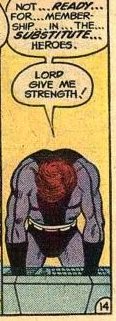
As with the real Legion, the membership of the Substitute Heroes underwent some changes over the years.  By the time I first encountered them, the initial five Subs had been joined by Color Kid, who had the power to change the color of any object. As of DCCP #59, Night Girl had left the team.  It seems she'd only wanted to join the Legion to meet Cosmic Boy, so once she started dating him she left those losers in the Subs behind.  New Subs included Infectious Lass, with the power to give people diseases, and Porcupine Pete, who was covered with quills and could project them but not with any accuracy.  When Ambush Bug proves a little too much for the Subs, they call in their newly created Auxillary, consisting of Heroes who weren't quite ready to be Substitute Heroes.  Those shown in this issue are Antenna Lad, who can pick up radion broadcasts, and Double Header, who has two heads. Yes, his sole "super-power" appears to be having two heads.  I suppose he must have figured that his options were limited to becoming a super-hero or joining a carnival.  He could have gone into politics, where a person with two faces can go far.
The Subs are portrayed in this story as well meaning but ineffective due to their limited powers and their inexperience.  This is consistent with the way they were used in the Earthwar, where they totally failed to make any difference against the marauding Khunds and really only succeeded in taking up two pages of story.  Being essentially an Ambush Bug story, DCCP #59 plays up the Subs' inadequacies for comic effect.  In addition to giving the Bug some more people to play off, the Subs efforts to stop him also tend to end up getting in Superman's way as he attempts to do the same.  At one point, in attempt to stop Ambush Bug, Chlorophyll Kid causes a tree to spring up out of nowhere, but its Superman who ends up colliding with it.
The Subs from their Who's Who entry by Giffen

Previously in this series, I've addressed the issue of new reader friendliness, and it occurs to me that anyone not steeped in Legion history might be at first be a bit confused by this issue, as Giffen and his co-writer Paul Levitz don't take the time to introduce the Subs either as a group or individually.  Even Legion fans might be at a bit of a loss, as the appearances of the Subs did tend to be few and far between. Still, I suppose, the fact that their function in the story is not really as full fledged guest stars but more as a plot complication makes such background superfluous in this case.
Giffen and Levitz do a little better on that score in the Legion of Substitute Heroes Special, however.  The book begins with a recap of the Subs origin in the form of a song, and throughout the issue Levitz provides background information on each of the members as they get their page in the spotlight.
"The Ballad of the Subs" Click to Enlarge and feel free to sing along

The story opens as the planet Bismoll, home of former Legionnaire Tenzil Kem, a.k.a. Matter Eater Lad, prepares to turn control of it planetary economy over to super-computers.  Kem, now a member of the Bismollian Senate, is suspicious of the computers, but not wanting to call out the Legion on a hunch he sends for the Subs instead.  We learn that Kem's fears are well founded on the title splash page when we get to see that all the giant computers resemble the Legion's old foe, the rougue computer Computo.  Of course, not being up on Legion history, I actually didn't get this reference at first, only fully appreciating it after I saw Computo's entry in Who's Who.  Nonetheless, you don't have to be a Legion scholar to realize that something's amiss when the rogue computers revive another old Legion foe, Pulsar Stargrave, giving him a new robotic body, and enlist his aid in conquering and ruling Bismoll.
Meanwhile, the Subs find themselves stuck on a satellite orbiting the planet, unable to get down to the surface.  After a couple of pages of this, there's a "memo" from scripter Levitz to plotter Giffen in which Levitz tells Giffen that he "can't dialogue a story that isn't going anywhere" and to "Get them the blazes down to the planet Bismoll already." Thus, without explanation, the Subs, with the exception of Infectious Lass, appear scattered at various locations around the planet.
In order to make the Subs capable of carrying their own Special, Giffen had two options.  He could have made them more competent and heroic, rushing into defeat Stargrave and proving themselves at last worthy of Legion membership.  Instead, he makes them even more comically inept.   Things start to go wrong even before they get to Bismoll, as Infectious Lass' uncontrollable power infects Color Kid with Grandin Gender Reversal Germs, turning him into a her, and the device they use to chose a leader for the mission instead merely knocks Porcupine Pete unconscious, while Stone Boy has turned himself to stone, in which state he is totally immobile, and forgotten to change back.
Needless to say, the Subs prove fairly useless against Stargrave, succeeding mostly in getting themselves into trouble.  Fire Lad sneezes and causes a major forest fire, and Color Kid finds herself trapped in a garbage incinerator.  Chloropyll Kid, who previously had been depicted with a traditional trim and muscular super-heroic figure but here is shown as short and pudgy, gets himself arrested because apparently it is a crime to be fat on Bismoll.
As in DCCP #59, its up to the more experienced former Legionnaire, in this case Matter Eater Lad, to stop the threat, though he does so with a little bit of help from Polar Boy and Stone Boy.
Their first starring role also turned out to be the Subs last hurrah, as the story ends with Polar Boy thinking "Maybe the Substitute Heroes wasn't such a good idea, after all..."  He subsequently went on to disband the Subs and ultimately joined the real Legion, eventually becoming the group's leader, a post he held when the Legion itself disbanded during the Five Year Gap.
I didn't read DCCP #59 until I got Showcase Presents Ambush Bug about five years ago.  Back in 1985, I was unfamiliar with Ambush Bug and knew the Subs only from their brief cameo in Superboy and the Legion #243, in which they were depicted as more or less traditional and serious super-heroes.  So, my first reaction to the Subs Special was something along the lines of "What the hell?"  Of course, over the ensuing years, especially as I've become more familiar with Giffen's body of work, I've come to appreciate this comic for what it is.  While not quite as laugh-so-hard-you'll-break-all-your-furniture hilarious as some of the early appearances of Ambush Bug, the Subs Special is a gently amusing send up of super-heroic conventions.  The story ends with a note from editor Karen Berger stating that Levitz and Giffen had gotten out of control and assuring the reader that the regular Legion title was nothing like this. The note ends "I'm sorry,everyone---really I am!"
Karen, if by some wild chance you happen to ever read this, I want to assure you that you have absolutely nothing to apologize for.   In fact, let me take this opportunity to thank you, as well as Keith and Paul, for all you've done for comics over the years. 

Monday, March 17, 2014

The Greatest G'Nort Stories Ever Told

In honor of St. Patrick's Day, we turn our attention to one of the super-hero genre's proudest wearers of the green; a most distinguished member of that fabled cadre of interstellar policemen known as the Green Lantern Corps.  I speak of the greatest being ever to wear a power ring, none other than the inimitable G'Nort Esplanade Gneesmacher.  From the moment that he burst upon the scene in 1987's Justice League International #10, this furry wonder immediately captured the hearts and minds of comics fans the world over, and quickly became a beloved fan favorite.
Well, maybe not, but I like him.  Thus, I have compiled a list of what I consider to be the five best stories featuring the character. 

5. Justice League America #36 
"G'Nort by G'Nortwest"
by Keith Giffen, J.M. DeMatteis, Tom Artis and Art Nichols
For the number five spot on my list, it was a toss-up between this issue and Justice League Quarterly #2's "Designing Humans."
"G'Nort by G'Nortwest" finds G'Nort's "arch-enemy", by virtue of being the only criminal G'Nort ever actually apprehended, the Scarlet Skier, former "locater" for interplanetary designer Mr. Nebula, coming to Earth after being released from prison to seek revenge on the Green Lantern who put him behind bars.
The JLQ issue, in which Mr. Nebula comes to Earth looking for the skier and the Justice League must prevent him from redecorating the planet, is actually, in my opinion, a better story.  However, JLA #36 features G'Nort more prominently, so it makes the list.

4. Green Lantern #9-#12 
 "A Guy And His G'Nort"
by Gerard Jones, Joe Staton and Bruce Patterson

Although this was billed as the first ever Guy Gardner solo story, the JLI's brain damaged ring-bearer isn't exactly going it alone for these four issues.  He's got ol' G'Nort in tow as the two go on a quest to uncover G'Nort's true origins.  After the newly returned Guardians of the Universe reveal that they've never seen or heard of G'Nort before, Guy and G'Nort uncover a plot by the Thunderers of the Anti-Matter universe of Qward to discredit the Green Lantern Corps by distributing fake GL rings to idiots like G'Nort.  G'Nort, however, proves himself truly worthy of the ring when he sacrifices his power to save Guy.

3.  Mister Miracle #6  
"Barking Up the Wrong Tree"
by Giffen, DeMatteis, Mike McKone and Peter Gross

When some two-bit gangsters try to get a protection racket going in Bailey, New Hampshire, the small town where Scott Free (a.k.a. Mr. Miracle) and his wife Barda have settled down, Oberon contacts the Justice League for help and G'Nort answers the call.  Any story that contains the line "Help! A giant dog is trying to sell me insurance!" has got to be a classic.

2. Justice League America #51
 "My Dinner With G'Nort"
by Giffen, DeMatteis, Adam Hughes and Joe Rubinstein

I actually have two copies of this issue.  One is to read, and the other is bagged, boarded and signed by artist Adam Hughes.
When G'Nort drops by the JLI's New York embassy for a surprise visit, a bored of his skull Kilowog invites his "brother alien" out for a night on the town.  J'Onn J'Onnz, the Martian Manhunter, tags along to keep the pair out of trouble.  You can imagine how well that works out.  You've got to wonder who thought that taking G'Nort to see Cats was a good idea, and things only get worse when a super-villain attacks during dinner.
This issue was a serious candidate for the top spot on the list, but after some consideration I decided to give it to:

1. Justice League America Annual #4 
 "What's Black and White and Black and White and Bl..."
by Giffen, DeMatteis, McKone and Bob Smith

 After inadvertantly foiling a robbery, which they themselves had intended to commit, the quintet of inept second rate super-villains known as the Injustice League find themselves hailed as heroes and decide to go straight, offering their services to the Justice League International.  Together with G'Nort and the Scarlet Skier, they become Justice League Antarctica and soon find themselves facing a horde of genetically engineered, man-eating penguins.
There you have it, dear readers.  The Top 5 G'Nort stories.  Proof, if any were needed, that G'Nort Esplanade Gneesmacher is indeed the greatest canine Green Lantern of them all.

Monday, April 8, 2013

Me and Irwin

As I mentioned back in my wrap-up of my weekend at Gem City Comic Con, among the many comics fans wandering the Wright State University's E.J. Nutter Center dressed in the costumes of their favorite comic book super-hero was one who had chosen to don the guise of Irwin Schwab, a.k.a. the Ambush Bug.  At my urging, Canada Keck, with whom I was manning the Sunday Comix table, retrieved her camera from her car and I fetched Mr. Schwab to our table to pose with me for the photo which appears below.
For those of you who may not be familiar with Ambush Bug, or me, for that matter, the Bug is the green one and I'm the one wearing the scarf.
Now, if I can only get a picture of me with G'Nort, I could die happy.

Saturday, March 30, 2013

More On "Welcome Back, Kotter" #3

Now, I realize that I previously declared that I had said all I had to say about Welcome Back, Kotter #3.  It appears, however, that I was mistaken.  Upon reading it again after over three decades I was impressed by how well the comic has held up over time.  It would seem that one reason this particular comic has stuck in my mind for all that time is that its actually a pretty good comic.
As you may remember, if you're a fan of cheesy 70's TV sitcoms, the basic premise of Welcome Back, Kotter was that, in high school, Gabe Kotter had been a member of a group of remedial students known as the Sweat Hogs.  Years later, Gabe has become a teacher and finds himself back at his old alma mater, James Buchanan High School, teaching Social Studies to the newest group of Sweat Hogs.  I mention this because its important to the story in this issue.
"The Return of Augie Berelli" has Kotter receiving an unexpected visit at school by the Augie Berelli of the story's title.  Berelli was another of the original Sweat Hogs with a rep as the toughest kid in school, as well Gabe's rival for the affections of classmate Dolores Duffelmeyer.  Kotter tricked Augie to get him out of the way so that Gabe could go to the prom with Dolores, and Berelli vowed to get even.  It doesn't make Kotter feel any better about Berelli's return that, in the years since high school, his old classmate has become a prominent gangster.
The real purpose of Berelli's visit to James Buchanan High, however, is to visit his nephew, Vinnie Barbarino, one of the current crop of Sweat Hogs.  Vinnie looks up to his uncle and the other Sweat Hogs are impressed by his expensive clothes and fancy car.
After Berelli takes the Sweat Hogs out for pizza, Gabe is approached by FBI agents who want his help to apprehend Berelli.  Vinnie, who had stayed behind when everyone else left, confronts Kotter and the Feds and ends up slugging one of the G-Men on the jaw.  Kotter agrees to help the FBI if the agents will agree not to arrest Barbarino.
When Berelli hears about the incident, he worries that Vinnie follow his footsteps into a life of crime.  To prevent this, he contacts the Feds himself, and hatches a plot to turn himself in and make himself look like a heel in front of Vinnie and the Sweat Hogs while making Kotter look like a hero. 
As a tale of misplaced hero worship, "The Return of Augie Berelli" is hardly the most original of stories.  If you were in a particularly uncharitable mood, you might even call it cliched.  Even Shakespeare borrowed many of his plots from earlier works of myth and history.  The magic of any story lies in the telling.  I'm sure that even Tony Isabella, the writer of this issue, would agree that he's no Shakespeare, but he does tell this particular story very well.  He displays a gift for humor that I've not really seen in his super-hero comics.
I've mentioned the opening line of the story, which I had remembered, across the decades since I'd last read this story, as one of the funniest lines I'd ever read in a comic.  There are quite a few other funny lines as well.  For example, when Augie extends his hand to Kotter, Gabe, still fearing that Berelli has come seeking revenge, reacts, "This is the handshake of death, right?  Like the kiss of death, but more sanitary."  Overall, Isabella nicely captures the feel of a typical Kotter episode.
He also effectively portrays the emotional reactions of the characters, especially Vinnie.  The final panel image of Vinnie sitting in an empty classroom, head in hands and crying, is genuinely moving.
The art is by Bob Oksner over layouts by Ric Estrada.  Oksner was a veteran of earlier DC humor books, including The Adventures of Jerry Lewis, The Adventures of Bob Hope, and Angel and The Ape, and had a gift for caricature that made him perfect for this book.  Meanwhile, Oksner's layouts tell the story in a clear and effective manner.
The letters column heralded Isabella's arrival as the book's new writer.  However, this would be the only issue of Welcome Back, Kotter that he would write.  That's too bad, because based on his performance in this story, I'd kind of like to have seen him do more Kotter stories.
I was going to post this yesterday, but I decided to wait a bit and see if I have now really said all I have to say about Welcome Back, Kotter #3, and I think I have.  I can now move on to other, more important, topics, like....oh, I don't know...Prez or "Super-Heroes Battle Super-Gorillas" or something significant and earth-shaking like that.

Tuesday, March 26, 2013

(Near) Total Recall

Its funny the things that stick in your mind, isn't it?
A while back, I did a piece on the career of Tony Isabella, and in it I mentioned that he was responsible for what I still to this day think is one of the funniest lines I've ever read in a comic book in Welcome Back, Kotter #3.  I went on to quote that joke. However, since at the time I did not own a copy of the comic in question and it had been over thirty years since I'd read it, I had to rely on my memory.  
Well, as I mentioned yesterday, I just acquired another copy of Kotter #3 at Gem City Comic Con this past weekend.  So I decided to go back to that earlier post and check how accurately I'd actually remembered the passage.  It turns out I did pretty well.
I had the line as "There are a million stories in the Naked City.  There are almost as many in Brooklyn, but here we keep our clothes on.  It makes it easier to conceal weapons that way," which is pretty much verbatim.  I only left out two words.  The last part actually reads "It makes it a lot (italics mine, added for emphasis) easier to conceal weapons that way."
Not bad for a middle aged guy, huh?
Now if I could only remember where I set down my coffee cup.

Saturday, March 16, 2013

The Power & Glory of Howard Chaykin

The annual Gem City Comic Con takes place in Dayton next weekend. Bob Corby of Backporch Comics and SPACE is generously sponsoring a table for Sunday Comix, the Columbus, Ohio cartoonists group of which he and I are both members.  I'll be travelling there Saturday morning to put in some time behind the table.  Actually, the real reason I'm going is because I haven't attended a mainstream comics convention for nearly three years, the most recent being the last pre-Wizard World Mid-Ohio Con, and, most importantly, there are a couple of my favorite artists scheduled to attend and I really want to meet them.
One of these is Howard Chaykin, and I've been pondering lately which one--and only one--comic I wish to shove in his face and demand that he affix a signature to.  Among the list of candidates, from the works of Mr. Chaykin littering my collection of comics are

  • American Flagg!--probably his most famous work, and sort of a cliche choice if you think about it.
  • The Shadow--this four issue mini-series brought the 1930's pulp adventurer out of retirement and into the modern world of the 1980's
  • Blackhawk--this reinvention of a Golden Age character kept the legendary pilot in his WWII milieu but brought a 1980's, and distinctly Chaykin, sensibility to the tale
  • Midnight Men--a quite frankly unremarkable four issue mini-series from Marvel's Epic imprint.  Without rereading it, I couldn't even tell you what its about.
  • Marvel Premiere #32--featuring the debut of space-faring adventurer Monark Moonstalker
I thought about putting the question to you, my readers.  However, I decided the answer was pretty obvious.  It should be my favorite Chaykin comic. When I asked myself what that was, the title that leaped to mind was Power & Glory, the 1994 four issue from Malibu's creator owned Bravura line.
Power & Glory revolves around the efforts of fictional government agency the National Intelligence Agency, and its sleazy leader Malcolm LeStrange, to create a real-life American super-hero.  Unfortunately, the candidate LeStrange chooses to become A-Pex, the American is Allen Powell, a superficial, cowardly, NIA agent with a pathological fear of disease that is only amplified by the treatments that give him super-powers.  On his first outing in costume, Powell proves a potential embarrassment to the NIA and a threat to LeStrange's continued employment as NIA director.  Michael Gorsky, a dedicated if slightly disillusioned NIA agent who had been the second choice for the A-Pex experiment, is brought in to covertly do the real heroic work. Powell publicly takes all the credit, appearing on talk shows and magazine covers and having his name and image plastered on products ranging from breakfast cereal to video games and comic books.  Complicating matters is the fact that Gorsky is going through a divorce from LeStrange's assistant Avis Cutlett, who ends up sleeping with Powell until he leaves her for vapid pop star Belladonna.  Further complicating things is that the drug dealing third world head of state and rap musician, Jean-Paul M'butu, who went to school with LeStrange's son and calles the NIA head "Uncle Malcolm", is involved in secret dealings with LeStrange and wants Powell and Gorsky eliminated.  
Power & Glory is an often hilarious dark comedy that satirizes the super-hero genre, and 1990s pop culture and politics while providing generous helpings of the complex, multi-layered plotting and witty, fast paced dialogue, as well as the over the top sex and violence that fans had come to expect from Howard Chaykin. There's even a connection to American Flagg! snuck in on the very last page.
I happen to have two copies of the first issue.  It was released with two covers and I bought both of them. (Hey, don't judge me, man.  It was the 90s.  I was young and didn't know any better.  Everybody was doin' it.  We didn't realize we were helping the industry commit suicide.)  So, I can get one signed and stick it in  a bag for posterity and still have a copy to read again in the future.

Saturday, December 22, 2012

...And I Feel Fine

No, Walter, I'm really not sure at all.

Tuesday, November 6, 2012

Gutter Talk Endorses....

With the polls closing in a couple of hours here in Ohio, its a little late to be endorsing a candidate--or even to exhort you to get out and vote, though I certainly hope you did.  However, in American politics, its never too early to get started on the next campaign...provided, of course, that the world doesn't end next month, or we all get absorbed into the Superstructure, or whatever Grant Morrison thinks is going to happen on December 21st.   In that spirit, GUTTER TALK wishes to be the first to get behind a candidate for 2016.
In this blog's opinion, there is only one man--or rather demonic killer ape doll--with the vision and strength of character to look America's problems straight in the eye and boldly SMASH THEM WITH HIS "MAGIC CANE"!! (I could make some sort of crude joke here about Mitt Romney and "magic underwear", but this this being a political endorsement, it should be treated as a solemn and dignified occasion--and besides, I couldn't think of a good one.)
Therefore, GUTTER TALK AMALGAMATED MEDIA ENTERPRISES INTERNATIONAL officially and unequivocally endorses for President of the great nation of the United States of America in 2016:
MR. MONSTER
 
Thank You, and Grodd Bless America!

Monday, June 25, 2012

Skeates To Be Honored With Bill Finger Award for Excellence at Comic-Con

Plastic Man #15 from 1976 remains to this day one of my favorite comic books.  In that issue, written by Steve Skeates, Plas battles an a killer robot and an amnesiac dressed as a giant carrot.  The name of the diminutive West Coast based hired killer who sends the mechanized monster after the stretchable sleuth is "Rice" O'Rooney, The San Francisco Threat.  That name still makes me laugh every time I think about it.
Two decades later I published my first small press comics and joined a couple of small press "co-ops".  These were clubs for small press publishers who traded comics with each other and contributed columns to the club's newsletter.  One of these groups folded shortly after I joined.  I believe I only got one issue of the newsletter.  This was enough to allow me to start up a correspondence with one of the other members, who turned out to be the very same Steve Skeates who had written Plastic Man #15, as well as many other comics, of course, twenty years previously.  At first, I wasn't sure it was the same guy.  It seemed hard to believe that someone who'd been at the top of the comics profession as a writer for DC would now be self-publishing obscure photocopied mini-comics. (I was much more naive in my youth.)  But if it was, I knew I couldn't pass up a chance to get to know him a little bit.
I sent him my somewhat amateurish attempts at a humorous action/adventure comic and in return he sent me a series of surreal, silly, and slightly philosophical mini-comics that he drew himself in a wonderfully loose and simple cartoony style.  While I might at first have viewed mini-comics as a step down for him, these comics were actually, in many ways, superior  to his mainstream work.
They were accompanied by somewhat rambling letters filled with  anecdotes and reminiscences, as well as constructive criticism, advice and encouragement.  I was thrilled that the writer of one of my favorite comic books actually seemed to like my work. 
Recently, I learned that Steve Skeates is to be honored with the Bill Finger Award For Excellence in Comic Book Writing during the Eisner Award ceremonies at this year's Comic-Con International. 
Begun in 2005, the Bill Finger Award is the idea of veteran Batman illustrator and political cartoonist Jerry Robinson.  Its sort of a lifetime achievement award for the comics industry's journeyman creators. The recipients are writers who have built up a respectable body of work over a long career but never quite achieved super-stardom or racked up a bunch of flashy awards.  Each year two comics writers, one living and one dead, are chosen to be honored.
The selection is made by a committee of five comics professionals chaired by Mark Evanier, who himself could be a candidate for the prize.
This year's other recipient of the Bill Finger Award is Frank Doyle, long time writer for Archie Comics who passed away in 1996.
Unfortunately, its been quite some time since I've written to Steve.  I'll have to drop him a line through Facebook and offer my congratulations for this great achievement.
Speaking of Facebook, thanks to Matt Dembicki for alerting me to this bit of news by posting about it there.

Wednesday, June 13, 2012

Free Comic Book Day Comics Part 3

I'm sure no one's going to be too disappointed if I skip the lengthy, rambling preamble this time out and get right to the comics.
I was in college when Voltron debuted back in the mid-80's.  While I enjoyed the series, mine was more of an ironic, detached appreciation.  I was laughing at it, whereas fifteen or even ten years earlier I would have bought into the premise unquestioningly.  Thus, I don't have the same nostalgic attachment to the show that people that much younger than me might.   Still I can tell a well written and drawn comics story when I read one, and VIZ Media's Free Comic Book Day offering, Voltron Force: Shelter From The Storm, written by Brian Smith with art by Jacob Chabot, presents the opening pages of what looks to be a very well done graphic novel.
Shelter From The Storm picks up several years after the events of the cartoon series with the original Voltron Force training a trio of new recruits to eventually take their places.  On a training exercise, the newbies encounter a runaway robeast created by the team's arch-nemesis King Lotor.  I would definitely consider reading the full graphic novel, though unless you're a real diehard Voltron junkie, I might recommend checking it out of the library.
The free comic from Red 5 Comics, with previews of the cover featured Atomic Robo, as well as NeoZoic and Bonnie Lass, and including stories featuring pirates and dinosaurs, seems shrewdly calculated to appeal to readers' inner child.  Nonetheless, it does hit most of the right buttons.
The titular Atomic Robo of the lead story is a robot created by Nikola Tesla in the 1920's who today leads a globe spanning scientific troubleshooting organization known as Tesladyne. In this tale, Robo is tricked by his old enemy Dr. Dinosaur, a super-intelligent talking dinosaur, naturally, into unleashing a super evolved dinosaur, or Futuresaurus Rex, intended by Dr. Dinosaur to destroy him.   While I didn't enjoy this quite as much as last year's Super Dinosaur free sampler, I can see that Atomic Robo has the potential to be a lot of fun.
I believe that in one of last year's posts in the wake of Free Comic Book Day I expressed a preference for free comics that give you complete stories rather than teasers continued in something you're expected to pay for.  This sampler from Red 5 contains a mix of both of those.  The Atomic Robo story is complete in this issue, while the other two stories are merely the beginnings of longer tales.
NeoZoic posits a world where dinosaurs never died out and have existed side by side with humans, giving rise to an organization called the Predator Defence League whose mission is to protect humanity from the beasts.   This eight page preview provides just enough  of a glimpse into that world to leave me slightly confused about just what's going on, but somewhat curious as to what the deal is.  Adding to the confusion is the art, done in sort of an Americanized Manga type of style.  The story features three female characters and they are all drawn with basically the same face.  The only thing differentiating them is hair and skin color.  If this were a black and  white comic I'd have been totally lost.  This is definitely a comic I'd want to check out from a library before shelling out any of my hard earned cash for it.
Bonnie Lass chronicles the adventures of the daughter of a famous pirate in what appears to be some sort of alternate history present day.  Bonnie and two of her companions have gotten themselves captured by some sort of cult or something looking to retrieve an object she stole from them.  They end up being rescued by probably the last person Bonnie wants to save them. With its cartoony art and irreverent tone, Bonnie Lass looks like it might be the most fun of the three series previewed here.
Finally for today, we come to Donald Duck Family Comics, presenting two vintage stories by legendary "good duck artist" Carl Barks.  The first deals with yet another scheme by the nefarious Beagle Boys to hijack Uncle Scrooge's money bin, while the other details Donald's efforts to be free of the nightmares which plague him whenever he tries to get some shuteye.  Rounding out the issue are a series of one page strips by Barks featuring Donald and Scrooge.
As to the question of whether the full books that this comic is promoting are worth buying, the answer seems pretty self-evident to me. Any collection of Barks' duck comics would make a worthy addition to anyone's bookshelf.
You know, its kind of funny, to me at least, that two of the best comics for young kids this Free Comic Book Day, this one and Barnaby and Mr. O'Malley, come from Fantagraphics, a publisher not exactly known for its kid friendly fare.  That they both contain material written and drawn over a half century ago is not so surprising to me, however, as I'm rapidly turning into a cranky old man who thinks everything new sucks.
I've still got two more free comics to write about, but I'll get to those next time. 

Wednesday, June 6, 2012

Free Comic Book Day Comics Part 2

The three books I'll be looking at today are all flip books, so it'll be like getting double the reviews for your money.  Not that you pay anything to read this blog, nor should you.  If you had to, I could honestly think of several dozen blogs or other forms of reading matter far more worthwhile than this one for you to blow your paycheck on.  
Actually--returning, however briefly, to my topic--of the nearly dozen free samplers I picked up on Free Comic Book Day, the majority of them featured previews of two or more series or graphic novels.
By the way, you may be wondering how I came away from the day with so many books when I only visited three shops.  True, all the stores I went to did have a limit of one, or at most, two comics per person.  However, my last stop on the tour, Packrat Comics, had a deal wherein if you threw a buck or two into a jar for donations to a charity that aids wounded veterans you could snatch up as many comics as you liked.  It was for a good  cause, and I do have to find stuff to write about on this blog somewhere, so I tossed two George Washingtons into the kitty and grabbed anything that I hadn't picked up at the Laughing Ogre or Comic Town that looked interesting or that, at the very least, I thought I might be able to get a halfway entertaining bad review out of.
To digress yet again, isn't it the bad reviews that are more fun to read than the good ones, especially if the reviewer really despises the comic, movie, or TV show in question? Its the same basic appeal that American Idol held for people, at least until Simon Cowell left.  We were all slightly embarassed by Paula Abdul's tearful gushing over any sixteen year old Whitney Houston wannabe with even a moderately decent singing voice.  What we really wanted, what we tuned in for, was to see mean old Simon make that poor little girl cry. 
Now, I don't know how entertaining my first review is going to be--that, as always, is for the you, the people I'm seeking to entertain, to decide--and I sincerely hope no one cries, especially not the "title character." Atfter all, there are few sights more pathetic than that of a washed up actor/"pop culture icon" on his knees and bawling like a damned baby. That said, however, I really have nothing at all nice to say about BlueWater Comics' Burt Ward: Boy Wonder.
The concept is similar to last year's BlueWater freebie, The Misadventures of Adam West, in that it features the actor transformed by magical/super-scientific means into a younger version of himself from when he was at the height of his popularity and becoming the swashbuckling crimefighter he only pretended to be in front of the TV cameras.  In this case, Ward is walking a couple of dogs in L.A.'s Griffith Park out near where the exteriors for the Batcave where filmed back in the 60's. Before he really knows what's happening, he finds himself chasing some masked stranger who kind of resembles the original Red Hood (that's the man who became the Joker, not Jason Todd) through a teleportation device which, oddly for a denizen of a world in which such things don't exist outside of science fiction, he instantly recognizes as such.  Then the story does a reverse Wizard of Oz as the art goes black and white when Ward emerges from the space-time warp on Pluto in the distant future, forty years younger, a hell of a lot thinner, and still in pursuit of the mysterious masked stranger.
Whereas the Adam West book had a certain campy charm, not entirely unlike the TV series that made West famous, Ward's book is just this side of unreadable. I  shall not be paying for any more of this story, nor do I recommend that you do so.
That wasn't so bad, was it, Burt?
The flip side of the BlueWater book is Wrath of the Titans.  This is set up like a children's picture book, with full page illustrations on one side and text on the facing page describing in tediously painstaking detail exactly the scene depicted in the illustration.  Ok, obviously I am not the target demo for this book, but this seems to me the kind of book that would make even the most dim-witted kid feel that he was being talked down to. Needless to say, this one's a pass  as well.
We come now to the Bongo Comics Free-For-All 2012, featuring "Tales From The Springfield Bear Patrol" in which the titular semi-official law enforcement body consisting of Homer, Barney, Karl and Lenny rise up to save the town from a horde of marauding ursines set loose by a vengeful TV traffic reporter.  This is a very funny story typical of the Simpsons style of humor.  I'm sure I don't have to tell you what I mean by that, as the TV series has been running since the dawn of time---first there was the Big Bang, then, after a word from the sponsor ("The universe brought to you by GOD Brand Supreme Deity.  Accept no substitutes---OR BURN IN HELL!"), there was the first episode of The Simpsons.
This half of the book also includes a short autobiographical piece by Sergio Aragones.
Flip this book over and you get SpongeBob Comics Freestyle Funnies. The main story has SpongeBob reading the latest issue of his favorite comic book, Merman Comics, to Squidward, who just wants the little yellow pest to go away.  Eventually, SpongeBob gets the message and leaves without finishing, leaving Squidward, to his chagrin, obscessed with learning how the story.  The story includes pages from the comic book adventures of Merman, a parody of Aquaman, and those are drawn by comics veteran Ramona Fradon, who pencilled many of the real deals exploits back in the Silver Age.  The story overall is excellent, but the real treat is seeing all too rare new art from Fradon, which looks just as great as it did back when she was the Sea King's regular artist. 

Finally, we have a preview three of DC's comics for younger readers.  On one side there's an excerpt of Superman Family Adventures, written and drawn by Art Baltazar and Franco, the same team responsible for the late, much loved Tiny Titans. From the little taste we get here, it seems that this new series has all the charm and energy of their previous effort.  I may not actually buy this.  My niece Alison was a huge fan of Tiny Titans, and she'll probably get this as well, so I'll read her copies.
The other side spotlights two titles based on shows appearing on Cartoon Network, Green Lantern: The Animated Series and Young Justice.  Even though the GL story is written by Baltazar and Franco, I'm not quite taken  with it.  It borrows too heavily from the post-Rebirth Geoff Johns mythos for my taste. I'll skip this one.
I can't really say anything about the Young Justice sampler.  At a mere six pages that don't tell us what the full story is about, there's just not enough here for me to decide whether or not I'd ever want to buy this comic.
So, I'm only about halfway through my FCBD haul.  Next time: Barks, robeasts, and Dr. Dinosaur.

Monday, June 4, 2012

Free Comic Book Day Free Comics Part 1

So, what exactly is the point of reviewing comics from Free Comic Book Day?  The big day was a few weeks ago, and those comics aren't widely available right now, so its not like I can urge you to go out and grab your own copy if you didn't already.  However, FCBD comics are essentially promotional items whose intent is to get you to start following an ongoing monthly series or perhaps to interest you enough to invest a huge chunk of change in a hardcover reprint of some obscure but supposedly "classic" old comic.  Therefore, the rating system I shall employ here shall be simply "buy" or "don't buy" based on whether I would for a second consider laying out the cash for the item being flogged by the free comic.  Of course, there are degrees of "don't buy", there being comics that I would consider checking out of the library if I ever get around to paying off my heavy fines, and books that I wouldn't give a second look to. 
I almost wish I'd been alive back in the early 1940's so that I could have followed Crockett Johnson's wonderful classic comic strip Barnaby, chronicling the misadventures of an adventurous and mischievous little boy named, of course, Barnaby and his bumbling but well-intentioned fairy godfather Mr. O'Malley, when it first ran in newspapers.  I've seen very few examples of the strip, but have loved what little I've been able to get my hands on.  That includes Fantagraphics' FCBD offering,Barnaby and Mr. O'Malley, which includes the first two strips, featuring the meeting of the two principles, and the beginning of a long storyline in which Barnaby, his friend Sally, and Mr. O'Malley set out to investigate mysterious goings on at a supposedly haunted old house and find it occupied not only by a ghost who happens to be an aquaintance of O'Malley's but also by gangsters who are using it to stash the loot from the coffee shipments they've been hijacking.  These gems are but a taste of the first of five hardcover volumes to be published annually over the next five summers reprinting the entire ten year run of the strip.  I'm going to rate this one a "buy".  Sure, each volume's probably going to cost something like forty or fifty bucks, and I might not be able to afford it right away, but I'm definitely going to have to seriously consider picking up at least one of them at some time in the future.
By the way, you might recognize the art style in the cover image up above. After Barnaby, Johnson went on to write the children's book Harold and the Purple Crayon and its several sequels, which are every bit as delightful as his comics work.
Though there is precedent for it--Dell published Peanuts comics in the 50's and 60's, many of them drawn by Jim Sasseville, Charles Schulz's assistant on his short lived second strip It's Only A Game--the idea of Peanuts material being produced by anyone but Schulz seems today almost like sacrilege.  The strip was not just his life's work, it was his life, and when it ended, so did he.   That's why the preview of the new Peanuts book from Boom Studios kids imprint Kaboom is definitely in the "don't buy" column.  The writers and artists of the new material do a somewhat passable job of imitating Schulz's style of art and humor, but when they are presented alongside classic strips by the man himself, it becomes sadly obvious that something is missing, and that something is Schulz's soul.
The flip side of the book is a preview of Kaboom's Adventure Time series.  While I can see the appeal of the series to some people, it's not really my cup of tea.  Again, it's a "don't buy", at least for me.
Hermes Press, an outfit I'd never heard of before, offered up My Favorite Martian, reprinting an issue from Gold Key's adaptation of the fondly remembered 1960's sitcom featuring Ray Walston as the titular extraterrestrial "Uncle Martin" and Bill Bixby as the only Earthling privy to Martin's true nature, which ran fifteen issues, a long time by Gold Key standards, with most of their TV adaptations lasting only three or four issues, if that.  The story, "Destination Mars", tells of Martin's efforts to hitch a ride back home on a NASA space probe bound for the Red Planet.  It's actually a lot better than I expected from a Gold Key TV based comic.  The art is by veteran comics illustrator Dan Spiegle.  He doesn't quite capture Walston and Bixby's likenesses, though he gets it close enough that you can tell who they're supposed to be.  
This is a teaser for Hermes' hardcover reprinting of the entire series.  I wouldn't mind reading more, but I'm not sure I'd want to read it more than once, and I don't really want to spend fifty bucks on something I'm going to read once and then sell to Half Price Books.  So, My Favorite Martian: The Complete Series is a "don't buy", though I would check it out of the library.
I hit several stores on Free Comic Book Day and came away with nearly a dozen free comics, so this is just the first of several parts.  In the next installment, I'll look at free comics from DC, Bongo, and Bluewater.

Friday, May 25, 2012

Comics You Could Have Picked Up At SPACE Part 2

Hunter S. Thompson has been much on my mind of late.  A couple of weeks ago, I purchased a copy of the new edition of  Will Bingley and Anthony Hope-Smith's "graphic biography" of Thompson, Gonzo, a review of which shall be forthcoming. I have long been a fan of Thompson's work, but over the years, my collection of Thompson's books had dwindled to zero, with my copies being either stolen, lost or borrowed and never returned.  Slowly, I have begun to rebuild it, first picking up a new (new to me, at least, it's an early printing that I picked up at Half Price Books) copy of Fear and Loathing on the Campaign Trail '72, and just a few days ago, inspired by Gonzo to reread some of the classic Thompson pieces referenced in the comic, I purchased The Gonzo Papers Anthology, which collects in one hefty brick of a trade paperback the three of Thompson's books that carry the "Gonzo Papers" subtitle: The Great Shark Hunt, Generation of Swine, and Song of the Doomed.  (Anyone who's looking for something to get me for my birthday in September should note that I still need a new copy of Hell's Angels.) Readers of my various blogs over the years should be able to spot when I've been re-reading Thompson, as I am overcome by a barely controllable urge to imitate his prose style.
At such times, I also tend to emulate Thompson's tendency to careen wildly off topic, thus explaining the above paragraph about my favorite writer and my book buying habits in a post that is meant to be about comics I purchased at SPACE last month.
Of course, the tangent about HST isn't entirely off-topic, as it does segue neatly into the discussion of Bill Volk's 24-Hour Comic The Dewey Decimal System Is Decadent and Depraved.   From the cover, it is apparent that Volk is as big an admirer of Thompson as I am.  Not only is the cover design and lettering reminiscent of Ralph Steadman's work on Campaign Trail and Fear and Loathing in Las Vegas, but the very title of the comic harkens back to Thompson's seminal "gonzo" article about the Kentucky Derby.
The cover, though, is as Thompsonesque as the comic gets.  The story itself displays a style that is, I assume though I've never read anything else by him, uniquely Volk's.   It concerns Bill's experiences after he got a job shelving books at a library. He discovers that Maus gets shelved in the "History" section apart from the other graphic novels.  At first, this upsets him and he sets out to discover the reason for it, but no one he turns to can answer his questions about who assigns the Dewey Decimal numbers.  The bulk of the comic is taken up by a hallucinatory fever dream in which an astral Volk goes on a spiritual journey, confronting the specters of Melvil Dewey, Art Spiegelman and Fortuna, who seems to be a sort of personification of Fate, attempting to find the enlightenment he seeks.
In the end, Volk awakes to a conclusion that mirrors a point I've been making for years.  He realizes that there shouldn't even be a separate "graphic novel" section in libraries, or, I might add, in bookstores, for that matter.  Maus should go in the History section, fiction comics should be shelved with other fiction and literature novels. Likewise, I have long contended that Scott McCloud's Understanding Comics should sit besided Marshall McLuhan's Understanding Media (speaking of potential birthday gifts, my copy of that book seems to have disappeared somewhere along the line), and American Splendor should be found in the "Biography" section. 
It doesn't seem right to talk about the art in a 24-Hour comic.  To say it seems rushed is kind of silly, as that is the very nature of the beast, and the creator may not even be an artist normally.  Still, I want to say that art has a certain simplistic charm about it and tells the tale clearly and cleanly.
You can order a copy of The Dewey Decimal System Is Decadent and Depraved at Bill Volk's web-site.
Jack C. Harris and Joe Quesada's 1991 mini-series The Ray turned out to be one of my favorite comics of that year, but due to the fact that DC barely promoted this book, I had no idea what to expect from it.  In fact, the reason I initially picked it up when I saw it at a convenience store in Conneaut Lake, Pennsylvania--where I was living at the time--is that it had my name on the cover.  This same self-centeredness also motivated my purchase at SPACE of Nathan Kissel's Cosmic Raymond.  Once again, it turned out to be a good decision.  Raymond tells the story of an ordinary office worker who recieves a message from outer space telling him that he has been "chosen" and finds himself whisked off to another planet to stand in line with others who have been "chosen" to be tested to see if they are the king of a race of odd looking aliens whose return has been foretold by prophecy.
This is an clever and amusing, well drawn comic.  I especially like the way Kissel uses pictograms to depict Raymond's thoughts. 
In an introduction, Kissel says that he wasn't able to finish the comic, at least not to his satisfaction, so he calls this a "preview edition."  Personally, I think it's just fine the way it is, but I'd like to see the "finished" edition someday.
Also at Kissel's table, I picked up Deserted Aisles, a really nice looking little twelve page comic that tells an amusing story about a chance encounter between a supermarket stockboy and an unlikely looking genie in the canned goods aisle.
The last book from this year's SPACE that I want to talk about is Morgan Pielli's Indestructible Universe Quarterly #8. Morgan described the book to me as a series of Twilight Zone inspired short stories. The first tale in the book certainly fits that description. "The Worry Tree" is an an odd, eerie and haunting tale about a man who stumbles upon a mysterious hidden cemetary at the center of which is a strange tree upon the bark of which is inscribed the secret, hidden anxieties of the people, and cats, buried there.
The second, and cover-featured, story, "A Forged Man" is also quite weird, thought provoking and a little disturbing.  It concerns a space faring super-hero on a seemingly routine mission suddenly confronted by the shocking truth not only of the nature of his mission, but his own nature.
I hope Morgan comes to SPACE next year, so I pick up some more of these.
Oh, by the way, my birthday is September 3rd.

Wednesday, May 23, 2012

Comics You Could Have Picked Up at SPACE Part One

So, I've been away from the blog again for another extended period, though a mere month this time, due to various "real world" circumstances, among them the remodeling of my apartment which had me staying with my sister for a few days.  This has only increased the backlog of stuff that I want to write about, as during this latest down period has occurred the Small Press and Alternative Comics Expo (SPACE), and Free Comic Book Day, not to mention that DC, Marvel and other publishers have continued to put out new comics during this time.
So, let's get started with some of the comics I picked up at SPACE.
I am not even going to pretend to attempt any sort of objective review of A Bowl Full of Happiness, an anthology of comics and pin-ups about Sea Monkeys published by Columbus cartoonists group Sunday Comix and benefitting the Hero Initiative in their efforts to provide assistance to comics creators in need.  After all, I am a founding member of Sunday Comix and I have worked with the Hero Initiative before, and, of course, I have a piece in this book, as do several of my closest friends and, most importantly, my niece Tamara Marshall, which is the reason I cannot be objective about this book.   This is a great book for a very good cause, and if  you didn't get your copy at the show, I recommend that you do so as soon as possible.  Hopefully, by the time I get this post, editor Canada Keck will have updated the web-site to allow you to order your own copy.  If not, shoot me an e-mail and I'll arrange to get you a copy.
Speaking of my closest friends, I got my copy of Matt Wyatt's Joking Victim #0 well before SPACE, and you can pick a copy at various locations around Columbus, including What The Rock, Kafe Kerouac and the Laughing Ogre, or order a copy through Matt's web-site.  He will also be appearing at Ratha Con in Athens, Ohio this coming weekend.  Once again throwing objectivity to the wind, I highly recommend that you do so.  Featuring a variety of comics and cartoons by Matt, Joking Victim is loaded with parody, satire, silliness, wordplay and puns, and a heaping dose of what MAD artist Will Elder termed "chicken fat", little throwaway visual gags in the background. The mention of MAD is apt, because this book is very reminiscent of early MAD, when it was a comic book and reflected the sensibility of one man, Harvey Kurtzman.
Another comic to which I personally contributed (That's an excerpt from my contribution down there in the lower left corner of the cover.) is the SPACE Anthology 2012, a full color trade paperback collection featuring work from many of the artists who were present at the show this year. This is the third year, I believe, that there's been a SPACE Anthology, though in the past it has been available only as a pdf download on-line.  This is the first year that the collection has  been available in physical book form, with proceeds from sales at the show going to fund the SPACE Prize, recognizing excellence in small press publishing.  You can download a copy of the anthology here, or go here to get a print copy.
Small press veteran J. Kevin Carrier did not have a table at the show, however he was present on Saturday carrying copies of the latest issue of his long running anthology Fantasy Theater, a showcase for his extensive reportoire of comics characters.  FT #22 features brand new adventures of Kevin's futuristic sword and sorcery warrior Glorianna and second generation super hero Cappella.  You should be able to order a copy at Kevin's blog
I'll  close out this post by mentioning Suzanne Baumann's As Eavesdropped Volume Three, in which Suzanne illustrates in her charming and simple style dialogue that, I assume from the title of the book, she has actually overheard.  This comic is free, and, I assume, available at her web-site, along with all her other great comics.
That covers the comics from me and my friends.  I did actually get out in the room and talk to some people whose work I wasn't previously familiar with and who weren't among my closest friends and associates, and I'll be looking at the comics I got from them soon.

Friday, April 8, 2011

"We Tease Him A Lot, 'Cause We've Got Him On The Spot..."

Around the middle of 1975, DC unveiled its DCTV line, consisting of a quartet of  comics tieing in to television series then currently airing.  The four titles were Shazam!, Isis, SuperFriends, and Welcome Back, Kotter.  

Of these, Kotter seems to me the oddest for DC at that point in time.  The others are more logical choices.  With Shazam!, it was simply a case of re-branding an already existing title.  Isis was a made-for-TV super-heroine created as a companion to Shazam! on CBS' Saturday morning line-up.  The SuperFriends comic was based on an animated show that was, in turn, loosely based on a DC comic, Justice League of America.  DC was a little slow out of the gate with SuperFriends.  By 1975, it had been two years since new episodes of the series had been produced.  The extant episodes, however, had been run over and over on Saturday mornings by ABC, and new episodes would appear within a few months.
On the other hand, Kotter just doesn't really fit into the DC line of 1975.  True, the company had published 109 issues of The Adventures of Bob Hope and 124 of The Adventures of Jerry Lewis (the first 40 as The Adventures of Dean Martin and Jerry Lewis).  However, those titles had disappeared with the passing of the Silver Age at the dawn of the decade.  Humor was, for the most part, notably absent from DC's Bronze Age publishing strategy.  So were adaptations of TV shows.  Those were mostly the province of Charlton, whose 70's offerings included comic books based on The Six Million Dollar Man, Space: 1999, and Emergency!, and Gold Key, who continued to churn out god-awful Star Trek comics, as well as other TV inspired comics.  I'd really like to know what went on behinds the scenes that led to DC pursuing the Kotter license.
The debut issue's story, "So Long, Kotter!", concerned the efforts of the Sweat Hogs to convince Kotter to remain as their teacher at his alma mater, James Buchanan High, after the school board approves his request for a transfer.  The art by Jack Sparling and Bob Oksner finds a sweet spot between portraiture and caricature that effectively captures not only the actors' likenesses, but the personalities of their characters as well.  The backgrounds are a bit sparse and lacking in detail, but, then, so were the show's low budget sets. Elliot S! Maggin, best known for his work on Superman, here proved himself one of the rare super-hero writers actually capable of writing humor.  He turned in an amusing, though not laugh out loud funny, script that nicely recreated the feel of a typical Kotter episode.  
Maggin and Sparling did not remain with the title past the second issue.  Subsequent stories were written by the likes of Tony Isabella, Mark Evanier, Bob Toomey and Scott Edelman and drawn by Ric Estrada and Oksner. 
The first issue is the only one that I currently own.  I picked it up for a quarter at Mid-Ohio Con this past October.  Back in the day, as the kids say now, I also picked up #'s 3, 6 and 7.  The third issue had Kotter competing for the Sweat Hogs' affection and respect with Vinnie Barbarino's mobster uncle.  In #6, the Sweat Hogs somehow find themselves babysitting an elephant.  I seem to recall a scene where they attempt to bathe the pachyderm by running her through a carwash.  "Camp Waterloo" from issue seven featured the Sweat Hogs and their teacher as counsellors at a summer camp, competing in a series of sporting events against their counterparts at a rival resort.  Throw in Bill Murray and you've got Meatballs.
Apparently, comics readers of the era didn't feel that Kotter fit in with DC's line, either, as they failed to buy it.  After ten issues and a tabloid sized Limited Collector's Edition, Welcome Back, Kotter, the comic book, came to an end, thus closing out one of the stranger chapters in the history of DC Comics and the Bronze Age.

Sunday, March 6, 2011

New Web-Comic Mocks Sheen and Keane

I'm taking a break from my posts on Green Arrow today to tell you about a blog I just happened upon this afternoon.
The latest media obsession to distract the nation's easily diverted collective attention from such frivolous issues as the economy, the wars in Iraq and Afghanistan and revolution in the Middle East has been provided over the past couple of  weeks by my "evil twin," Charlie Sheen.  I have been referring to him that way since I discovered that he and I happen to have been born on the same day, September 3, 1965.  Recently, though, he has certainly been going out of his way to live up to the "evil" part, granting interviews to several news and entertainment programs and providing them with a seemingly endless supply of bizarre, but eminently quotable, statements.  Okay, maybe he's not exactly "evil."  Honestly, "pathetic" is probably a better word.  "Insane" certainly fits.
Sheen's recent rantings actually provide a unique challenge for the nation's comedians and satirists.  How can they make Charlie's lunatic ramblings any funnier than they already are? Well, two bloggers known as Jon L. and Chris D. have managed to do just that on their blog The Sheen Family Circus  by combining Sheen's mad mouthings with another pretty easy target for mockery, long running comic panel The Family Circus.   They take old Circus panels and replace the original warm and fuzzy, family friendly and, frankly, not very funny captions with a quote from Sheen that perfectly suits the image.  In doing so, they have crafted an original and hilarious web-comic. 
It's definitely worth reading and I hope they keep it up for awhile.  They've certainly got enough raw material, both in the form of Sheen's blathering and more than fifty years of Family Circus panels, for quite a lengthy run.