Showing posts with label 147. Show all posts

Sunday, April 27, 2014

Superboy #147

I'd never read the lead story  in Superboy #147 before yesterday, yet I'd read the story many times.  The seeming contradiction in that previous sentence dissolves once I reveal that this is the story that finally, a dozen years on since their initial appearance, revealed the origin of the Legion of Super-Heroes.  It's a story that has been told and retold, with only slight modification, many times since.  Besides this issue, my vast accumulation of old comics includes the Legionnaires 3 mini-series, Secret Origins #25, and Legion of Super-Heroes (Vol. 4) #1, #8 and #0, all of which contain retellings or summaries of these same events.
Thus, anyone with even a mere passing knowledge of the Legion and its history, such as myself, should not need me to provide a recap of the story. However, I'm going to do so anyway.  
Three teenagers, Garth Ranzz from the planet Wynath, Rokk Krinn of Braal, and Imra Ardeen, a native of Saturn, find themselves travelling together as passengers on a spaceship bound for Earth.  Each has their own reasons for coming to our world.  Garth is searching for his missing brother, and  Rokk has come to find work, while Imra has hopes of joining the interplanetary law enforcement agency known as the Science Police.  Additionally, each of the trio of youngsters has their own super-power.  Rokk's and Imra's are innate.  Everyone on Braal has magnetic powers, and all Saturnians are telepathic.  Garth's electrical powers are the result of an attack by Lightning Monsters while out joyriding with his twin sister and brother, who gained similar powers in the incident.
Also on board is R.J. Brande, whom Rokk describes as "richest man in the universe."  When the ship lands on Earth, a pair of gunmen attempt to assassinate Brande on behalf of his shady cousin Doyle.  After Imra reads the killers' minds and warns the tycoon of the danger, Garth and Rokk use their powers to disarm and capture the criminals. The grateful Brande invites the heroic trio to meet him in his office the next morning where he offers to set them up as a team of teen super-heroes inspired by the example provided by 20th century legend Superman through his adventures as Superboy.  
The subsequent retellings of the tale to which I alluded above are all remarkably faithful to this seminal version by writer E. Nelson Bridwell and artist Pete Costanza.  The basic story survived the continuity changes of Crisis On Infinite Earths, and writer Paul Levitz even found a way to keep Superboy as a part of  Legion history after John Byrne's revamp of Superman wrote that phase of the Man of Steel's life out of existance.  The most significant alteration of the origin came with Legion #8 in 1990.  Apparently  operating under an editorial decree that all ties between the Legion and Superman be cut, writers Keith Giffen and Tom and Mary Bierbaum fashioned a new time line in which the inspiration for the Legion's founding was not Superboy, but rather Daxamite hero Lar Gand, the former Mon-El now to be known by the name of Valor.
It's interesting that, aside from a cameo on the splash page and a brief mention at the end of the story, the title character of the series does not appear in the lead story of his own book.  This foreshadows developments of just over a decade hence when Superboy would abandon the title, which had become known as Superboy and the Legion of Super-Heroes some years earlier altogether, after which it would be entitled simply Legion of Super-Heroes, and finally Tales of the Legion of Super-Heroes before ultimately being canceled in 1987. 
The remainder of this 80 Page Giant issue is filled out by a quitnet of reprints re-presenting the initial appearances of several Legion members or elements of the Legion mythos, as well as the story in which Supergirl is inducted into the group.   The Legionnaires whose debuts are shown are Ultra Boy, Triplicate Girl, Phantom Girl, Sun Boy, Bouncing Boy, Shrinking Violet and Brainiac 5.  Also included are the initial appearances of the Legions of Super-Villains and Super-Pets, the latter consisting of Krypto, Streaky the Super-Cat, Comet the Super-Horse and Beppo the Super-Monkey.
"The Legion of Super-Traitors," the tale which introduces the Super-Pets, has a couple of pieces of unintentionally hilarious dialogue.  After Superboy, under the influence of the sinister Brain Globes of Rambat, attempts to kill Krypto, meeting, understandably, with a look of disapproval from the super-dog, the Boy of Steel, still controlled by the Brain  Globes, thinks to himself, "Where does this mere mutt get off looking down his wet nose at the mightiest boy in the universe?"  Where, indeed?
Later, as Krypto attacks one of the Globes, it pleads, "Don't come near me, Accursed Mongrel!"  In reply, Krypto thinks, "Accursed mongrel, huh?--Making with the mental digs, eh?  Okay, you're asking for it, Buster!"  Yeah, baby, it is ON! Krypto don't take no shit from nobody!
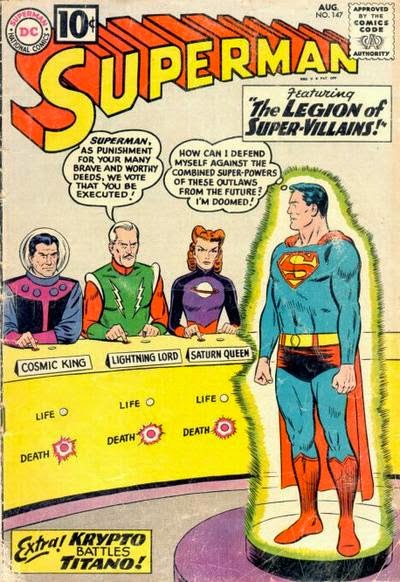
Since this post is part of my series on 147th issues, I'm going to go into a little more detail here on the final story in the book, which first appeared in Superman #147.  This is the tale which introduces the Legion of Super-Villains in a story by Superman co-creator Jerry Siegel and artists Curt Swan and Sheldon Moldoff imaginatively entitled "The Legion of Super-Villains."
The story begins with an imprisoned Lex Luthor volunteering to help out his fellow convicts by repairing their broken radios.  Clandestinely stealing parts from every unit he works on, Luthor builds a device capable of communicating with the future.  Knowing of the existence of the Legion of Super-Heroes, Luthor has reasoned that there must also be a Legion of Super-Villains to oppose them.  His attempt to contact the villainous Legion is answered by the appearance in his cell of futuristic devices which he uses to escape.  Shortly, he hooks up with the Super-Villains themselves, who proceed to introduce themselves and relate their origins.
Cosmic King is a scientist from Venus who invented a ray that could transmute matter, and who gained that power for himself after being zapped by his own ray.  Unfortunately for him, his dreams of fame and fortune are short circuited when he learns that transmutation is considered a great evil on Venus and he is subsequently banished from his homeworld, leading him to journey to Earth and take up a life of crime.
Lightning Lord is the brother of Legionnaire Lightning Man, formerly Lightning Lad.  He relates a slightly different version of the incident which gave him and his brother powers which does not include any mention of their sister, whose first appearance as Lightning Lass was still two years in the future as of this story's initial publication.  A footnote added for this reprint observes that "Lightning Lord hasn't told the full truth," and directs the reader to "See the first story in this magazine."  Well, of course he's lying. He IS a super-villain, after all, and therefore EEEE-VIL.
Saturn Queen comes from Saturn, where there is no crime.  Upon arriving on Earth, however, she suddenly felt compelled to use her powers of super-hypnotism to become a criminal.
The evil Legionnaires lure Superman to a planet in another solar system and trap him in a Kryptonite force field.  Luthor is prepared to execute his archenemy when the adult version of Superman's former teenage pals in the Legion of Super-Heroes arrive.
The two Legions battle to a stand off until Superman tricks Luthor into releasing him from the force field, after which he journeys to Saturn and uses a giant shovel gather material from Saturn's rings and encircle the planet where he had been imprisoned with it.  Apparently it is radiation in the rings of Saturn that affects the minds of its citizens and keeps the world free of crime.  Under the influence of Superman's newly created ring around this planet, Saturn Queen turns against her comrades, tipping the balance of power and winning the battle for the good guys.  The good Legion take their evil counterparts back to future and Superman returns Luthor to his cell on Earth.
While I'm reluctant to criticize the work of one of the men who invented the entire super-hero genre and without whom I would not be writing this blog, I have to say that the level of imagination reflected in the rather bland title of the story is, unfortunately, on display throughout the entire eleven pages of the story.  It is a rather pedestrian and unremarkable tale, aside from its importance in Legion history. 

Wednesday, March 13, 2013

"A Debt Repaid..." in Marvel Team-Up #147

Analogy Time:  The Human Torch was to Marvel Team-Up what Green Arrow was to The Brave and the Bold, only more so.
You could say, as I once did about Green Arrow and The Brave and the Bold, that Marvel Team-Up was almost as much the Human Torch's book as it was Spider-Man's.  Like GA in B&B, Johnny Storm appeared in MTU more times than any other hero, save for Spider-Man, of course.  In fact, the Torch showed up in MTU more frequently than GA in B&B.  Whereas GA appears in 11 of the 151 issues between the initiation of the team-up format in B&B #50 and  the series' end with #200, MTU was graced with the Human Torch's presence 16 times in its 150 issues run.  Two of those appearances were as a member of  the Fantastic Four, while six of them were as the star of the book, teaming up with other heroes while Spidey took an issue off.  The tradition of teaming Spider-Man and the Torch predates MTU, of course, going back to their friendly rivalry in the early days of The Amazing Spider-Man.
So when I tracked down  Marvel Team-Up #147 for my ongoing series of reviews of 147th issues, I was not at all surprised to find that the web-slingers co-star for the issue was none other than the Human Torch.
"A Debt Repaid..." is written by Cary Burkett, with art by Greg LaRocque and Mike Esposito.  This is one of only a handful of stories Burkett wrote for Marvel, primarily in MTU.  He spent the bulk of his career at DC, where he wrote a few issues of The Brave and the Bold, including, not surprisingly, a Batman/Green Arrow team-up.  
This issue is the middle part of a trilogy of sorts, teaming Spidey with Nomad (in #146), the Torch, and Thor (in #148) against a new villain called the Black Abbott.  The Abbott has set himself up in a base located off the shore of New Jersey where he is using his hypnotic powers to recruit scientific wunderkind to help him build a device to amplify his psychic powers enough to allow him to control an entire city.  He is also planning an assault on the prison at Ryker's Island to free the prisoners there to act as an army to carry out his dreams of conquest.
One of the science prodigies the Abbott, wearing the psychic disquise of a seemingly harmless old coot calling himself Mr. Abbott, recruits is none other than Peter Parker.  Thanks to his Spider-Sense, Peter is able to resist the Abbott's mental control, but he goes along with him to find out what his scheme is and to perhaps a rescue an old friend of his whom the Abbott also claims to have recruited.
Earlier, the Torch and Spidey had rescued a defector from Abbott's organization from other agents of the Abbott seeking to kill him for his betrayal.  However, the man's injuries were too severe to allow him to survive for long, but before he died, he spilled the beans about the Abbott's plans to the Torch.  Thus, shortly after Peter arrives at the Abbott's base, the Torch shows up as well.  However, Torchy gets himself captured pretty quickly and ends up under the hypnotic control of the Abbott, unable to flame on or fight the villain in any way. 
Switching to Spider-Man, Peter finds the mesmerized Torch and attempts to snap him out of the Abbott's spell by hurling insults at him in an effort to make him angry.  One particularly cruel and totally inappropriate remark finally manages to piss Johnny off enough to snap him back to reality.  Infuriated with Spidey, he and the wall crawler have a brief fight---because this is a Marvel comic, after all, and such is expected--before teaming up to take down the Black Abbott.  Even though his current plans are thwarted and his offshore base abandoned, the Abbott himself escapes to regroup and face off against Spidey and Thor in the issue following.
The title of the story, by the way, comes from Spidey feeling that his motivating the Torch to fight back against the Abbott's mental control is repayment for the Torch unknowingly inspiring him to get back in the game and defeat Doctor Octopus way back in Amazing Spider-Man #3.
All in all, this is a pretty typical meeting of two Marvel heroes, playing out as so many others did during the Silver and Bronze Ages.  Nonetheless, its an enjoyable little story, and I'll be keeping an eye out for a reasonably priced copy of #148 so I can find out how the saga of the Black Abbott plays out.

Thursday, November 1, 2012

Back To Basics--Hellblazer #147

Looking back over some of my old posts, I see that its been more than a year since I've done one of my series of posts on the 147th issues of a comic series lucky enough to have lasted that long.  There doesn't seem to be a resounding outcry amongst my readers for a new installment.  However, I've got this pile of borrowed Hellblazer comics, including #147, that I've had for several months and its long past time I returned them to their owner. 
Hellblazer #147 contains the second installment of "Hard Times," the inaugural storyline of writer Brian Azzarello's two and a half year stint on the title.  Much was made at the time of Azzarello being the first American to chronicle the ongoing adventures of John Constantine.  Many wondered if he would be able to accurately depict the London setting that had become so integral to the series.  In what could be perceived as an admission that his critics were right, Azzarello took Constantine out of his familiar environs and sent him on an extended tour of the colonies.  More charitably, this move can be seen as an attempt to breathe new life into the series by taking the character out of his comfort zone.
In "Hard Times," Azzarello throws Constantine into a very unfamiliar and hostile setting--an American prison.   The story begins in #146 with Constantine arriving at the prison.  His reasons for being there aren't yet revealed, and, quite frankly, when they are in #150, the final issue of the storyline, I didn't quite buy them.  That, however, is irrelevant to the issue at hand.
A con named Traylor takes a liking to "Connie" (For some reason, I'm attempting to be as delicate as possible here, but if you've ever seen any prison movies you probably know what I mean by that.), and gives him a tour of the place, introducing him to the various prisoner cliques.  After using magic to put an end to Traylor's advances, John begins to develop a rep as being dangerous. In part two in #147, representatives of the aforementioned cliques have decided that something's got to be done about Constantine, so they go to Stark, the lifer who runs the prison from his cell, to tell their tales of their encounters with the Englishman.
When Alan Moore introduced Constantine early in his run on Swamp Thing, it was as an enigmatic and possibly dangerous character.  However, once Constantine graduated to his own title, and after more than ten years and lengthy runs from Jamie Delano, Garth Ennis and Paul Jenkins, the mystery was pretty much gone.  Familiarity dulled Constantine's edge.  Azzarello attempts to bring back the mystery in this issue by showing John Constantine as seen through the eyes of people who've just met him as,  In fact, until the last page of the issue Constantine doesn't actually appear except in flashback in the tales of his fellow prisoner.
Though, as I stated above, I found the storyline as a whole disappointing, Hellblazer #147 is a very good single issue and works as a reminder of what makes the character of John Constantine so cool.

Tuesday, April 12, 2011

Fiddling Around While Stark International Burns--Iron Man #147

(Once again, I present an installment of what could be the oddest ongoing feature of any comics blog in which I review the 147th issue of a long running comic series.  This time out, it's Iron Man.)
To be honest, I was never a fan of Iron Man, the book or the character.  Not that I had anything especially against the guy, it's just that the basic concept of the character never quite grabbed me.  Now that I think about it, I never got into Milestone's Hardware back in the mid-90's, either.  I guess I just don't dig armored super-heroes all that much.
That said, however, the relatively few Iron Man tales I've read have been fairly decent.  I was actually surprised by how much I enjoyed the Silver Age sagas collected as Essential Iron Man Volume Two.  Of course, it didn't hurt that the majority of them were illustriously illustrated by Gene "The Dean" Colan.  I still haven't gotten around to seeing the second movie, but the first one ranks in my mind among the best super-hero movies ever produced, thanks in large measure to the performance of Robert Downey, Jr. in the title role. 
Furthermore, I'd heard quite a few good things, many of them from Jonathon Riddle, who lent me his copy of Iron Man #147 to read for this piece, about the David Michelinie/Bob Layton era of the title.  So I was fairly certain that I wasn't going to hate this issue.
"Holocaust At High Noon" opens with a splash page image of the Golden Avenger facing off against his old foe Whiplash, now powered up and calling himself Blacklash, who has been hired by some Philadelphia mobsters to kill Iron Man's, or rather his alter-ego Tony Stark's, head of security Vic Martinelli as Martinelli himself looks on. All around them, the campus of Stark International is ablaze as a result of Iron Man's initial battle with Blacklash.  Meanwhile, newly hired SI Vice President Yvette Avril, Public Relations chief Artemis Pithens, and a group of children visiting Stark International on a school field trip are trapped in the laboratory where the conflagration began.  
Leaving Blacklash temporarily trapped under a pile of rubble, Shellhead flies off to deal with the flames and maybe save a life or two.  Freeing himself, 'Lash realizes that Stark International is soon to be swarming with police, firemen and other authority types in addition to Iron Man, so he flees to assassinate another day. 
Sure enough, the villain returns bright and early the next morning to take another crack, literally, as his weapons are electrified whips, at Martinelli. I don't think it constitutes too much of a spoiler to reveal that the character whose name is in the indicia of this magazine eventually defeats and captures Blacklash.  Of course, I won't say exactly how, but the issue's cover, shown at the top of this post, does give some indication.  
This issue is penciled by John Romita, Jr. with inks by Layton.  However, the art doesn't quite reflect the distinctive JR, Jr. style that has grown on me over the years since I first encountered it on Uncanny X-Men.  This may be at least partially because this work occurs early in Jr.'s career, though it seems to due mainly to the influence of Layton's finishes.  The art more closely resembles the work by Layton that I've seen in other comics.  Either way, it's a polished, professional product that tells the story  clearly and effectively, which what you want in a comic, especially one heavy on action. 
That's certainly what Iron Man #147 is.  Basically, it's an all-fight issue, but, overall, a pretty good one. I said at the outset that I expected to like this issue, and I wasn't proven wrong.  With a good balance of action, characterization, and even a flash of humor when appropriate, "Holocaust At High Noon" is near textbook example of the kind of comic that Marvel did best during the tenure of editor-in-chief Jim Shooter in the late 70's and 80's.
 *   *   *   *   *   *   *   *   *   *
By the way, if you're an Iron Man fan, and I know at least one of my readers is, check out the three part series of posts from last year about the "Demon In A Bottle" story line at the blog Bronze Age Babies:

Tuesday, February 1, 2011

No Fun: Defenders #147

It's about time for another one of those posts where I take a look at the 147th issue of a long running comic series.  Check out this earlier post for a full explanation of this madness. Today's example is from a series that barely made it to #147, The Defenders, which ended with #152.
One caveat before we proceed: While The Defenders has become one of the most fondly remembered titles and teams from Marvel's Bronze Age, this issue does not feature any of the "classic" Defenders line-up of Dr. Strange,  the Hulk, the Sub-Mariner or the Silver Surfer.  These are the characters most associated with the team and the ones who have been gathered together for subsequent reunions of the group.  The issue we're considering today, however, features the "New Defenders", a team consisting of three ex-X-men, the Beast, the Angel and Iceman, and several obscure fourth string characters such as the Gargoyle and the Valkyrie, most of whom got killed off in the final issue.
The first thing you notice about this issue is, of course, the cover.  It's actually a pretty cool cover with a slightly altered logo and a painted image of a World War II era Sgt. Nick Fury leading the team as they charge into battle against a background of a giant American flag.  It's the kind of cover that makes you want to open up the book and see what's on the inside.  If you do that, however, you'll almost instantly regret it.
This is a truly awful comic.  It fails on every level from writing to art, and it didn't even have a letters page.  To be fair, the lettering and coloring are decent. The story, bad as it is, is at least legible.
"...and Games" is actually an appropriate title for the story, since it contains no fun whatsoever.   (Actually, "Fun..." was the title of the first part of the story in the previous issue, though I doubt that issue was much fun, either.)
As to the story itself, I really can't tell you what's going on in this issue.  The Defenders, consisting mostly of a bunch of characters I don't know and aren't adequately identified or even differentiated from one another, are in Central Park fighting some villain with the silly name of Hotspur, whose evil plan isn't quite made clear, though apparently it involves mind controlling innocent civialians.  Of course, I have not read the previous issue, but I doubt that the story would make any sense even if I had.  The storytelling, both in the writing and the awful, amateurish art, is muddy and confused and the dialogue is simply awful. By the way, the people credited with creating this mess are writer Peter B. Gillis and artists Don Perlin and Art Nichols, and editor Carl Potts probably deserves a share of the blame as well. 
If this issue was typical of The Defenders back in 1985, then its no wonder it was cancelled a mere five months later.

Monday, January 3, 2011

"When The Bugle Blows"--Sensational Spider-Man #147

Back in November, as I wrote my post about Amazing Spider-Man #147, I noticed that I had also, quite coincidentally, earlier spotlighted The Brave and the Bold #147 and Justice League of America #147.  Afterwards, I decided to do it on purpose from now on. So, today I begin an irregular feature wherein I shall read and review the 147th issue of one of the comparatively few comic book series  in the nearly eight decade history of the comics industry that have reached that number.  While thumbing through the back issues at Half-Price Books yesterday, I came upon a copy of The Spectacular Spider-Man #147, which seems as good a place as any to start.
Like the corresponding number of its older sister series, SSM #147 was written by Gerry Conway.  That's about all the two stories have in common, however. In the intervening thirteen years, a lot had changed. Peter Parker had married his long-time, on-again/off-again girlfriend Mary Jane Watson, and his old friend Ned Leeds, long presumed to be the super-villain known as the Hobgoblin, had been killed by terrorists.  
Oh, and demons had apparently overrun Manhattan Island. 
This issue is part of the cross-over story line "Inferno."  Don't ask me what "Inferno" is about.  I can't tell you.  Other than this issue, I've read a couple issues of The Avengers that cross over with the story, but since it was primarily an X-Men event, these issues exist on the periphery of the story and don't really give the reader a sense of the big picture.  Kind of sucks for you if you're not reading the X books, I guess, which I wasn't at the time and am not inclined to do now. All I know is that for some reason there's a bunch of demons running around everywhere and attacking people.
Conway himself sums up the dilemma of the casual reader in a caption toward the end of the story:
"Only a few know what is happening, and only they can confront the evil at it's source. 
"For the rest of those trapped on this unhappy isle, Inferno is a catastrophe without rhyme or reason."
He's referring to the inhabitants of Manhattan within the story, but those words also pretty much sum up how I felt while reading this story. 
The story opens with the new Hobgoblin sulking away from a battle with Spider-Man and Harry Osborn, who had once again assumed the role of the Green Goblin.  You'll remember that at this time the original Green Goblin, Harry's father Norman Osborn, was "dead," though he eventually got better.  After a run-in with the demons,  the Hobgoblin gets the bright idea to go to the Empire State Building, which was apparently the center of the demon infestation, and see, N'Astirh, the head demon.  Once granted an audience with N'Astirh, Hobby offers the demon his soul in exchange for the power of a demon.  Amused, N'Astirh grants the Hobgoblin's request.  The issue ends with Hobgoblin gazing in horror at a reflection in a pond of his now demonic looking face. 
Meanwhile, Spider-Man has an encounter of his own with a mysterious demonic wind that rises up out of nowhere and slams him against a wall.  Injured, the wall-crawler takes refuge in the offices of the Daily Bugle, only to find that its no safe haven, but rather under seige by a horde of demons.  As depicted on the cover, Spidey ends up fighting alongside his perennial nemesis J. Jonah Jameson against the demonic invaders.  Once the battle is over, Spider-Man collapses from his wounds. 
For what it is, which is basically a footnote in someone else's story line, "When The Bugle Blows" is a pretty decent issue.  We get some nice characterization of Spider-Man and his friends, the beginnings of a major plot development, and plenty of demon-bashing action all nicely illustrated by the late, great Sal Buscema. 

Thursday, November 4, 2010

Greatest Marvel Panel Ever!

In the same post where he reveals his choice for greatest DC Comics cover ever, J.M. DeMatteis also gives us his pick for the greatest Marvel cover.  I tried to come up with my own favorite Marvel cover, but nothing occurred to me.  I guess I don't really have one.
I do, however, have a favorite panel from a Marvel comic.  It's from Amazing Spider-Man #147, "The Tarantula Is A Very Deadly Beast!" written by Gerry Conway and drawn by Ross Andru, Mike Esposito and Dave Hunt, and its the most hilarious unintentionally (I presume) funny moment I've ever read in  a comic book.
The story begins with the Tarantula escaping from prison with the aid of the Jackal, and proceeding to attack Spider-Man.  As the two battle across downtown Manhattan, eventually they end up fighting on a city bus.  The frightened passengers flee at the next stop, but the bus driver appears not to notice anything unusual going on.  Seemingly oblivious, he keeps admonishing the combatants to "Please move to the rear of the bus."  When the Jackal created clone of Spidey's dead girlfriend Gwen Stacey gets on the bus and the driver continues to act oddly, the web-slinger snaps. "You can't be real!," he shouts at the unflappable driver, "Nobody behaves like you do...Nobody!"
At this point, the driver removes his "bus driver" mask to reveal the mask of the Jackal, complete with its giant protruding ears.  That's not the funny part, of course.  After years of reading Batman comics, you learn not to think about it too much.  The hilarious part is  what  the Jackal says as he unmasks:
"Then I suppose "the gig is up," eh, lawman? Nobody real does act like I do---
"--Because no one "real" is the Jackal!"
Cracks me up every time I read it.
Of course, when I first read that when I was ten years old, I didn't see the humor in it.  It was only when I came back to it years later as an adult that I  realized how funny it is.
Another thing that wasn't too funny to me is that the issue ended on a cliffhanger, but I missed the next issue at the local drugstore and it would be nearly twenty years before I found how Spidey survived being thrown off the Brooklyn Bridge by the Jackal and the Tarantula.  The next issue of Amazing Spider-Man that I would pick up was #153, so I knew he did survive, just not  the details of his escape.
By the way, I just noticed something as I've been typing this up.  What's the deal  with me and 147th issues? Just yesterday, I wrote about The Brave and the Bold #147, and a few months ago I spotlighted Justice League of America #147.  Coincidence?  Probably, but maybe I should consult my astrologer.

Wednesday, November 3, 2010

Dr. Light: Ok, He WAS Lame, But So What?

Coming near the end of writer Bob Haney's long tenure on The Brave and the Bold, issue #147 teams Batman and Supergirl in a story written not by Haney but by relative newcomer Cary Burkett.  I can only speculate as to why this issue is not written by Haney, however I do know that there were conflicts toward the end of Haney's run between the writer and new B&B editor Paul Levitz that would eventually force Haney off the book.  It may be that Levitz wanted a Supergirl team-up and Haney either refused to do it or didn't do it to Levitz's satisfaction.  If Haney did refuse, I'd speculate that it was because he had already planned the story that would appear just three issues later in #150 featuring Superman.  It does seem almost redundant to me to have team-ups with two so similar characters in so  short a span of time.
However, my purpose in writing about B&B #147 was not going to be to talk about how badly DC treated Bob Haney, but how badly DC treated Dr. Light in Brad Meltzer's awful Identity Crisis mini-series.  I saw another review of this issue on-line and, remembering that Light was the villain of the piece, decided to write a post about how the doctor wasn't always lame and how the revamp of the character in Meltzer's story was unnecessary, not to mention a really bad idea and  an equally bad story.
After rereading B&B 147's story, "Death-Scream From The Sky", I realized that I couldn't do it.  Oh, I still feel the same way I always have about Identity Crisis. It is and shall remain for all time one of the worst comics ever published.  However, I am now forced to admit that Dr. Light really was pretty lame.
In B&B #147, his scheme to blackmail Gotham with the threat of a laser attack from a hijacked satellite is pretty generic, having been tried by a host of other villains ranging from the Parasite to Kobra, and Batman barely breaks a sweat taking out him and his henchmen.  A couple of years earlier, in Teen Titans #44, Light tried to take revenge on the his old enemies in the Justice League of America  by defeating their sidekicks in the Titans, but ended up getting his ass handed to him by wannabe hanger-on Mal Duncan , an even lamer character than Light, wearing a second hand Guardian costume.
In these stories, the heroes, at least, take Light seriously.  Batman tells Supergirl that Light is "more deadly than a dozen rattlesnakes."  The writers, for their part, do their best to make Light a real menace, though they don't quite succeed. 
By the 80's, things had changed. Dr. Light's inherent lameness was acknowledged and even embraced. In the Batman and the Outsiders/New Teen Titans team-up Marv Wolfman and Mike W. Barr portray Light as a craven, cringing coward.  His backstory in Secret Origins was played for laughs, paired in that issue with the origin of the even lamer  and far sillier Legion of Substitute Heroes, and John Ostrander used him mainly as a punchline in Suicide Squad.
As I've said before, there's really nothing wrong with having one or two easily defeated comic relief villains to provide the heroes a little breather between the real world-beaters.  Besides, the point I'd intended to make in this post is still a valid one.  If DC really had to make Dr. Light into a badass mofo, there had to be better ways to do it than a clumsy retcon that turned him into a brutal rapist and had Zatanna psychically violate him and the rest of the JLA as accomplices.  
It just amazes me that DC actually approved this piece of crap instead of shouting "Are you freakin' crazy!?! We can't print this garbage!!!" and having security escort Meltzer out of the building. I, for one, prefer to pretend the whole mess never happened.  That would be a whole lot easier if nearly everything that's happened in nearly every DC title for the five years since didn't spring directly from it.
Still, I hope that someday DC will choose to just ignore Identity Crisis.  However, it seems far more likely that instead they'll eventually publish an even worse story to explain it away.  Now that's something to look forward to.

Friday, November 20, 2009

Just WRONG: Justice League of America #147

To be honest, the story contained in Justice League of America issues #147 and #148 is one of my favorite of the annual pre-Crisis on Infinite Earths teamings of the League and their Earth-2 counterparts, the Justice Society of America.  It features the JLA and the JSA teamed with the 30th century heroes the Legion of Super-Heroes facing off against old Legion foe Mordru and veteran League enemies the Demons Three in a quest for a trio of mystical objects that spans time, space and dimension.  This type of wild, far-fetched epic is everything I love about super-hero comics.
However...

There is a sequence early on in the story that just makes me cringe.  The best word to describe it is "icky."
As the 147th issue of Justice League of America begins, the JSA are guests aboard the League's satellite headquarters after having captured the Psycho Pirate, who fled to Earth-1 in an attempt to elude the Society, a story related in the JSA's own feature in the recently revived All-Star Comics.  Just as the Earth-2 heroes are about to head back to their own dimension with their prisoner, Green Arrow, not wanting this reunion of the super-teams to end too soon, shoots the infamous boxing glove arrow at the controls of the dimensional transporter, shutting it down. As the machine needs an hour to warm up again, the Society members are forced to hang out for a while longer.
Now comes the creepy part.
One member of the JSA, Power Girl, seems delighted with the delay.  She's hanging all over Earth-1's Man of Steel as she purrs, "I'm beginning to really like this place!  It has a much nicer brand of Superman, y'know?"  Kal-El is, understandably, a little uncomfortable with this, but offers to show her the JLA's trophy room anyway.  As they head off, Black Canary snipes, "Incredible! And I used to call you a fast worker, Oliver!"  Ollie's response is "*CHUCKLE* I guess they've got Women's Lib on Earth-Two, too, Pretty Bird!"
Thankfully, a giant disembodied mystical hand invades the satellite right at that moment and spirits members of both teams away through time to the 30th century..
Power Girl was essentially the Earth-2 analog of Supergirl.  Like Supergirl, she was the cousin of that world's Superman, who was essentially the same person on Earth-2 as he was on Earth-1, unlike, say, the Flashes or Green Lanterns, who shared only their heroic name and super powers in common.   In essence, she's coming on to her cousin.
Like I said: "icky"
The sexist language notwithstanding, Ollie's reaction is taking the whole "liberal" schtick a bit far. He might be OK with it, but even when I first read this as a kid, I found that whole sequence disturbing.  Fortunately, it's only three panels long in a story spanning two double sized issues, and is thankfully not revisited.