Showing posts with label history. Show all posts

Thursday, March 20, 2014

Swamp Thing Artist Stephen Bissette to Appear at the Wexner Center in April

Stephen R. Bissette
The Comics Code is widely regarded by comics historians and fans alike as the most repressive set of content restrictions ever imposed upon any entertainment medium.  From its adoption in 1954 following the public shaming of the comics industry during Senate hearings on the causes of juvenile delinquency through the height of its power and influence during the 1960s and its long, slow slide into irrelevancy in the 1970s, 80s and into the 90s until its final dissolution in early 2011 the Code and its ubiquitous Seal of Approval stood as symbol and reminder of a dark chapter in the history of not only comic books but America itself. 
The Ohio State University's Wexner Center for the Arts, in co-operation with the Billy Ireland Cartoon Library & Museum, has invited Stephen R. Bissette, renowned artist for much of Alan Moore's historic run on Swamp Thing and creator of the short-lived independent comic Tyrant in the mid-90s, to give a presentation entitled Swamp Thing and the Birth, Life and Death of the Comics Code Authority in the Wex's Film/Video theater on Tuesday, April 29 at 7 p.m.  The event is free and open to the public, and there's a Facebook event page where you can RSVP if you're planning to attend.
It is quite probably safe to say that Bissette's talk will deliver, as the saying goes, exactly what it says on the tin, covering the origins and  six decade history of the Code from the Senate hearings until its ultimate demise just three short years ago with emphasis on the role that Bissette's own work with Alan Moore on Swamp Thing played in that history.
Swamp Thing began life as a standard format Code approved newsstand comic, but shed the Seal of Approval shortly after Moore came aboard as writer.  The story, at least as I've heard it told, is that after months of just automatically rubber stamping the book with the Seal, someone at the Code Authority actually bothered to read it and wasn't happy with what they saw.  DC, rather than ask Moore to tone down his stories in order to comply with the Code, decided to continue publishing the series without the Seal.  The creative and commercial success of Swamp Thing inspired DC to publish other non-Code approved mature readers titles, including the Swamp Thing spin-off Hellblazer and Neil Gaiman's almost universally beloved Sandman, and led eventually to the 1993 formation of the mature readers imprint Vertigo.
Other factors, of course, contributed to the weakening and eventual demise of the Code.  Chief among these, by my reckoning, was the rise of the direct market and with it the plethora of independent comics publishers who bypassed the traditional system of newsstand distribution and offered their product exclusively through comics shops without the benefit of Code sanction. This development roughly coincides with the arrival of Moore on Swamp Thing and the genesis of DC's mature readers line.  Both of these developments were contributing factors to the final revision of the Comics Code in 1989.
The history of the Comics Code has long been a subject of special interest to me.  I've read several books about, including David Hadju's excellent The Ten Cent Plague: The Great Comic Book Scare and How It Changed America and Seal of Approval: The History of the Comics Code, Amy Kiste Nyberg's more academic and analytical approach to the subject.  Thus I will be particularly interested to hear Bissette's take on the topic.  While I don't know if he'll be able to tell me any facts that I really don't already know, it will be interesting to get his unique perspective on those facts as someone who battled the Code's restrictions on the front lines.

Sunday, July 21, 2013

Grant Morrison's "Supergods" Reviewed

Ok, let's start right off with the one major problem with Grant Morrison's Supergods: Our World In The Age Of The Superhero. (At least, that's the subtitle on my copy of the book, which is apparently the British edition.  It's amazing what you can come across at Half-Price Books, ain't it?  [My copy of Scott McCloud's Making Comics carries the warning "Uncorrected Proof: Not for Sale" on the back cover.]The American edition carried the tag "What Masked Vigilantes, Miraculous Mutants, and a Sun God From Smallville Can Teach Us About Being Human."  The AV Club called that "ponderous."  I kind of agree, but as the entire book tends to be a little ponderous, perhaps its totally appropriate.  Still, I prefer the British version of the title.)  There are, as you might have inferred from my parenthetical asside just now, some other smaller problems with the book, but only one that really bothers me.  Its a problem I've noticed, but chose to overlook in most cases, in other histories of the comics, but find a little more egregious in this case.
I don't think that I've ever read a history of comics that didn't include at least a couple of factual errors.  I am usually forgiving of  these because most of those books are written by "outsiders" with a particular thesis to prove or agenda to advance, little things like research or accuracy be damned.   Morrison, however, is an industry insider and a self-professed life long fan, so such errors are somewhat harder to overlook, especially when they concern properties on which the author built his considerable reputation in the business. 
Now that I've got the nit-picky stuff out of the way, let me say that I quite enjoyed this book, actually.
Morrison does have his special thesis to advance in this book, which is equal parts history of comics and autobiography of Morrison himself.  That only makes sense, as for the past twenty-five years or so the two have been intimately intertwined.  
Morrison's thesis is that we all have the potential to become superheroes, and, with the aid of 21st century technology, in fact already are, and that tales of fictional superheroes have been there for us over the decades to show us the way.  To be honest, there's really nothing startlingly original in Morrison's theorem.  It's really just another variation on the old "superheroes as modern mythology" trope that's been with us for ages.  Morrison, however, does manage to bring to the table an understanding of psychology, alchemy, and magic as well as a knowledge of world mythologies that goes beyond the Greek/Roman pantheons that are the traditional basis for the metaphor.
The main appeal of Supergods, especially for Morrison's fans, is Grant's breathless, hyperbolic prose, most on display during the comics history parts of  the narrative.  He details the real life history of superheroes in the same mythopoeic terms that he applies to  their fictional adventures. Here's a sample from the very first page of the first chapter:
"From the beginning, the ur-god and this dark twin presented the world with a frame through which our own best and worst impulses could be personified in an epic struggle across a larger-than-life, two-dimensional canvas upon which our outer and inner worlds, our present and future, could be laid out and explored.  They came to save us from the existential abyss, but first they had to find a way into our collective imagination."
"Ur-god and his dark twin...?"  Couldn't just say Superman and Batman, could you, Grant?  That passage, besides setting the tone for most of what's to come, also serves as a fairly succinct synopsis of Morrison's central theme.
When he turns this same technique to his own life story, its just as fun to read, for the most part, though it at times comes off as immodest self-aggrandizement.  Of course, we long time fans expect that. Though I suspect it might put off mainstream readers, who are at least part of the target audience for this book. 
As I said above, the narrative can get somewhat ponderous, as when Morrison discusses his infamous "alien abduction" in Kathmandu, during which he was supposedly shown the true nature of reality by a bunch of fifth dimensional silver blobs.  This was actually part of the book I was looking forward most to reading.  However, before it was done I was waiting for Grant to get back to talking about writing Flex Mentallo, which, unfortunately, he never did.
Despite its over 420 page length, I burned through Supergods in under two days, and it would have been less if I hadn't taken time out to go to my job and sleep.  That is due, I suppose, not only to my intense interest in both of the books main topics, Grant Morrison and superheroes, but to the frenetic pace with which Morrison leads us through our journey of seven decades.  Though, as I said, the book gets bogged down when it should have been its most compelling, for the most part its an exciting and involving read. 
If you're a fan of Morrison, I recommend this tome in no uncertain terms.  If you're not quite the Grant-o-phile that I am, its still worth reading.  If you're someone who doesn't read comics, but might be curious about them (or if you know such a person), I could think of worse places to start your journey into their 2D universe.

Saturday, February 23, 2013

THE GLORY DAYS OF THE BRAVE AND THE BOLD: Bob Haney, Jim Aparo, Murray Boltinoff and B&B #'s 98-131 (Conclusion)

(For the edification of those who may have missed my last post, I shall reiterate the explanation and history of this two-part series of posts as it appeared previously: The following long--for a blog post, at least--piece was written a couple of years ago for Jim Main's fanzine Comic Fan.  Shortly after I submitted it, however, Jim decided to suspend publication of CF in order to concentrate on comic books.  Thus, other than the select few trusted friends whom I sent copies to for proofreading and kibitzing, this masterpiece of comics history and journalism has gone regrettably unread.  Until now, that is.  Due to the aforementioned length of the article, I found a natural breakpoint about halfway through and split it up into two posts.  Part one can be read by going here.)
Now let's take a closer look at some of the individual stories that made the Haney/Boltinoff/Aparo B&B era so great. 

Friday, February 22, 2013

THE GLORY DAYS OF THE BRAVE AND THE BOLD: Bob Haney, Jim Aparo, Murray Boltinoff and B&B #'s 98-131 (Part One)

(The following long--for a blog post, at least--piece was written a couple of years ago for Jim Main's fanzine Comic Fan.  Shortly after I submitted it, however, Jim decided to suspend publication of CF in order to concentrate on comic books.  Thus, other than the select few trusted friends whom I sent copies to for proofreading and kibitzing, this masterpiece of comics history and journalism has gone regrettably unread.  Until now, that is.  Due to the aforementioned length of the article, I found a natural breakpoint about halfway through and split it up into two posts.  The conclusion will appear here in a day or so.)
In the December 2004 edition of BACK ISSUE magazine, editor Michael Eury called THE BRAVE AND THE BOLD (B&B) the most influential comic book put out by DC during the Silver and Bronze Ages. While Eury admits that his claim may be somewhat overblown, the evidence that he offers to support his theorem, in the form of a listing of important characters and concepts that first saw the light of day in B&B, is nonetheless compelling.

Sunday, June 17, 2012

It Was 40 Years Ago Today--Nixon, Kirby, the Great Disaster and the End of the 60s

It was forty years ago this very morning that the 1960's ended. 
Allow me to clarify that seemingly chronologically challenged assertion.
You see, I vaguely recall having read something in Reader's Digest many years past about the concept of "sociological decades", measured not by calendar years but by the duration of the social trends that come to define the decade in the mass consciousness.  Thus, the 1960's began when shots rang out from the Book Depository in Dallas, Texas in late November of 1963 and ended, by my reckoning at least, on a late spring night in Washington, D.C. when five men, later revealed to  be in the employ of the Committee To Re-Elect The President, were apprehended in the act of breaking into the headquarters of the Democratic National Committee in the Watergate apartment building.  
In Rolling Stone, Hunter S. Thompson wrote, "The slow-rising central horror of 'Watergate' is not that it might grind down to the reluctant impeachment of a vengeful thug of a president whose entire political career has been a monument to the same kind of cheap shots and treachery he finally got nailed for, but that we might somehow fail to learn something from it."
Yet the human animal is not especially noted for the ability to learn from its mistakes. We tend to either learn nothing, or worse, gradually forget what we learned when the crisis passes. Worse yet, we will learn all the wrong lessons and forget them eventually nonetheless.  In the Watergate scenario, the case appears to be a sad combination of the latter two pathways.  Any half-hearted attempts by a Congress newly emboldened in the aftermath of Nixon's downfall to rein in the power of the executive branch and make it more accountable to the legislature and the American people have long since fallen by the wayside.  During the first dozen years of the 21st century, this proud nation has drifted farther in the direction of a so-called "imperial presidency" than that poor doomed bastard Nixon ever dared dream even in his most megalomaniacal moments.  The only executive power that Congress in recent memory has seemed interest in curbing is his power to get a blowjob from a starstruck intern in the Oval Office while simultaneously talking on the phone to the President of Russia.
When I was casting about in my mind for some way to tie the remembrance of Watergate and  reflection on its legacy that I wanted to inflict on the blogosphere on this unhappy anniversary to comics, I remembered Kamandi #15.  I dug it out of one of the nearly dozen boxes of old comics piled precariously in the corner of my bedroom closet, but didn't actually get around to rereading it until I'd already composed the first portion of this post.  Thus, I was actually pleasantly surprised to discover that with only a minimum of rhetorical sleight of hand I could bend my analysis of the issue to fit the themes of the first part of this post.
Like many comics scribes of the Bronze Age, KIrby, when acting as his own writer, plundered liberally from the prevailing pop culture and current events to fuel his mad masterpieces.  The Kamandi series itself, set in a future world after something called the Great Disaster, when intelligent animals rule and the  remnants of the once proud human race  are reduced to mere pets, or worse, seems little more than Kirby's take on the Planet of the Apes concept, with not just apes, but bears, tigers and even snakes among the ruling class.  Thus, the idea that Kirby would use Watergate as fodder for a comic book story comes as little surprise to anyone who really knows what they're talking about.  In early 1974, when this comic would have been appearing on the nation's newsstands, Watergate consumed a very thick slice of the American zeitgeist.
At last we arrive at the story itself, which picks up pretty much where the previous issue left off.  In order to save Kamandi's life, Tuftan, the Tiger Prince, has apparently made a mysterious bargain with the department store owning snake Mr. Sacker.
In fulfillment of the pact, Tuftan and his Tiger Troops, accompanied by Kamandi and the dog scientist Dr. Canus, ride off toward the fabled mythical city of Washington, D.C. in pursuit of the legendary Watergate tapes.  Its not made clear why exactly Sacker wants them, though his emporium is filled with pre-Disaster artifacts looted from the ruins of human civilization and it is likely that he wishes them to be but one more item offered for sale to wealthy collectors of antiques and curios.
After a long hard ride, Tuftan and his party arrive at a place called "Stake Out" on the outskirts of the legendary city.  I assume that "Stake Out" is meant to be what remains of some real life locale in our nation's capital, but I can't tell exactly what is supposed to represent.  As the troops settle in to explore the place, Tuftan and Canus soon find themselves abducted by a troop of gun toting apes who take them to the headquarters of their arcane cult in the ruins of the Capitol building.
Soon, the two captives are taken to the "hearings," a bizarre ritual that mocks the Senate Watergate hearings which were taking place on national TV at the time that Kirby would have been writing and drawing this issue.  There they are confronted by a panel of apes who "indict" them for "planning to steal the sacred Watergate tapes--the voices of the Spirits!"  For this, Tuftan and Canus are sentenced to death by means of a strange weapon that uses soundwaves to kill.
Kamandi and Tuftan's Tiger Troops arrive, as the cavalry always does in tales like this, in the nick of time to rescue their prince and the scientist.  After defeating the apes, the tigers dismantle the sound weapon to discover the very Watergate tapes they had come there in search of used as the source of the machine's deadly sound waves.  Canus attempts to play one of the tapes, but it breaks after playing only a snippet of what I assume is meant to be Nixon's voice saying, "I want to make this perfectly clear--".   Tuftan decrees that Canus should not bother to mend the tape, for, as Kamandi observes, "It doesn't mean much--NOW--".
Kamandi #15 is not one of Kirby's best works.  In his greatest stories, the events move at such a frantic pace that questions like my above query as to why Sacker wanted the cursed Watergate tapes in the first place would never have occurred to me until long after I'd finished reading.  Here, though, that lapse in logic threatens to derail the whole endeavor, but doesn't quite bring it down completely.  Nonetheless, the tale serves the purposes of this post well enough.  For the apes who worship the spirits of Watergate have learned from the affair, but the lessons they have absorbed are quite obviously the wrong ones.  They endlessly and pointlessly rehearse the charade of "hearings" again and again in the manner of subsequent Congressmen who seem to think that the way to make a name for themselves is to uncover any little hint of scandal, motivated not by altruism  or patriotism or a quest for the truth, but by self-aggrandizement or simple, mean spirited vengeance.
Ultimately, in the wake of Iran-Contra, the Clinton Impeachment and the depradations of the George W. Bush administration, we must every now and then take time to remember the lessons, if any, has our country learned from the Watergate scandal and  ask ourselves whether they are the right ones.

Thursday, April 5, 2012

Meet Fritzi Ritz

I hadn't read the comic strip Nancy for years.  But a couple of hours ago, for some damn reason I found myself clicking on a link in an e-mail and checking out today's strip.  It featured a lame gag pretty typical of the strip as I remember it, but I was somewhat taken aback by the panel over there on the left, featuring an on panel appearance by Nancy's Aunt Fritzi. 
You see, back when I would read Nancy as a kid, Aunt Fritzi never actually appeared.  Though referred to often, she was at most an occasional off-panel voice.  Thus, it was quite a surprise to me when I eventually learned that she had once been the star of the strip.
Another surprising thing I learned when I looked the strip up on Wikipedia just now is that Ernie Bushmiller, the cartoonist most closely associated with the strip, was not its originator.   The comic began life in October 1922 as Fritzi Ritz, drawn by Larry Whittington.  Whittington left after three years to start another strip, leaving Fritzi Ritz to his assistant Bushmiller.  Bushmiller at first continued the strip under Whittington's name, not signing his own name to it for about a year.
In 1933, Bushmiller introduced Fritzi's niece, Nancy.  She eventually took over the strip to such an extent that it was renamed for her in 1938, the same year that Sluggo joined the cast.  Fritzi Ritz continued as Sunday only strip, separate from the Sunday version of Nancy, until the late 1960's.  
Bushmiller died in 1982, and the strip has passed through various hands since then.  In 1995, it was taken over by Guy and Brad Gilchrist, who remain to this day.

Sunday, October 2, 2011

'Tec Support: "The Million Dollar Debut of Batgirl!" (Focus On Batgirl)

Created by a trio of comics legends, editor Julius Schwartz, writer Gardner Fox and artist Carmine Infantino, at the behest of Batman TV series producer William Dozier, who was looking for a female character to appeal to that segment of the TV audience, the new--and "real", as we're told in a caption--Batgirl (there had been a previous character called Bat-Girl in the late 50's and early 60's) met the comics reading public in the January 1967 issue of Detective Comics, #359, in a story entitled "The Million Dollar Debut of Batgirl!"   The introduction of Batgirl, incidentally, was not the first change made in the comics to accomodate the TV series.  One of Schwartz's first moves on assuming editorship of the Batman books was to kill off Bruce Wayne's butler, Alfred.  However, he and Fox were compelled to bring the character back to life when the producers wanted to include him in the show.
The story moves quickly, giving us just a two panel introduction to Barbara Gordon, the previously unseen and unmentioned librarian daughter of Gotham City Police Commissioner James Gordon, before she dons her Batgirl costume and is off to the Policeman's Masqerade Ball.  Setting off  for the ball, Barbara thinks that "...tonight will be the highlight of my life!"  She's right, of course, but not quite in the way she was thinking of.  A funny thing happens on the way to the party, when she sees Killer Moth's minions attempting to put the snatch on "...Daddy's millionaire friend" Bruce Wayne.  Proving that "clothes make the woman," she leaps into action to save Wayne, allowing the millionaire to slip away and change to Batman.  The Caped Crusader ends up having to rescue Batgirl while Killer Moth escapes. Her costume messed up in the fight, Batgirl tells Batman she won't be going to the masqerade after all, but holds back on telling him her name, despite thinking to herself that this might be both Batgirl's "...debut and farewell appearance..."
She soon finds, however, that after her brush with crimefighting, the fast paced life of the librarian just doesn't thrill her the way it used to.  Then one night, Barbara goes to deliver a rare book to Bruce Wayne and sees him apparently murdered by Killer Moth.  She once again goes into action as Batgirl, but soon learns that her interference has spoiled the Dynamic Duo's plans to follow Killer Moth back to his hideout.  Nonetheless, it turns out, somewhat predictably, I'll admit, that despite her initial blunder, it is Batgirl whose nick of time arrival at Killer Moth's lair serves to save Batman and Robin's bacon and capture the villain.
If, as the conventional wisdom among comics fans holds, the intentionally campy tone of the TV series had infected the comics, it is not much in evidence in this issue.  True, Killer Moth, with his themed henchmen Larva and Pupa, is a silly villain, and Robin spouts a couple of truly dreadful puns, while, at one point, daring to criticize Batgirl's "terrible puns."  For the most part, however, "The Million Dollar Debut of Batgirl!" is a fairly straightforward, serious minded adventure story, thanks to Fox's fast-paced and witty script and Infantino's suitably dark and moody artwork.
Quite a few of the "important" stories of the Silver Age--the first appearance of the Teen Titans springs to mind--are worth reading only for their significance to comics history.  Detective #359 is not one of those issues, though.  "The Million Dollar Debut of Batgirl!" stands on its own, aside from its place in history, as an entertaining and fun Batman story.
In a future post, I'll take a look at Batgirl's second first appearance, in the third season premiere of the Batman TV show.

Saturday, May 14, 2011

The Failed Promise of Giant Size X-Men #1

The latest issue of liberal political journal The American Prospect offers up an essay on the history of minority representation in American super-hero comics.  Focusing mainly on Green Lantern and Captain America, two characters with big budget Hollywood blockbusters coming up in the next couple of months,  author Gene Demby traces the history of minority super-heroes from John Stewart to Milestone Media to the recent criticism by narrow minded fanboys of the late Dwayne McDuffie for his inclusion of minority characters in Justice League of America, touching on  Marvel's Luke Cage, and the rather embarrassing practice from the 1970's of giving all African-American heroes names with the word "Black" in them along the way.  
Despite a new movie on the horizon, Demby fails to mention the X-Men.  The "All-New, All-Different" Uncanny X-Men was a book that had the potential to be truly groundbreaking and history making in terms of diversity and minority representation in comics, but blew it pretty much right of the gate.  The new team as presented in Giant Size X-Men #1 was a much more diverse group than had ever been seen in comics up to that point.  The roster included a Japanese man (Sunfire), a Native American (Thunderbird) and a black woman (Storm).  In short order, their very next appearance in Uncanny #94, as a matter of fact, Sunfire quit and went home to Japan and Thunderbird was killed off.  The team still had the "international" flavor that  creator and writer of Giant Size X-Men #1,Len Wein, had envisioned, with a Canadian (Wolverine), an Irishman (Banshee), a German (Nightcrawler) and a Russian (Colossus) in the group.  Still, you were essentially left with a line-up consisting of a bunch of white guys (though Nightcrawler was actually blue) and Storm.
This is somewhat ironic, given how often longtime Uncanny writer Chris Claremont has been lauded for indirectly addressing racial issues by using anti-mutant prejudice as an allegory for racial bigotry.  It appears, however, that he, or perhaps his editors at Marvel, shied away from the chance to tackle the subject head on.

Monday, April 11, 2011

'Tec Support: The Seeds of "Knightfall"--Detective Comics #480

While notable for being one of the first two Batman stories drawn by the late Don Newton (Batman #305 hit the stands that same month), "The Perfect Fighting Machine" from Detective Comics #480 is, in truth, an entertaining but rather unremarkable tale.  According to writer Dennis  O'Neil, however, this obscure little story helped spawn one of the biggest event story lines of the 1990's.  Within the pages of 'Tec #480 lie the seeds of "Knightfall."
But I'm getting ahead of myself.  Let me tell you about the story first.
The tale begins in medias res, with Batman already locked in a life or death struggle with a silent, hulking brute who appears to be kicking the living crap out of him.  As he's getting tossed around, Bats thinks, "He's creaming me...and I don't even know his name!"  As the taciturn killer is strangling him, Batman decides it's a good time to try and make friends.  He chokes out the words, "Wh-Who are you?", cuing the inevitable flashback.
In the next panel, we are taken back in time six weeks to find a homely, fat schlub being harassed by a trio of young punks who break his calculator and make him drop his ice cream cone.  Slinking away in tears, he is befriended by a stranger identifying himself as Ivan Angst, who offers to buy the poor kid a new ice cream cone.  Angst is soon revealed to the reader as the leader of a terrorist organization known as Mercenaries, Incorporated, whom Batman has been after for several weeks.
While Batman is bedridden with a fever of 104 degrees, Angst, with all purpose mad scientist Dr. Moon, begins the process of transforming the poor nerd he befriended into a the "perfect fighting machine" of the story's title through a series of surgeries and hormone treatments which render him super strong, nearly invulnerable, and unable to feel pain.  Moon later refers to him as a "gork," which, the doctor explains, is "...medical slang for a living, breathing vegetable!" Angst has plans to create an army of such perfect soldiers. When the process is complete, he decides to test his prototype against the "perfect opponent," the Batman, and issues a challenge to the Caped Crusader via a classified ad in the Gotham newspaper.  Despite not being fully recovered from his illness, Batman accepts the challenge, and the story shifts back to the present where Batman is still struggling to survive the relentless onslaught of Angst's perfect soldier.
Just as he's about to deliver the killing blow, the would be assassin falters and collapses.  Moon declares, "As I feared! The strain was too great! His whole system is collapsing! Not being able to feel pain, he didn't realize anything was wrong--until it was too late!"  The dying giant turns to the one man he believed to be his friend, Ivan Angst.  But Angst, calling him "...an experiment--that failed!", refuses.  Enraged, the "gork" turns on Angst as the cowardly Dr. Moon flees.  Batman attempts to pull him off Angst, but he fails.  The "perfect fighting machine" kills Angst before dieing himself, with neither Batman nor the reader ever having learned his name.
Back in 1993, while the "Knightfall" story line was running in Batman and Detective Comics, Dennis O'Neil, then editor of the Batman titles, and Julius Schwartz, editor of 'Tec at the time #480 was published, were in Columbus as guests at the annual SF con Marcon.  They also did a signing at the now out of business local comics shop Central City Comics that Saturday.  I got my friend Dave Alkire to give me a ride out to the shop, and gave him my copy (I've long since aquired another) of 'Tec #480 so he'd have something for O'Neil and Schwartz to sign.  When Dave handed O'Neil the book, the writer told us a little story about it.
Denny hadn't felt that the seventeen pages allotted to him for this story had given him sufficient space to fully explore the premise.  Thus, he eventually returned to the idea, reworking it and expanding it.  This new story was called "Venom," which appeared as issues #16-20 of Batman: Legends of the Dark Knight in 1991.
"Venom," of course, introduced the titular strength enhancing drug, which was later used by the villain Bane, the prime mover behind the events of "Knightfall."  This story eventually gave us Jean-Paul Valley, a.k.a. Azrael, as the replacement Batman after Bane break's Bruce Wayne's back.
So, "The Perfect Fighting Machine," a little known seventeen page story from the late 70's, is indirectly responsible for giving us not only this:

...but this, as well:
Furthermore, the success of "Knightfall" may have had a hand in inspiring such later abominations as "Emerald Twilight," the story that introduced Kyle Rayner as the new Green Lantern even as it transformed Hal Jordan in a cosmic powered mass murderer. (The latter is  the abominable part.  I actually liked Kyle as GL.)
Despite all that, I still like "The Perfect Fighting Machine."  In fact, I like it even more knowing the unheralded role it played in comics history.  I say "unheralded" because, other than hearing it from Dennis O'Neil himself, I've never come across this info in any comics magazine or on the web.  For all I know, I may be first person, even after all this time, to write about this. 
That's kind of cool, actually, if it's true.

Friday, April 1, 2011

Comic Book Comics # 5

One of my favorite items in The Onion's look back at the 20th Century, Our Dumb Century, is an article headlined "Siegal, Shuster Sign Lucrative Publishing Contract."  The piece details how Jerry Siegal and Joe Shuster signed over to DC Comics "rights to their fantastical 'Superman' character in perpetuity" for $25 and a sandwich.  It's the kind of piece that almost makes you want to cry even as you're rolling on the floor laughing over it.  The sad part is that it's not all that far from the truth.  Siegal and Shuster received a mere $130 for the very first Superman story and all rights to the character, which has netted untold millions for the company  over the last seven decades.
In Comic Book Comics #5, the most recent installment of their six issue comic book history of  the comics industry, Fred Van Lente and Ryan Dunlavey detail the struggles of Siegal and Shuster, and their heirs, to gain their rightful due for creating one of the most well known and beloved fictional characters of all time.  Siegal and Shuster's tale, though, is only part of an overview of the history of creator's rights and copyright disputes throughout the history of the comics industry.  Van Lente and Dunlavey also cover the dispute between Jack Kirby and Marvel over rights to the characters he created for them and the return of his original artwork, the case of the Walt Disney Company versus the underground cartoonists collective calling themselves The Air Pirates, the famous court battle between DC and Fawcett over Captain Marvel and the tangled legal web that, until recently, has ensnared the rights to Marvelman/Miracleman. They also touch on the disputes between Joe Simon, Marv Wolfman and Steve Gerber and Marvel and Dan DeCarlo and Archie Comics.
Van Lente's clear, concise text provides an easily grasped introduction to these complex issues.  As the artist, Dunlavey may have the harder task. He has to find a way to somehow illustrate abstract legal concepts.  Fortunately, he is up to the task, with drawings that emphasize and enhance the key points of Van Lente's essay.
This is the only issue of Comic Book Comics I've read so far.  I picked it up because the subject matter was on my mind after re-reading Sirius Entertainment's similarly themed Trademark & Copyright Book.  However, if the rest of Van Lente and Dunlavey's history of the comics industry is as entertaining and informative as this issue, I'm definitely interested in reading more.

Saturday, March 26, 2011

The Evolving Origins of Green Arrow (Part Two)

(The second part of my series on the various versions of Green Arrow's origin story over the past seven decades of the character's existence picks up with Mike Grell and The Longbow Hunters, the 1987 mini-series that redefined the character as an urban hunter.  The first part of the series covered the Golden Age origin, Jack Kirby's Silver Age origin and Green Arrow's first mini-series from 1983.  You can read that by clicking here.)
In 1987, Mike Grell crafted a new version of Green Arrow's origin for The Longbow Hunters that suited his more realistic, less super-heroic take on the character.  He later expanded upon it in 1989's Secret Origins #38 and the four issue mini-series Green Arrow: The Wonder Year, published in 1992. Grell envisioned Oliver Queen as being in his early forties and having been active as Green Arrow for about two decades.  Thus, The Wonder Year  takes place in the turbulent presidential election year of 1972.
On a friend's yacht, enjoying what he declares to be his first vacation in six years, a drunken Oliver Queen falls overboard and finds himself the next morning on the shores of a deserted and uncharted island.  In order to survive, he teaches himself to hunt and shoot a bow and arrow.  Where Grell's version differs significantly from all past and future versions is that on the island, Ollie uses only regular pointed arrows.  The trick arrows came later, after he had returned to civilization and adopted his Green Arrow identity.
After stumbling upon a couple of stoners who are growing pot on the island, Ollie captures them and uses their boat to return home.  He turns them over to the police, but doesn't stick around because he doesn't want to get involved.
Returning to work, he finds himself increasingly bored and dissatisfied.  Later, he is attending a charity masquerade ball dressed as Robin Hood, when he foils an attempted robbery.  The next day, the local newspapers dub him "Green Arrow."  Deciding that his little adventure had been fun, he begins his career as a costumed crime fighter, despite not being too happy with the name he's found himself saddled with by, as he puts it, "...a reporter with no sense of style."
Soon, he becomes involved with a former girlfriend who is at the center of a plot to assassinate a presidential candidate.  At one point, he allows men who'd been trying to kill them to escape, despite Brianna, the ex-girlfriend, urging him to shoot them.   "I'm no killer," he protests.
"You will be...someday," she retorts.  "You keep carrying that bow around and sooner or later you're going to have to use it...for real."  Inspired by this insight, he begins to develop his array of trick arrows.
The most recent revision of Green Arrow's origin occurred in 2007's six issue mini-series Green Arrow: Year One, written by Andy Diggle, with art by Jock.  In stark contrast to Grell's somewhat more realistic and down to earth take on Ollie's beginnings, Year One is the widescreen, big budget, summer blockbuster movie version of the story.  It is loud--or would be if it were a movie--action packed and exciting.
The story begins by introducing us to shallow, self centered, thrill seeking and heavy drinking young billionaire Oliver Queen.  Soon, he is betrayed by his security chief Hackett, whom he had considered a friend but was actually working with drug queenpin Chien Na-Wei, aka "China White" in a scheme to steal billions from him. When Ollie tumbles to the scheme, Hackett knocks him out and tosses him off his own yacht into the ocean.  As in all the other versions of the origin, Ollie finds himself on an island where he fashions a crude bow and arrows and hones his natural talent for archery in order to survive.
However, this time the island is not quite as deserted as in previous tellings.  In fact, it just happens to be the headquarters of China White's whole operation.  She has enslaved the native population, forcing them to grow her  genetically modified opium poppies.
Armed with only a bow and a few improvised trick arrows, Ollie manages to pretty much singlehandedly take down an army of desperate criminals, destroy China White's entire operation and free the native population.  The grateful natives give him the name "Auu Lanu Lau'ava," which, in their language, means, as you've probably guessed, "Green Arrow."
Improbable, even preposterous, as it is, Green Arrow: Year One is, nonetheless, the currently "official" version of the origin of Green Arrow.  You can be assured, however, that in a few years, changing times or changing creative teams will dictate yet another retelling and re-imagining of Ollie's early days for yet another generation.

Friday, March 25, 2011

The Past Ain't What It Used T'Be: The Evolving Origin of Green Arrow (Part One)

(NOTE: This look at the changes in Green Arrow's origin stories is another of those long rambling posts covering several decades of comics history that I have a tendency to write when I've got too much time on my hands and nothing better to do.  Thus, I shall be dividing it into two parts.)
It's a bit of a cliche to speak of super  hero comics as modern mythology, but you know what they say about why cliches are cliches.  Central to  any hero's myth is his origin story.  Like the myths and legends of old, there are often many different versions of a hero's origin as is it occasionally tweaked or completely rewritten to fit the needs of the story at hand, the changing times and tastes of the readers or the approach of the current creative team to the character. 
In 1992, John Byrne, writing in his editorial column "A Flame About This High" in the letters  pages of John Byrne's Next Men #1, stated that "Origins are a fairly recent convention, as comics go."  It is certainly true that during the Golden Age of the 1940's, many super heroes leapt right into crimefighting without stopping to explain to the reader why they did so or where their powers, if they had any, came from.  Even Batman, who these days can't seem to go a single issue without flashing back to his origin, wasn't granted a backstory until several months after his initial appearance.  Many characters of this period didn't last long enough to even have an origin, disappearing after just one or two outings.   Green Arrow was one of the lucky ones.  Not only was he was popular enough with readers to stick around, but  the editors apparently considered him a sufficient drawing card to warrant his taking over the covers of More Fun Comics within months of his debut.  Still, it wasn't until 1943, nearly two years after his initial appearance, that he was finally provided with an origin.  This occurred in a story entitled "The Birth of the Battling Bowmen," the lead feature of More Fun Comics #89.
According to this version of events, Oliver Queen was a wealthy collector of Native American artifacts who, after his collection is destroyed in a museum fire, is told by a friend of a "gold mine" of such relics at a place called Lost Mesa.  Some criminals who overhear this conversation and think it is about an actual gold mine head to Lost Mesa  to get the gold before Queen can.  Living on Lost Mesa are a boy named Roy Harper and his faithful Indian companion Quoag, who had been stranded there years before after a plane crash that killed Roy's father.  After the criminal gang kills Quoag, Queen and Harper use their archery skills to defeat them.  Queen then takes Harper in as his ward and the two decide to continue fighting crime as the Green Arrow and Speedy, taking the names from remarks made by the criminals on Lost Mesa.  Prior to Crisis on Infinite Earths, this story had come to be considered the origin of the Earth-2 Green Arrow.  For all I know, it may be once again, now that the Multiverse and Earth-2 have been reinstated following Infinite Crisis and 52.
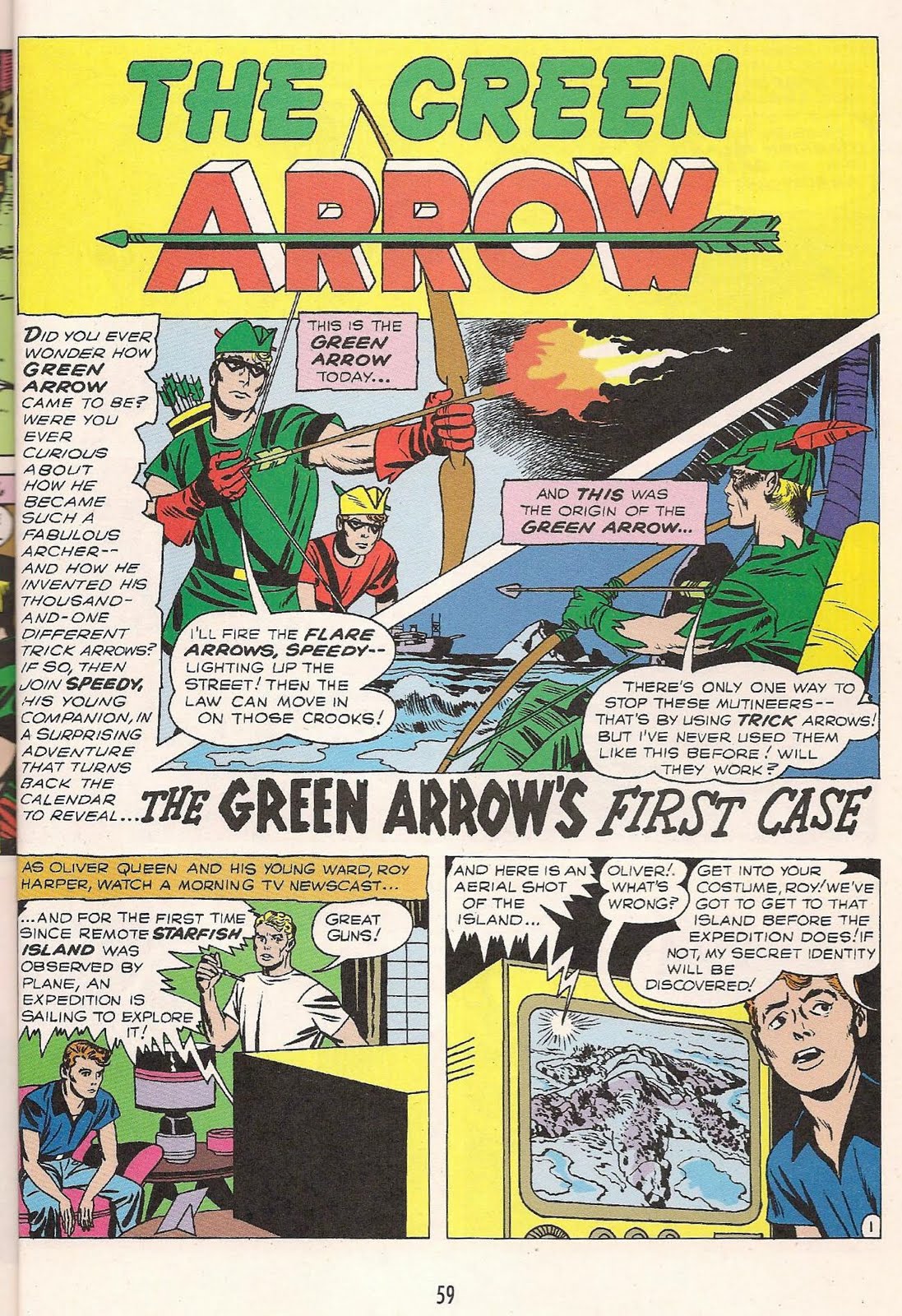
Fifteen years later, Ed Herron and Jack Kirby crafted a totally different origin story in "The Green Arrow's First Case" which appeared in Adventure Comics #256. After falling overboard during a sea voyage, millionaire Oliver Queen  washes up on Starfish Island, which, as the name implies, just happens to be shaped like a starfish for no reason that has anything to do with the story.  While stranded there, he makes a bow and teaches himself archery in order to survive, fashioning a variety of trick arrows to help him perform various tasks. Eventually,  a freighter anchors itself off shore. Swimming out to it, Oliver discovers that the crew has mutinied.  After using his archery skills and trick arrows to thwart the mutineers, Ollie hitches a ride back to civilization.  Upon his return, he continues using his new found mastery of archery to fight crime as the Green Arrow.
A revised version of this origin appeared as a part of a flashback sequence in the debut issue of Green Arrow's first ever eponymous mini-series in 1983 written by Mike W. Barr and illustrated by Trevor Von Eeden and Dick Giordano.  When his girfriend dumps him, Oliver Queen takes a cruise to help him escape the pain of his broken heart.  He gets more of an escape than he bargained for when pirates raid the ship and toss him overboard.  He eventually finds himself on a deserted island where he builds himself a bow and several trick arrows and teaches himself to shoot in order to survive.  Eventually,  the very same pirates who stranded him there come to the island to stash the loot from their latest act of piracy.  Ollie captures them using his newly developed archery skills and trick arrows.  Upon returning to civilization, Oliver decides to use these skills to fight crime in Star City as the Green Arrow.  
As you can see, Barr altered a few details from the Herron/Kirby story,  such as changing the mutineers to pirates and making them the reason for Ollie being on the island.  By the way, the  island isn't given a name in this or any of the subsequent future retellings and re-imaginings of the origin and is not depicted as having any unusual or distinctive shape.  The motivation for Ollie being on the ship in the first place is important in that the girl who broke his heart all those years ago naturally comes back into his life in the course of the mini-series. 
(That brings us to about the halfway mark of this overwrought essay, so I'm going to give my fingers a rest from typing and pick this up later.   In part two, I look at Mike Grell's take on Green Arrow's beginning and get to the current "official" version of the classic origin as related in Green Arrow: Year One.)

Monday, February 21, 2011

Trivia Challenge Answer: "We're Off...."

 As promised on Friday, I am back with the answer to the latest Gutter Talk Trivia Challenge.  You may remember that I asked you if you could name the first co-publishing venture between Marvel and DC Comics, noting that it was not, as you might have believed, Superman vs. The Amazing Spider-Man, though that was, indeed, the first meeting of any of the two companies' super-heroes.
Now, without further ado, the answer is (drumroll please, Maestro.):
MGM's Marvelous Wizard of Oz
(Published in 1975--A year prior to Superman vs. The Amazing Spider-Man)

And now, also as promised, the not all that secret origin of this historic comic book...
Through sheer coincidence, in 1975 both DC and Marvel had a Wizard of Oz comic in the works.  Marvel was planning an adaptation of L. Frank Baum's novel, while DC had acquired the rights from MGM to adapt the 1939 movie.  Upon learning of DC's project, Stan Lee approached DC publisher Carmine Infantino with the idea that the two companies pool their efforts and jointly put out one book.  What eventually saw print was an adaptation of the film produced by writer Roy Thomas and artist John Buscema, the team which had been set to do Marvel's comic based on the book. 
The legend about this book, confirmed by Roy Thomas in an essay in the book Stan's Soapbox: The Collection, is that Buscema laid out the book entirely from memory, without a plot from Thomas, even though he hadn't seen the film for many years.  Thomas claims that when he got the pages back only one or two small scenes where out of place.
Now on to the "bonus question":  What is the word that means, as defined by Wiktionary, "A form of error arising from mishearing a spoken or sung phrase" (though I've actually only ever heard it used to refer to misheard song lyrics)?
The word is "mondegreen."  I love the word precisely because it's so obscure and I'm really the only person I actually know who's ever heard of it.
If you're wondering how I could hear "new wastes of winter" as "new age of friendship," just listen to the song.  Ian Anderson doesn't exactly enunciate all that clearly.  Besides, either phrase really makes just as much sense in the context of the song, which is to say not very bloody much at all. I mean, "Titanic breaking children lost in melting crystal tears."  What the hell is that supposed to mean?
Actually, if I were going to propose a serious theory, I would suppose that my brain, being unable to interpret Anderson's mumbling, filled in a phrase that fit the song's rhythm and seemed to make sense.  At least as much sense as Progressive Rock lyrics ever make, anyway. For example, is there anybody who can really tell me what "Roundabout" by Yes is supposed to be about?
Honestly, though, however nonsensical "Something's On The Move" may be, I still love it.  It was the first Jethro Tull song I ever heard (or, more appropriately, misheard) and thus my introduction to a truly great band.

Friday, February 18, 2011

Gutter Talk Trivia Challenge 2: To Celebrate The Dawning of the New Wastes of Winter

It's been a while since we've done one of these trivia quizzes, and while I'm sure you haven't exactly missed it or been clamoring for another, I'm going ahead and serving up another one anyway.
Just about everyone knows that Superman vs. The Amazing Spider-Man, published in 1976, was the first ever meeting of super-heroes from the two largest comics publishers, DC and Marvel.  It was not, however, the two companies' first co-publication.  So, what was, then?
I'll let you think on that over the weekend, and I'll be back on Monday with the answer and the story behind that historic first co-publishing venture.
Now for an explanation of the title of this post.  For over thirty years, from the time I first heard Jethro Tull's song "Something's On The Move," I  was sure that the third line in the first verse was "To celebrate the dawning of the new age of friendship."  That line seemed to be perfectly fit the subject of this post, so I decided to use it as the title.  Then I went and looked up the lyrics for "Something's On The Move" on-line.  Well, it turns out I'd been wrong for three decades.  The line is, in fact, "To celebrate the dawning of the new wastes of winter." I couldn't use that line for my post title.  It wouldn't make any sense.  However, I couldn't think of anything else.  So, I went with it regardless and "sense" be damned.
I'd initially planned to include a "bonus question" asking you to name the song I took this post's title from. But I just told you that and the story behind it.  However, that story suggested another "bonus question." 
There is a word for, as Wiktionary defines it, "A form of error arising from mishearing a spoken or sung phrase."  Do you know what it is?
I do, and I'll tell you on Monday.

Saturday, January 22, 2011

Ding Dong, The Comics Code Is DEAD!

The Comics Code, generally regarded as the most repressive set of content guidelines ever imposed on any entertainment medium, has been on life support for a while now.  Some chinks in its armor began to appear as soon as the early 70's when Marvel decided to publish its famous anti-drug story in The Amazing Spider-Man sans the CCA seal of approval, leading to changes in the Code allowing depiction of drug use as long as it was shown in a negative light.  The same set of changes also allowed for depiction of such previously banned classic monsters as vampires and werewolves, leading to the resurgence of horror comics over the ensuing decade. Zombies, by the way, were still verboten, but one or two managed to slip through the cracks anyway. In 1989, the Code was revised again to reflect new realities in the comics industry, such as the rise of the direct market and the emergence of an older readership.   
In 2001, industry leader Marvel Comics dropped the Code seal and instituted an in-house ratings system.  After that, it was just a matter of  time until we'd be reading a piece like the one which appeared today on the Comic Riffs blog declaring the Comics Code not only merely dead, but also most sincerely dead.  
After Bongo, publisher of the Simpsons comics, gave the Code the heave-ho sometime last year, only two publishers, DC and Archie, still bothered to submit their books for approval.  Only Archie, however, carried the Code seal on their entire line of books, while DC used it mainly for their "Johnny DC" line of titles for younger readers. 
Not that anyone noticed, of course.  A couple of years ago, I was doing research for an article on the current state of the Comics Code.  In the course of this research I talked to a few friends of mine who bought comics for their kids and asked them if the Code seal of approval had any impact at all on what they let their kids read.  My friend James had no idea what the Comics Code was, despite the fact that his daughter was a fan of Sonic the Hedgehog, which was published by Archie.  My sister and the father of her children told me that they simply used their own best judgment.  
James' ignorance of the Code is understandable, as the actual seal had radically shrunk over the decades.  Where once it was so prominent that it would sometimes obscure part of a comic's logo, in recent days  it was so small as to be almost invisible.
The Code no longer seemed to have any impact on what comics got carried by retailers, either.  In the few places outside of comics specialty shops where I found comic books for sale, there were just as many, if not more, titles available from publishers who were not members of the Comics Code Authority as from those who were.
Nor, I discovered, did the Code have all that much impact on the way comics were written.  As part of my research for this never published article, I interviewed Sean McKeever, who  at the time was the writer of Teen Titans, one of the handful of DC comics still carrying the Code seal.  He revealed that, at first, he hadn't even been aware that TT carried the seal.  He said that he only learned that fact when his editor pointed out something in one of his scripts that might not make it past the Authority's censors.
So, not that it really matters to anyone, but DC officially announced on their official DC blog on Thursday that, as of this month, their comics will no longer carry the Comics Code seal and that they have instituted a ratings system similar to the one Marvel's been using for the past decade.   The only real surprise here is that it took so long.  Somewhat more surprising was the next day's news that Archie Comics, long the Code's staunchest supporter among comics publishers, was abandoning the Code as well.  Although, I suppose, given that they were the last guest remaining at the party, its not all that surprising that they finally decided to head home. 
I doubt, however, that Archie's dropping the Code seal will mean we're suddenly going to see Veronica or Betty doing a nude centerfold in Archie's Pals 'n' Gals.  Archie comics were squeaky clean before the Code took effect, and will continue to be so as long as the company exists.  Nor is the absence of the Code seal likely to affect the content of DC's books.  Thus, this news, while long overdue and certainly most welcome, is essentially irrelevant. 
Thus ends the Comics Code's decades long slide into obsolescence and obscurity, not with a bang but a whimper. 

Friday, November 19, 2010

The Unbearableness of Being Dr. Light--Part 2

Welcome back for the second part of my look at the history of the four DC Comics characters who have been known as Dr. Light.  This retrospective was inspired by the following question posed by one of my readers in a comment on an earlier post:
Didn't Doctor Light die in Suicide Squad? I know comic book characters never STAY dead, but still... Also, I thought there was a female Doctor Light who used a similar-powered suit as a hero. She served in the Justice League for awhile. What happened to her?
In part one, I covered the Golden Age Dr. Light, an obscure foe of the first Dr. Mid-Nite, looked at the "second" Dr. Light, actually the fourth one to appear in comics, whose heroic career was cut short by a freak lab accident, and traced the career of Arthur Light, the most well known and longest lasting of the four Dr. Lights, from his earliest efforts to destroy the Justice League of America to his death and resurrection in the pages of Suicide Squad.  In short, after several hundred words, I'd managed only to answer the first part of the commenter's question.  In this installment, I will bring the bio of Arthur Light up to the present and review the career of the female Dr. Light.
If you haven't read that earlier opus, click here and do so while I take a few deep calming breaths so that I may attempt to write about Identity Crisis, one of the worst comics ever, without barking and foaming at the mouth.  Forgive me if I might get one or two details wrong in my summary of the story.  I'm writing about it from memory, since I really didn't want to read the damned thing again.   

Tuesday, November 16, 2010

The Unbearableness of Being Dr. Light--Part 1

Its time once again to answer questions posed to me by my rabid readers via their carefully considered comments.  My recent rantings on the overall distastefulness of Identity Crisis and the general lameness of Dr. Light moved one reader to inquire:
"Didn't Doctor Light die in Suicide Squad? I know comic book characters never STAY dead, but still... Also, I thought there was a female Doctor Light who used a similar-powered suit as a hero. She served in the Justice League for awhile. What happened to her?"
This query inspired me to do a little surfing on the wild, wild web and digging through back issue bins at the recent Mid-Ohio Con in order to cobble together a  retrospective on the four characters from DC comics who have borne the name of Dr. Light over the course of the company's seven and a half decades of cranking out funny books.  The most surprising thing I discovered in my investigations is that there have, in fact, been four characters calling themselves Dr. Light, whereas I had previously been aware of only three.  Since we are dealing here with a quartet of  characters and a time span of over sixty years, this expository essay may just tend a little toward the longish side.  Therefore, I shall be dividing it into at least two parts.

Thursday, November 11, 2010

Gerry Conway Fans, Check This Out! Conway Career Interview at "Views From The Longbox"

If I could conduct an in-depth, career spanning interview with any comics creator, it would be Gerry Conway.  One of my favorite writers, Conway has been responsible for some of the finest super-hero comics ever ("The Night Gwen Stacy Died", The Last Days of Animal Man) and some of the absolute worst (the not at all unfairly maligned Justice League Detroit).  He bounced back and forth between the two largest comics publishers, Marvel and DC,  during the 70's and 80's, along the way creating such fan-favorite characters as the Punisher and Firestorm and writing the history making first inter-company crossover pairing Superman and Spider-Man.  Away from comics, his second act as a writer for television has also run the gamut from the sublime to the silly with credits that include The Father Dowling Mysteries, Diagnosis Murder, and Law & Order: Criminal Intent
There are many questions I would have loved to pose to Mr. Conway, but now it seems I don't really have to.  I recently came across an installment of Michael Bailey's podcast Views From The Longbox from last April in which he and the Irredeemable Shag, keeper of the Firestorm Fan blog, conduct just the kind of extensive interview with Conway that I envisioned.  
Clocking in at just under two and a half hours, the conversation covers every aspect of Conway's career as a writer of comics and television, from his brief stint at DC as a teenager; through his lengthy runs on The Amazing Spider-Man, Justice League of America, and The Fury of Firestorm; onto his years in the wilderness of Hollywood; to his return to DC to write The Last Days of Animal ManAlong the way, Bailey and Shag ask just about every question to which I have always wondered about the answer, such as the reasons behind the killing of Gwen Stacy, how Conway felt about not getting any credit for essentially writing the ending of the first Spider-Man movie thirty years before its release, and "What the bloody hell could you  have possibly been thinking when you gutted the Justice League of America like a fish and turned what should be the world's greatest, most powerful super team into a two-bit, fifth rate imitation of Batman and the Outsiders?"
Of course, Bailey and Shag phrase that last inquiry somewhat more politely than I did above. Shag, poor benighted soul that he is, appears to be one of the few people who actually enjoyed the Detroit era JLA.  
If that's not enough Gerry Conway for you, a few months earlier on his own site, Shag posted a solo interview with Conway, which he uploaded in two installments, that lasts, all told, about an hour and a half and focuses, as you'd expect from a blog called Firestorm Fan, mainly on the Nuclear Man. 
Between these two interviews, we get nearly four hours of Gerry Conway attempting to justify his existence and doing a pretty good job of it.  These are definitely recommended listening for any fan of Gerry Conway's work, whether you know him mainly from comics or television.

Thursday, October 28, 2010

Where's Johnny? (Dredging Up The Past Part X)

(This is probably going to be the last of my re-posting of old pieces from my past blogs.  This one is from The Word From On High and is presented here for no other reason that it happens to be one of my favorite posts from that blog.  Note that I was writing for a more general audience on that blog, not just comics fans, who are the target audience for this effort.  Thus the parenthetical phrase defining my terms.)
The Silver Age of Comic Book Art, written and designed by Arlen Schumer, is a beautiful over-sized coffee table book featuring heavily illustrated profiles of eight prominent comics artists of the 1960's, the era known to comics fans and historians as the Silver Age. (The Golden Age, by the way, was the era that began with the publication of Action Comics #1, featuring the debut of Superman, in 1939 and lasted until approximately the end of the Second World War. The Silver Age begins in 1956 with the first appearance of Julius Schwarz's updating of DC's Golden Age Flash character in Showcase #4 and most historians have it ending somewhere around 1970--which seems to be the cut-off date that Schumer uses in this volume.) The artists include are: Carmine Infantino, Steve Ditko, jack Kirby, Gil Kane, Joe Kubert, Gene Colan, Jim Steranko, and Neal Adams. All had distinctive styles that made them fan favorites. Ditko, Kirby, Steranko and Adams were also groundbreaking visionaries whose innovations changed the ways that comic books told stories. All eight are worthy of inclusion in a book that purports to present an overview of one of the comic book industry's most creative periods.
Now, some might make a case that Don Heck should have been included. I have never been a fan of Heck's work, but he was perhaps the 2nd hardest working artist of the early Marvel Age, surpassed only by the "King" himself, Jack Kirby. Heck followed Kirby on such features as The Avengers, Giant-Man, and The X-Men,and was the first artist on Iron Man--though the character was designed by Kirby. 
A more significant omission, in my opinion (nothin' humble about it, baby!), is "Jazzy" John Romita. Romita began at Marvel on Daredevil, and soon took over as artist on The Amazing Spider-Man with #39 (thus paving the way, by the way, for Gene Colan's lengthy run drawing Daredevil) when Ditko left the "House of Ideas"for reasons that have never been fully explained but that most assume to be "creative differences" with Stan "The Man" Lee. Romita came to the world of super-heroes from a background in romance comics and the style he developed working in that genre perfectly suited the slick, sub-plot intensive "soap-opera" style of stories that Lee was turning out. Romita's depictions of Peter Parker and his friends and enemies would define the look of the feature well into the 1980's.
A man who contributed so much to the success of Marvel Comics is certainly worthy of recognition as one of the greats of the Silver Age.

Sunday, October 24, 2010

The Man Behind the Magician: Meher Baba and His Influence On The Works of J.M. DeMatties

Does the man in the picture to your left look familiar to you?
If you've read J. M. DeMatteis' Dr. Fate or Seekers Into The Mystery he should. 
In the former, he shows up as the Guide, a.k.a. the Old Man, who leads the souls of Eric and Linda Strauss to their ultimate destiny.  In Seekers, he is seen in the form of the Magician, the enigmatic guru who holds the key to Lukas Hart's redemption. 
In real life, he was Meher Baba, an Indian spiritual leader who believed himself to be the latest manifestation of the Avatar, or the incarnation of God in human form.  According to Baba, the Avatar shows up on Earth every 700 to 1400 years or so and past incarnations have included Jesus, the Buddha and Muhammed. Baba taught that all major religions were equally true and valid and that the true path to salvation was faith and devotion to God.  As the article "Who Is Meher Baba" from the web-site The New Humanity Times states it, "To truly love God requires that we love and embrace everyone and everything as a dimension of God."
The influence of Baba's teachings are obvious in most of J.M. DeMatteis' work, and in Dr. Fate and Seekers Into The Mystery he makes it explicit.  Both works concern the evolution and perfection of the human soul through reincarnation and both feature Baba as a character in the story.
At the end of his Dr. Fate run, in his farewell message on the letters page of #24, J.M. DeMatteis sums up the philosophy behind the story and essentially dedicates the tale to Meher Baba:
In a comics universe that seems to be getting progressively more cynical and down beat, we tried to do stories that looked the darkness square in the face and said, "No. This life is worth living, this world is a rare and wonderful place, and the God that rules over it is compassionate, loving, and sitting on a throne in our very hearts." That vision would not have been possible without the love and guidance of Avatar Mehar Baba.  Jai Baba!
You know, I may not buy into the stuff he says about God, but there's certainly something to be said for the notion that not all super-hero comics have to be dark, cynical and downbeat, or, as they were often referred to in the 80's and 90's, "grim and gritty."  Look it up in your thesaurus; "violence" and "pessimism" are not synonyms for "realism." The idea of embracing your fellow humans with love and respect, God or no God, appeals to me as well, despite the way I behave and the things I say sometimes.
You'll notice as you read Dr. Fate and Seekers Into The Mystery that the Guide/Magician never speaks.  That seems to be a reflection of the vow of silence Meher Baba took in real life and stuck to for nearly half a century.  From July 10, 1925 to his death in 1969, he reportedly spoke not one word, communicating instead through writing and gestures.  His silence was supposedly part of what he termed his "universal work."  In his own words, "Because man been deaf to the principles and precepts laid down by God in the past...I observe silence."
In recognition of this, many of Meher Baba's followers, including DeMatteis, observe Silence Day every July 10.
More info on Meher Baba can be found in his Wikipedia entry, and at what appears to be his official web-site.