Showing posts with label my favorite comics. Show all posts

Sunday, May 18, 2014

Giffen's Legions Part 4: The Subs

The Subs from the cover of Superboy #243 by Mike Grell
The first, and for a long time the only, Legion comic I ever owned was Superboy and the Legion of Super-Heroes #243.  My favorite part of that issue has always been the brief appearance of the Legion of Substitute Heroes.  The issue took place right in the middle of the five part "Earthwar" saga.  Earth was under attack by the Khunds, but various other crises conspired to keep the Legion busy off planet.  So the Subs step up to the plate to fight off the invaders.  Of course, being the Subs, they were pretty quickly defeated, but by then I'd fallen in love with this plucky little band of wanna-be heroes. Well, maybe not love, exactly, but I did think that the Substitute Legion was a really cool idea.  So, years later, when I spotted a copy of the Legion of Substitute Heroes Special on the comics rack, I picked it up.  I was eager to see more of these heroes who'd so intrigued me, but wasn't quite expecting what I found inside, despite the joking cover. 
I'll talk more about that special later.  Right now, it occurs to me that it might be a good idea to go over just what the heck the Legion of Substitute Heroes actually is for the benefit of any readers out there who might not be familiar with the concept.  The Legion of Super-Heroes occasionally held open try-outs for Legion membership that worked kind of like the auditions for American Idol.  Would be Legionnaires would come to Metropolis from all across the galaxy to stand up in front of a panel of Legionnaire judges and demonstrate their powers in hopes of going on to Hollywood...excuse me, I meant being admitted into the Legion. In Adventure Comics #306, five of these rejected applicants decided to form their own group.  They acted as back-up to the real Legion, going into action when the proper super-heroes were unavailable.  The initial membership of the Legion of Substitute Heroes consisted of Polar Boy, with the power to make things cold; Night Girl, whose super-strength worked only in the absence of sunlight; Fire Lad, who could generate flames; Chlorophyll Kid, who could speed up the growth of plants; and Stone Boy, who turned to stone. 
Let's face it, the Legion of Substitute Heroes is a completely ridiculous concept.  Nowadays, of course, the trend is to take the silly ideas from comics written for kids and make them serious, adult, and dark.  I believe that Keith Giffen would take this route with the Substitute Legion late in his run on Legion of Super-Heroes Volume 4.  However, when he first got his hands on the Subs, a decade previous, he fully embraced their inherent silliness. In fact, he not only embraced it, but enhanced, making the Subs even more ridiculous than they already were. Of course, when I think about it, I suppose that could be seen as another way of making the Subs palatable to the so-called adult comics reader.
The real significance of DC Comics Presents #59 is reflected in the story's title, "Ambush Bug II."  It occured to me as I was  drafting this post in my head that perhaps someday I should write a piece on the evolution of Ambush Bug's character from his first appearance in DCCP #52 to the first issue of his first mini-series.  This post, after all, is meant to be about the Legion of Substitute Heroes.  For now, it should be sufficient to say that the Bug as seen in this story is much closer to the the character we know than he was in his initial outing.  There he was more of a run of the mill insane villain who actually murdered Metropolis' District Attorney on national television.  In his second appearance, while still technically a villain, the Bug is not so much evil but more of a trickster.  The role of the Subs in this tale is to serve as his foils.
The story is simple enough.  Ambush Bug decides to bug Superman just as the Man of Steel is beginning a journey through time and the two end up in the thirtieth century.  Superman has urgent business even farther into the future, so he decides to leave the Bug with the Legion of Super-Heroes for safekeeping until he gets back.  Unfortunately, no one's home at Legion HQ, so he drops his prisoner off with the Substitute Heroes instead, all the while hoping he won't come to regret the decision.  Needless to say he will, as the Bug quickly escapes and proceeds to raise havoc across thirtieth century Metropolis despite the efforts of the Subs and Superman to recapture him.
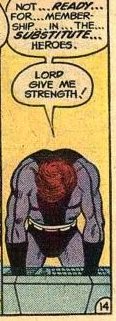
As with the real Legion, the membership of the Substitute Heroes underwent some changes over the years.  By the time I first encountered them, the initial five Subs had been joined by Color Kid, who had the power to change the color of any object. As of DCCP #59, Night Girl had left the team.  It seems she'd only wanted to join the Legion to meet Cosmic Boy, so once she started dating him she left those losers in the Subs behind.  New Subs included Infectious Lass, with the power to give people diseases, and Porcupine Pete, who was covered with quills and could project them but not with any accuracy.  When Ambush Bug proves a little too much for the Subs, they call in their newly created Auxillary, consisting of Heroes who weren't quite ready to be Substitute Heroes.  Those shown in this issue are Antenna Lad, who can pick up radion broadcasts, and Double Header, who has two heads. Yes, his sole "super-power" appears to be having two heads.  I suppose he must have figured that his options were limited to becoming a super-hero or joining a carnival.  He could have gone into politics, where a person with two faces can go far.
The Subs are portrayed in this story as well meaning but ineffective due to their limited powers and their inexperience.  This is consistent with the way they were used in the Earthwar, where they totally failed to make any difference against the marauding Khunds and really only succeeded in taking up two pages of story.  Being essentially an Ambush Bug story, DCCP #59 plays up the Subs' inadequacies for comic effect.  In addition to giving the Bug some more people to play off, the Subs efforts to stop him also tend to end up getting in Superman's way as he attempts to do the same.  At one point, in attempt to stop Ambush Bug, Chlorophyll Kid causes a tree to spring up out of nowhere, but its Superman who ends up colliding with it.
The Subs from their Who's Who entry by Giffen

Previously in this series, I've addressed the issue of new reader friendliness, and it occurs to me that anyone not steeped in Legion history might be at first be a bit confused by this issue, as Giffen and his co-writer Paul Levitz don't take the time to introduce the Subs either as a group or individually.  Even Legion fans might be at a bit of a loss, as the appearances of the Subs did tend to be few and far between. Still, I suppose, the fact that their function in the story is not really as full fledged guest stars but more as a plot complication makes such background superfluous in this case.
Giffen and Levitz do a little better on that score in the Legion of Substitute Heroes Special, however.  The book begins with a recap of the Subs origin in the form of a song, and throughout the issue Levitz provides background information on each of the members as they get their page in the spotlight.
"The Ballad of the Subs" Click to Enlarge and feel free to sing along

The story opens as the planet Bismoll, home of former Legionnaire Tenzil Kem, a.k.a. Matter Eater Lad, prepares to turn control of it planetary economy over to super-computers.  Kem, now a member of the Bismollian Senate, is suspicious of the computers, but not wanting to call out the Legion on a hunch he sends for the Subs instead.  We learn that Kem's fears are well founded on the title splash page when we get to see that all the giant computers resemble the Legion's old foe, the rougue computer Computo.  Of course, not being up on Legion history, I actually didn't get this reference at first, only fully appreciating it after I saw Computo's entry in Who's Who.  Nonetheless, you don't have to be a Legion scholar to realize that something's amiss when the rogue computers revive another old Legion foe, Pulsar Stargrave, giving him a new robotic body, and enlist his aid in conquering and ruling Bismoll.
Meanwhile, the Subs find themselves stuck on a satellite orbiting the planet, unable to get down to the surface.  After a couple of pages of this, there's a "memo" from scripter Levitz to plotter Giffen in which Levitz tells Giffen that he "can't dialogue a story that isn't going anywhere" and to "Get them the blazes down to the planet Bismoll already." Thus, without explanation, the Subs, with the exception of Infectious Lass, appear scattered at various locations around the planet.
In order to make the Subs capable of carrying their own Special, Giffen had two options.  He could have made them more competent and heroic, rushing into defeat Stargrave and proving themselves at last worthy of Legion membership.  Instead, he makes them even more comically inept.   Things start to go wrong even before they get to Bismoll, as Infectious Lass' uncontrollable power infects Color Kid with Grandin Gender Reversal Germs, turning him into a her, and the device they use to chose a leader for the mission instead merely knocks Porcupine Pete unconscious, while Stone Boy has turned himself to stone, in which state he is totally immobile, and forgotten to change back.
Needless to say, the Subs prove fairly useless against Stargrave, succeeding mostly in getting themselves into trouble.  Fire Lad sneezes and causes a major forest fire, and Color Kid finds herself trapped in a garbage incinerator.  Chloropyll Kid, who previously had been depicted with a traditional trim and muscular super-heroic figure but here is shown as short and pudgy, gets himself arrested because apparently it is a crime to be fat on Bismoll.
As in DCCP #59, its up to the more experienced former Legionnaire, in this case Matter Eater Lad, to stop the threat, though he does so with a little bit of help from Polar Boy and Stone Boy.
Their first starring role also turned out to be the Subs last hurrah, as the story ends with Polar Boy thinking "Maybe the Substitute Heroes wasn't such a good idea, after all..."  He subsequently went on to disband the Subs and ultimately joined the real Legion, eventually becoming the group's leader, a post he held when the Legion itself disbanded during the Five Year Gap.
I didn't read DCCP #59 until I got Showcase Presents Ambush Bug about five years ago.  Back in 1985, I was unfamiliar with Ambush Bug and knew the Subs only from their brief cameo in Superboy and the Legion #243, in which they were depicted as more or less traditional and serious super-heroes.  So, my first reaction to the Subs Special was something along the lines of "What the hell?"  Of course, over the ensuing years, especially as I've become more familiar with Giffen's body of work, I've come to appreciate this comic for what it is.  While not quite as laugh-so-hard-you'll-break-all-your-furniture hilarious as some of the early appearances of Ambush Bug, the Subs Special is a gently amusing send up of super-heroic conventions.  The story ends with a note from editor Karen Berger stating that Levitz and Giffen had gotten out of control and assuring the reader that the regular Legion title was nothing like this. The note ends "I'm sorry,everyone---really I am!"
Karen, if by some wild chance you happen to ever read this, I want to assure you that you have absolutely nothing to apologize for.   In fact, let me take this opportunity to thank you, as well as Keith and Paul, for all you've done for comics over the years. 

Monday, May 12, 2014

Giffen's Legion Part 3: Life After The Legion--Darkness, Light and Compromise

This is the post where I actually get around to discussing the story lines of Legionnaires 3 and Legion of Super-Heroes Volume 4.  Thus, spoilers lay ahead.  Tread carefully.
The greatest thematic similarity between Legionnaires 3 and the first year of Legion of Super-Heroes Volume 4 is that they both deal with life after the Legion.   The main characters of L3 are the three founding members of the Legion of Super-Heroes; Lightning Lad, Saturn Girl and Cosmic Boy. These three had recently, for different reasons, retired from the Legion and were no longer appearing regularly in the main Legion title.  Lightning Lad and Saturn Girl had recently had a child and left to devote themselves to raising him, while Cosmic Boy had simply decided it was perhaps time to do something else with his life.  LSH v4, of course, is the infamous Five Years Later version of the Legion, in which the team had been disbanded several years before the series picked up their story.  In both cases, the former Legionnaires learn that they can never truly leave their pasts, and especially the Legion, behind.
The two stories share a similarity in tone, as well.  While Giffen is best known for his humorous works, especially Ambush Bug and Justice League International, many of his comics, most famously LSH v4, can be quite dark.  Even Justice League has its serious moments, such as the Despero story line or the story in Justice League America #26, 27 and 28 where the Blue Blue Beetle, under the control of the Queen Bee, nearly kills Max Lord.
One of the criticism leveled against a lot of the so-called "grim and gritty" comics that followed the groundbreaking work of Alan Moore on Watchmen and Frank Miller on Daredevil and The Dark Knight Returns is that they copy only the surface darkness and violence of those works while missing the elements that truly made these comics great.  Giffen's LSH v4 is often lumped in with those clueless imitators.  However, I think that Giffen got it right with his Legion stories.
One thing that people often overlook about the seminal works listed above is that amidst the darkness, these stories contain an element of hope.  Miller's "Born Again" story in Daredevil is not the story of a man's life falling apart, its the story of a man fighting to get his life back.  The story ends on a hopeful note. By the the final issue of the story line, Matt Murdock has his life back.  It may not be the life he had before, but its one he has chosen for himself and one with which he is content. The Dark Knight Returns ends with Bruce Wayne embarking on a new chapter in his life with a new, more positive attitude.  Throughout the series, Batman would think in certain situations, "This would be a good death," but the story ends with him thinking, "This will be a good LIFE."
If you ask me, if anybody failed to see the hopefulness in Miller's work, especially on Daredevil, its Brian Michael Bendis.  His acclaimed run on the character is very good, I have to admit, but it is also almost unrelentingly bleak.  He just piles the crap on top of poor Matt Murdock and climaxes his run with Murdock sitting in a jail cell. 
Forgive my tangent. I was meant to be talking about Keith Giffen's Legion of Super-Heroes, wasn't I? Ok, then, let's get back on topic. 
The Legion of Super-Heroes had always been seen as presenting a utopian view of the future.  Of course, it was far from perfect.  To paraphrase Geoff Johns from Infinite Crisis, a perfect galaxy wouldn't need a Legion of Super-Heroes.  Besides, perfection makes for boring stories, especially super-hero stories.  There was always an Earthwar, a Magic War, a Great Darkness, an evil sorcerer, or a time traveling conqueror, not to mention Khunds, Dominators and other alien races of malicious intent, to keep the Legion busy.  Yet the Legion's world of the 30th century was one of hopefulness and optimism for the future of mankind.  Hell, sometimes it takes a heaping load of optimism just to imagine the human race surviving for another century, let alone a thousand years.  The Legion presented a universe where mankind had united and stood at the center of the United Planets, an alliance of civilized, space-faring worlds.  All of the threats I noted above were external, coming from outside the peaceful UP worlds.
By the first issue of LSH v4, however, the universe of the 30th century, even the once near utopian United Planets, had become a much darker place. The United Planets has all but dissolved in the wake of a galaxy wide economic disaster, the Khunds have initiated a new campaign of conquest while at the same time former UP worlds war amongst themselves, and the government of Earth (a.k.a. Earthgov) is revealed to have been infiltrated by Dominators decades earlier.  Worst of all, what had once been the light in even the UP's darkest hours, the Legion of Super-Heroes, is no more, hounded out of existence by a campaign of harassment from the Dominator controlled Earthgov.
That all does sound pretty bleak, but there is hope.  That hope lies in a reformed Legion.  Reep Daggle, the former Chameleon Boy, and Rokk Krinn, once known as Cosmic Boy, set about re-uniting their former comrades in arms becaues they are optimistic that the Legion is needed, and that they can make a difference and be the light that turns back the darkness that has spread throughout the galaxy. 
By the end of LSH v4's first year, it looks like Reep and Rokk's dream is going to come true.  The former Legionnaires have faced down two of their deadliest foes and emerged victorious.  The Legion of Super-Heroes, at last, lives again.  While it takes place against a dark backdrop, the first year of Keith Giffen's Legion of Super-Heroes Volume 4 is, in truth, a story about hope, optimism, and the belief that the right people can make a difference in even the darkest of times.
Although taking place in the near utopian environment of the pre-economic collapse United Planets, in many ways Legionnaires 3 is a much darker story than LSH v4.  It establishes the Time Trapper as a truly formidable villain and presents the three founding Legionnaires with a very personal tragedy, the kidnapping by the Trapper of Lightning Lad and Saturn Girl's son. The series does not exactly end on a hopeful note, either.  The heroes don't defeat the villain, they simply outlast him.  The conflict only ends when the self-imposed time limit that the Trapper set on what he calls his "game" runs out and the Trapper simply sends the former Legionnaires and the child home.  Furthermore, the Trapper's soliloquy on the story's final page makes it clear that even though this battle has ended, his war with the Legion is far from over.
I guess you'd call that ending an anti-climax, and its a hallmark of Keith Giffen's work, not just on Legion, but on Justice League and even as recently as Doom Patrol.  Many times the conflicts in Giffen's stories are resolved not by a knock down drag out melee between the forces of good and evil, but by negotiation and compromise, or often by the intervention of an outside force.  In LSH v4, the re-united Legionnaires free their former comrade Mysa, once known as the White Witch, from Mordru by coming to an agreement with the wizard after he and Rokk Krinn conduct negotiations over dinner.  This is quite similar to the mutual non-aggression pact reached between the Justice League and the Queen Bee at the end of the first four issue story line in Justice League Europe.  That's not to say that LSH v4 is lacking in action.  The Legion will fight when it has to, and some villains can't be reasoned with, such as the insane mass murderer Roxxas. However, Giffen recognizes that violence isn't always the answer and sometimes it takes more strength not to fight.
I'm pretty sure that this is my last post comparing and contrasting Legionnaires 3 and Legion of Super-Heroes Volume 4.  It may not, however, be my final word on Keith Giffen and the Legion of Super-Heroes.  After all, I haven't said anything about the Legion of Substitute Heroes yet. 

Sunday, May 11, 2014

Giffen's Legions Part 2: Welcome, New Readers! (...or not so much)

Before I get into today's post, I should offer a slight correction to something I wrote in part one of this series.  There are actually three full page splashes in Legion of Super-Heroes Volume 4 #12.  Yes, I have actually read the book, and do own a copy, however, I didn't look at it while I was writing the post, and the full page image of Celeste Rockfish bathed in a mysterious green light slipped my mind.  This error, though, in no way invalidates the point I was making about Giffen's use of splash pages in LHS v.4, as this "revelation" is pretty effectively telegraphed in the pages leading up to it.
To begin today's post, I invite you to join me on a journey through time, back three decades to 1985 where we will meet me as I was then.  I was quite different back then.  I hadn't yet taken up smoking, nor was I yet a coffee addict, and I was only just beginning to discover that I am not a man who can hold his liquor.  More relevant to our topic, I also was not yet the slavering obsessed comics fanboy that I would later devolve into.  I was a casual reader of super-hero comics at perhaps the last time in the history of the genre was such a thing was possible.
I knew little of the Legion of Super-Heroes.  While I was aware of the comic's existence, I didn't really know anything about the characters or the strip's then two and a half decade history.  Aside from a brief cameo in DC Comics Presents #2 and their appearance, along with every other DC hero, in Crisis On Infinite Earths, the only Legion stories I'd read were the 1977 JLA/JSA cross-over in Justice League of America #'s 147 and 148 and a 1978 issue of Superboy and the Legion of Super-Heroes that was part of the "Earthwar" saga.  As it was thirty years ago, I can't really say at this point what it was that motivated me to purchase the first issue of the Legionnaires 3 mini-series. I suppose, however, that having enjoyed the few Legion tales I had read, I was curious about the team and looking to learn more about them, and the first issue of this mini-series seemed a good place to start.
That, as it turned out, was a pretty accurate assessment.  Though I've still read relatively few Legion stories compared to the vast amount that have been published since 1958, of the ones that I have read L3 is probably the one that I'd recommend to someone as their first Legion comic, with the possible exception of the origin story in Superboy #147 or one of the retellings of that tale I mentioned in my post on that issue.
While the primary audience for this mini-series is obviously long time hardcore Legion fans, the series is carefully crafted to be welcoming to new readers as well.  The story can be read and understood by a reader unfamiliar with Legion history and I'd even venture to say that someone totally new to comics and unfamiliar with their language and storytelling conventions would have little problem following the action.    A knowledge of the history of the characters certainly provides a richer reading experience for those in possession of such facts, but it is hardly a prerequisite.  All the back story and information about the characters pertinent to the story at hand is laid out for the reading within the first issue.  Even the creative team's one questionable story telling choice, the decision to show three Legionnaires who are supposedly retired from active duty with the group lounging around at home and off duty in their super-heroing attire, was, as scripter Mindy Newell explains in answer to a reader in the third issue's letters column, made in the name of enhancing the reader's comprehension of the story by making recognition and identification of the characters easier.  Not only does this not make sense within the context of the story but is ultimately unnecessary due to penciler Ernie Colon's skill in rendering each character in the story in a unique and recognizable manner.  Even two characters who share similar characteristics, Cosmic Boy and Rond Vidar, and could, in the hands of a lesser artist, have been rendered almost interchangeably, stand out instead as distinct individuals.
To me, L3 stands out as a particularly well crafted example of what Colin Smith, writing about Stan Lee and Jack Kirby's work on the first Avengers #1 at his blog Too Busy Thinking About My Comics, terms the "paternalistic" approach to comic book story telling.  In this model, the creative team figuratively take the reader by the hand in order to, as Smith puts it, "guide them through a story in a highly controlled and specific sense."  Every story telling choice, from the dialogue and captions to the number,placement and size and shape of the panels to the composition of the images within those panels, is carefully calculated to enhance the reader's understanding and enjoyment of the story and produce in them the effect desired by the creative team.  To a greater or lesser extant, and with varying degrees of success, the paternalistic model was the dominant mode of comics story telling through most of the medium's history.
As far as I can tell, Legion of Super-Heroes Volume 4 represents one of the mainstream super-hero genres earliest moves away from the paternalistic approach, as well as an early flirtation with what has come to be known as decompressed story telling.
I think it may be time now for another disclaimer.  I may not be the most qualified person to talk about the issue of new reader friendliness. Personally, I don't mind a little initial confusion on jumping into a series, and a long and complicated back story usually doesn't deter me as long as the story I'm reading at the moment is understandable and enjoyable.  When I started getting into Doctor Who a couple of years ago, I found learning the show's fifty years of history to be as much fun as watching the current episodes.  With that qualification in mind, let me say that I don't find LSH v4 as impenetrable as it has acquired a reputation for being.
On the other hand, creators Keith Giffen and Tom and Mary Bierbaum certainly aren't holding our hands here, either.  They expect the reader to be a participant in the story telling process and do a little bit of work to make sense of what's going on.  As with any long running series, the long time reader has an advantage over the new reader, and that's especially true in LSH v4, although in the the letters columns, even some long time readers expressed a degree of confusion. Still, setting the beginning of this series five years after the end of the previous Legion book does serve to put both new and older readers on somewhat of an equal footing, as now neither knows the status quo.
In sharp contrast to L3's showing off duty heroes lounging around in their fighting uniforms, this series eschews super-hero costumes for at least the first twelve issues. Furthermore, the characters are referred to by their civilian identities rather than their super-hero code names. A few characters are referred to by abbreviated versions of their code names, but these are more like affectionate nicknames rather than noms de guerre, such as Brainy (Brainiac 5), Cham (Chameleon Boy, also referred to as Reep Daggle) and Vi (Shrinking Violet or Salu Digby). This is entirely appropriate in a story that begins with the Legion having been disbanded several years in the past, but this seems to have been one reason even long time readers, more familiar with the character's super-heroic names, experienced some confusion.
With overall lack of narrative captions, other than those tersely telling us what planet we're on, and establishing panels that just show background with no people along with several unattributed dialogue balloons, sometimes it can be difficult at first to figure out what's going on or who's speaking. Nonetheless, all the information the reader needs to fully understand each issue is contained within that issue.  Its just that it is not presented right up front and the readers has to piece it together for himself.
I'm a big fan of Keith Giffen's artwork, and the late 80'/early 90's is one of my favorite periods of his work.  He had synthesized his early Jack Kirby and Jim Starlin influenced style with the controversial influence of Jose Munoz to produce a style that blended cartooniness and realism in a way that particularly suited the super-hero genre.  His face and figure drawings are excellent, giving each character a recognizable individual look.  His background drawings, however, can at times be a little too busy and somewhat hard to interpret at first glance, especially when divided into multiple panels. 
In both its story and art, LSH v4 is most definitely a series that rewards, and in fact demands, repeated readings.  I find myself understanding and enjoying the story more each time I read it.
I also find that its best to read several issues  at one time, as the story does unfold rather slowly and developments in early issues do take some time to pay off.  The series would definitely benefit from being collected, but no such collected editions exist. 
 It seems that many people writing about LSH v4 experience a problem similar to the one I've been having in writing this post.  I really like the series, but the story telling approach taken by Giffen and the Bierbaums has it drawbacks as well as its pleasures and the series does take some time to get into.  In pointing this out, I may seem to be discouraging you from seeking this series out and reading it.  That however, is the exact opposite of my intent.  Legion of Super-Heroes Volume 4 is actually a series I would highly recommend. Anyone willing to be patient with the series and put the required effort into it will ultimately find it a rewarding reading experience.

Sunday, May 4, 2014

Giffen's Legions: Legionnaires 3 and Legion of Super-Heroes Volume 4

If, to open this post with a reference to an obscure episode of the animated Star Trek, Keith Giffen were to be kidnapped into space and place on display in an  interplanetary zoo for the amusement of giant slug-like extra-terrestrials (which could totally happen, you know), back here on Earth he would most likely be remembered by future generations of comics readers, if indeed there are to be any, for three things: Ambush Bug, Justice League International, and The Legion of Super-Heroes.  Celebrated primarily for his artistic contributions to the series in collaboration with long time writer Paul Levitz, Giffen also wrote, along with Tom and Mary Bierbaum, the controversial and divisive "Five Years Later" version of the Legion that appeared in Volume 4 of the series beginning in 1989.
However, Giffen's first crack at writing a Legion story came some four years earlier in a largely unheralded four issue mini-series entitled Legionnaires 3, with dialogue by Mindy Newell and art by Ernie Colon and Karl Kesel.  Perhaps I should qualify that statement a bit.  L3 was Giffen's first attempt at writing a serious Legion story featuring actual Legionnaires.  He had earlier written DC Comics Presents #59, co-starring the Legion of Substitute Heroes in 1983 and 1985's Legion of Substitute Heroes Special.  These efforts were more in the spirit of Giffen's work on Ambush Bug, however.  In fact, DCCP #59 featured that character's second appearance.
In contrast to the goofiness of those stories, L3 and LSH v.4, while they do contain flashes of humor, are for the most part deadly serious, even grim, affairs.  The first year of Volume 4 is concerned with the rebuilding of the Legion several years after the team's dissolution in the wake of a galaxy wide economic collapse that has left the 30th century a much darker and more dangerous place than it had been in the previous Legion series.  In L3, retired Legionnaires Lightning Lad and Saturn Girl's baby is kidnapped by one of the Legion's deadliest foes, the Time Trapper, in as part of a plot to destroy the Legion.  This post, however, is concerned not so much with the plots of the two series, but with the story telling choices Giffen makes in each and how they compare and contrast.
Giffen drew the early issues of LSH v. 4, with inks by Al Gordon, while on L3 he is credited as plotter and "designer".  I assume this means the same thing as "breakdowns", which is how his credit on the Justice League books read, thus the story telling choices are his for the most part, with Colon and Kesel following his lead.
A hallmark of both series is their dense visual story telling.  On Volume 4, Giffen famously, or infamously, stuck to a grid of nine equal sized panels for the overwhelming majority of pages.  This, combined with the text pieces at the end of most issues, even today draws comparisons between this volume of LSH and Alan Moore and Dave Gibbons Watchmen, which used similar techniques.  However, whereas Gibbons, while essentially sticking to the nine panel design, would judicially "combine" panels, eliminating the borders and gutters to create a larger uninterrupted image when it suited Moore's story, Giffen, for the most part, stuck to the grid seemingly at all costs.  Larger images, mostly establishing shots, where divided into two or three panels.  Also, ocassionally a single drawing would be reproduced across several panels.
L3 is, if anything, even more dense.  While not bound to a rigid nine panel pattern, each page is similarly packed with images.  There are very few pages with fewer than six panels, and one page in the first issue crams in a whopping thirteen panels. Unlike Volume 4, in which Giffen's nine panels were all of uniform size and shape throughout, even on pages with nine or more panels Colon gave greater emphasis to some images by varying the width of panels within the grid.  This was accomplished through the widening of certain panels to allow more to be shown while narrowing others in order to focus attention on detail.  Many pages consist of a relatively large image, running either across the top or bottom of the page or in some cases along the side, accompanied by a series of smaller panels.  While not meaning to diminish Colon's contributions to the storytelling, I'm attributing thes story telling techniques to Giffen, as perhaps communicated through his "designs."  He uses similar techniques in Legion tales of the period that he drew himself, such as the story contained in Tales of the Legion of Super-Heroes Annual #4.
The profusion of smaller panels serves to give the sporadic half and full page images, when they occur, a greater impact.  Full page splashes are not there merely to show off Colon and Kesel's beautiful art, though, make no mistake, the art in L3 is some of Colon's best super-hero work and Kesel's inks are part of the reason for that, but instead they serve to give proper emphasis to moments that are meant to shock or surprise the reader.  
While full page images are decidedly far rarer in Giffen's work on Volume 4, their impact, perhaps somewhat paradoxically, is not as great.  For the most part, the few story ending full page images serve to re-emphasize certain story points rather than to shock or reveal new information.  Most effective are the blank white pages at the end of issues #4 and 5 after the time line is shattered first by Mon-El's destruction of the Time Trapper then by Glorith's spell to restore the former time line.  The sixth issue's full page reintroduction of Jan Arrah, formerly known as Element Lad, is hardly shocking or even mildly unexpected.  After all, it is Arrah who Celeste Rockfish, Bounty and Devlin O'Ryan traveled to the dead planet Trom to find, and he is, in fact, the only living being on the planet.  Issue #12 contains two full page splashes.  The first is merely a field of stars with the words "The Legion of Super-Heroes" in the middle of the page.  This somewhat redundantly serves only to re-emphasize the point made by the previous pages nine panel exchange of dialogue between Rokk Krinn (Cosmic Boy) and Reep Daggle (Chameleon Boy) that the Legion has at long last been reborn.  The final page splash serves as a cliffhanger, emphasizing the danger that the newly introduced character Kent Shakespeare is in from the escaped villain The Persuader.  
Well, folks, it looks to me like we've got a series on our hands here.  Having said, I believe, all I have to say on the use of panel layouts in L3 and LSH v. 4, the next part will deal with the thorny issue of accessibility, or new reader friendliness.

Monday, March 17, 2014

The Greatest G'Nort Stories Ever Told

In honor of St. Patrick's Day, we turn our attention to one of the super-hero genre's proudest wearers of the green; a most distinguished member of that fabled cadre of interstellar policemen known as the Green Lantern Corps.  I speak of the greatest being ever to wear a power ring, none other than the inimitable G'Nort Esplanade Gneesmacher.  From the moment that he burst upon the scene in 1987's Justice League International #10, this furry wonder immediately captured the hearts and minds of comics fans the world over, and quickly became a beloved fan favorite.
Well, maybe not, but I like him.  Thus, I have compiled a list of what I consider to be the five best stories featuring the character. 

5. Justice League America #36 
"G'Nort by G'Nortwest"
by Keith Giffen, J.M. DeMatteis, Tom Artis and Art Nichols
For the number five spot on my list, it was a toss-up between this issue and Justice League Quarterly #2's "Designing Humans."
"G'Nort by G'Nortwest" finds G'Nort's "arch-enemy", by virtue of being the only criminal G'Nort ever actually apprehended, the Scarlet Skier, former "locater" for interplanetary designer Mr. Nebula, coming to Earth after being released from prison to seek revenge on the Green Lantern who put him behind bars.
The JLQ issue, in which Mr. Nebula comes to Earth looking for the skier and the Justice League must prevent him from redecorating the planet, is actually, in my opinion, a better story.  However, JLA #36 features G'Nort more prominently, so it makes the list.

4. Green Lantern #9-#12 
 "A Guy And His G'Nort"
by Gerard Jones, Joe Staton and Bruce Patterson

Although this was billed as the first ever Guy Gardner solo story, the JLI's brain damaged ring-bearer isn't exactly going it alone for these four issues.  He's got ol' G'Nort in tow as the two go on a quest to uncover G'Nort's true origins.  After the newly returned Guardians of the Universe reveal that they've never seen or heard of G'Nort before, Guy and G'Nort uncover a plot by the Thunderers of the Anti-Matter universe of Qward to discredit the Green Lantern Corps by distributing fake GL rings to idiots like G'Nort.  G'Nort, however, proves himself truly worthy of the ring when he sacrifices his power to save Guy.

3.  Mister Miracle #6  
"Barking Up the Wrong Tree"
by Giffen, DeMatteis, Mike McKone and Peter Gross

When some two-bit gangsters try to get a protection racket going in Bailey, New Hampshire, the small town where Scott Free (a.k.a. Mr. Miracle) and his wife Barda have settled down, Oberon contacts the Justice League for help and G'Nort answers the call.  Any story that contains the line "Help! A giant dog is trying to sell me insurance!" has got to be a classic.

2. Justice League America #51
 "My Dinner With G'Nort"
by Giffen, DeMatteis, Adam Hughes and Joe Rubinstein

I actually have two copies of this issue.  One is to read, and the other is bagged, boarded and signed by artist Adam Hughes.
When G'Nort drops by the JLI's New York embassy for a surprise visit, a bored of his skull Kilowog invites his "brother alien" out for a night on the town.  J'Onn J'Onnz, the Martian Manhunter, tags along to keep the pair out of trouble.  You can imagine how well that works out.  You've got to wonder who thought that taking G'Nort to see Cats was a good idea, and things only get worse when a super-villain attacks during dinner.
This issue was a serious candidate for the top spot on the list, but after some consideration I decided to give it to:

1. Justice League America Annual #4 
 "What's Black and White and Black and White and Bl..."
by Giffen, DeMatteis, McKone and Bob Smith

 After inadvertantly foiling a robbery, which they themselves had intended to commit, the quintet of inept second rate super-villains known as the Injustice League find themselves hailed as heroes and decide to go straight, offering their services to the Justice League International.  Together with G'Nort and the Scarlet Skier, they become Justice League Antarctica and soon find themselves facing a horde of genetically engineered, man-eating penguins.
There you have it, dear readers.  The Top 5 G'Nort stories.  Proof, if any were needed, that G'Nort Esplanade Gneesmacher is indeed the greatest canine Green Lantern of them all.

Tuesday, September 10, 2013

Green Arrow Volume I: Hunter's Moon Preview

As I noted earlier, next month sees the release of Green Arrow Volume I: Hunter's Moon, the far too long overdue collection of the first six issues of the Mike Grell's Green Arrow series. Since I happen to own the issues that comprise this forthcoming trade paperback, I don't have to wait until next month to review it for you.
With the advent of Green Arrow's first ongoing series, Grell continued in the new direction that he had established for the character in the Prestige Format mini-series The Longbow Hunters.  Grell's Oliver Queen was, as editor Mike Gold termed it, an "urban hunter," who had left behind the fictional Star City for Seattle, Washington, eschewing the boxing glove arrow and other such gimmicks in favor of plain old pointy tipped shafts. Furthermore, Grell banished many traditional elements of the super-hero genre, including colorful costumed super-villains, from the book's pages.  Actually, this last wasn't all that much of a departure from tradition in Green Arrow's case.  If you look at the Silver Age adventures collected in the character's Showcase Presents volume, you'll see that his opponents were more often common street thugs, bank robbers and mobsters rather than maniacal super-villains.  Another indicator of the less, shall we say, "comic booky", for lack of a better term, direction of the book, and one that's so subtle that I didn't actually notice it until it was pointed out to me, is that nowhere in these stories is Oliver Queen actually referred to as Green Arrow.
While Grell's new approach was, for the most part, popular with readers, at  least the majority of those who took the time and trouble to write in to the letters column, there was some scattered opposition to the supposed changes that Grell had made in Ollie's character.   For my part, I consider what Grell did with Ollie not so much change as evolution.  I can plainly see how the character Grell is writing is, in fact, the same anti-establishment defender of the common man defined by Denny O'Neil over a decade and a half earlier.  Grell's version is older and more world weary, if not wiser, and with an outlook on life somewhat hardened by time and experience.
Grell structured the Green Arrow series, for the most part, as a series of two-part stories with the ocassional four parter about once every year.  Thus, Hunter's Moon, reprinting as it does six issues of the series, contains three separate stories.  It is the first of these, "Hunter's Moon," from which the volume's title is taken.
In this inauguaral two parter, a notorious child murderer is released from prison after eighteen years pending a new trial.  Somehow, despite his house arrest and constant police surveillance, he manages to get out to terrorize his sole surviving victim and the only eyewitness against him.  Ollie becomes involved when that survivor, Dr. Annie Green, turns out to be the therapist that he and Dinah Lance, a.k.a. the Black Canary, go to in order to help her deal with the trauma she experienced in The Longbow Hunters.
This story gets the new series off to a strong start, picking up on plot threads from The Longbow Hunters and cementing the new direction for Oliver Queen's adventures Grell established in that mini-series, including, most controversially, the character's newfound willingness to kill when he deemed it necessary.
The second two parter, "The Champion," begins with a top secret space shuttle exploding, causing an experimental biological weapon to fall to Earth somewhere in the vicinity of Washington state.  Oliver is recruited by agents of the Soviet Union (you remember them, right?) to find the vial containing the biological agent before the Chinese, their partners in the secret experiment, can get to it.  The Chinese have recruited to work for them the nerdy looking but nonethess deadly killer for hire introduced in The Longbow Hunters, Eddie Fyers. (Although for some reason, Grell spelled it Fyres in that series.)  While this is a good and exciting story, the premise seems more suited to Jon Sable, Freelance than to this version of Green Arrow.
The final two parter that comprises Hunter's Moon is "Gauntlet," which returns Oliver to the urban jungle to investigate a series of gay bashings that turn out to be related to a gang called the Warhogs which is attempting to expand its terrotory into Seattle.  This is a solid story that is squarely in the Denny O'Neil Green Lantern/Green Arrow tradition of putting Ollie in situations taken from the news of the day.
"Are you still?  A good guy?" Annie Green asks Oliver in the first issue.  The answer is an unqualified yes, and in Hunter's Moon, Grell has put him in three very good stories.  I definitely recommend this forthcoming volume, and hope that it sells well enough to convince DC to reprint the remainder of Grell's eighty issue run on Green Arrow

Tuesday, September 3, 2013

Top 5 Comics by John Ostrander

As you have probably gathered from the contents of some of my recent posts, I gots me a mad crush on Johnny O.  He's one of those writers whose name on a project will get me to consider buying a comic about a character that I would normally give a wide berth.  He has a talent for taking lame or under utilized characters and giving them depth and life.  Even his weakest efforts are worth reading at least once.  When he's at his peak, he exemplifies the best that comics as as medium, not just the super-hero genre, has to offer. 
Here, then, is my list of what I consider to be his five greatest accomplishments in the comics field.

5. The Kents--Essentially this is a Western, though it was likely its connections to the super-hero genre, and the Superman mythology in particular, that sold it to DC and to readers.  The 12 issue series, drawn by frequent Ostrander collaborators Tim Truman (issues #1-8) and Tom Mandrake (#'s 9-12), tells the tale of the ancestors of Jonathan Kent, Superman's Earthly father, and how they came to settle in Smallville, Kansas around the middle of the 19th century.  Ostrander uses this framework to dramatize the events leading up to the Civil War by placing members of this fictional family near the center of those events.
4.   Wasteland--Co-written with Chicago theater legend Del Close and drawn by a variety of  artists including Don Simpson, David Lloyd, Tom Artis, Ty Templeton, Tim Truman and William Messner-Loebs, just to list the ones I can name off the top of my head, Wasteland was an 18 issue experiment in reviving the horror anthology, though perhaps editor Mike Gold was more on the mark when he described it in the letters pages as a "black hole humor" book. Eschewing blood and guts for the most part in favor of more psychological horrors, Ostrander and Close produced short tales that were sometimes funny, often disturbing, generally thought provoking and always worth reading.  Among the highlights were the recurring adventures of The Dead Detective, a corpse who was nonetheless capable of thought, and constantly wondering why that was, and of getting involved in increasingly absurd situations, and the frequent biographical sketches showing incidents from Close's colorful past.

3. Deadshot--A dark, disturbing and compelling journey into the life and mind of the Suicide Squad's resident killer with a death wish, Floyd Lawton, a.k.a. Deadshot.  For more details on this one, see my previous post.

2. Hawkworld--Expertly blending super-heroics, hard science fiction and social commentary, Ostrander uses the characters of Katar Hol and Shayera Thal, visiting policemen from the alien planet Thanagar, to show the readers modern day American society as seen through the eyes of outsiders from a repressive totalitarian society, in the process challenging the reader to really think, for perhaps the first time, about the principles on which this country was founded and the rights and freedoms we so blithely take for granted.  This, by the way, is another series about which I have written previously.

1. The Spectre--My choice for the top spot on this list should be no surprise considering the glowing write up I gave this series last week.  By focusing on the Astral Avenger's human side, Jim Corrigan, as a three dimensional character rather than the Spectre entity itself as a cosmic force, Ostrander crafted the finest series of stories ever told about the character in his seven decades of existence, telling the tale of the spiritual growth of a lost soul struggling toward his ultimate redemption. 
************************************************
This list, of course, represents only my opinion, and yours may vary.  I'm almost certain that one particular regular reader of this blog will take me to task for not including Suicide Squad.  That was the hard part of making this list.  There was so much good stuff that it was difficult to decide what to leave off. If I were David Letterman, and this was a Top 10 list, Squad, as well as Firestorm, Grimjack and even Batman: Gotham Nights would surely have found its way onto the list.

Monday, September 2, 2013

Deadshot: Beginnings

Apparently, I've got some pull with DC Comics.  Yep, the world's oldest comics publisher actually seems to listen to me.
OK, maybe not.  However, for whatever reason, DC has finally begun to grant my wish for more trade paperbacks collecting the excellent work that John Ostrander did for the company back in the late 1980's and 1990's.  Since I first lamented the tragic lack of  collections of Ostrander penned comics on this blog some a couple of years ago, DC has seen fit to release a volume collecting the first several issues of Suicide Squad.  More recently, there are, as I reported a week or so ago, plans afoot to reprint the initial year's worth of The Spectre, as well as a forthcoming collection of his Martian Manhunter series.  This very month is scheduled to see the release of Deadshot: Beginnings, collecting, along with a couple of old Deadshot tales from Batman and Detective Comics, the four issue Deadshot mini-series from 1988 written by Ostrander and his wife Kim Yale and penciled and inked by then regular Suicide Squad artist Luke McDonnell.
The Deadshot mini-series built on the work that Ostrander had been doing with the title character ever since the new Suicide Squad's debut in the Legends crossover.  Ostrander had established pretty early on established that Floyd Lawton (Deadshot) was hanging around with the Suicide Squad because he took the name seriously and harbored a pretty serious death wish.  The mini-series places Deadshot in a situation springing from his sordid past, allowing the readers to see the roots of the character's dysfunction.
The story begins when Lawton receives a message from his ex-wife.  Their son has been kidnapped in an attempt to extort Lawton into committing a murder that he'd refused to two decades earlier.  Lawton vows to get the kid back "his way." Meanwhile, Marnie Herrs, Lawton' entires therapist at Belle Reve prison, the headquarters of the Squad, has become too close to Lawton's case and is removed by her superior and takes a leave of absence, going off on her own to look into Lawton's past in an effort to understand and, perhaps, help him. Things start to go south when the kidnappers leave the child in the care of a known child molester, who inadvertently kills the boy.  Deadshot then vows to kill everyone involved in the whole fiasco, leaving a trail of blood that eventually leads back to his old hometown and a confrontation with the person behind the kidnap plot. 
If I make the story sound pretty dark, that's because it is.  Do not, however, make the mistake of dismissing Deadshot as yet another "grim and gritty" pretender to the Frank Miller/ Dark Knight Returns throne.  This, however, is "grim and gritty" done right.  Miller himself could take a few lessons from  the way Ostrander wrote this series. The darkness of the story is no affectation, but instead grows naturally from the nature of the characters.  There are no heroes in this story, only villains and victims.  That includes Deadshot himself, who, we learn, is a little bit of both.  Floyd Lawton is presented as a severely damaged individual, and, through the events of this mini-series, we begin to see how he got that way. The violence is not glamorized, but presented as just as repulsive as the people perpetrating it.
This is a very dark and disturbing story, and while it is one of my favorite mini-series of all time and I heartily recommend it, it may not be for everyone.  However, it does feature some of John Ostrander's best writing, which is more than enough reason to check it out, not to mention that it contains what I personally feel to be Luke McDonnell's finest art.  
Ok, then, DC, now that I seem to have your ear, where the heck are those Hawkworld collections?

Sunday, August 25, 2013

The Uncollected (For Now): Ostrander and Mandrake's The Spectre #'s 1-12

As reported Friday on the Collected Editions blog, next year will see the release of another trade paperback collection, The Spectre Vol. 1: Crimes and Judgments, collecting the first twelve issue story line from writer John Ostrander and artist Tom Mandrake's phenomenal 64 issue (counting #0 and an Annual) run on The Spectre, that I'm very glad is going to exist even though I don't actually need to buy it.  You see, I was one of those lucky readers who snapped up each and every issue as soon as they hit the shelves twenty years ago.  Still, I highly and enthusiastically recommend that those of you who missed out on this series the first time around and haven't yet sought out the series in back issues latch on to this collection as soon as copies become available. I only hope that the release of this volume signals that DC has finally come to their senses and plans to publish further volumes collecting the rest of the series. 
It has, after all, been, as I just stated above, more than twenty years since I picked up The Spectre #1 in October of 1992.  I kind of have a hard time grasping the concept that it has taken DC two entire decades to decide to put back in print one of the finest tales it, or any other comics publisher for that matter, has ever published.  This is especially egregious in light of the company's latter day practice of releasing instant trade or hardcover collections of the latest mediocre story lines from even the weakest of their New 52 line before the ink is even dry on the concluding chapter. True, DC did put out a similarly titled TPB, Crimes and Punishments,  in 1993, but that volume contained only the first four issues and was never followed up with further collections until now.
I will try, in the next few paragraphs, to convey just what it is about this series, and this initial story in particular, that has me gushing about it like a little girl.  I will likely fail, but don't let that deter you from checking the comic out.
The story in issues #1-12 reintroduces the Spectre in a way that is accessible to readers who, like me, were not all that terribly familiar with the character's previous adventures, wraps up a few loose ends from the previous Spectre series written by Doug Moench which had ended just over a year earlier, and weaves various elements from even further back in the Spectre's five decade history into a moving and exciting tale of vengeance and horror.  The plot involves the Spectre becoming involved in the life of Amy Beiterman, a social worker infected with the HIV virus who has become the target of the Reaver, a serial killer targeting women with AIDS.  His efforts to protect Amy are hindered by the appearance of a threat of a more cosmic nature.  Spectre's old enemy Azmodus, who first appeared in a series of Spectre issues of Showcase back in the mid-60's, appears on Earth seeking revenge on behalf of his master, the demon Shaithan.  Further complicating matters are the efforts of Spectre's erstwhile ally Madame Xanadu to usurp his power. 
The inclusion of Azmodus and Xanadu in the story is an example of something that Ostrander would continue to do throughout the series.   He seamlessly incorporated such elements from past stories, blending them with his own inventions to give the tales a sense of history that almost made it feel as if all the previous Spectre stories over the years were part of one grand narrative to which Ostrander was providing merely the latest chapter.  A  wonderful example of this is issue #24's tale, "A Small Boldness."  Here Ostrander tells the story of the Spectre's indescribably silly 1940's sidekick, known as Percival Popp the Super-Cop.  Ostrander makes the character "realistic", not by making him a "grim and gritty" overly violent stereotype, but by treating him with respect, transforming him from a cartoon into a fully rounded and sympathetic character. 
Anyway, to get back to the initial storyline, I won't give any spoilers here (well, maybe one very minor one), but I want to say that the ending of #12 affected me in a way that no other comic book story ever had up to that point in time.  Having read comics for a couple of decades up to that point, I'd seen many characters die.  But The Spectre #12 was the first time a comic book character's death had ever moved me to tears.  That, by the way, is the minor spoiler. I'm not saying who dies, although its probably obvious from my description of the plot who it is, so maybe its not such a minor spoiler.  Actually, however, this character's death is telegraphed pretty early on in the story.  It is a testament to the power of Ostrander's writing on this series  that despite knowing it was coming, I was still shocked and saddened and, as I said, moved to tears when the death actually occurred in the story.  Even more of a testimony to that power is the fact that despite the untold times that I have reread this story over the past two decades, up to and including my latest reread of #12 just a couple of days ago, those final pages never fail to have the same effect on me.
Tears may seem a pretty incongruos reaction to what could be classified as a "horror" comic.  Certainly, supernatural and horrific elements are a big part of this series and a huge factor in its appeal to some readers.  Unfettered by the approval of the Comics Code, although shunning the "For Mature Readers" label, the book certainly had its share of blood and gore.  If you're a fan of that type of thing, you will absolutely love the "Desecration" story line that commenced in #27.  For me, though, what made The Spectre so compelling was not the blood and guts, but the souls of the characters and the emotional journeys that Ostrander took every member of the book's core cast on.
That cast included not only the Spectre and Amy Beiterman, but Amy's friend police detective Nate Kane.  Nate starts out hostile to the Spectre, but that attitude thawed as the series progressed, especially after Spectre, in his human guise of Jim Corrigan, becomes Nate's partner.  In #13, Ostrander introduced into this book a character who is in my opinion the finest he has ever created, Father Richard Craemer.  Craemer was created by Ostrander for Suicide Squad, but its only once that book had been cancelled and the good Father transferred over to The Spectre that he was really given a chance to shine.
While I applaud DC for its decision to finally collect this excellent series and I think that every serious comics fan should read it, there is a reason that I'm glad that I have those original monthly issues.  The Spectre had one of the greatest letters columns ever.  Ostrander dealt with several serious and weighty topics in his stories, from relatationships to religion to politics to race, and his intelligent and thoughtful scripts inspired equally intelligent and thoughtful responses from many of his readers.  Rather than fanboy gushing about how great it was to see Azmodus appear again after nearly three decades, the letters were more likely to be about the moral and theological implications of the conflict between the Spectre and Azmodus.  Reading the letters was almost always as entertaining as reading the story that preceded them.  The excellence of The Spectre's letters column was one of the reason I missed letters columns after DC banished them in the early 2000's, although by that time The Spectre had long since finished its run.
Of course, the letters did contain a certain amount of what I termed above "fanboy gushing."  A lot of that was in praise of the art of Tom Mandrake, which I cannot conclude this post without mentioning.  Quite a few of the correspondants remarked that Mandrake seemed born to draw this series, and I have to agree.  His style was perfectly suited to the character and to Ostrander's stories, and he turned in his best art to that point throughout the run of the book. 
To be honest, when I first saw Mandrake's art on Batman back in the 80's, I didn't really like it.  I admitted as much to writer Dan Mishkin, who was at the time collaborating with Mandrake on a book called Creeps, at Mid-Ohio Con a few years ago.  He said that Mandrake really wasn't happy working on that title for a number of reasons and really wasn't putting his heart into it.  It's obvious, however, that he really enjoyed drawing  The Spectre.  
Mandrake drew nearly every issue of the series, but when there were guest artists, they were uniformly excellent.  To me, the standout was Jim Aparo's return to the character in issue #16, after illustrating the Spectre stories by Michael Fleischer in Adventure Comics in the 70's.  That issue also featured an appearance by the Phantom Stranger, another character Aparo had drawn during his early days at DC.  Its almost too bad that Ostrander couldn't have figured out a way to squeeze Batman into the story.  Aparo's pencils in that issue were inked by Kelly Jones, which at first seems an odd pairing but which, in practice, struck just the right tone for this incarnation of the Spectre.
I hope that the trade paperback collection, or, if all goes well, collections, include a gallery of the original series covers, as they were some of the best on the racks at the time, not to mention before or since.  Most every issue featured on its cover a fully painted image by one of the best artists in comics.  
I'm almost ashamed to admit that I nearly didn't collect this series.  While I enjoyed the story in issue #1, I didn't feel afterwards especially compelled to pick up the next one.  However, it was the cover of #2 that made me buy it.  It didn't glow in the dark like the first issue's cover did, nor was it chromium or 3-D or any of the other so-called "enhancements" that were all the rage at the time.  It was simply an arresting and hauntingly beautiful painting by Glenn Fabry, who was also providing cover art for Hellblazer at the time, that I simply could not walk away from after I saw it on the rack of new comics. By the time I got to the end of that issue, which concluded with police pulling the Reaver's latest victim out of a river where they also discovered the barrel in which police detective Jim Corrigan had been sealed in cement by mobsters five decades earlier, which led to his death and rebirth as the Spectre, I was hooked.  I came back for the next issue and the next sixty. The editors of The Spectre knew what many editors today have yet to discover, that the best cover enhancement was simply great art. Of course, having a great story behind that cover doesn't hurt.
I hope that, in the preceding paragraphs, I have managed to convey some sense of what made The Spectre one of the best series DC has ever published and one of my all time favorites.  If so, I hope you'll do yourself a big favor and check it out, either in trade paperback or by seeking out the back issues.

Tuesday, July 9, 2013

The Stolen Crisis (or Crisis On Infinite Whos)

As I mentioned yesterday, I spent a good chunk of the past weekend listening to the commentaries on the DVDs of Doctor Who Series Four.  Listening to then Executive Producer Russel T. Davies talking over the two part series finale "The Stolen Earth" and "Journey's End", I was struck by the parallels between that apocalyptic storyline and DC Comics' seminal company wide crossover Crisis On Infinite Earths.  
Davies talks repeatedly about how the story unifies the so-called "Doctor Who Universe," consisting of characters from the core seres, Torchwood and The Sarah Jane Adventures, in much the way that Crisis brought together all the characters in DC's comic book universe in one big story.  The parallels go beyond that, however.  There are references in the Who finale to the destruction of multiple alternate universes, similar to the destruction of the Multiverse in Crisis.  Davros' master plan in "The Stolen Earth"/"Journey's End" to destroy all of reality, leaving only himself and the Daleks, bears a great deal of resemblance to main Crisis villain The Anti-Monitor's plan to destroy every parallel universe except his own.   The Anti-Monitor even "steals" the Earth in the final issue of Crisis, dragging it into Qward, the anti-matter universe, in much the same way that Davros and the Daleks spirit the planet away to the Medusa Cascade.
Coincidence?
Maybe.
Maybe not.
After all, by his own admission, Russell T. Davies, who wrote the episodes in question, is not unfamiliar with American super-hero comics.  In the commentary for "The Stolen Earth," he reveals that Captain Jack's last name was inspired by Agatha Harkness, the aged sorceress who was nanny to Franklin Richards in The Fantastic Four and mentor to the Scarlet Witch.  She is, he claims, one of his favorite characters.
If Davies is enough of a geek to even know who Agatha Harkness is, much less to claim her as a favorite character, then it is perfectly reasonable to assume that he is at least aware of the existence of Crisis On Infinite Earths.  From there, its not a huge leap of logic to surmise that he may have actually read the series and been so impressed by it that he wanted to write his own version of it. 

Friday, June 14, 2013

The Kindly Ones (Sandman and Related Topics)

Back in the 1990s, you saw a lot of a certain class of story in DC comics, although then, as now, I wasn't really paying a lot of attention to Marvel so there may be some examples from that company that I'm unaware of, in which a writer approaching the end of his tenure on a given titled concocted a tale in which he tied up all the loose ends from his run while simultaneously destroying all that he built up over his years on the book.  Some examples include "Breakdowns" in Keith Giffen's Justice League titles, the Candlemaker story in Grant Morrison's Doom Patrol, Garth Ennis' "Rake at the Gates of Hell" in Hellblazer, and the story which is the subject of today's post, "The Kindly Ones," which spanned Sandman #'s 57-69 and brought the story of Morpheus, the Lord of Dreams to a close.
This type of catastrophic story tends to make things a bit challenging for the next writer.  Ennis' successor had it easiest, perhaps, as Ennis, in erasing all that he had created, pretty much left John Constantine as he had found him.  It took a little while, but the Justice League comics eventually bounced back from the repercussions of "Breakdowns."  On the other hand, I don't that the Doom Patrol has ever fully recovered from Grant Morrison's departure.  John Byrne's continuity ignoring reboot of the team only made matters worse.  Now, technically, there was no next writer on Sandman, which, after six issues of epilogues, ended with #75.  However, there was the follow-up series The Dreaming, which continued the stories of many of the characters from Neil Gaiman's story, beginning as an anthology with rotating writers before settling down with a regular author about two years into its run and going on to enjoy a respectable lifespan of 60 years over five years.
The real problem with these run ending stories is that they often seem driven more by plot necessities than creative inspiration.  Its almost as if the writer starts out with a laundry list of things he needs to accomplish before moving on, and the writing is just a matter of connecting the dots.  Keith Giffen's list probably included such items as
  • Bring back Injustice League
  • Check in on Kooey-Kooey-Kooey
  • Wrap up Bialya/Queen Bee/Global Guardians storyline
  • Get all the "fat jokes" about Blue Beetle out of your system
Over the course of "The Kindly Ones," Gaiman dutifully checks off all the right boxes, providing his readers with everything they wanted or needed to see before saying good-bye.  Favorite characters from past storylines; Delirium, Lucifer, Hob Gadling, and, of course, Death; are trotted out for one last bow.  Dangling plot threads involving Loki, Puck, Rose Walker, and, most importantly, Hyppolyta Hall and her son Daniel are gathered together and tied off.  The identity of the woman over whom Morpheus was moping at the start of "Brief Lives" is revealed, although why, other than to give fans something to speculate on, this was kept a mystery is, to me, a mystery in itself. The supporting players are all given a final moment in the spotlight and the story of this aspect of Dream of the Endless is brought to a conclusion.
The heart of the tale is the abduction of Daniel Hall, the child born to former super-heroine Hyppolyta Hall after her time spent living in a remote corner of the Dreaming with her dead husband Hector, as shown in the earlier story "The Doll's House," and Lyta's efforts to exact revenge on Morpheus, whom she mistakenly believes responsible for her son's disappearance, by seeking out the Furies, a.k.a. the Kindly Ones of the story's title, who set about to destroy Morpheus for the crime of killing his own son, Orpheus, at the end of "Brief Lives."
The pace of "The Kindly Ones" is less frenetic than some of the other examples of end of run stories I've cited previously.  Gaiman makes time for an issue detailing a week in the life of the Dreaming and a particularly grim fairy tale related to Rose Walker by an aspect of the three witches.  Even these diversions, however, seem like just another item on the checklist, as if Gaiman knew that these types of stories within stories were expected in of him in a Sandman story and so he gave them to us.  
I've been a little harsh so far in my assessment of "The Kindly Ones," but that doesn't mean I don't like the story.  That's not the case at all, actually.  Even though this particular arc seems a little bit more by the numbers than most  as it moves toward its inevitable conclusion, "The Kindly Ones" is nonetheless a well told and beautifully written tale that provides a satisfying climax to the much loved series.