Showing posts with label Around the Web. Show all posts

Sunday, March 2, 2014

Jere-Moore-Ad

-->
-->
We just can't stop talking about Alan Moore, can we?
Never mind that its been years since he's produced any truly significant work. The output of his 1980's heyday remains worthy of reading, discussion and in-depth study. To say that he almost single-handedly changed the comics art form, as well as the public perception of that art and comic industry's image of itself is only a small exaggeration.
Increasingly, however, when Moore is discussed these days, it is not his work that sparks the debate, but rather his progressively problematic persona and especially his prickly public pronouncements. The latest dust up is actually a couple of months old. However, I only really delved into it recently when I spent, or perhaps you could say wasted, as there was a whole list of other things I really should have been attending to, almost an entire Saturday afternoon on the Internet losing myself further and further down the rabbit hole of responses, replies and rebuttals to Moore's so-called “last interview,” which appeared on-line in early January.
Its not so much an interview, really, as a rambling, epic length screed ostensibly in response to a handful of e-mailed questions from blogger, and noted Moore friend and apologist, Pádraig Ó Méalóid. Prior to embarking upon the writing of this piece, I looked up the word “jeremiad” in order to assure that I would be using it correctly should I chose to do so. Sure enough, my dictionary defines the word as “a tale of sorrow, disappointment, or complaint.” If you actually invest the time to read the whole thing, I believe you'll agree that that definition comprises a fairly accurate assessment of Moore's tirade. 
I don't want to accuse Moore of lying, however he inarguably does exaggerate and distort certain facts. Its entirely possible that this is due more to faulty memories or skewed perceptions rather than any intentional effort to cloud the issue and make himself out to appear even more the wounded party. Still, its difficult to reconcile journalist, and target of Moore's wrath, Laura Sneddon's account of her brief interaction with Moore and his wife with Moore's more Machievellian and conspiratorial version of events.
To be fair to Moore, his critics have engaged in a certain amount of hyperbole of their own. The blanket statement that Moore has included a rape scene in every single thing he's ever written is patently ridiculous on its face. I seem to have missed the rape scene in “Mogo Doesn't Socialize” and glossed over it in “Whatever Happened to the Man of Tomorrow?” (Although, Julian Darius at Sequart points out the irony that Moore's chosen example of a work of his that is free of sexual violence actually does contain a rape scene in an early issue, thus further undercutting the credibility of Moore's arguments)
-->
On the other hand, the argument that white males should not attempt to write minority or female characters is one that I seen refuted by any number of white male writers over the years. However, I cannot recall reading any instance of anyone actually seriously arguing this position. It is a text book example of a classic “straw man” argument. It certainly appears, from the reactions to Moore's accusations that I've read, that no one was saying that in this case. Rather, Moore's critics are doing exactly what he implores them to, taking him to task for a specific portrayal in a specific work.
Honestly, I, being a middle aged white guy who grew up in a nearly all white small town and never really interacted with people of color until I went away to college and have never really experienced any serious racism, I feel spectacularly under qualified to discuss matters of race. There's also the fact that I've not read the work in question. However, for an in-depth examination of the issue, you can read Pam Noles (who, by the way, is the unnamed African-American woman whom Moore claims confronted Kevin O'Neil at a book signing) detailed deconstruction of the history of the character of the Golliwog and its use in League of Extraordinary Gentlemen here.
I cannot say that Moore's depiction of sexual violence has never bothered me. I do remember have some difficulty in my early readings of Watchmen with Sally Jupiter's forgiveness of Eddie Blake. Still, I find Brad Meltzer's trivialization of the rape of Sue Dibny into a retconned plot device in Identity Crisis to be far more “problematic” (by which I mean “reprehensible”) than anything I've encountered in Moore's work.  For an examination of the most commonly stated problems with Moore's depiction of sexual violence, I recommend this piece.
-->
Not content with re-imagining the past in order to bolster his sense of outrage, Moore resorts to belittling and denigrating his critics. This is especially true in the case of the un-named by Moore “Batman scholar” whose tweets in reaction to a public appearance by the writer apparently kicked off this current controversy. Moore characterizes the man as a disgruntled middle-aged fanboy upset not over issues of sexual violence and race in Moore's work, but rather using these as a smoke screen to cover his outrage over Moore's cavalier dismissal of the fan's beloved super-heroes in a newspaper interview. It appears that Moore's cynical assessment of his nemesis could not be farther from the truth. Other sources on-line have revealed the so-called “Batman scholar” to be Dr. Will Booker, who is, in fact, a bona-fide scholar who has written an intelligent and insightful book entitled Batman Unmasked, that examines the Dark Knight's place in popular culture. As an aside, I just want to say that I have read and enjoyed this book and highly recommend it. Booker himself has written a long account of his part in this controversy that expands on his issues with Moore and his work and what inspired his Moore-offending tweets.
Moore's worst outpourings of venom, and most of his most outrageous distortions of reality, are reserved for Grant Morrison. He has inflated a handful of semi-serious comments by the Scottish writer into a three decade long sustained campaign of stalking and harassment. Moore's most serious accusation against Morrison contends that Morrison has never had an original idea in his life and has stolen everything he's ever written directly from Moore's work. It is true, and Morrison himself has admitted this in numerous places, that the first four issues of Animal Man represent a conscious effort on Morrison's part to write like Moore, since this was, as he has explained, what he believed his American editors at DC Comics wanted. With that exception, it might be more accurately contended that Morrison's career output, particularly his work in the super-hero genre, has been a reaction against Moore's work and his perhaps disproportionate influence on the way super-hero comics have been written ever since Moore's early 80's rise to prominence in the field.
I wouldn't go so far as to suggest, as one on-line pundit does with the eye catching headline that initially drew my attention to this whole mess, that Moore has gone insane. There's nothing in this rant that even remotely approaches Dave Sim's level of crazy as exhibited in the latter years of his Cerebus run. However, while he starts off seeming perfectly reasonable and level headed in refutation of his straw man critics, his rant becomes increasingly vitriolic as it progresses. Still, its only right at the end that Moore turns into an out of touch, totally unreasonable asshole. Moore actually has the nerve to demand that anyone who enjoys Grant Morrison's work should never again read any of his comics. It is undoubtedly the very height of unmitigated arrogance for Moore to believe even for a second that he actually has the right to make such a demand. In the very same sentence he claims “respect and affection” for his readers, yet it is abundantly and painfully obvious that he does not respect us enough to allow us to make our own choices concerning what else, other than his supposedly sacred texts, that we wish to read.
I'm somewhat torn. I don't know whether I should gather up all my Moore written comics and sell them to Half-Price Books, or pick up my copy of Watchmen and read it from cover to cover, followed by a re-reading of Morrison's Flex Mentallo as a symbolic “Fuck You” to Moore.
At one point relatively early in his jeremiad, Moore states that “...while everyone is entitled to their informed opinion, this is actually the full extent of their entitlement.” Besides being true, this is the most reasonable and rational statement Moore makes in the entire screed. However, it would seem from his subsequent mad demand that his readers forsake all other comics writers, or at least those who have done him some perceived injustice, that Moore does not believe that sentiment actually applies to himself.
If this is truly Moore's last interview, and if it truly represents what Moore has become, then its just as well that we, to paraphrase Richard Nixon, won't have Alan Moore to kick around any more. (Perhaps its worth pointing out that Nixon made that statement in 1962, well before he was elected President in 1968.) It might perhaps, as Moore suggests, “...be better for everyone concerned, not least myself,” if we let him continue the process of disappearing further and further up his own ass and leave the world with his body of work to speak for itself, which, he claims, is all he's ever wanted anyway.

Sunday, February 2, 2014

Super Sunday IV: Elliot S. Maggin's "Superman: Last Son of Krypton"

Once again, in somewhat of an annual tradition, while the vast majority of the nation focuses its attention on some sort of big sporting event or something like  that, we hear at Gutter Talk HQ turn our attention to telling readers of this blog about a classic tale of the Man of Steel.  This time out, our subject is not one of the character's comic book exploits, but one of his early ventures into the realm of prose novels. 
Regardless of outward appearances, despite the fact that it uses the  film's crystalline Superman logo, notwithstanding the picture of Christopher Reeve in his Superman costume on the cover, and setting aside the sixteen pages of black and white photos from the movie embedded in the center of the book, Elliot S. Maggin's 1978 novel Superman: Last Son of Krypton is not an adaptation of the then newly released Superman: The Movie.  Rather,  it is an original tale set in a rough approximation of DC's Bronze Age Earth-One continuity and reflects pretty accurately Superman as he was appearing in the comics of the day, many of them, not coincidentally, also written by Maggin.  As had been the case for several years in his comics titles, Superman, in his secret identity of Clark Kent, works not as a mild mannered reporter for a great metropolitan newspaper but as anchor for the WGBS six o'clock news and fairly recent additions to the supporting cast Steve Lombard and Morgan Edge figure prominently in the story alongside old standbys Lois Lane, Perry White and Jimmy Olson.
It has been said that the advantage that comics had over film, especially in the pre-CGI days when this novel was published, is that they could portray things that were beyond the scope of special effects technology.  Comics, especially in the Bronze Age, had their own limitations, however.  One was space.  A typical single issue of the day contained a mere seventeen pages of story, and, at least at DC, single issue stories, or at least stories no more than two or three issues in length, were still the norm.  Words and pictures, of course, take more room to tell the same events than words alone, thus far more story could be conveyed in a 238 page novel, allowing Maggin to tell an epic, cosmic science fiction adventure story on a scale previously unattempted in any Superman comic.
Maggin peppers the novel with many of his signature themes and tropes.  The author's admiration of Albert Einstein is well known among comics fans and the renowned physicist, though never actually identified, is a major character in the novel as well as a main motivating factor in the plot.  The Guardians of the Galaxy, from Green Lantern, make an appearance, and in a nod to the classic Dennis O'Neil/Neal Adams "Hard Traveling Heroes" era of the book, the exiled Guardian known as the "Old Timer" shows up.  Part of his purpose in the story is to give voice to another of Maggin's favorite themes as he, in  disguise as a human sociologist being  interviewed by Lois Lane for a TV talk show, warns of the possible negative effects of Superman's presence on Earth on human evolution, echoing Maggin's earlier short comics story "Must There Be A Superman?"
The novel begins begins with a retelling of Superman's origin, but with a new spin.  Prior to baby Kal-El's arrival on Earth, a probe carrying a message from Jor-El visits Einstein, who, as "the most highly developed intellect" on Earth, is entreated by the Kryptonian to take in and raise his son.  Instead, the aged scientist travels to Smallville, Kansas, near where Kal-El's rocket is to land, and chooses a local couple, Jonathan and Martha Kent, whom he deems suitable to give the Kryptonian child a good upbringing.  Through the ruse of selling the Kents a new tractor, he maneuvers the couple into position to discover the child from the stars upon his arrival. 
The novel then moves to the present day, as Superman's arch-enemy Lex Luthor makes plans to steal a document left behind by the now late Professor Einstein and sealed in a vault for the last quarter century.  Einstein, it turns out, is a personal hero of the criminal scientist, and it is speculated that the document may contain one last scientific breakthrough.  
Lex makes off with the document, but it is, in turn, stolen from him by an alien named Towbee on behalf of the Master, not the Doctor Who villain but the ruler of the planet Oric in the Vega system.  After meeting with the Old Timer, Superman recruits Luthor to journey with him to Oric and aid him in retrieving the Einstein papers.  Once on Oric, the unlikely allies discover a plan by the Master to make himself ruler of his section of the galaxy, after he has, by manipulating black holes, physically separated that arm of the galaxy from the rest of the rest of the Milky Way, thus putting him out of the Guardians' jurisdiction and beyond the reach of the Green Lantern Corps.
One of the best things about the book is Maggin's exploration of the character of Lex Luthor, who emerges as much more than simply a two dimensional mad scientist.  Throughout the early chapters of the novel, Maggin introduces flashbacks to Clark Kent and Lex Luthor's childhood days in Smallville.  He expands the story of how Luthor came to hate Superboy, giving the future villain a more emotionally resonant and realistic reason for his emnity toward the hero than simple vanity over the loss of his hair.  Superboy, in his attempt to save Luthor's life, in Maggin's account not only causes the permanent loss of Luthor's hair, but destroys his greatest experiment as well. 
I've wondered recently how come someone supposedly as smart as Luthor never figured out that Clark Kent and Superman were the same person, especially since he knew both of them back in Smallville.  After all, both Clark and Superman are about the same age, each left Smallvile at the same time, and then showed up in Metropolis at pretty much exactly the same time.  It really doesn't take a scientific genius, as Luthor purports to be, to put two and two together and come up with something other than mere coincidence. 
Okay, digression over, let's wrap up this post.
While Superman: Last Son of Krypton is dressed up as a novelization of the first Superman movie, it is, in my opinion at least, something even better; the ultimate Superman epic from one of the character's premier writers. 
Here are some links to sites where you can get other opinions and perspectives on today's topic (and maybe even buy a copy):


Sunday, January 19, 2014

New "Secret Origins" Series Likely On The Horizon for April

Recently, I ran across an interesting news item on Bleeding Cool.  Although I've been unable to find any confirmation of this information from any other source on-line, let alone DC Comics itself, that really doesn't matter, at least as far as this post is concerned.  What is important for my immediate purposes is that I have an opinion on the matter that I wish to share with the world.
Secret Origins is a venerable title with a long and storied history in the annals of DC Comics.  It first appeared on a 1961 giant sized one-shot reprinting several then fairly recent origin stories, including those of the Flash, the Challengers of the Unknown, and Martian Manhunter among others.  
The first ongoing Secret Origins series appeared over a decade later in 1973.  This series, which lasted a mere seven issues, like the earlier one-shot, consisted entirely of reprints of previously published material.
After another decade and change, in 1986, following in the wake of its continuity altering maxi-series Crisis On Infinite Earths, DC launched a second regular Secret Origins  series.  Unlike the earlier editions, this series consisted of new material retelling the classic origins of iconic DC characters taking into account changes brought about by the Crisis.  In one instance, the series debuted a new character, the "Golden Age" Fury, meant to take the place of the Golden Age Wonder Woman, who was retroactively wiped from existence when Earth-2 ceased to exist as a result of the Crisis, as the mother of the Infinity, Inc. member also known as Fury. 
Anyway, as reported on Bleeding Cool, it appears that DC is set to launch a third volume of the venerable title this coming April.  Like its immediate predecessor, which existed to clarify and codify the changes of Crisis On Infinite Earths, this rumored new Secret Origins series would feature original material relating the origins of DC Comics' stable of heroes taking into account the changes brought on in the wake of Flashpoint and the re-creation of the DC Universe as the universe of the New 52.  I would assume that the series will begin, as the previous two volumes of Secret Origins have, with a retelling of Superman's beginnings.
This is, as far I'm concerned, a step in the right direction.  At this point, the history of the New 52 DC Universe remains somewhat unclear.  We have had a few stories, such as Grant Morrison's run on Action Comics, the initial storyline of the new volume of Justice League, 2012's spate of Zero issues, and the currently ongoing "Zero Year" in Batman, that take place approximately five or so years ago, at the beginning of the current age of heroes, and then a big black hole between those tales and the ones set in the present day.  A new Secret Origins series would go some way toward filling in that gap.
However, I really think that what DC needs is something more along the lines of 52.  I don't mean a weekly series, though if some anbitious creative team wants to give it a go, they're welcome to try.  You'll remember that in the wake of Infinite Crisis, DC bumped its timeline forward a year, and 52's ostensible purpose was to fill the readers in on what had happened during that missing twelve months.  Something like 5, though I hope DC could come up with a better title, is needed to fill in the missing time between Superman and the Justice League's early days and now.  Hopefully, the new Secret Origins, if it does indeed materialize, will go beyond the basic origin stories tell some of those heretofore unrevealed stories of the "lost" years.

Thursday, October 24, 2013

What's In A Name?

In January, Marvel Comics will release Miracleman #'s 1 and 2, beginning a semi-monthly series reprinting the seminal early 80's stories by Alan Moore that are credited by many comics historians with giving birth to the so-called Modern Age of super-hero comics. At least I think these are the Alan Moore stories.  The solicitation credits "The Original Writer" and Mick Anglo, the man who created the character as a substitute for the original Captain Marvel back in the late 50's.  Apparently the plan is that once the reprints of the stories by TOW and his successor Neil Gaiman ("The Un-Original Writer"?) are exhausted, Gaiman will at last be given the chance to continue and conclude the story begun over two decades ago and interrupted by the demise of publisher Eclipse Comics and the long legal battle over the rights to the character.
There are a couple of interesting things about the solicitation for these books.  The first is that, as noted above, the name of Alan Moore, who is well known to have written these stories despite the solicit's coyness, does not appear in it.  By the way,  I am unable, nor do I actually feel the need, to  restrain myself from observing at this juncture that I find the reference to Alan Moore as "The Original Writer" somewhat ironic in light of the longstanding  suspicions/allegations/rumors concerning the actual originality, or lack thereof, of these comics and a couple of other of Moore's best known and well regarded works from the mid-1980's.
The omission of Moore's name in the solicitation is apparently in accordance with Moore's request that Marvel and DC no longer use his name in publicizing reprints of work he did for them back when he didn't think they were the source of all evil in the universe. Marvel, I would assume, was only to happy too comply with Mr. Moore's wishes if only to avoid the backlash of negative publicity that greeted DC's flagrant flaunting of the writer's preferences in publishing its series of prequels to Watchmen.  
This development is, as I said, interesting, although, given Moore's highly publicized contempt for the mainstream of the American comics industry and the reverence with which his every mood swing is regarded by comics fans, hardly surprising.
What I find somewhat more interesting, and slightly curious, is that Marvel Comics has chosen to re-present these stories under the title Miracleman.   That was, you may remember, the name under which the comic, originally presented in Britain as "Marvelman", appeared upon its first publication within the United States in order to head off any threat of legal action by the very same Marvel Comics in whose hands the rights to the character now reside.  One of the supposed advantages of Marvel's aquisition of those rights posited at the time of said aquisition was that the deal would at last allow the early stories to be presented in America under their original title.  I can, and shall proceed to, only speculate as to Marvel's reason for this decision.
It might be that since the comics were  originally published here under the Miracleman title Marvel may believe that most people know them by that name and might not recognize them if they were presented as Marvelman.  However, I find that unlikely, as the real world story behind these comics, including the name change and the years of litigation over the rights, are today perhaps more well known than the comics themselves, which have been out of print for over two decades.  This is certainly true in my case.  All I know about these stories comes from what I've read about them, not from reading the actual comics.
More likely to me is that Marvel chose to keep the Miracleman designation in order to avoid confusion with other similarly named characters appearing in the mainstream Marvel Universe, namely Captain Marvel and, in particular, Marvel Boy.
On the other hand, I find the most likely reason to be that, as Timothy Callahan observed in the third and final installment of his 2009 series of "When Words Collide" columns at Comic Book Resources tracing the origins and history of the Marvelman/Miracleman comics, by the time that Neil Gaiman took over as writer from Alan Moore, the series had been known as Miracleman for some time and Gaiman was very clearly writing about a character named Miracleman.  Callahan wonders whether "...the name "Marvelman" would even make sense for the character Gaiman writes..." and notes that "The word 'miracle' appears repeatedly, and the god-like status of the character makes him more than just a marvel." It is very likely then, that Gaiman will continue in this vein when the narrative resumes.
Regardless of what they are called or why they are called that, the return of Miracleman/Marvelman to print after so long a hiatus is to be celebrated.  As I said before, I have never read these comics, although I just might now, I recognize that, both for their value as stories and for their importance to the development and maturation of the comics art form, in particular the super-hero genre, these comics most definitely deserve to be in print and available to all.

Sunday, April 28, 2013

Defending Sue Dibny

After reading Colin Smith's analysis of the writings of Mark Millar at Sequart, I was poking around the site sampling some of the other articles and came across a piece written about a year and a half ago entitled "Defending Identity Crisis," in which author Cody Walker responds to then recent criticism of  Brad Meltzer's comics debut in an interview with Grant Morrison and a blurb on comics news site Newsarama. Despite my passionate hatred of that particular mini-series, I went ahead and clicked on the link, determined to give  Mr. Walker's views fair and open minded consideration, though I knew that nothing he could say would convince me of the merits of Identity Crisis.  What I did become convinced of was that I needed to address some of the points that Mr. Walker makes here on my own blog.  
Before proceeding any further with this post, I urge you to give Mr. Walker's piece a read
To continue, then...
Mr. Walker does not, as he quite rightly chastises the Newsarama piece for, put forth statements unsupported by any evidence.  However, the evidence he offers up is the evidence of his own experience, which, if the evidence of my own experience is to be trusted, is hardly typical.  
What Mr. Walker fails to offer evidence for is his assumption that simply because he has apparently never read an Elongated Man solo story, or Justice League Europe for that matter, and thus was unfamiliar with the very existence of Sue Dibny and had no previous emotional investment in the character prior to reading Identity Crisis, that the same somehow holds true for every reader of that mini-series.   Actually, Mr. Walker's lack of knowledge of Ralph Dibny's marriage, which to me is intrinsic to the basic concept of the character, leads me to believe that Identity Crisis was, in fact, his first exposure not only to Sue Dibny but to the Elongated Man himself.
Returning to my own experience, I had been aware of Sue ever since I first read of her and her husband's travels in the back pages of Detective Comics. In fact, I believe that my first exposure to the characters was the story in Detective #465 in which, perhaps ironically, the Elongated Man first met the Calculator, another character revamped by Meltzer in Identity Crisis, where the author turned the previously somewhat silly villain into an evil counterpart to Oracle.  
What made me truly love Sue, however, was the work of plotter Keith Giffen and his scripters, J.M. DeMatteis, William Messner-Loebs, and Gerard Jones, on JLE.  Over the course of three years on that title, Giffen and his collaborators crafted a delightful and witty portrait of an equal and loving relationship between two mature, intelligent adults.  Thus, contrary to Mr. Walker's contention, it was not the strength of Brad Meltzer's writing that made me  mourn his unneccessary sacrifice of a character of whom I was, in fact, a fan, despite Mr. Walker's assertion that such people had not existed prior to the publication of Identity Crisis.  
As to Mr. Walker's statements about the quality of Mr. Meltzer's writing, once again the only evidence he offers is that of his own perceptions.  These are his opinions and he has every right to them, despite the fact that I vehemently disagree with them.  What Mr. Walker sees as powerfully moving, I see as cheap, cynical, manipulative and exploitive.  One of the most egregious, and commonly cited in other critiques of the series, examples of Mr. Meltzer's shameless excess is that  Sue's death in itself was apparently not tragic enough, so Mr. Meltzer had to add the detail that prior to her death she was going to tell Ralph  that she was pregnant.
That, by the way, is also an example of Mr. Meltzer's cavalier disregard for what had been previously established about the characters of which he wrote.  Nowhere in any of the Dibnys' previous appearance had it ever been mentioned that the couple had any interest in having children.  It also seems to promote the rather old fashioned notion that procreation is the sole and proper purpose of marriage, but that's really a can of worms for another post, although I probably won't be the one to write it. 
What I can refute is Mr. Walker's clinging to the outdated and discredited notion that violence, cynicism and darkness are needed to make comics "adult" and "real."  In the real world, adults do certainly experience more than their share of dark times and even perhaps violence, though for most people, fortunately, such times are the exception rather than the rule.  Most of us do not allow them to define us or our world.
J. M. DeMatteis' run on Dr. Fate is, to me, the most eloquent refutation of the idea of darkness as realism that I've ever read.  While it has its share of violence and darkness like any super-hero comic, the overall tone is one of optimism and hope. Yet, I consider Dr. Fate to be one of the most "adult," by which I mean emotionally mature, comics ever published. 
Identity Crisis is no more "real" than any other super-hero comic.  After all, how "real" can a story be when among its protagonists are a guy who can run faster than light, a women who weaves magic spells by speaking backwards, and a man who uses a magic ring to create giant green boxing gloves and its villain is a guy who makes weapons out of solid light and wears a costume that includes a fin on top of his head.  Honestly, by attempting to make the heroes more "real", Identity Crisis, in many cases, ends up making them look kind of silly.  Rags Morales' realistic rendering of Ralph literally melting in his grief over his wife's death is less moving and affecting than utterly ridiculous looking.
Furthermore, I don't really see how Mr. Walker can name Grant Morrison as his "hero" and yet still hold such a view.  Most of Mr. Morrison's super-hero work has been a reaction to and refutation of the notion that darkness and violence equal "adult."  In fact, as early as Animal Man #26, the final issue of his first American comics run, Mr. Morrison, appearing in the story as himself, tells the book's title character, "We thought that by making your world more violent, we would make it more 'realistic' more 'adult.'   God help us if that's what it means.  Maybe, for once, we could try to be kind."  Since then, his work on such titles as Flex Mentallo, JLA, and All-Star Superman has been dedicated to recapturing the child like joy and sense of wonder and awe that he feels super-heroes should inspire.  Even Doom Patrol, by far Mr. Morrison's darkest super-hero work, champions the strange and wondrous over the dull mundanity and clockwork order of the "real" and "adult" world.
And now, I, heeding the words of Mr. Morrison, shall endeavor to be kind to you, my readers, and end this rant now.  Thank you for your attention up to this point and good day.

Thursday, April 11, 2013

Hey, Guys! Can I Play, Too! (X-Men #117)

In the past couple of weeks, two blogs that I follow on a regular basis, Bronze Age Babies and Comics Bronze Age, have run reviews of X-Men #117, so I'd thought I'd join in the fun and take a crack at it myself. I've got two copies of this story on my bookshelves.  One is in the first volume of Essential X-Men and the other is in a pocket sized mass market paperback in the "Marvel Illustrated Books" line that reprints this issue and Giant Size X-Men #1.  For this review, I chose to read the story from the Essential volume, as that was closest to the experience of reading the original comic.
I love those old mass market paperback reprint comics, and have a small but growing collection of them.  My one regret from my excursion to Gem City Comic Con is that I had to leave a few of these that I needed for my collection lying on the dealer's table because it was late on Sunday afternoon and I only had so much money left and I wanted to pick up those Bloom County collections that  were on sale for half price at another dealer's  table.  Still, as much as I love the mass market paperback comics, they really aren't the ideal way to read a comic.  Due to the smaller page size, and to keep the panels readable, one page of a comic is spread out over two or three pages of the book.  Panels are rearranged, shrunk, sometimes cut in half, and often omitted altogether to make the story fit.  I originally read Fantastic Four #31 in this format and, until I reread in Essential Fantastic Four Volume 2, I had no idea the Avengers appeared in the story because their cameo was omitted completely.  I have seen some that just shrink the whole page down and run it otherwise unaltered, but that makes those comics much harder to  read, especially for my aging eyeballs.
So, I was meant to be talking about X-Men #117, wasn't I?
Since I had the Essential reprint, I decided to start reading with #111 in order to place #117 in context.  The story is, after all, more or less an epilogue to the series of stories that began with #111.  It begins with Hank McCoy, a.k.a. the Beast of the original X-Men, on leave from the Avengers and searching for the missing new X-Men.  He finds them working in a circus, having been hypnotized by their old foe Mesmero into forgetting who they are.  No sooner do they escape from Mesmero's influence than they are captured by none other  than Magneto who has defeated Mesmero.  Magneto holds the team prisoner in his base beneath a volcano in Antarctica.  Yes, some villains have hide outs in the Antarctic, and some have secret lairs in volcanoes, but Magneto is so bad-ass that he had both at once.
Our heroes escape from Magneto, but during the climactic battle Magneto's Antarctic volcano HQ is destroyed.  Hank and Jean Grey are separated from the rest of the team.  Hank and Jean make their way back to the Xavier  Institute, while Cyclops, Nightcrawler, Wolverine, Storm, Colossus and Banshee end up in the Savage Land.  Each group assumes that the other died in the explosion of Magneto's lair.  
In the Savage Land, the X-Men battle their old foe Sauron, then team with Sauron's human self, Karl Lykos, and Ka-Zar to battle Garokk the Petrified Man and his high priestess Zaladane.  
Leaving the Savage Land by boat, the X-Men encounter a storm, and that's where "Psi War" in #117 picks up.
Believe it or not, all that took place in only six issues.  (Of course, Bob Haney could have squeezed all that into just one issue.)
As "Psi War" begins, the tempest tossed mutants are rescued by the crew of a Japanese ship.  The ship's on a secret mission, so the X-Men are forbidden from attempting to contact Professor X.  Thus, back in the states, the Professor, Jean, and the Shi'ar majestrix Lilandra still believe the team to be dead.  Jean decides to leave the school and get on her life, and Lilandra is trying to convince Charles to fly off to deep space with her.  Charles, meanwhile, is quite understandably feeling a bit melancholy as he reflects back on events in his past that eventually led him to form the X-Men.  
After getting out of the Army and being dumped by Moira MacTaggart, Charles had found himself wandering around Europe and eventually ending up in Cairo.  Its there, after having his pocket picked by the young Ororo, a.k.a. Storm, that he encounters his very first honest to goodness evil mutant. Amahl Farouk hits Xavier with a brain blast to get his attention, leading Charles to a seedy saloon where the two meet face to face.
After rejecting Farouk's offer to join him, Charles battles the evil telepath on the psychic plane.  Things look bad for Charles for awhile, but eventually he reaches a new mastery of his own psychic powers that allows him to defeat Farouk.
Back in the present, after telling his tale to Lilandra, Charles decides to take her up on her offer and accompany her back to the Shi'ar homeworld.
After the breakneck pace of the previous six issues, this flashback tale provides a bit of a breather before things get hectic again when the X-Men arrive in Japan next issue and face off against Moses Magnum.  "Psi War" is an excellent single issue tale that really marks the beginning, in a way, of Chris Claremont's decade and a half of fleshing out the characters of the X-Men and  turning them into believable, real seeming people.  One way he did that throughout his tenure on the title was, as with this issue, by fleshing their pasts.  He shows the characteristic Marvel respect for Continuity (that capital "C" was originally a typo, but I realized that its kind of appropriate for the Marvel Universe's approach to the subject) by acknowleding an earlier tale of Professor X's past from X-Men #20, Roy Thomas' first issue as writer, and building on that without in any way contradicting it.
The entire run of issues I mentioned above, from #111 onward, are the work of two creators, Claremont and penciler and co-plotter John Byrne, at the height of their talents working together to produce some of the finest comics of the Bronze Age.  Byrne had begun drawing the book with #108 and #111 was the first where he is credited as co-plotter.  However, I'm guessing he was perhaps co-plotting from the get-go, as #109 features the first appearance of Byrne created character James Hudson, called Weapon Alpha in that issue, though he would later be known as Vindicator and eventually Guardian.  Byrne certainly hit the ground running on X-Men, and the quality of the stories improves one hundred percent as soon as he's on the book.  In fact, when I pick up Essential X-Men Volume I, I usually skip right to #108, despite the fact that its the conclusion of a two-parter.  
The late Dave Cockrum gets my respect for reviving X-Men from five years of reprint limbo (despite what is generally reported, the title was never actually "cancelled",until just last year that is.  Marvel just stopped producing new material for it for half a decade yet continued to publish it  containing reprints of the older stories.)  with writers Len Wein and Claremont, and co-creating and designing the new characters introduced in Giant Size X-Men #1.  However, to be frank, I've never been a really big fan of his work.  There's nothing really wrong with it.  He's a competent and professional artist.  It's merely a matter of personal preference.  His art just doesn't appeal to me for some reason. 
Claremont, meanwhile,  spurred on to new heights by his collaboration with Byrne, really hit his stride as a writer with this story arc.  The conventional wisdom is that X-Men has never been as good as during the Claremont/Byrne era, and I tend to agree with the CW in this case.
So, now that I've done my take on X-Men #117, I'm throwing down the gauntlet to any other comics blogger who wants to take up the challenge.  Who's going to be next?

Sunday, November 4, 2012

The Return of MR. MONSTER!!

It's been a little while since I checked in the blog The Comics Curmudgeon, so I spent a good portion of this morning catching up.  While clicking through the archives from the past couple of months, I came across this Family Circus panel from September 19:

At first it seems like just another failed attempt at heartwarming gentle humor with nothing especially remarkable about it. Then I took a closer look at one of the dolls that Dolly is carrying.

Could it be?  
Yes, I think it is.
It's none other than Mr. Monster, titular star of the lead story in the issue of Boris Karloff Tales of Mystery that I reviewed yesterday.

Apparently, some time after the events of that story, Mr. Monster escaped his attic trunk prison, murdered the entire Harrison family in their sleep and fled, leaving his top hat and "magic cane" behind at the scene of the massacre, eventually making his way back to the old toymaker's stand where he was purchased by FC's Daddy as a gift for his not so angelic little daughter.  Obviously, poor little P.J. needs a hug because he's just endured a savage beating at the hands (or, rather, paws) of the demonic doll.
Joshua Fruhlinger, the author of The Comics Curmudgeon, has long intimated that there's something sinister going on in the cartoon Keane household, and this rather disturbing panel only confirms that for me.

Tuesday, March 27, 2012

More About Moore (and Watchmen and Timothy Callahan and and Raccoons and Other Stuff)

When I posted a link to my post about "Before Watchmen" on my Facebook page, one of my friends left this comment:
"... Allegedly, Moore and Gibbons themselves were planning a Minutemen prequel before Moore left DC in the 80's. Also, there was a Watchmen RPG in the 80's that (also allegedly) Moore wrote portions of."
Yes, there was, back in the ancient days of pre-history that historians call the 1980's, a time when Alan Moore did not consider DC Comics to be the Great Satan and source of all evil in the multiverse, and, according to all accounts I've read, was actually open to the idea of further stories set in the universe of Watchmen.  
Some DC apologists out here in cyber-land have attempted to use that fact to justify the existence of "Before Watchmen."  That argument just doesn't hold water.  What Alan Moore may or may not have wanted two and a half decades ago really has no bearing at all on what DC Comics does in 2012.  If DC had any concern about honoring Mr. Moore's wishes, and its quite clear that they do not, it is current wishes that should be taken into account, and he has made it quite clear that he does not want this project to happen.
Moore most recently expressed those wishes in an interview  with Kurt Amacker, a link to which was posted in a comment on the Open Salon version of Gutter Talk by commenter "Chiller Pop".  Though quite lengthy, the interview is worth reading all the way through.  In it, Moore not only gives his thoughts on "Before Watchmen", but traces the origins of his emnity for DC and details the dissolution of his friendship with Watchmen collaborator Dave Gibbons, among other topics.  Moore may come across, as Jason Aaron condemned him in a column last year, as "bitter", but it seems he has at least some right to be.  
One of the other tepid defenses of "Before Watchmen" that I've seen offered up is that DC owns these characters and therefore can do whatever the bloody hell they want with them.  In the interview, Moore casts some doubt on that assertion, though insists he has no intent or desire to take any legal action.  Interestingly, Moore sidesteps the question of whether he ever once may have wanted to do a Minutemen series.   Does he, I wonder, believe that somehow undercuts his arguments against the new prequels?  If so,  I can't see why, because I, as I stated above, certainly do not think that is so.  
CP also observed in his comment that, "I think these prequels show a severe, regressive lack of imagination on DC's part."
I have to agree with you there, Pop.  For that matter, so does much of what DC has published over the past decade or more.  Geoff Johns run on Green Lantern has been pretty much just an expansion of concepts from Moore's Tales of the Green Lantern Corps stories, especially "Tygers", which Geoff riffed on for the whole "Sinestro Corps War" storyline.  In another  interview, Moore remarked, "... these days, I increasingly get a sense of the comics industry going through my trashcan like raccoons in the dead of the night."
Going back to the Facebook comment, Alan Moore is, in fact, credited as co-writer on one of the three Watchmen role playing modules released by Mayfair games shortly after the release of the mini-series.   Details on that can be found in this early "When Words Collide" on-line column by Timothy Callahan.  To me that column is more noteworthy for Callahan's take on Captain Metropolis' role in the story.  He goes so far as to contend that "...Captain Metropolis is the glue that holds Watchmen together," and makes quite a convincing case in favor of that bold assertion.
I think that with this post I have reached the limits of all I have to say about Watchmen and any past or future sequels or prequel, at least for the time being, so its time to move on to other subjects. 

Monday, March 26, 2012

Watchmen and the Human Condition

Its been--what--three years now since the Watchmen film came out, right? 
Anyway, it was about that time, maybe a month or two before the movie's release date, that Max Ink and I were discussing the comic.  In particular, we were debating the view of human nature put forth by Alan Moore in the book.
The discussion found me attempting to argue that Watchmen presented a more hopeful and optimistic view of humanity and its future than the bleak outlook that Max seemed to see in the comic.  Reflecting on this, it almost seems as if the sides should have been reversed.  Certainly no one who knows Max, either personally or even just through his work, especially on Blink, would accuse him of being a cynic.
Anyway, despite my best efforts, which pretty much merely amounted to citing Dr. Manhattan's "thermodynamic miracle" speech at the end of chapter 9, which is one of the most moving  and inspiring passages I've ever read, I failed to make my case in a manner that convinced even me.  I'm not that good at arguing off the top of my head.  Most of these posts, the better ones at least, ferment in my head for a few days before I sit down at the keyboard.  This particular one has been knocking around my brain for a week now.
The reason that this three year old conversation came back to me is that someone has come along and made the case that I was trying to make back then.  In the conclusion of his four part analysis of Watchmen at tor.com, Timothy Callahan responds to a remark made by Darwyn Cooke, writer and artist of the upcoming Minutemen mini-series, in an article about the "Before Watchmen" series of prequels to Watchmen
Addressing what he sees as the graphic novel's "pervasive darkness", Cooke said, "I’d consider it a masterpiece if it had been able to have found what I would refer to as a hopeful note." 
This prompted Callahan to write, "As flawed as [the] characters, and their world, may be, I can’t imagine an interpretation of Watchmen that doesn’t recognize its inherent hopefulness. It presents a world prepared for global nuclear war, and the war is averted....in the end, Dan Dreiberg and Laurie Juspeczyk are together, living happily ever after....Viedt’s preposterous plan has worked. Millions have died so billions might live.  Harsh as it may be, there’s a hopefulness there....To read it any other way, particularly as some kind of justification for profiting from working on sequels, that’s the cynical act."
I've just excerpted enough of what Callahan to give the gist of his meaning, but you really should follow the link above and read the whole thing.  His review of Watchmen, by the way, is part of his year long "Great Alan Moore Reread", in which he will be taking a look at all of Moore's major works over the course of 2012. He just finished up Watchmen last Monday, and so far has covered V for Vendetta, Swamp Thing and Moore's Superman stories, among other early works. In today's column, he tackles Moore's Vigilante two parter, his two short Omega Men back-up stories and the Green Arrow story "Night Olympics". (If you're interested, you can check out my take on "Night Olympics" here.) It's definitely a series worth following.

Saturday, October 1, 2011

Things To Come--I Hope

So, I recently wasted spent an entire afternoon downloading and listening to all the extant episodes of The Fire and Water Podcast, a show devoted to Aquaman and Firestorm and hosted by Rob Kelly, author of the blog The Aquaman Shrine and The Irredeemable Shag of the Firestorm Fan blog, who, by the way, has been known to check in on this blog occassionally and has left a comment or two in his wake.  Anyway, there's a point in each episode where   the pair tell the listener about all the other blogs and podcasts that they do on top of having jobs and families and lives outside of cyberspace.  This left me feeling a little bad about not even being able to keep up one blog on anything resembling a regular basis recently.  Of course, there have been "real world" events that have kept me away from the keyboard, but I think those are now under control to the point where I can devote a little more time to spouting off about the funny books for the half dozen or so people who actually care about my opinions. 
Sitting on the floor beside my computer desk is a pile of comics that I want to write about and taped to the wall in front of me is a long list of topics to cover, so I've got more than enough material to carry the blog through the end of the year if I can just overcome the the forces of inertia and start writing. That's part of the reason for this post.  I figure that if I tell you about some of the stuff I  want to write about, I will then be obligated to actually do it.  Here's just a sample of what's in the pile and on the list:
photo by Max Ink
Thanks to Jonathon Riddle, who gave me First Issue Special #4 for my birthday a few weeks ago, I now have the complete run of that quirky little Bronze Age book and hope to write about the entire series issue by issue.
I managed to lay my hands on a copy of Batgirl #1 after all.  Before I get to reviewing it, however, I want to look at a handful of significant Batgirl stories, including her first appearances both in print and on the tube. 
Earlier I said that I might pick up Superman #1 if I had $2.99 burning a hole in my pocket.  Well, it turns out I did.  Actually, it was a twenty dollar bill that I found lying on the ground in the parking lot of the office building next to where I work and which I proceeded to blow entirely on comics.  
In addition to Superman, I also purchased two The Fury of Firestorm #1's.  That's two different comics, by the way--the new one and the one from 1982, which I probably paid too much for because the Laughing Ogre tends to overprice their back issues, but it was found money, so what the hell--and not two copies of the same book.  With that acquisition, I now have all four of Firestorm's debut issues, and plan on reviewing them in chronological order. 
Dark Horse recently released a trade paperback collecting all fifteen issues of John Arcudi and Doug Mahnke's Major Bummer, originally published by DC in the late 90's.  I didn't buy it, in part because I didn't really have thirty dollars to spend on a comic book right then, but mainly because a few days before it was released I had found nine of the fifteen issues in the clearance boxes at Half-Price Books for a quarter apiece and subsequently tracked down the remaining six for a buck each at Packrat Comics.  Thus, I managed to acquire the contents of a thirty dollar trade paperback for $8.25, which, even if I never get around to writing the review, I just felt like bragging about. 
Also, even though it's now almost two months since their release, there are still a couple of the DC Retroactive one-shots that I'd like to write about. 
If you actually see the list I wrote of above, you'd see that what I've described is just the tip of the iceberg. Therefore, it's time to quit yapping about what I plan to do and actually do it. 
Talk to you all soon.

Tuesday, April 12, 2011

Fiddling Around While Stark International Burns--Iron Man #147

(Once again, I present an installment of what could be the oddest ongoing feature of any comics blog in which I review the 147th issue of a long running comic series.  This time out, it's Iron Man.)
To be honest, I was never a fan of Iron Man, the book or the character.  Not that I had anything especially against the guy, it's just that the basic concept of the character never quite grabbed me.  Now that I think about it, I never got into Milestone's Hardware back in the mid-90's, either.  I guess I just don't dig armored super-heroes all that much.
That said, however, the relatively few Iron Man tales I've read have been fairly decent.  I was actually surprised by how much I enjoyed the Silver Age sagas collected as Essential Iron Man Volume Two.  Of course, it didn't hurt that the majority of them were illustriously illustrated by Gene "The Dean" Colan.  I still haven't gotten around to seeing the second movie, but the first one ranks in my mind among the best super-hero movies ever produced, thanks in large measure to the performance of Robert Downey, Jr. in the title role. 
Furthermore, I'd heard quite a few good things, many of them from Jonathon Riddle, who lent me his copy of Iron Man #147 to read for this piece, about the David Michelinie/Bob Layton era of the title.  So I was fairly certain that I wasn't going to hate this issue.
"Holocaust At High Noon" opens with a splash page image of the Golden Avenger facing off against his old foe Whiplash, now powered up and calling himself Blacklash, who has been hired by some Philadelphia mobsters to kill Iron Man's, or rather his alter-ego Tony Stark's, head of security Vic Martinelli as Martinelli himself looks on. All around them, the campus of Stark International is ablaze as a result of Iron Man's initial battle with Blacklash.  Meanwhile, newly hired SI Vice President Yvette Avril, Public Relations chief Artemis Pithens, and a group of children visiting Stark International on a school field trip are trapped in the laboratory where the conflagration began.  
Leaving Blacklash temporarily trapped under a pile of rubble, Shellhead flies off to deal with the flames and maybe save a life or two.  Freeing himself, 'Lash realizes that Stark International is soon to be swarming with police, firemen and other authority types in addition to Iron Man, so he flees to assassinate another day. 
Sure enough, the villain returns bright and early the next morning to take another crack, literally, as his weapons are electrified whips, at Martinelli. I don't think it constitutes too much of a spoiler to reveal that the character whose name is in the indicia of this magazine eventually defeats and captures Blacklash.  Of course, I won't say exactly how, but the issue's cover, shown at the top of this post, does give some indication.  
This issue is penciled by John Romita, Jr. with inks by Layton.  However, the art doesn't quite reflect the distinctive JR, Jr. style that has grown on me over the years since I first encountered it on Uncanny X-Men.  This may be at least partially because this work occurs early in Jr.'s career, though it seems to due mainly to the influence of Layton's finishes.  The art more closely resembles the work by Layton that I've seen in other comics.  Either way, it's a polished, professional product that tells the story  clearly and effectively, which what you want in a comic, especially one heavy on action. 
That's certainly what Iron Man #147 is.  Basically, it's an all-fight issue, but, overall, a pretty good one. I said at the outset that I expected to like this issue, and I wasn't proven wrong.  With a good balance of action, characterization, and even a flash of humor when appropriate, "Holocaust At High Noon" is near textbook example of the kind of comic that Marvel did best during the tenure of editor-in-chief Jim Shooter in the late 70's and 80's.
 *   *   *   *   *   *   *   *   *   *
By the way, if you're an Iron Man fan, and I know at least one of my readers is, check out the three part series of posts from last year about the "Demon In A Bottle" story line at the blog Bronze Age Babies:

Sunday, March 27, 2011

Green Arrow In Cyberspace

It appears that I am not the only blogger out here in the wilds of cyber-webland with the Emerald Archer on his mind recently.  
Even more obsessive than devoting two entire months to posts about a single character is dedicating an entire blog to that character.  That is exactly what the blogger who signs his posts "Mac" has been doing for over three years now with The Green Arrow Guide to Revolutionary Heroism. Recent posts have reviewed the first couple of issues of the new Green Arrow monthly series and a new Green Arrow action figure based on that series.
J. Caleb Mozzocco, on his blog Every Day Is Like Wednesday, has an entire category labeled "Green Arrow Is A Dick", though it's clear from reading those posts that he harbors a certain affection for the character.  The latest entry in that category was uploaded on Friday.  Entitled "Green Arrow, possessive a-hole," it spotlights GA's role in Justice League of America #88, and is illustrated with scans of some nice black and white artwork, taken from the latest volume of Showcase Presents Justice League of America, by long time JLA artist Dick Dillin.
Just this morning, the blogger identifying himself only as "Earth-Two" , author of the blog DC Multiverse, offers up a brief intro to two vintage "Kings of Crime", the Clock King and the Storm King, who fought Green Arrow back in the days before he stopped shaving.
As for this blog, I've still got a couple of Green Arrow related essay to unleash on you before April Fool's Day.  Tomorrow, my series "The Uncollected," which looks at comics as yet unavailable in trade paperback or hardcover reprints,  continues with a look at the collections starring GA that are available and those that have yet to see the light of day.

Sunday, March 6, 2011

New Web-Comic Mocks Sheen and Keane

I'm taking a break from my posts on Green Arrow today to tell you about a blog I just happened upon this afternoon.
The latest media obsession to distract the nation's easily diverted collective attention from such frivolous issues as the economy, the wars in Iraq and Afghanistan and revolution in the Middle East has been provided over the past couple of  weeks by my "evil twin," Charlie Sheen.  I have been referring to him that way since I discovered that he and I happen to have been born on the same day, September 3, 1965.  Recently, though, he has certainly been going out of his way to live up to the "evil" part, granting interviews to several news and entertainment programs and providing them with a seemingly endless supply of bizarre, but eminently quotable, statements.  Okay, maybe he's not exactly "evil."  Honestly, "pathetic" is probably a better word.  "Insane" certainly fits.
Sheen's recent rantings actually provide a unique challenge for the nation's comedians and satirists.  How can they make Charlie's lunatic ramblings any funnier than they already are? Well, two bloggers known as Jon L. and Chris D. have managed to do just that on their blog The Sheen Family Circus  by combining Sheen's mad mouthings with another pretty easy target for mockery, long running comic panel The Family Circus.   They take old Circus panels and replace the original warm and fuzzy, family friendly and, frankly, not very funny captions with a quote from Sheen that perfectly suits the image.  In doing so, they have crafted an original and hilarious web-comic. 
It's definitely worth reading and I hope they keep it up for awhile.  They've certainly got enough raw material, both in the form of Sheen's blathering and more than fifty years of Family Circus panels, for quite a lengthy run.

Sunday, February 20, 2011

The Funky Flap

The latest minor comic related controversy on the Wild, Wild Web, as I discovered from reading the Robot 6 blog at Comic Book Resources, involves Tom Batiuk, creator of Funky Winkerbean, and his lawyers taking on a site devoted to commenting on and critiquing the strip.  Blog hosting service Wordpress received a letter from Batiuk's legal representatives demanding that they take down two sites, Stuck Funky and Son of Stuck Funky, which had been re-posting the strips with original commentary.  The original Stuck Funky was no longer being updated, and Son of had stepped up  to continue its work. 
Batiuk, in a response to a query from the Daily Cartoonist web-site, insists that he was merely acting to preserve his copyright and trademark protection.  Predictably, there are some who suspect that he was motivated more by a desire to shut down a particularly vocal critic.
Of course, if Batiuk were just trying to shut the guy up, he probably wouldn't come out and say so.  Still, there's no reason to doubt Batiuk's account of his motives.  It all depends, as I see it, on what, if anything, happens next.   Son of Stuck Funky has resurfaced with its own domain name and a slight change in format.  Rather than re-posting the strip, which is what Batiuk was ostensibly objecting to, the posts now link to the strip at a site authorized to carry it.  That really should end the matter.  If Batiuk is, indeed, simply concerned with protecting his legal rights and not in censoring his critics, I suspect it will and no more about this matter will be heard.  Even if he were more interested in just shutting this blogger up, he must realize that taking any further action would only generate more publicity, the majority of which would surely be negative.  In fact, as one Daily Cartoonist commenter noted, this whole incident has mostly served to bring attention to Son of Stuck Funky.  The truth of which is attested to by the fact that I'm even writing this post.
All of this has got me thinking.  I've been trying to come up with ways to attract more readers to this blog.  Maybe I should start a feud with Scott Adams.

Thursday, February 17, 2011

Did I Err?

Let's be charitable and say that perhaps I overstated things a bit.  Though the truth is that I'm guilty of passing on unsubstantiated rumor as fact.  I should have my own show on Fox News.
Back in October, in my post entitled "Death and the Captain",  I related the story that Neil Gaiman had been so angered by the use of Death of the Endless in Captain Atom #42 in 1990 that he insisted that no one could use Death or any of his Sandman characters without his express permission.  Well, Brian Cronin addressed this very issue this past weekend in his latest installment of "Comic Book Legends Revealed."  It turns out I got quite a bit wrong.
Whereas I was relying entirely on hearsay for my account, Cronin went straight to the source and talked to Gaiman himself.  The Sandman writer denies having "laid down the law," as I put it in that earlier post, to DC, and says that he was not angry about the story.  In fact, he tells Cronin that "...it wasn't a big deal."  I suppose if I were to characterize Gaiman's feelings about the Captain Atom issue as related by Cronin, I would say he was "chagrined."   Cronin quotes Gaiman as saying:
"I just felt it confused things — she wasn’t an 'aspect' of Death. She was Death. When one day Nekron or the Black Racer stops existing, she’ll be there to take them."
That part, at least, I got right, by the way.
Gaiman goes on to say:
"If the script or lettered comic had been run by me back then I would have noticed the continuity issues and corrected them. As it was, it wasn’t a big deal: it was a fine comic as far as it went, but it tried to shoehorn Death into DC Continuity and got it wrong. So I clarified matters in Sandman 20."
That last part is something I hadn't heard before.  Gaiman's response to the story in Captain Atom was not to make unreasonable demands of DC management, but to write a story of his own in order to define and clarify Death's true nature and role in the universe.  That story, entitled "Facade," appeared in Sandman #20 and is reprinted in the book Dream Country.  In it, Death encounters Urania Blackwell, the Element Girl, a long forgotten supporting character from Metamorpho's Silver Age series.  She is depressed and wants to die, but her elemental nature makes killing herself almost impossible.  She encounters Death, who had come for the woman upstairs and heard Urania crying.  Ultimately, the Sandman's sister gives the Element Girl some advice to help her attain her goal. But first, Death takes a few panels to explain just who and what she is.


My purpose in writing about Captain Atom #42 in the first place was to show that Death's recent appearance in Action Comics was not, as some were claiming, the character's first appearance in a mainstream DC Universe super-hero comic.  Cronin's column actually reinforces that point by mentioning a Death cameo in Legion of Super-Heroes in 1992 that I'd been unaware of previously.  LSH #38 was the issue where Keith Giffen and Tom and Mary Bierbaum blew up the Earth, so it's only logical that Death should be on hand for the festivities.

I apologize for the error.  I'll try to be better at checking my facts in the future.  Because I really hate to be wrong.

Monday, February 14, 2011

The Blog of Love

As much as I may try to ignore it, I can not help but be reminded that today is Valentine's Day,which I remain convinced is all a vast conspiracy by the greeting card and candy industries to remind me that I HAVE NO ONE AND NO ONE LOVES ME!!  Except my readers, that is.  You guys love me, right?
Anyway, now that I've gotten the insane ranting portion of this post out of the way, let's get to the point.  Since I wrote about a horror comic on Halloween and spent the whole month of December blathering about Christmas themed comics, you might expect me to write about an old romance comic today.  However, I can't do that, because I don't read them.  I can not truthfully say that I've never read one.  I have.  ONE.  It was a reprint of the very first romance comic, 1947's Young Romance #1. Despite the fact that it was by Jack Kirby and Joe Simon, I wasn't terribly impressed.
Although now that I think about, I suppose you could count Tom Beland's True Story, Swear To God as a romance comic.  It's subtitle, after all, is "The True Story of a Real Life Romance."  I've read several issue of that comic and absolutely love it.  However, I really consider it an autobiographical comic.  Besides, when I say I've only read one romance comic, I'm referring to the fictional romance story anthologies that existed from the late 1940's until the 70's.
Anyway, if you really want to read about that type of comic, you're in luck.  There's a whole blog devoted to them.  It's called Sequential Crush and is written by a woman named Jacque Nodell.  Ms. Nodell describes her blog this way, "Sequential Crush is a blog devoted to preserving the memory of romance comic books and the creative teams that published them throughout the 1960s and 1970s."

So, if that's the kind of thing you're into, Sequential Crush is definitely worth checking out. But don't forget to surf on back here to Gutter Talk when you're done.

Monday, February 7, 2011

The Road Not Taken: DC Anti-Heroes

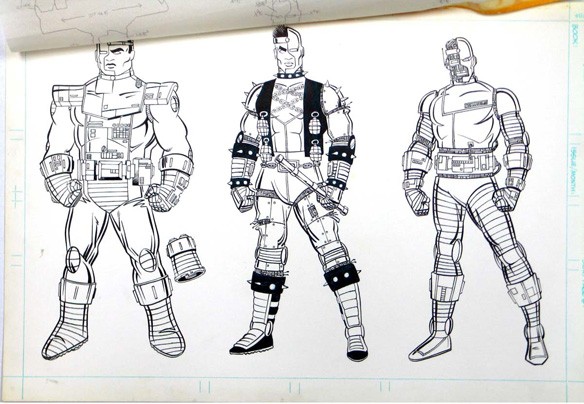
I'm not really a huge fan of Firestorm, but I still occasionally check out the Firestorm Fan blog from time to time, and I'm really glad that I clicked on today's post.  The blog's author, Shag, writes about a series of drawings now up for auction at Comic Link that purport to be concept drawings from the mid 80's for a never produced line of toys from Kenner that was to be called "DC Anti-Heroes."  The line apparently would have consisted of three alternate, darker versions of six DC heroes: Batman, Superman, Wonder Woman, Firestorm, Robin and Cyborg.  The three versions of each hero presented are "High Tech," "Road Warrior," and "Robotic."
Let's take a look at a couple of these drawings:

I think, and I'm not the first to observe this, that the "High Tech" version of Superman bears an uncanny resemblance to the Eradicator from the "Reign of The Supermen" storyline.  Since these drawings predate that saga by about six years, it is possible that whoever designed the Eradicator could have been influenced by them.  Also, now that I think about it, the "Robotic" Supes has a passing resemblance to the armor Superman donned after losing his powers in the "Krisis of the Krimson Kryptonite" storyline, which was also a few years in the future at the time these drawings were produced.

All three of these Wonder Woman drawings are among the most hideous character designs I've ever seen...

...though these Batman redesigns give them a run for their money.  Chris Sims says of the "High Tech" version, "Basically, it's a 100% accurate prediction of what every comic would look like in the '90s four years before they actually happened."

The Robin redesigns are actually pretty cool, and my favorites of the bunch.  However, I'm not exactly sure what's supposed to be so "High Tech" about the "High Tech" Robin. 

"Robotic" Cyborg?  Isn't that a bit redundant?  In fact, isn't "High Tech" Cyborg as well?
Finally... 

I don't have anything to say about these Firestorm drawings, but it seemed wrong to leave them out.
These concept drawings offer a fascinating look behind the scenes of the toy industry and an intriguing glimpse of what might have been.  Thanks again to Shag at Firestorm Fan  for bringing them to my attention.