Showing posts with label The Brave and The Bold. Show all posts

Monday, January 13, 2014

Gutter Talk's 2nd Annual, Rather Quite Late, Year In Review Post

[Before we proceed any further, it is my bloggerly (like that word? I just made it up just now) duty to inform you that the sections of this post concerning Doctor Who contain spoilers pertaining to the recent fiftieth anniversary special.  If you've not yet seen it, proceed at your own peril.]
You might be wondering why my 2013 Year In Review post is so late, coming as it does nearly 1/26 of the way through the New Year.  The first and most important answer to that is quite simply that I am lazy and I tend to procrastinate.  
My lack of ambition notwithstanding, nonetheless I have always preferred, on my various blogs over the years, to put off doing my Year In Reviews until the year is actually over.  You never know when some earth shattering, game changing bit of news is going to occur on New Year's Eve, leaving all the other  bloggers who wrapped up their post mortem on the year the week before Christmas slapping their foreheads and making Homer Simpson noises.  To be sure, that didn't happen in  2013, but one of these years it will and I shall be hailed far and wide as prescient and a visionary.
Enough preamble, on, at last, to the business at hand:
On a personal note, I did somewhat better at keeping up the blog in the year past, with 88 posts compared to a mere 58 in the twelve months previous.  However, as is my typical pattern, I sort of slacked off in the latter half of the year.
Since September, my contributions to this blog have mostly been limited to my weekly reviews of Star Trek: The Animated Series.  These have turned out to be some of my most popular and well received posts, so you can rest assured that I shall, as promised, be resuming the series with the second season of six episodes come September.  Its perhaps worth noting that, other than my observance of it here, the fortieth anniversary of the debut of the animated version of Trek went largely unheralded by fandom.  On the other hand, I am fairly certain that such shall by no means be the case in two years when the original series reaches its fiftieth anniversary year.  
One anniversary that did not slip by unnoticed by fandom was the fiftieth anniversary of Doctor Who's debut on November 23, 1963.  I feel that the anniversary episode, "The Day of the Doctor," was one of the best Who episodes since Series 5, which I consider the best of Stephen Moffatt's term as show runner.  The only real flaw in the episode is that I feel that Moffatt dropped the Zygon invasion plot about five minutes too soon, just short of an actual satisfying resolution.  Of course, the Zygons were not the point of the episode.  The real point was to lay to rest once and for all the specter of the Time War and to absolve the Doctor of his guilt for the supposed destruction of Gallifrey.  Retroactively making it so that Gallifrey was never really destroyed may seem to some a bit of a cop-out, but Moffat pulled it off in an emotionally satisfying manner and without contradicting anything that the series has established in the eight years since its return to the airwaves in 2005.  
The year in Doctor Who not only saw the end of Matt Smith's reign as the Doctor, but gave not just one, but three regenerations, and all within the space of little more than a month.  The on-line short "The Night of the Doctor" brought back eighth Doctor Paul McGann to show his transformation into John Hurt's "War Doctor"; the anniversary special ended with Hurt turning into the ninth Doctor; and, of course, there was the the Christmas special, featuring Peter Capaldi's first appearance as the Doctor, or his second if count his brief cameo, in extremely extreme close up, in "The Day of the Doctor."
Turning, finally, to the ostensible niche of this blog, the world of comics, it would appear that my powers of prognostication are perhaps not as prodigioous as I pretend. That bit of somewhat strained alliteration refers to the fact that in my previous Year In Review post, I forecast that when I sat down to write the post that you are reading right now I would be reporting the demise, sometime during the previous year, of DC's creator owned, mature readers imprint Vertigo after two decades of existence.  Unheeding of how it my affect my self-esteem, it turns out that the venerable imprint is  still chugging along.  However, it was announced a few weeks ago that the line will soon be losing its latest flagship title.  Bill Willingham's popular and long running Fables is due to cease publication with its 150th issue, due to appear on comic store shelves in just over a year. 
Meanwhile, a prediction that I ventured to make back in 2012 has, indeed, proven accurate.  Dark Horse's license to produce comics based on the Star Wars franchise is set to  expire in the upcoming year, and it has recently been announced that Lucasfilm's new owners, the Walt Disney Corporation, which also, not coincidentally, happens to own its own comics publisher, will be, as I foretold at the time of Disney's aquisition of the Star Wars property,  shifting the Star Wars license back to its original home at Marvel Comics.  Of course, you don't have to be Nostrodamus to realize that it makes more sense for Disney to produce Star Wars comics in-house if they, as they, in fact, do, have the means.
The past year saw the deaths of a trio of notable artists of the Silver Age of comics.  
Carmine Infantino's passing I noted when it occurred this April past.
Veteran Superman artist Al Plastino, who expired in November, had recently been in the news due to a legal conflict over some original artwork from a 1963 Superman story that he had wished, at the time, to be donated to the John F. Kennedy Library, but which, obviously, never ended up there.
To my mind, Plastino will always be the artist who was called in to "fix" Jack Kirby's Superman and Jimmy Olson faces during the King's run on Superman's Pal: Jimmy Olsen in order to bring them more in line with the look of the other Superman titles.  I also was somewhat surprised to learn when I read Schulz and Peanuts, David Michaelis' biography of the Charlie Brown's creator, that, back in 1978, Plastino had been in line to take over Peanuts if contract renewal negotiations between Schulz and his syndicate went sour.  It is my understanding that Plastino actually worked up about six weeks worth of Peanuts strips, just in case.  I've never seen them, but I've heard that they were fairly awful.
In November, the comics world also bade farewell to Nicholas Viscardy, better known to fans of his artwork on Aquaman, Teen Titans and The Brave and the Bold, among other titles, not to mention countless DC covers during the 1970's, as Nick Cardy.
Finally, speaking, as I was earlier, of anniversaries, I cannot believe that, being the huge fan of the Doom Patrol that I am, I failed to realize, and thus to mark the occasion on this blog, that 2013 had been the fiftieth anniversary of the team's debut in My Greatest Adventure #80, cover dated June 1963--which, of course, means it may have been on newsstands as early as March. In belated recognition of this milestone, I refer you now to this post from the very earliest days of this blog detailing the publication history of the Doom Patrol series around the time of the debut of the title's most recent incarnation, as well as all of the other posts I have composed about the team over the life of this blog.

Wednesday, March 13, 2013

"A Debt Repaid..." in Marvel Team-Up #147

Analogy Time:  The Human Torch was to Marvel Team-Up what Green Arrow was to The Brave and the Bold, only more so.
You could say, as I once did about Green Arrow and The Brave and the Bold, that Marvel Team-Up was almost as much the Human Torch's book as it was Spider-Man's.  Like GA in B&B, Johnny Storm appeared in MTU more times than any other hero, save for Spider-Man, of course.  In fact, the Torch showed up in MTU more frequently than GA in B&B.  Whereas GA appears in 11 of the 151 issues between the initiation of the team-up format in B&B #50 and  the series' end with #200, MTU was graced with the Human Torch's presence 16 times in its 150 issues run.  Two of those appearances were as a member of  the Fantastic Four, while six of them were as the star of the book, teaming up with other heroes while Spidey took an issue off.  The tradition of teaming Spider-Man and the Torch predates MTU, of course, going back to their friendly rivalry in the early days of The Amazing Spider-Man.
So when I tracked down  Marvel Team-Up #147 for my ongoing series of reviews of 147th issues, I was not at all surprised to find that the web-slingers co-star for the issue was none other than the Human Torch.
"A Debt Repaid..." is written by Cary Burkett, with art by Greg LaRocque and Mike Esposito.  This is one of only a handful of stories Burkett wrote for Marvel, primarily in MTU.  He spent the bulk of his career at DC, where he wrote a few issues of The Brave and the Bold, including, not surprisingly, a Batman/Green Arrow team-up.  
This issue is the middle part of a trilogy of sorts, teaming Spidey with Nomad (in #146), the Torch, and Thor (in #148) against a new villain called the Black Abbott.  The Abbott has set himself up in a base located off the shore of New Jersey where he is using his hypnotic powers to recruit scientific wunderkind to help him build a device to amplify his psychic powers enough to allow him to control an entire city.  He is also planning an assault on the prison at Ryker's Island to free the prisoners there to act as an army to carry out his dreams of conquest.
One of the science prodigies the Abbott, wearing the psychic disquise of a seemingly harmless old coot calling himself Mr. Abbott, recruits is none other than Peter Parker.  Thanks to his Spider-Sense, Peter is able to resist the Abbott's mental control, but he goes along with him to find out what his scheme is and to perhaps a rescue an old friend of his whom the Abbott also claims to have recruited.
Earlier, the Torch and Spidey had rescued a defector from Abbott's organization from other agents of the Abbott seeking to kill him for his betrayal.  However, the man's injuries were too severe to allow him to survive for long, but before he died, he spilled the beans about the Abbott's plans to the Torch.  Thus, shortly after Peter arrives at the Abbott's base, the Torch shows up as well.  However, Torchy gets himself captured pretty quickly and ends up under the hypnotic control of the Abbott, unable to flame on or fight the villain in any way. 
Switching to Spider-Man, Peter finds the mesmerized Torch and attempts to snap him out of the Abbott's spell by hurling insults at him in an effort to make him angry.  One particularly cruel and totally inappropriate remark finally manages to piss Johnny off enough to snap him back to reality.  Infuriated with Spidey, he and the wall crawler have a brief fight---because this is a Marvel comic, after all, and such is expected--before teaming up to take down the Black Abbott.  Even though his current plans are thwarted and his offshore base abandoned, the Abbott himself escapes to regroup and face off against Spidey and Thor in the issue following.
The title of the story, by the way, comes from Spidey feeling that his motivating the Torch to fight back against the Abbott's mental control is repayment for the Torch unknowingly inspiring him to get back in the game and defeat Doctor Octopus way back in Amazing Spider-Man #3.
All in all, this is a pretty typical meeting of two Marvel heroes, playing out as so many others did during the Silver and Bronze Ages.  Nonetheless, its an enjoyable little story, and I'll be keeping an eye out for a reasonably priced copy of #148 so I can find out how the saga of the Black Abbott plays out.

Saturday, February 23, 2013

THE GLORY DAYS OF THE BRAVE AND THE BOLD: Bob Haney, Jim Aparo, Murray Boltinoff and B&B #'s 98-131 (Conclusion)

(For the edification of those who may have missed my last post, I shall reiterate the explanation and history of this two-part series of posts as it appeared previously: The following long--for a blog post, at least--piece was written a couple of years ago for Jim Main's fanzine Comic Fan.  Shortly after I submitted it, however, Jim decided to suspend publication of CF in order to concentrate on comic books.  Thus, other than the select few trusted friends whom I sent copies to for proofreading and kibitzing, this masterpiece of comics history and journalism has gone regrettably unread.  Until now, that is.  Due to the aforementioned length of the article, I found a natural breakpoint about halfway through and split it up into two posts.  Part one can be read by going here.)
Now let's take a closer look at some of the individual stories that made the Haney/Boltinoff/Aparo B&B era so great. 

Friday, February 22, 2013

THE GLORY DAYS OF THE BRAVE AND THE BOLD: Bob Haney, Jim Aparo, Murray Boltinoff and B&B #'s 98-131 (Part One)

(The following long--for a blog post, at least--piece was written a couple of years ago for Jim Main's fanzine Comic Fan.  Shortly after I submitted it, however, Jim decided to suspend publication of CF in order to concentrate on comic books.  Thus, other than the select few trusted friends whom I sent copies to for proofreading and kibitzing, this masterpiece of comics history and journalism has gone regrettably unread.  Until now, that is.  Due to the aforementioned length of the article, I found a natural breakpoint about halfway through and split it up into two posts.  The conclusion will appear here in a day or so.)
In the December 2004 edition of BACK ISSUE magazine, editor Michael Eury called THE BRAVE AND THE BOLD (B&B) the most influential comic book put out by DC during the Silver and Bronze Ages. While Eury admits that his claim may be somewhat overblown, the evidence that he offers to support his theorem, in the form of a listing of important characters and concepts that first saw the light of day in B&B, is nonetheless compelling.

Friday, March 11, 2011

Green Arrow in The Brave and the Bold (Part 5): Volume 3

Back in August, when I reviewed issue #35 of the latest volume of The Brave and the Bold, I had no idea that it was the final issue.  Apparently, neither did anyone else.  There has been, as far as I know, no formal announcement of the book's cancellation from DC, but #36 is, as I write this, six months late. Therefore, this is, for the time being, the final installment of my series on Green Arrow's appearances in B&B.  
Harking back to the early days of the original B&B's team-up format, the latest volume had no fixed co-star, instead featuring different pairings of heroes in almost every issue.  Often, especially during Mark Waid's tenure as writer, there would be continued stories with different sets of heroes starring in each chapter.  Green Arrow is featured in three issues out of the extant thirty-five, with a brief appearance in one more, which about matches the ratio of his appearances in the original series. In the thirty-five issues between #100 and #134 of volume one, for example, the Emerald Archer also makes four appearances.
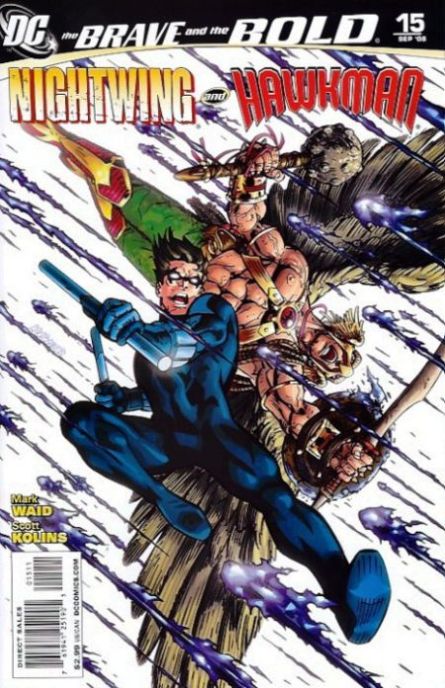
He first shows up in volume three with #14, teamed with Deadman in a story  by Mark Waid and Scott Kolins entitled "The Ghost Killers of Nanda Parbat."  The two meet when Green Arrow encounters a pair of the titular "Ghost Killers", who Deadman has pursued to Star City.  They are former residents of Nanda Parbat; the mystical Shangri-La hidden in Himalayas that is home to Rama Kushna, the god-like being who gave Deadman his powers and mission; who have been transformed by a demon priest called Siva Anuttara into entities similar to Deadman, except that they kill any living being they possess, after Anuttara imprisoned Rama Kushna in a magical amulet and took over Nanda Parbat. The Ghost Killers have been sent out into the world to spread Anuttara's evil and have set up a base in Star City.  When the Ghost Killers attack Green Arrow, Deadman hops into his body to keep them from taking it.  Still in Ollie's body, Deadman hops a plane for Nanda Parbat to confront Anuttara directly.  At the border of Nanda Parbat, Green Arrow and Deadman are able to jointly control Ollie's body and attempt to destroy Anuttara's amulet with an arrow to free Rama Kushna.  Anuttara easily swats the arrow aside, however.  Fleeing from the Ghost Killers, Ollie and Deadman enter Rama Kushna proper, where Deadman is forced to exit Ollie's body and becomes a living being.  Seemingly enraged by Deadman's delivering them right into their enemies hands, Ollie shoots Deadman, apparently killing him, and flings the body off a cliff and away from Nanda Parbat.  Thus ends The Brave and the Bold #14. Green Arrow had gambled that, once outside of the magical influence of Nanda Parbat, Deadman would simply turn into a ghost again and go off to seek help.  This is precisely what happens in the next issue in which Deadman recruits Nightwing and Hawkman to come back with him to Nanda Parbat, free Rama Kushna, defeat Anuttara and rescue Green Arrow. 
I'm not a big fan of Mark Waid, but this is one of his more enjoyable stories.  Green Arrow's a little out of his element amidst all the ghosts and demons and magical goings on, but he holds his own and his quick thinking manages to ultimately save the day. 
Green Arrow next appears in issues #21 and #22, sharing cover billing with his old pal Green Lantern.  However, despite being featured on the covers, he plays a relatively small role in the story, not even showing up until more than halfway through #21. These two issues comprise the second half of the four part story "Without Sin," written by David Hine and illustrated by Doug Braithwaite and Bill Reinhold.  The first two parts feature GL and the Phantom Stranger and the Stranger continues to play a major role in the stories conclusion, getting more on panel time than ostensible co-star Green Arrow.  My summary of these issues will focus primarily on GA's part of the story.
As "Without Sin" part three begins, GL and the Stranger are on the planet Kahlo battling an entity called the Purge who has possessed that world's Green Lantern.  Purge's schtick is to travel from world to world eliminating each planet's evil by killing the entire population, which he does by possessing the planet's most powerful being, such as, say, a Green Lantern.  After the Stranger banishes Purge from Orlan, the Kahloan GL, he and Hal remain on Kahlo to take care of a few loose ends. However, the Stranger senses that Cora, an autistic girl on Earth who appears to hold the key to defeating Purge, is in danger.  She is in a hospital for children with birth defects caused by trials of an experimental drug called Genesin. A team of killers has been sent to destroy the hospital to eliminate any evidence of the failed experiment.  The Stranger sends a psychic projection to Green Arrow, dispatching him to the hospital to try to save the children.  When he arrives, the killers are already there and manage to get off a lucky shot that grazes GA's head and leaves him lying on the floor helpless as they plant a bomb in the basement. 
In the conclusion, Green Arrow manages to recover in time to stop the bomb from exploding just as Hal and the Stranger arrive at the hospital for the final confrontation with the Purge. While that's going on, Green Arrow pursues and captures the squad of would be killers.  I like the fact that Hine keeps Green Arrow separate for the most part from the magical and science fiction elements of the story, even though that does limit his role.
I've now covered every appearance of Green Arrow in all comic book series carrying the title The Brave and the Bold.  At least those set in the mainstream DC Universe. Perhaps in the future, I'll get around to reading and reviewing the comics based on the  Cartoon Network series Batman: The Brave and the Bold. Green Arrow has been a frequent guest star on the show and I'm sure he plays a major role in the comic as well.  Furthermore, I'm fairly certain that some day, in the not too distant future, DC will revive  the title yet again and Green Arrow is sure to be a part of it. 

Monday, March 7, 2011

Green Arrow in The Brave and the Bold (Part 4): Volume 2

Nearly a decade after the end of the original The Brave and the Bold, DC revived the venerable title as a six issue mini-series written by Mike Grell and Mike Baron, drawn by Shea Anton Pensa and Pablo Marcos and featuring Green Arrow, the Question and the Butcher.   The story has no title other than The Brave and the Bold and the individual issues are simply identified by chapter number.
GA and the Question teamed up several times during Grell's tenure, but I believe that this is the only of those meetings that Grell actually had a hand in writing. Ollie and the Butcher act as if they've met before.  If you're unfamiliar with the Butcher, that's understandable.  The character, created and owned by Baron, made only a handful of appearances in the early 90's.  Previous to B&B vol 2, he debuted in an eponymous mini-series, then appeared in a two part illustrated text story in the pages of Ms. Tree Quarterly. Following this series, he was never seen again.  He did get an entry in Who's Who, which describes him as "free lance spook" John Butcher, Lakota Indian and former Army Ranger and CIA operative.
As the story begins, Green Arrow stumbles upon a Native American separatist movement with apparent ties to the Irish Republican Army which Butcher has infiltrated.  The Question becomes involved while investigating the murder of lumber baron Owen Hester, who was scalped in an apparent attempt to implicate Indians in the crime, as reporter Vic Sage. Together, the trio uncover a plot to foment a Native American uprising at a Mohawk reservation in Montreal.  The man behind the plot is revealed to be part Indian British Lord Sir Arthur Youngblood, head of the conglomerate that owned Hester's company.  His plan is that the uprising will cause the Canadian government to shut down the reservation, allowing him to swoop in and claim the land for a massive industrial and residential development project.  Naturally, of course, Green Arrow, the Question and Butcher unravel the plot, publicly expose Youngblood's duplicity and save the reservation.
A couple of years later, in an editorial in Shaman's Tears #1, editor Mike Gold wrote :
"...perhaps we should have reconsidered that Brave and Bold series when we knew it wasn't working out.  No knock on Mr. Baron; he did excellent work.  The idea was a good one, but no matter how hard we tried, Grell's style and Baron's style just didn't mesh."
Though it starts off well enough, the story never does quite gel.  Butcher  himself says in the story, reporting back to Sage and Ollie after attempting to infiltrate and gain intelligence on the Indian uprising, that he discovered "Bits and pieces, but they don't quite make a whole," which sums up the series better than anything I could could come up with.
While Pensa does a fine job on most of the faces and figures, his backgrounds are a bit crude and blocky.  I'm not a big fan of the way he draws Ollie, specifically, Ollie's beard and mustache.  He uses squiggly lines that just don't look right to me. It also seems that Pensa had some trouble making deadlines.  That's just conjecture, but it would explain why Pablo Marcos steps in to draw #5 and inks Pensa, who had handled the first four issues solo, on the final installment. At least in #6 Green Arrow's beard looks right.
In the time honored Brave and the Bold tradition, there are apparently some continuity issues surrounding this series.  According to the DC Data Base entry for Charles Victor Szasz (a.k.a. Vic Sage or The Question), because Butcher was a creator owned character who is no longer part of the DC Universe, it is "unclear" whether the events of this story still fit into continuity.

Friday, December 17, 2010

Christmas With The Caped Crusader: The Brave and the Bold #184

You know who loves Christmas even more than the Batman?
Mike W. Barr.
I'll bet he's got the biggest, most obnoxious outdoor light display in his neighborhood.  He certainly loves a good Batman Christmas story, and has written quite a few himself over the years.  Among the earliest of these is "The Batman's Last Christmas" in The Brave and the Bold #184, guest starring the Huntress and drawn by veteran B&B illustrator Jim Aparo.
This being the post-Haney B&B, the fact that Huntress lived on a different Earth from the Batman is actually accounted for.  Of course, given the nature of the pre-Crisis On Infinite Earths Huntress as the daughter of Earth-2's Batman, even Haney couldn't have just had her drop by without accounting for the dimensional difference.
With her parents, the Earth-2 Batman and Catwoman, gone, Helena Wayne, the Huntress, beams over to Earth-1 to spend the holidays with the only real family she has, her father's Earth-1 counterpart, whom she refers to affectionately as "Uncle Bruce."  She catches up with Batman just as he stumbles upon evidence that seems to suggest that his father, Dr. Thomas Wayne, had made payments to mobster "Spurs" Saunders to help Saunders establish his criminal empire.  Further investigation serves only to further incriminate Dr. Wayne, leading Batman to decide that his whole career as Batman has been a sham, since the parents whose deaths he's been avenging were seemingly just as bad as the criminals he fights. Thus, Bruce vows that "...It's time for the Batman to die!"
He tries to become the playboy he's always pretended to be, but his heart just isn't in it. Then he witnesses the Huntress save the life of a member of Saunders' mob who'd double crossed him.  The man had been Christmas shopping with his son, and Batman realizes that even though the guy was a crook, his son would have been traumatized by his murder. This leads him to further realize that his career as Batman has always been about more than just avenging his parents deaths. "...He (the Batman) exists to spare others the loss I felt when my parents died--a loss I felt even though they were also criminals." 
Newly re-inspired, Batman decides to discover the real truth about his parents.  Back at Wayne Manor a memory of his last Christmas with his parents causes him to remember a tell tale clue which leads him to the realization that it was actually his parents' accountant, Amos Randolph, pretending to be Dr. Wayne and embezzling his money, who had financed Saunders. Batman confronts the aging and bedridden accountant while Huntress tells Saunders that she knows the truth about his connection with Wayne and has turned the incriminating records over  to Commissioner Gordon.
Usually in Batman's Christmas stories, the Caped Crusader is simply a player in someone else's story; the instrument through which they learn a yuletide lesson.  In "The Batman's Last Christmas", however, its the Batman himself who learns a valuable lesson.  He tells Helena that she "helped give me back my faith and my cause. I couldn't ask for a better gift!"  Then, at his parents' graves, he rededicates himself to his war on crime.

Wednesday, December 15, 2010

Christmas With The Caped Crusader: The Brave and the Bold #148

In our celebration of Batman Christmas tales, we're still stuck in 1978 for the moment.  That's okay with me. 1979 was one of the worst years of my life, but that's not a tale for this blog. 
Today we're going to examine The Brave and the Bold #148, starring Batman and Plastic Man in "The Night the Mob Stole Xmas!" (I know there's usually a dash in there between the "X" and the "mas", but that's the way it was punctuated in the book, so that's the way I'm doing it here.)  Like all the the majority of issues of B&B, this one was written by Bob Haney, but the art chores are handled a little differently this time out.  Regular B&B artist Jim Aparo was usually a one man band, penciling, inking and even lettering the entire story every issue.  In #148, however, he inks over the pencils of Joe Staton.  I assume he did the letters as well, as they look the same as they do in every other issue. 
This unusual distribution of duties allowed Aparo time to adjust to the book's new publishing schedule.  In 1978, after thirty-three years, B&B finally became a monthly comic. The choice of Joe Staton to help out with this issue was probably because, if I'm remembering right, he was drawing a Plastic Man feature in Adventure Comics at the time.
But the Plastic Man who appears in this story is the Plas of Bob Haney's B&B, and is quite a different character than the one Joe was drawing over in Adventure.  Many characters tended to act a little differently when they entered Haney's corner of the DC Universe than they did anywhere else, but Plastic Man was the most extreme example.  Rather than the light hearted, happy-go-lucky adventurer he was in his solo stories, in B&B, Plas was, to be honest, a bit of a whiner, given to bemoaning his status as a "freak."  Thus, when Batman encounters Plas, reduced to working as a street corner Santa, Plastic Man tells the Caped Crusader how things have gone downhill since they last met in B&B #123.  "...Cheap carnivals I quit because I hated being a freak," he moans, "But I guess I'm doomed to play only phony roles...like this!" (Wait, is Plas saying Santa isn't real?)  Batman stammers out a few reassuring words, tosses a coin in Plas' pot, tells him to try to have a Merry Christmas, then goes off to continue pursuing the cigarette smugglers, or "buttleggers", that he's been on the trail of .
The next morning, Batman drives by "Lacey's" department store to discover that their world famous Christmas display has been stolen.  Not only that, but the thieves also also kidnapped Plastic Man. Fortunately, Plas was able to leave a clue for Batman, and the Dark Knight soon finds himself on the trail of a convoy of semis headed for Florida.
Its soon revealed that the Lacey's display was stolen to serve as decorations at a Christmas party thrown by supposedly dieing mob boss Big Jake Doyle , coincidentally, the head of the "buttlegging" ring, ostensibly to make peace with his rivals before he passes on.  Of course, Doyle isn't dieing after all and the party was just a ruse to get all his competitors in one place so he can rub them out.  Fortunately, Bats and Plas are on hand to prevent the carnage, arrest Doyle, and get the Lacey's display back to Gotham in time for Christmas Eve.
While many of the Batman Christmas stories I've read feature some sort of life affirming message about the meaning of the season, Bob Haney wasn't really much of a sentimentalist. This is pretty much a typical Haney B&B story featuring Batman and his co-star du jour taking on a group of fairly generic mobsters.
Fortunately, Plastic Man's moaning is kept to a minimum, and there are some pretty clever uses of his powers, making this my favorite of Haney's B&B stories with the character.

Saturday, March 20, 2010

Green Arrow in The Brave and the Bold (Part 3)

(I apologize to anyone who actully gives a crap for the week long delay in getting up further Green Arrow posts.  I'll fill you in on what I was up to a little later.  In the meantime, to get up to speed, you might want to check out parts one and  two of this series on GA's appearances in The Brave & The Bold...or you could just leap right into Part Three....)
Apparently unwilling to bow to pressure from new B&B editor Paul Levitz to bring his stories more in line with the rigid continuity of the other Batman books, longtime B&B writer Bob Haney wrote his last Batman team-up story for issue #157.  The remaining forty-three issues were written by a rotating roster of writers that included Gerry Conway, Cary Burkett and Mike W. Barr. Jim Aparo remained with the book to draw the majority of the final stories.
Haney favorite Wildcat, who at the time supposedly lived on a different Earth from B&B's Batman, a matter of continuity that Haney never addressed, made no further appearances in the book, however, Green Arrow, another mainstay of the Haney era, would show up twice more. 

Saturday, March 13, 2010

Green Arrow in The Brave and the Bold (Part 2)

Welcome to the second installment of my retrospective of the Emerald Archer's many appearances in DC's seminal team-up magazine, The Brave and the Bold.  Should you wish to read the first installment of this magnum opus, click here.  That epic length post took me the better part of three days to compose, so this time, in the interest of getting this post up somewhat quicker, I'm going to limit myself to the remaining Green Arrow/Batman pairings penned by long time B&B writer Bob Haney, and leave the two GA/Batman stories of B&B's post-Haney era for part three.

Friday, March 12, 2010

Rise and Fall Falls Hard

When I wrote about Brad Meltzer's "The Archer's Quest," I allowed as how it wasn't the worst Green Arrow story that I've ever read.  This may have inspired you to ask yourself, "Hmm. What, then, is the worst Green Arrow story that Ray Tomczak has ever read?" (If so, please, I beg you, get a life.) 
When I wrote that post, I probably would have said "Heading Into The Light" by Judd Winick mostly because it spins out of Meltzer's execrable Identity Crisis and features as the main villain the new, improved, badass Dr. Friggin' Light. 
That was, of course before I read the Justice League: Rise and Fall Special
As I stood before the racks of recently released comics at the Laughing Ogre on Wednesday taking a peek at the first page of Rise and Fall, the very one shown to the left of these words, I considered not buying it.  There had to be better ways to waste four bucks, like maybe giving it to my ex-roommate who'd put it toward buying crack. Sure, I had sort of promised to read and review the book here, but was I really obligated to follow through?  After all, it's not like this is my job.  I'm not a professional writer, I'm just an opinionated fanboy sitting at a cluttered computer desk in a small, dimly lit one bedroom apartment with a pack of cigarettes, a cup of coffee, and a stack of old comic books at my side.  I am doing this, as the saying goes, "for fun," and that first page, which seemed to confirm my worst fears about the awfulness inherent in the very concept of Rise and Fall, foreshadowed that reading the rest of the book would not be anything even remotely resembling "fun."  Besides, it's not like I've got millions of readers who would be bitterly disappointed and outraged if I just put the thing back in the rack and backed away slowly.
Nevertheless, despite these misgivings, I picked up Rise and Fall and Doom Patrol #8 and headed toward the counter.
While the story didn't get any worse after the first page, it utterly failed to get any better, either. The story is called "Green Arrow Unbound," which apparently means unbound by any obligation to act in a manner at all consistent with how he's been portrayed in the past.  
Do I really have to go into more detail?  Must I relive the horror? Isn't it enough just to know that this book utterly sucks and is to be avoided at all costs?  
Seriously, I'm doing this Green Arrow Month thing to celebrate what it is that I love about the adventures of Oliver Queen, so I will waste no more time with this garbage, and I urge you to do likewise.
On the bright side, Doom Patrol #8 wasn't bad.  It looks like the various subplots Giffen devoted the previous issue to might actually turn into a pretty good story or two.  And Crazy Jane's back, which could be cool if she's handled correctly, which I certainly think that Keith Giffen is capable of doing.

Green Arrow in The Brave and the Bold (Part 1)

(As I've got quite a few comics to cover here, and I tend toward long winded rambling in my blog posts, this look at Green Arrow's appearance in the original The Brave and the Bold is going to be at least two parts.)
To me, it almost seems as if the original The Brave and the Bold was as much Green Arrow's book as it was Batman's.  Not only did he appear in its pages more times than any other super-hero besides the Caped Crusader, but he was on hand for most of the series' milestones.  He co-starred in the fiftieth issue, which launched the book's team-up format, took time out, along with Green Lantern and Black Canary, from wandering around the country to visit Gotham for the celebration of the series' hundredth issue, and when B&B published its very first two part team-up tale, he was one of the participants.  It was in B&B that Green Arrow got a new costume and began the revitalization that saw him transformed from nondescript Batman wannabe to hotheaded liberal crusader for the little guy. The  Green Arrow team ups in B&B are not just important in the history of the book and the character, but a couple of them rank among my favorite GA stories of all time.