Wednesday, February 9, 2011

Starman/Congorilla #1

This comic came out last month, so I guess I'm a little late in writing about it, but I put off reading it for awhile.  I was a little afraid that I wasn't going to like it.  Now, if you knew me at all, you'd think that a comic starring an obscure Bronze Age character and a gorilla would be tailor made for me.  However, this particular comic has close ties to the current run of Justice League of America, a comic that I'm not reading, and Justice League: Cry For Justice, a comic that, based on the reviews I've read, you couldn't pay me to read.  I've seen that series compared to Identity Crisis, with many people actually saying that Cry is worse. On the other hand, even though Starman/Congorilla writer James Robinson is the same man responsible for Cry For Justice, he is also the author of the excellent Starman series from the 1990's and this one-shot features one of that series' major supporting characters.  In short, I really didn't know what to expect from this comic, but I was leaning slightly toward pessimism. Starman, after all, ended a decade ago and the ink is barely dry on Cry For Justice.
Fortunately for all concerned, "Now and Then", the story in Starman/Congorilla #1, turns out to be a pretty decently entertaining comic.  The story concerns the efforts of the eponymous heroes, together with Animal Man and Rex the Wonder Dog, to find a Congorilla's friend,  a super-intelligent gorilla scientist named Malavar, so that Malavar can use his knowledge of other dimensions in order to free the Justice League from a giant force dome which has mysteriously appeared over Washington D.C., trapping the League and a good chunk of the city citizenry inside.  That sounds a bit complicated, but "Now and Then" really boils down to a small group of heroes fighting off an army of terrorist gorillas.
As I mentioned above, there is a lot of back story behind this issue, leading to the story being heavy on expository dialogue.  However, that's a lot better than Robinson just assuming we've read all the relevant past comics and throwing us into the action without any explanation and leaving us totally bewildered.  With all the  exposition and the way the story shifts back and forth in time between the fight with the gorilla terrorists and the events leading up to it, the story had the potential to be a confusing mess.  Fortunately, however, thanks to the clear and conscise stoytelling skills of  Robinson and artist Brett Booth, this doesn't happen.  The story breezes along at a brisk pace and Robinson manages to make most of the expository dialogue sound perfectly natural.
In the way that this story manages to be part of the larger story of the DC Universe yet accessible to a casual reader, as well as its generally lighthearted tone and high concept, psuedo-science fiction premise, Starman/Congorilla reminds me a little of comics of the Bronze Age. 

Monday, February 7, 2011

The Road Not Taken: DC Anti-Heroes

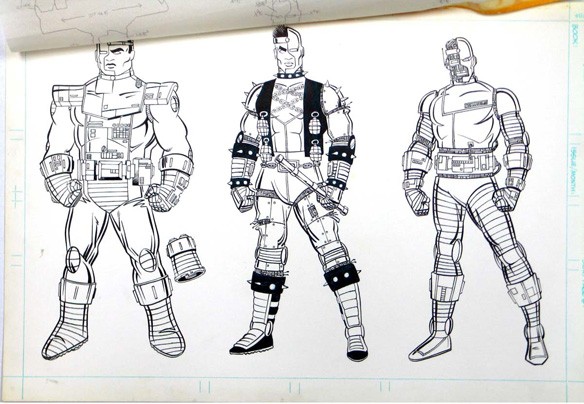
I'm not really a huge fan of Firestorm, but I still occasionally check out the Firestorm Fan blog from time to time, and I'm really glad that I clicked on today's post.  The blog's author, Shag, writes about a series of drawings now up for auction at Comic Link that purport to be concept drawings from the mid 80's for a never produced line of toys from Kenner that was to be called "DC Anti-Heroes."  The line apparently would have consisted of three alternate, darker versions of six DC heroes: Batman, Superman, Wonder Woman, Firestorm, Robin and Cyborg.  The three versions of each hero presented are "High Tech," "Road Warrior," and "Robotic."
Let's take a look at a couple of these drawings:

I think, and I'm not the first to observe this, that the "High Tech" version of Superman bears an uncanny resemblance to the Eradicator from the "Reign of The Supermen" storyline.  Since these drawings predate that saga by about six years, it is possible that whoever designed the Eradicator could have been influenced by them.  Also, now that I think about it, the "Robotic" Supes has a passing resemblance to the armor Superman donned after losing his powers in the "Krisis of the Krimson Kryptonite" storyline, which was also a few years in the future at the time these drawings were produced.

All three of these Wonder Woman drawings are among the most hideous character designs I've ever seen...

...though these Batman redesigns give them a run for their money.  Chris Sims says of the "High Tech" version, "Basically, it's a 100% accurate prediction of what every comic would look like in the '90s four years before they actually happened."

The Robin redesigns are actually pretty cool, and my favorites of the bunch.  However, I'm not exactly sure what's supposed to be so "High Tech" about the "High Tech" Robin. 

"Robotic" Cyborg?  Isn't that a bit redundant?  In fact, isn't "High Tech" Cyborg as well?
Finally... 

I don't have anything to say about these Firestorm drawings, but it seemed wrong to leave them out.
These concept drawings offer a fascinating look behind the scenes of the toy industry and an intriguing glimpse of what might have been.  Thanks again to Shag at Firestorm Fan  for bringing them to my attention.

New Gutter Talk Poll: Vote For Your Favorite Superman Actor

Henry Cavill--the new Superman
Speaking of Superman, as I was in yesterday's post, I have decided that it's about time for another Gutter Talk Poll.  This one was inspired by the recent announcement that Zach Snyder, director of the upcoming film Superman: Man of Steel,  has found his leading man.  The lucky, or perhaps unlucky, if you believe in the so-called "Superman Curse", winner of the role is Henry Cavill, a 26 year old British actor apparently best known to some for something called The Tudors, whatever the heck that is.  It seems that Cavill had actually been cast to play Superman in 2006's Superman Returns, until Brian Singer came on board as director and booted him in favor of Brandon Routh.
So, over to your right, at the top of the page, you'll notice a list of previous actors who have assayed the role of the Last Son of Krypton.  Your task, should you chose to accept, is to pick your favorite from among those listed.
Note that the choices are limited to those actors who have portrayed Superman, as opposed to Superboy or simply Clark Kent, in live action movies or television series.  Therefore, Bud Collyer of the 1940's radio show, Tim Daly from the 1990's animated series, Gerard Christopher of the 1980's Adventures of Superboy syndicated series, and Smallville's Tom Welling, among others, were excluded from consideration.
I actually thought about leaving Brandon Routh off the list as well.  I can't  think of anybody who really liked Superman Returns all that much and I honestly don't expect anyone to vote for him.
In truth, I expect this poll to come down to a two man race between George Reeves and Christopher Reeve. Still, I could end up being surprised.  Just maybe there are a lot of Kirk Alyn fans among my readers.
The poll will be open for the next seven days, and I'll discuss and analyze the results here sometime next week.
By the way, if you are reading this on my Open Salon site, click here to participate in the poll.

Sunday, February 6, 2011

Super Sunday II: Superman #330

Last year, on Super Bowl Sunday, I wrote about Superman #326, and today I officially make "Super Sunday", wherein I talk about an old Superman comic on the day that the rest of the country is obsessed with a football game, an annual tradition as I tell you all about Superman #330.
As I said in that earlier post, Martin Pasko is one of my favorite writers and has written some classic Superman tales.  "The Master Mesmerizer of Metropolis," however, is not one of them.  It's not so much that the story is bad, although it's certainly not good by any measure, but that it's utterly ridiculous and, most of all, totally unnecessary.
Comics fans, as you know, are an odd bunch.  They--ok, we--can easily accept that a man can fly faster than the speed of light, see through walls, shoot heat beams out of his eyes and push planets with his pinky.  On the other hand, the idea that when that same man changes his clothes and slaps on a pair of glasses no one can recognize him gives us--well, some of us, at least--trouble.  Now, as far as I'm concerned, the answer is simply, "Hey, it's a comic book!" If you're willing to suspend disbelief enough to buy the idea of super-heroes in the first place, then Superman's lame "disguise" really shouldn't be all that hard to swallow.
Apparently that wasn't enough for Al Schroeder III, a fan from Nashville, Tennessee who submitted an idea to DC for a story to explain away this "problem" which Pasko turned into the story in Superman #330.
Superman encounters a villain named the Spellbinder, who is able to hypnotize people into committing crimes.  To counter this scheme, Superman himself hypnotizes entire city of Metropolis via a giant flying TV screen to make them immune to hypnosis.  With me so far?
So, minutes later, Superman's in a storeroom at the Galaxy building changing back to Clark when Lana Lang walks in.  Despite seeing it with her own eyes, she refuses to believe that Superman is Clark Kent.  Later, Superman asks a Daily Planet artist named Ernie to draw Superman and Clark Kent.  Ernie's drawing of Kent looks thin, frail and, as Superman admits, "...not terribly handsome."  Superman now realizes that, with the aid of the lenses of his glasses; which are made of indestructible Kryptonian plexiglass from the rocket he came to Earth in as a baby; he has been unconsciously his power of super hypnosis to hypnotize everyone who looks at him as Clark Kent into seeing Kent as a wimp.  Apparently the hypnotic effect works through TV cameras and affects people who see still photos of Clark and lingers for a while so that people still see Clark as a wuss even if Superman temporarily loses his powers.   You got all that?  So, when Superman made the people of Metropolis immune to hypnosis, he unknowingly canceled his own unconscious Svengali routine.  Thus Lana saw not Clark Kent, but Superman in a blue suit and glasses.
I've often maintained that the entire super-hero conceit is built on a pretty flimsy foundation and tends to crumble if you think about it too hard.  "The Master Mesmerizer of Metropolis" is a textbook example of that theorem.
*************************************
On a completely different subject, today is the 100th of Ronald Wilson Reagan, 40th President of the United States of America.  If I'd realized this milestone was on the horizon, I might have held off on my post about the U.S. Presidents with the most appearances in comic books, a list topped by none other than Mr. Reagan himself, until today.

Saturday, February 5, 2011

Siegal, Pekar, Thurber Among Alive's 100 Greatest Ohioans

Harvey Pekar
Columbus Alive, one of Columbus, Ohio's "alternative" weekly papers--now part of the same local media empire that owns a TV station, an AM and an FM radio station and the town's daily newspaper--features  as it cover story this week its list ranking "The 100 Greatest Ohioans."  Of interest to the readers of this blog are the persons ranked at #91, #82, and #28.  They are, respectively, Jerry Siegal, Harvey Pekar, and James Thurber.  (In order to make the list, you had to have been born in Ohio.  Thus Siegal's creative partner, Joe Shuster, a Canadian by birth, was ineligible.)
James Thurber
Having noted that, now comes the part--as you knew it would--where I bitch about the rankings. I have no complaints about Thurber cracking the top 30, but Pekar and, especially, Siegal deserve to be higher on the list.
Just above Pekar, at #81, is a collective listing for "Ohio's U.S. Presidents (except Grant).  These include Rutherford B. Hayes, James A. Garfield, Benjamin Harrison, William McKinley, William Howard Taft, and Warren Harding.  Even Alive acknowledges that they don't know what these guys actually accomplished while in office.  I can't really help them there, although I do know that Harding is most remembered for the Teapot Dome Scandal, which led to a member of his cabinet going to prison. 
Jerry Siegal
So, according to Alive, a group of non-entity, placeholder Presidents are somehow greater than Pekar, who lifted autobiographical comics out of the underground and into the comics mainstream, or Siegal, the man who co-created Superman, a character once ranked second only to Oprah Winfrey among American pop cultural icons in a VH-1 Top 200 list.  I have a tough time buying that. 
Jerry Siegal and Joe Shuster didn't just create a character when they created Superman, the first true super-hero, but an entire genre that quickly moved beyond comic books to radio, movies, television and prose fiction.  The influence of Siegal and Shuster's creation on the pop culture landscape of 21st century American cannot be underestimated. Not to mention that the character of Superman himself has become a powerful symbol of the American ideal,  embodying, as the intro of the old Adventures of Superman TV show put it, the "...neverending battle for truth, justice and the American Way."
Contrast that to William McKinley, whose main claim to fame is being assassinated while in office.

Friday, February 4, 2011

Morrison and Quitely's "Flex Mentallo" To Be Reprinted At Last

Until recently, I was unaware that lurking amongst my accumulation of old comic books was a genuine, rare, highly prized and much sought after collector's item: the four issues of Flex Mentallo by Grant Morrison and Frank Quitely.  Since its publication in 1996, the series has never been reprinted, mostly due to legal conflicts with Charles Atlas Ltd., the company responsible for the famous ad "The Insult That Made A Man Out of Mac," which pitched their mail order bodybuilding course and on which Grant Morrison based the origin of Flex Mentallo which appeared in Doom Patrol #42.  When the story was called for to their attention, Atlas sued DC for trademark infringement.  While the case was settled in DC's favor, with a ruling that Flex's origin was parody and thus not an infringement, DC apparently agreed never to use the character again. Of course, to me at least, this doesn't seem to mean that they could not reprint the character's earlier appearances.  In fact, the Doom Patrol story line featuring the character has been collected in trade paperback, but the character's eponymous mini-series has remained in limbo.  In the meantime, as I learned just a few months ago, the series has become somewhat hard to find and the few copies that are available are fetching a "pretty penny" (as my mom might say) on ebay.  I was one of the lucky ones who had the foresight to buy the book when it came out, and I, for one, would never part with my copies. I think that  probably a lot of people who've read this book feel the same way and that may be a big part of why the series has become so difficult to find.
Through repeated re-readings, Flex Mentallo has come to be my favorite comics work by Grant Morrison.  It represents a highpoint in the careers of Morrison and Frank Quitely both individually and as a team.  I'll admit that I don't entirely understand it, but I love it.  (Which I suspect is how my mom feels about me.)
The series tell the story of Flex Mentallo, a formerly fictional super-hero created by a young boy named Wallace Sage and brought into the real world by Sage's psychic power.  Flex discovers that one of his fictional cohorts, the Fact, has apparently also become real. His search for the Fact leads Flex to a mysterious terrorist group called Faculty X and ultimately to the group of archetypical super-heroes known as the Legion of Legions.  Meanwhile, a suicidal young musician named Wallace Sage, who may or may not be the same Wallace Sage who created Flex, has taken an overdose of pills and called a suicide hotline.  He delivers a rambling reminiscence about his childhood and the comic books he read when he was a kid. 
In many ways, Flex Mentallo is the quintessential Grant Morrison comic, encapsulating most of the themes that have run through much of his work before and since, from Zenith to Final Crisis.  Here he explores the nature of reality, the untapped potential of the human race, the power of imagination, the history of comics and his unabashed love for the medium and combines them with elements of autobiography and super-hero adventure.  That sounds like a lot for one four issue story, but Morrison pulls it all together and makes it work somehow.
This series is central to an understanding of Morrison's career. It is the bridge between his work on Doom Patrol, Animal Man, and The Invisibles and his later, more mainstream work on JLA and New X-Men.  As Morrison himself told author Timothy Callahan in an interview for the book Grant Morrison: The Early Years, "So, you can see me re-engaging with super-heroes in the Flex Mentallo series...the last page of that is me preparing for the Justice League, I think."
I haven't said much about the art, but it's beautiful.  This series was the first time I saw Frank Quitely's work, and as far as I'm concerned this is the best thing he's ever done.  Honestly, his work since has been somewhat hit and miss for me.  For example, while I generally like his art, I absolutely hated his issues of The Authority.  Of course, it didn't help matters that Mark Millar's scripts were pretty awful.  Here, though, Quitely's art is near perfect, with just a hint of cartooniness that really serves the story well.
That this series has remained out of print for so long is truly a shame.  Fortunately, that's about to change.  Last month, DC's Vertigo imprint announced that Flex Mentallo will, at last, be reprinted. A hardcover edition of the story aincluding unspecified "bonus material" is slated to be released sometime this fall.
Even though I already have the mini-series, I might just give some serious thought to buying the collection.  In large part, it really depends on just what the "bonus material" turns out to be.  Also, if I do get the book, I'll have a spare copy that I can then loan out to friends to introduce them to this baffling, yet entertaining and thought provoking story.

Thursday, February 3, 2011

2010 SPACE Prize Winners Announced

Bob Corby, organizer of the annual Small Press and Alternative Comics Expo (SPACE), has announced the winners of the 2010 SPACE Prize.  
The prize, which honors excellence in small press and independent comics, is chosen from among comics submitted by exhibitors at the 2010 SPACE show.  Bob whittled down the dozens of submissions to a list of 10 finalists in three categories: General, Mini-Comic, and Webcomic.  The winners are then chosen by two judges in each category and a vote of the exhibitors.  Each of these  vote for their three favorites from among the finalists.  The winner of the General category receives $300 and a spiffy plaque.  The Mini-Comic and Webcomics winners get $50 each and an equally spiffy plaque. 
I was honored this year to be asked by Bob to be one of the judges in the General category.   I'm very pleased that two of the three books I voted for tied for first place. They are both great comics and truly deserving of this honor.  I'll write more about the General category winners and why I voted for them in future posts.
But now, without further ado, the winners of the 2010 SPACE Prize are:
***General Category***

Tied for 1st Place:
Cragmore: Book One
by Pat Lewis

Mirror Mind
by Tori Woollcott

3rd Place:
Trickster
edited by Matt Dembicki

***Mini-Comic***
  
1st Place:
Board of Superheroes #2
by Matt Feazell


2nd Place:
Veggie Dog Saturn #4
by Jason Young

3rd Place:
Ultimate Lost Kisses  #11
by Brian John Mitchell and Dave Sim

***Webcomic***

1st Place:
by Jed Collins


2nd Place:
by Jeff Gibbons

3rd Place:
by Mike Indovina 

The 12th annual Small Press and Alternative Comics Expo will be held on  Saturday, March 19 and Sunday, March 20, 2011 at the Ramada Hotel and Conference Center, 4900 Sinclair Road in Columbus, Ohio.  The presentation of the 2010 SPACE Prizes will take place on Saturday afternoon. For more details on the show and the SPACE Prize, check out the SPACE web-site.